
Reviewed · BERLIN COLD WAR TOURS
Karl-Marx-Allee Tour: Life and Architecture in East Berlin
Karl-Marx-Allee is more than a grand boulevard lined with oversized buildings. It is a long, open-air lesson in how East Germany tried to build a new society through architecture, propaganda, and carefully planned public life. This tour connects the sweeping facades with the people who lived and worked among them.
I like the small maximum group of 15, which gives a guide room to explain details and answer questions. I also like the focus on both architecture and ordinary life, from Hans Scharoun’s rejected postwar ideas to the café culture around Café Sibylle. The main consideration is that this is an outdoor walking tour, so poor weather can lead to a rescheduled visit or refund.
Key points to know before you go
- Seven stops along Karl-Marx-Allee: The route links Frankfurter Tor, the Laubenganghäuser, Weberwiese, the 1953 uprising memorial, Café Sibylle, the Karl Marx bust, and Strausberger Platz.
- A clear East German focus: You will look at architecture, politics, propaganda, housing, and daily life rather than only admiring the buildings.
- English-speaking local guide: Martina is specifically praised for lively storytelling, humor, original research, and personal experience of communist East Germany.
- A compact two-hour walk: The tour suits a short Berlin visit or a morning when you want something focused rather than a full-day city tour.
- Small-group format: The group can include up to 15 people, a useful size for hearing explanations beside a busy boulevard.
- Easy public transport access: Start at U Frankfurter Tor and finish at Strausberger Platz, about a 10-minute walk from Alexanderplatz.
Why Karl-Marx-Allee tells East Berlin’s story so well
Karl-Marx-Allee was built to make a political point as much as an urban one. Its broad scale, formal symmetry, and grand apartment blocks were meant to show the strength of the new socialist state. Yet the boulevard also reveals uncertainty, compromise, and changing ideas about how people should live.
That is what makes this walk worthwhile. You are not simply looking at decorative towers. You are comparing several different visions of postwar Berlin, then following the way the East German government used streets and buildings to shape public memory.
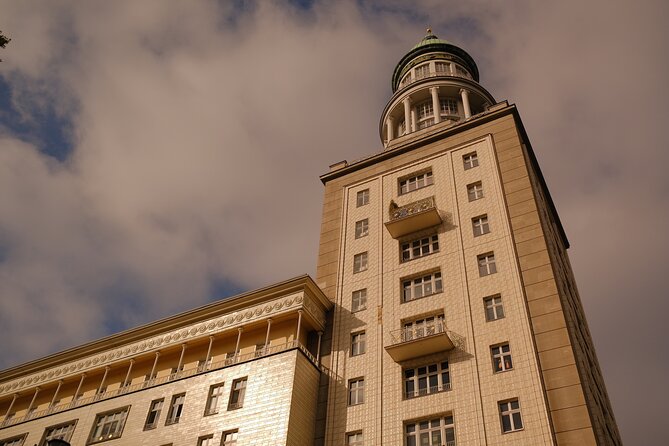
The route begins at Frankfurter Tor, where the twin towers create one of the most recognizable views in former East Berlin. From there, the walk moves through earlier modernist housing, a prototype socialist apartment block, a site tied to a failed workers’ uprising, and several places connected with culture and ideology.
You spend about 15 to 20 minutes at each stop. That pace gives you enough time to understand the main idea without turning the walk into a lecture that lasts all afternoon.
More architecture tours in Berlin:
- Potsdam: Guided Walking Tour of UNESCO Site and Architecture
★ 4.7 · 49 reviews - Private Taxi Tour City East & West History and Architecture 3-4h
★ 5.0 · 42 reviews - Private walking Tour: Berlin Architecture Tour
★ 5.0 · 14 reviews
Frankfurter Tor and the making of a socialist boulevard
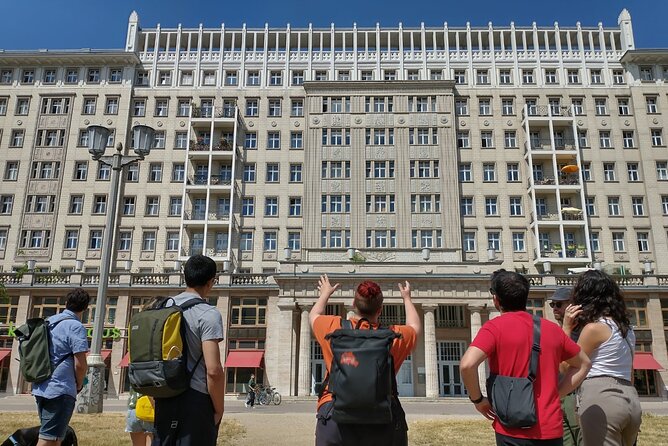
The two towers at Frankfurter Tor are the visual opening statement. Designed by Hermann Henselmann, they frame the entrance to Karl-Marx-Allee with strong symmetry and a ceremonial scale.
Your guide explains how plans for Germany’s first socialist street took shape in the early 1950s. The project was part of a national rebuilding program that called on thousands of volunteers. That detail matters because the boulevard was presented not only as construction, but as a collective act of socialist citizenship.
Look closely at the balance between the towers, the broad road, and the long blocks beyond them. The design was intended to make the state feel orderly and permanent. It also created a public stage for parades, official events, and displays of political power.
This is one of the best places to ask questions about the difference between an impressive building project and the life it created. A grand avenue can look successful from a distance. The guide helps you consider who planned it, who paid for it, and who was expected to believe in its message.
Laubenganghäuser and the postwar alternative
The Laubenganghäuser offer a sharp change in mood. These buildings represent the modernist architecture of the years immediately after World War II, when Berlin’s planners were imagining new ways to house people after widespread destruction.
Hans Scharoun’s urban ideas were shaped by the ruins around him. His plans were more open and experimental than the formal socialist boulevard that followed. They reflected a hope that a rebuilt city could support healthier, freer, and more human daily life.
The guide sets up the contrast between Scharoun’s ideas and the direction later taken by the East German regime. His vision was rejected soon after, and the state moved toward architecture that could communicate discipline and political unity more clearly.
I find this stop especially useful because it prevents the tour from presenting East Berlin as architecturally uniform. You see that different ideas were competing in the same damaged city. The buildings are evidence of a debate, not just examples of one official style.
Weberwiese, the prototype with political purpose
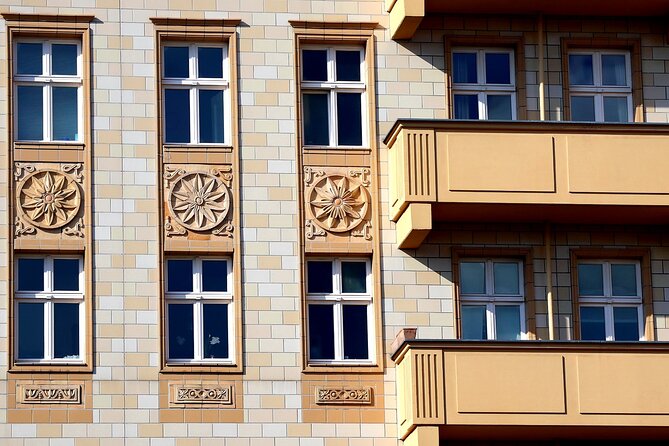
At Weberwiese, you see the Hochhaus an der Weberwiese, a high-rise building that served as a prototype for the later Karl-Marx-Allee development. Its first tenants received a level of comfort that was unusual for the period, making the project both a housing experiment and a public relations tool.
The building helped the government show what socialist housing could offer. It also attracted attention from architects in the West, an awkward reminder that East German construction could command professional respect beyond the Iron Curtain.
This stop adds a practical question to the political story: what did the new system promise to ordinary residents? New apartments, modern facilities, and improved living conditions were powerful arguments in a city still marked by war damage.
At the same time, the building’s role in propaganda is impossible to miss. Housing was not only a social service. It was also used to prove that the state could deliver a better future.
More Cold War tours in Berlin:
- Berlin: Third Reich and Cold War 2 Hour Walking Tour
★ 4.9 · 6,830 reviews - Berlin’s Best: 2 Hour Walking Tour Third Reich and the Cold War
★ 5.0 · 5,486 reviews - Skip-the-Line: Berlin Wall Museum at Checkpoint Charlie
★ 4.1 · 2,041 reviews - Cold War, Berlin Wall, Spies and the East Side Gallery
★ 5.0 · 1,024 reviews
The June 17, 1953 uprising
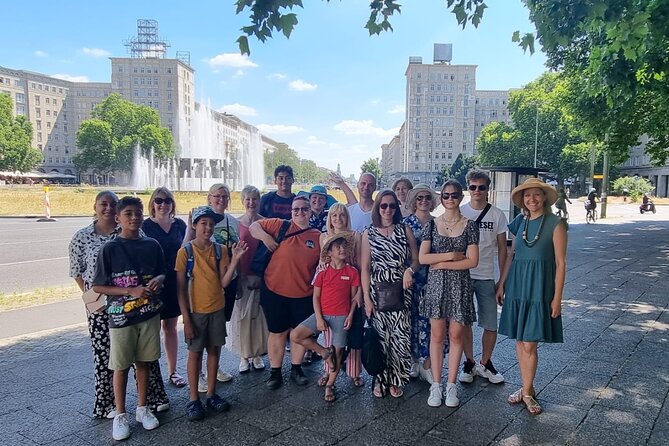
The memorial to the workers’ uprising of June 17, 1953, brings the tour into direct contact with conflict. This is where disgruntled workers began a mass protest that came close to toppling East Germany’s socialist government.
The event complicates the official image of Karl-Marx-Allee as a proud success story. The same workers whose labor helped rebuild the boulevard could also challenge the government when working conditions and political demands became unbearable.
The monument itself is controversial, and your guide explains why. Public memorials are never neutral, especially when they recall an event that the state once tried to control and reinterpret.
This is one of the most important stops for understanding the limits of architecture as political messaging. A government can build a monumental street, but it cannot fully control how people feel about work, housing, freedom, or authority.
Café Sibylle and the vanished Stalin statue
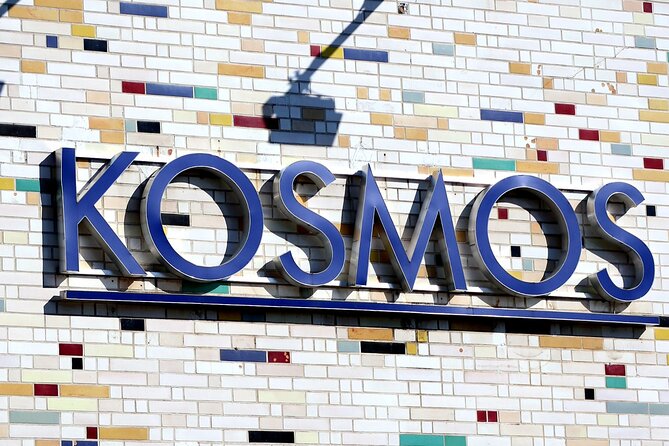
Café Sibylle brings the scale down from monumental avenues to a more social setting. Once one of the most exclusive cafés on Karl-Marx-Allee, it was connected to the nearby statue of Joseph Stalin, the Soviet dictator. The statue remained until 1961.
The café’s story helps you imagine the boulevard as a place where people met, talked, watched public life, and formed opinions. That is valuable because large political streets can seem empty of ordinary human activity when you only see them in photographs.
You also learn how quickly official symbols could change. A statue that had once dominated the area could be removed, while the surrounding buildings continued to shape the neighborhood. Political power left physical marks, but those marks were not always permanent.
This is a good point in the walk to think about the difference between the public face of East Berlin and private life behind the apartment doors. The boulevard was designed to project certainty. Daily life was often more complicated.
Karl Marx, ideology, and everyday life
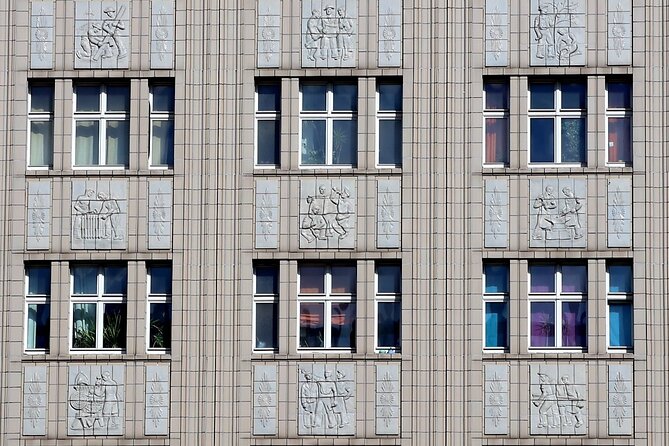
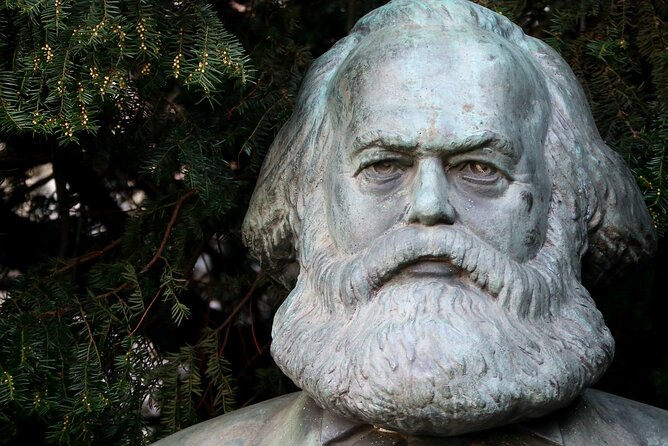
The Karl Marx bust takes the tour directly to the ideas behind the street’s name. Marx, co-author of The Communist Manifesto, became a central figure in the state’s public language and political identity.
The guide uses the monument to explain how socialist ideology affected everyday life in East Berlin. That might include the names of streets, the messages presented in public spaces, and the way architecture was expected to educate citizens.
This part works best when you treat the bust as more than a portrait. It represents the effort to place political theory into ordinary surroundings. People did not encounter ideology only in books or speeches. They met it on street signs, monuments, apartment blocks, schools, and public ceremonies.
The stop also helps connect the various parts of the route. The architecture, the housing promises, the work culture, and the memorials all formed part of one attempt to make socialism visible.
Strausberger Platz and Karl-Marx-Allee after 1989
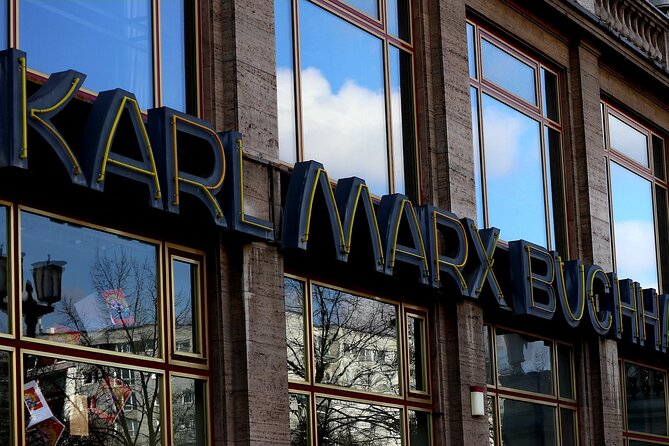
The final stop is Strausberger Platz, another strong example of Henselmann’s style. Its broad circular layout and formal buildings give the tour a fitting closing view of the boulevard.
Here, the story moves beyond the Cold War. You hear how life along Karl-Marx-Allee changed after the Berlin Wall fell and how the area functions today. That modern perspective is important because the boulevard did not freeze in 1989. People continued to live in, use, debate, and reinterpret it.
The end point is also practical. Strausberger Platz is about a 10-minute walk from Alexanderplatz, so you can easily continue into central Berlin after the tour. The route does not leave you stranded at an inconvenient edge of the city.
By the end, you have seen several architectural periods and followed a political story from postwar rebuilding through the East German years and into reunified Berlin.
Guide style and the value of local knowledge
The guide makes a major difference on this tour. Martina is repeatedly described as organized, funny, passionate, and able to explain a complicated period without losing the human side. Her storytelling is supported by carefully prepared material, including original data and visual aids.
She also brings personal experience of part of communist East Germany. That does not replace historical evidence, but it can add texture to questions about how the system felt in daily life. A guide who can connect official policy with lived experience helps you understand why the same building could represent hope to one person and control to another.
The tour also appears to work well for younger visitors. One account describes a 17-year-old staying engaged because the guide used stories and specific details rather than relying on dates alone.
The supplied information also names Marina and Luis in other tour comments, but the strongest direct connection to this Karl-Marx-Allee walk is Martina. Guide availability can change, so you should not assume a particular person unless the booking details confirm it.
Price, group size, and practical value
At $30.01 per person, this is a fair price for a two-hour guided walk if you want more than a quick look at the buildings. Every stop is outdoors and admission is free, so you are paying for interpretation, structure, and access to a guide who can connect architecture with politics.
I would not choose it for someone who prefers to wander silently or photograph facades without discussion. The value comes from explanation. Without context, Frankfurter Tor and Strausberger Platz can look like impressive examples of planned architecture. With context, they become part of a story about power, housing, labor, memory, and failed ideals.
The maximum group size is 15. That is small enough to make questions realistic and large enough to keep the cost moderate. The mobile ticket is useful for a city itinerary, and the English-language format removes a major barrier for international visitors.
Start at U Frankfurter Tor, which is near public transportation. Finish at Strausberger Platz, on the eastern side of the roundabout. You should allow for an outdoor walk and wear shoes suited to pavement. The tour requires good weather. If conditions force a cancellation, you can choose another date or receive a full refund.
Free cancellation is available up to 24 hours before the start time. Changes or cancellations within 24 hours are not refunded, so keep that cutoff in mind when arranging a tight Berlin schedule.
Who should book this Berlin walking tour?
I would choose this tour if you care about architecture, 20th-century politics, urban planning, or the personal effects of life under communism. It is also a smart choice if you have only a short time in Berlin but want a focused look at a part of the city that many first-time itineraries skip.
It suits adults and older teenagers who enjoy explanation and discussion. The route is also useful for anyone who has already seen the Brandenburg Gate, Museum Island, and the Berlin Wall sites and wants a different side of the city.
You might skip it if you need an indoor activity, have limited mobility for a two-hour walk, or want a broad overview of all Berlin rather than one boulevard. The tour is specific by design. Its strength is the close study of Karl-Marx-Allee, not a general introduction to the capital.
Should you book the Karl-Marx-Allee tour?
Book it if you want to understand why East Berlin looks the way it does. The walk gives you a clear route through grand socialist architecture, rejected modernist ideas, a workers’ revolt, changing public symbols, and life after reunification.
The best reason to go is the connection between buildings and people. You will not only hear who designed the towers. You will also learn what the buildings promised, how the government used them, and how residents experienced the system around them.
At $30.01, the tour offers good value for an informed two-hour look at a major but often misunderstood Berlin avenue. Just plan for outdoor conditions and confirm the guide assigned to your date if Martina’s personal perspective is important to you.
FAQ
How long is the Karl-Marx-Allee tour?
The walking tour lasts approximately two hours.
What language is the tour offered in?
The tour is offered in English.
Where does the tour begin?
It begins at U Frankfurter Tor, 10243 Berlin, Germany.
Where does the tour end?
It ends at Strausberger Platz, on the eastern side of the roundabout.
How far is the endpoint from Alexanderplatz?
Strausberger Platz is about a 10-minute walk from Alexanderplatz.
How many people can join the tour?
The tour has a maximum group size of 15 people.
What places are visited?
The route includes Frankfurter Tor, the Laubenganghäuser, Hochhaus an der Weberwiese, the June 17, 1953 workers’ uprising memorial, Café Sibylle, the Karl Marx bust, and Strausberger Platz.
Is the tour available with a mobile ticket?
Yes. A mobile ticket is available.
Can I cancel for a full refund?
Yes, if you cancel at least 24 hours before the experience start time. Cancellations made less than 24 hours before the start time are not refunded. If poor weather causes the tour to be canceled, you will be offered another date or a full refund.
Newest Berlin reviews
- Where It All Began: Berlin’s Queer & Trans History Tour★ 4.9 · 6 reviews
- Understanding Kreuzberg: The roots of local (sub)culture★ 4.9 · 11 reviews
- Berlin: guided canoe | kayaktour★ 4.1 · 7 reviews
- Private Potsdam City Tour in an authentic vintage van★ 5.0 · 14 reviews
- Warnemünde Shore Excursion: Private Sachsenhausen and Berlin Tour★ 5.0 · 12 reviews
- Ultimate E-Bike Tour of Berlin with Beer Garden Stop★ 5.0 · 4 reviews
- Potsdam Highlights – Private sightseeing tour by minibus★ 5.0 · 3 reviews
- In the Forbidden City – Potsdam Walking Tour★ 5.0 · 17 reviews
Berlin Cold War Tours, compared.
Berlin’s Best: 2 Hour Walking Tour Third Reich and the Cold War
Read our review →
Skip-the-Line: Berlin Wall Museum at Checkpoint Charlie
Read our review →
Cold War, Berlin Wall, Spies and the East Side Gallery
Read our review →
Listening Station Teufelsberg Tour with Transfer
Read our review →Browse the lists this tour appears in