
Reviewed · BERLIN ARCHITECTURE TOURS
Private Taxi Tour City East & West History and Architecture 3-4h
Berlin’s story is scattered across a huge city, and this private taxi tour brings the pieces together quickly. In three to four hours, Gunter Bauer connects the imperial west, divided Berlin, Nazi-era sites, socialist architecture, and the rebuilt center without asking you to spend the day changing trains.
I like the door-to-door pickup and the chance to stay warm in the car between stops. I also like the personal touch: Gunter asks about your interests, answers questions in fluent English, and has taken photographs for visitors at places such as the Brandenburg Gate and Humboldt Forum.
The trade-off is simple: this is a broad city overview, not a slow museum tour. You will see many places from the car and make short stops, so anyone wanting long interior visits should plan extra sightseeing afterward.
Key points at a glance
- Private taxi and flexible attention: Only your group takes part, with pickup from a hotel or apartment inside Berlin’s S-Bahn ring.
- A true East and West Berlin route: The tour links Ku’damm, the Wall, Checkpoint Charlie, Unter den Linden, Alexanderplatz, and the government quarter.
- Useful in poor weather: The heated or air-conditioned vehicle makes a major difference in winter, rain, or for visitors who cannot walk long distances.
- Strong historical range: You move from Prussian kings and Wilhelmine Berlin to Nazi terror, the Cold War, reunification, and modern Germany.
- Short sightseeing stops: The itinerary includes the Brandenburg Gate, Gendarmenmarkt, Hackesche Höfe, Humboldt Forum, Topography of Terror, and more.
- Best for a first orientation: You see far more of Berlin than you could comfortably cover on foot in half a day, but some sights receive only a quick look.
Why a private taxi makes sense in Berlin

Berlin is not a compact old town. Its major sights are spread across former districts and two once-divided halves of the city. The Kaiser Wilhelm Memorial Church is in the west, the Brandenburg Gate sits at the old border, and Alexanderplatz lies farther east. Moving between them by public transport is possible, but it takes time and can break up the story.
This tour solves that problem with a private car. Pickup is included within the S-Bahn ring, and private transportation, parking fees, WiFi, and the taxi ride are covered. Pickup from BER Airport or outside the S-Bahn ring costs extra, so check that point before booking.
The private format matters most if you want to ask questions or adjust the pace. Gunter can focus on imperial architecture, World War II, the Berlin Wall, Jewish Berlin, modern government buildings, or general highlights. That flexibility is more useful than a fixed group bus route, especially for families or small groups with mixed interests.
The price is listed at $150.18 per person. That is not cheap for a three-hour outing, but the value changes with group size. For one person or a couple, it is a premium way to see the city. For a family or small group, the private vehicle, pickup, parking, and guide time can make the price easier to justify.
More architecture tours in Berlin:
- Potsdam: Guided Walking Tour of UNESCO Site and Architecture
★ 4.7 · 49 reviews - Karl-Marx-Allee Tour: Life and Architecture in East Berlin
★ 5.0 · 19 reviews - Private walking Tour: Berlin Architecture Tour
★ 5.0 · 14 reviews
West Berlin begins at the Kaiser Wilhelm Memorial Church
The western part of the tour opens with the Kaiser Wilhelm Memorial Church, one of Berlin’s clearest reminders that war is still part of the city’s daily scenery. The damaged tower and preserved west portal were kept after World War II, while the modern church hall and tower were built around them from designs by Egon Eiermann.
The modern buildings are often nicknamed lipstick and powder compact because of their shape. Inside, blue glass blocks create a quiet, almost otherworldly room despite the traffic outside. The double-wall construction helps keep out city noise.
Across the area, you get the Berlin Zoo, one of Germany’s oldest zoological gardens. The elephant gate and lion gate are easy to spot, and the zoo’s architecture reflects the countries associated with different animal exhibits. The tour does not turn into a zoo visit, but you receive a useful look at this important West Berlin landmark.
The nearby Theater des Westens adds another layer. Its ornate exterior reflects the period when Berlin’s wealthy residents and cultural institutions moved west from the crowded center. It is now used as a musical theater, but its imperial box and confectioner-style decoration still recall the district’s earlier ambition.
Ku’damm, Tauentzien, and KaDeWe
Kantstrasse leads toward Kurfürstendamm, usually shortened to Ku’damm. The boulevard was modeled partly on the Champs-Élysées and once carried grand villas, cinemas, cafés, and entertainment venues. Today it is mainly a shopping street, with luxury labels farther west and large modern stores closer to the center.
The tour also reaches Tauentzienstrasse and Kaufhaus des Westens, better known as KaDeWe. With around 60,000 square meters, it is one of Europe’s largest department stores. The gourmet floor is the main attraction, with chocolates, bread, cheese, seafood, and wine.
You receive about 15 minutes at KaDeWe, so think of this as a quick orientation rather than a full shopping visit. If you want to browse the food hall properly, ask Gunter if the timing can be adjusted or return on your own.
The route continues through Wittenbergplatz and Nollendorfplatz, where Berlin’s older underground railway system becomes part of the story. The guide explains how wealthy Charlottenburg resisted having a noisy, dirty railway pushed through its villa districts. These details help you see the city as a collection of former towns, not one uniformly planned capital.
Tiergarten and the western government quarter
The tour then crosses the Tiergarten, Berlin’s huge central park. It began as a royal hunting ground before being opened to the public and reshaped as an English-style park by Peter Joseph Lenné. The Landwehr Canal helped drain wet ground and created waterways, ponds, paths, and long views.
World War II left the park badly damaged. Trees were cut down, and parts of the area were used for growing food. Later reforestation restored much of its current form. From the taxi, you will not experience the park as you would on foot, but you will understand why it is so important to Berlin’s shape.
The Victory Column is another major sight. It was originally placed in front of the Reichstag and later moved to its current position during the Nazi period. Its golden figure and elevated setting make it one of Berlin’s most recognizable landmarks.
Nearby, the House of World Cultures, once the Congress Hall, curves beside the Spree. Berliners gave it the nickname pregnant oyster because of its unusual roof. The roof collapsed in 1980, killing a journalist, but the building was reconstructed and now hosts international cultural events.
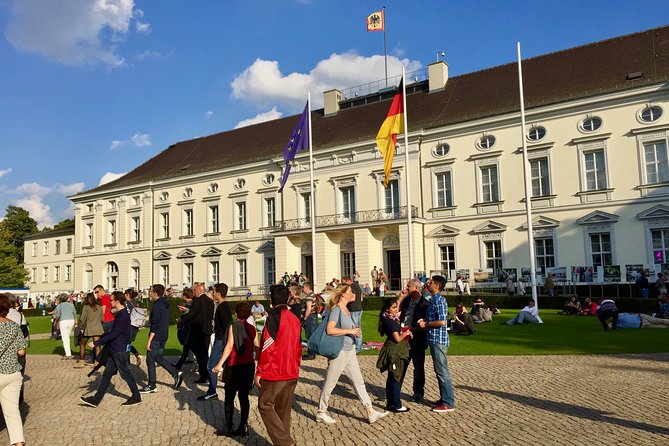
You also pass Bellevue Palace, the official Berlin residence of the Federal President. Its name came from the view it once offered toward Charlottenburg Palace. That view has disappeared, and the small palace was rebuilt after wartime damage. It is a good example of how Berlin’s royal and federal identities overlap.
More history tours in Berlin:
- Berlin: Natural History Museum Entrance Ticket
★ 4.6 · 3,382 reviews - Berlin: World Heritage Cruise to Potsdam
★ 4.5 · 1,435 reviews - Berlin Historical Highlights Walking Tour
★ 4.9 · 657 reviews - Berlin Private Complete History All Day Walking Tour
★ 5.0 · 474 reviews
Reichstag, government buildings, and modern Berlin
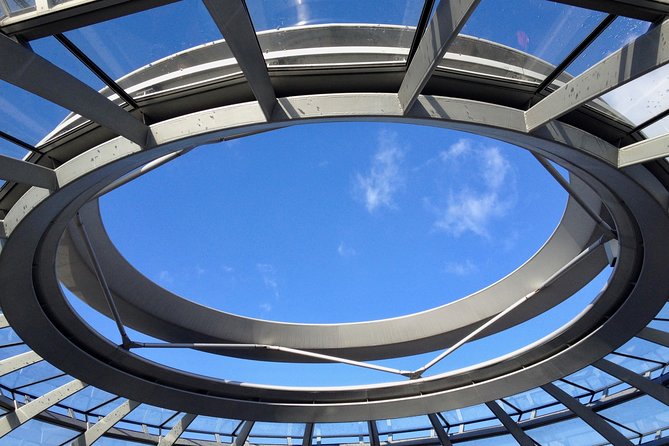
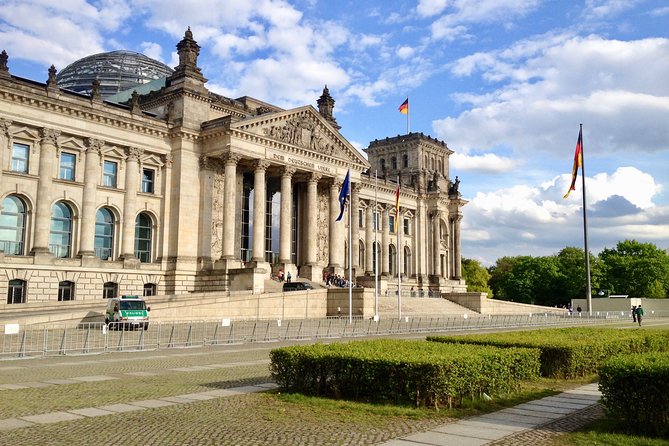
The Reichstag is one of the most important stops, even when viewed from outside. Its Wilhelmine design, wartime damage, Cold War neglect, Christo’s wrapping project, and modern glass dome tell the story of Germany’s political changes in one building.
The glass dome is not included as a separate visit in this taxi tour, so book a different time if you want to go inside. The tour instead places the building in context with the surrounding government quarter.
You pass the Bundestag offices, the Federal Chancellery, and the press building. The long parliamentary office block was designed so that much of the daily work could take place in committee rooms rather than in the main debating chamber. The Chancellery is a huge modern building with hundreds of offices, while the press building’s large window reflects its role in Germany’s media life.
The taxi is especially helpful here because the district covers a lot of ground. You can see how the new federal quarter was laid out after reunification, then compare it with older royal and military buildings nearby.
From Hackesche Höfe to Jewish Berlin
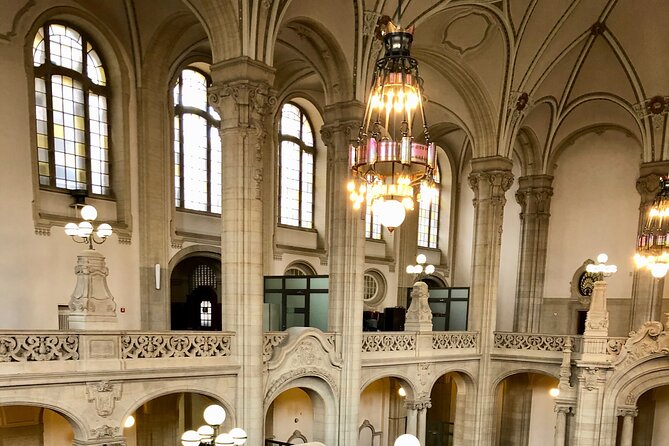
The route crosses into former East Berlin at Hackesche Höfe. These linked courtyards were built in 1908 to mix workshops, small factories, offices, and homes. Run-down during the East German period, they were restored after the Wall fell and now contain shops, cafés, and design businesses.
The courtyards are worth seeing on foot, even if your stop is brief. Their tiled facades and connected spaces show a different side of Berlin from the grand avenues and government buildings.
Nearby, the New Synagogue is easy to recognize by its Moorish details and golden dome. The main synagogue was badly damaged during the war, but the front section was rebuilt and now contains an exhibition about Jewish life in Berlin. Security is strict, with airport-style checks, so allow extra time if you plan to enter later.
You also pass Friedrichstrasse and the former Friedrichstrasse station. During the Wall years, this was the only East Berlin station with a regular route onward to West Berlin. It became a painful place of departure for families divided by the border. The Palace of Tears next door preserves that story in a reconstructed station setting.
Unter den Linden, Brandenburg Gate, and Gendarmenmarkt
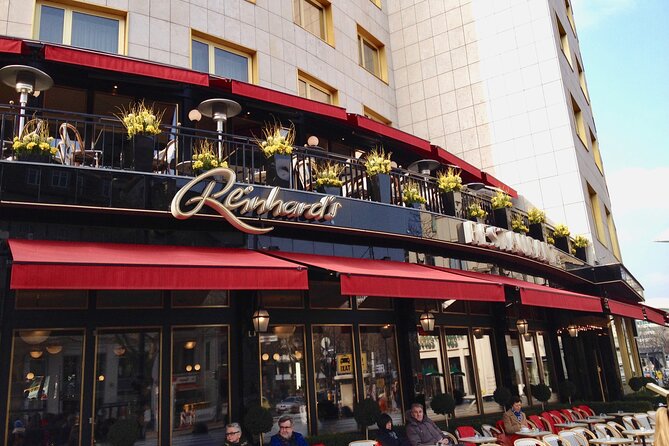
Unter den Linden is Berlin’s grand historic avenue. It began as a path from the royal palace toward the hunting grounds and gradually became a boulevard lined with palaces, universities, the State Opera, and the State Library.
The Brandenburg Gate sits at its western end on Pariser Platz. Before reunification, the gate was trapped between walls, fences, and empty ground. Today, the surrounding buildings have been rebuilt in a controlled modern style, including the French and American embassies, the Academy of Arts, and the Liebermann House.
The stop here lasts about 15 minutes. That is enough for photographs and a short walk, but not enough for a full visit to nearby buildings. Gunter has taken photos for visitors at the gate, which is useful if your group wants a picture together.
Gendarmenmarkt is another short stop, listed at about five minutes. The German Cathedral, French Cathedral, and Concert Hall form one of Berlin’s most handsome squares. The two domed buildings are not cathedrals in the usual sense. They are churches with monumental towers added during the reign of Frederick the Great.
The nearby Neue Wache is now a memorial to victims of war and tyranny. Its small interior holds Käthe Kollwitz’s sculpture of a grieving mother and son. This is a brief but serious stop, and the guide’s explanation helps prevent it from becoming just another photograph.
Humboldt Forum and the old center
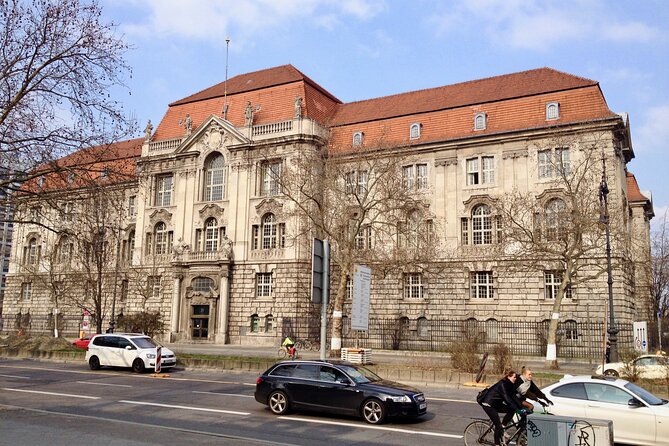
The Humboldt Forum occupies the site of Berlin’s former royal palace. The palace was damaged in the war, demolished by East German authorities, and replaced for decades by an open space. The present building combines a modern interior with reconstructed Baroque facades and the detailed Schlüter courtyard.
The visit here is the longest interior stop, about 30 minutes, with admission included. It is not enough to see every collection, but it gives you a taste of the building and its role in the rebuilt center. The collections include non-European art and material connected with Humboldt University.
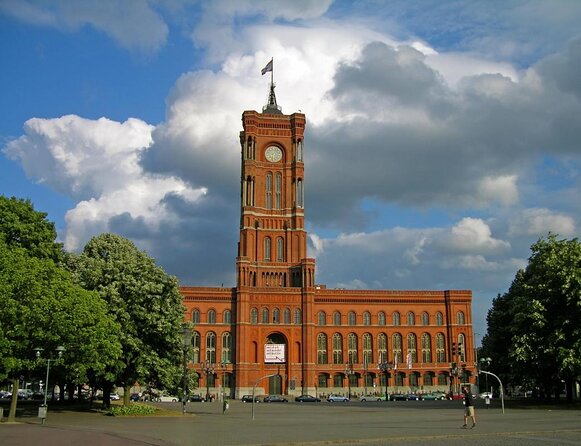
From there, the route reaches Museum Island, the Red City Hall, Alexanderplatz, and Nikolaiviertel. Alexanderplatz reflects East Berlin’s socialist planning, with broad open space, tall modern buildings, and the television tower. The Red City Hall gets its name from its red brick, not from the political party in power.
Nikolaiviertel offers a smaller, more intimate picture of old Berlin. Much of what you see was rebuilt in the 1980s, but the Nikolaikirche and Knoblauchhaus provide a link to earlier Berlin. The area includes restaurants and a pleasant view toward the Spree.
Cold War Berlin and Checkpoint Charlie
A strong part of the tour is the return to the former East-West border. You pass places linked to the Berlin Wall, including the harbor where Günter Litfin was shot while trying to escape by swimming.
Checkpoint Charlie is a short photo stop of about 10 minutes. The guard hut and sign are replicas, not the original Cold War installations. That is important to know before you arrive. The site can feel staged, but it still marks the place of the 1961 tank confrontation, one of the most dangerous moments of the Cold War.
The nearby Topography of Terror offers a more serious historical stop. The site covers Nazi institutions, the former Gestapo and SS headquarters, wartime crimes, and the later Berlin Wall. An open-air section and documentation center explain how terror was organized from the heart of the city.
The stop lasts about 15 minutes and includes a chance to use the toilets. If Nazi history is central to your visit, plan a separate, longer visit here. The taxi tour gives you the setting and basic framework, not enough time for every display.
Who should book this tour?
I would choose this tour if you have limited time, prefer a private setting, or want a broad explanation before exploring Berlin on your own. It also suits older visitors, families, and anyone who finds long walks or complicated public transport tiring.
The experience works well in winter or wet weather because you spend much of the time in a warm, air-conditioned taxi. A child seat for toddlers from six months to three years and a booster seat for older children are available. Service animals are allowed, and most visitors can take part.
I would not choose it as my only Berlin experience if I wanted long museum visits, quiet time in parks, or a detailed walk through each historic district. The itinerary covers a great deal, and some stops last only five to 15 minutes.
Bring water. The schedule is full, and one direct piece of practical advice is to stay hydrated. Free cancellation is available up to 24 hours before the start time, which gives you some useful flexibility.
FAQ
How long does the private taxi tour last?
The tour lasts approximately three to four hours.
Who provides the tour?
The experience is provided by Gunter Bauer of GAT-Productions.
Is hotel pickup included?
Pickup is included from hotels or apartments within Berlin’s S-Bahn ring. Pickup from BER Airport or locations outside the ring costs extra.
What is included in the price?
The price includes private transportation, WiFi in the vehicle, air conditioning, parking fees, pickup within the included area, the taxi fare, and the city tour.
Is this a private experience?
Yes. Only your group takes part in the tour.
Can children join the tour?
Yes. A toddler seat for children from six months to three years and a booster seat for older children are available. A baby seat can be brought on request.
Should you book it?
Book this private Berlin taxi tour if you want to cover the city’s major historical zones in one sitting and value a guide who can tailor the conversation to your interests. Gunter’s personal attention, clear English, flexible approach, and willingness to help with photographs add real value.
The best plan is to use it as your first Berlin outing. Let the taxi show you the city’s framework, then return on foot to the museums and memorials that deserve more time. For a fast, comfortable orientation across East and West Berlin, it is a practical choice.
Newest Berlin reviews
- Where It All Began: Berlin’s Queer & Trans History Tour★ 4.9 · 6 reviews
- Understanding Kreuzberg: The roots of local (sub)culture★ 4.9 · 11 reviews
- Berlin: guided canoe | kayaktour★ 4.1 · 7 reviews
- Private Potsdam City Tour in an authentic vintage van★ 5.0 · 14 reviews
- Warnemünde Shore Excursion: Private Sachsenhausen and Berlin Tour★ 5.0 · 12 reviews
- Ultimate E-Bike Tour of Berlin with Beer Garden Stop★ 5.0 · 4 reviews
- In the Forbidden City – Potsdam Walking Tour★ 5.0 · 17 reviews
- Private Walking Tour of Potsdam and Sanssouci★ 5.0 · 24 reviews
Berlin Architecture Tours, compared.
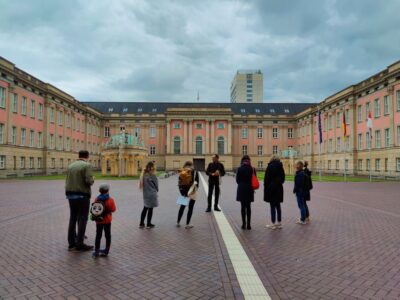
Guided Walking Tour of UNESCO Site and Architecture
Read our review →
Karl-Marx-Allee Tour: Life and Architecture in East Berlin
Read our review →
Browse the lists this tour appears in