
Reviewed · BERLIN NEIGHBORHOOD TOURS
Berlin: Modernist Architecture Tour in the Hansaviertel
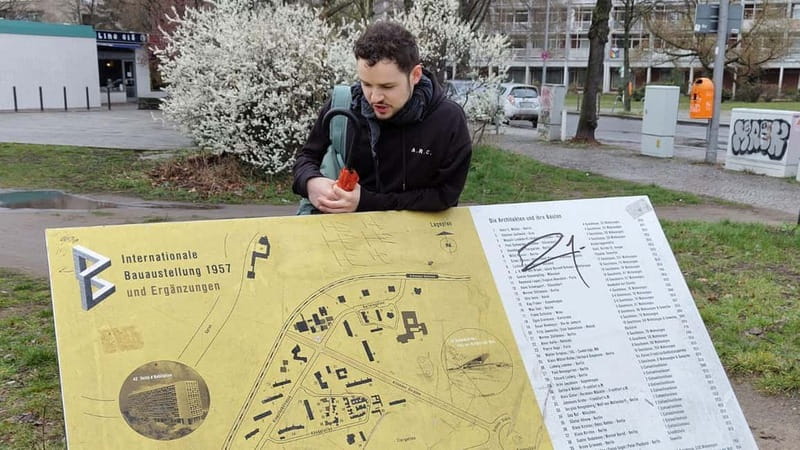
Hansaviertel is where Berlin’s past and future sit side by side. In two hours, you move from elegant 19th-century villas and the memory of a destroyed Jewish community to a Cold War showcase designed by Walter Gropius, Oscar Niemeyer, Alvar Aalto, and other major architects. This is architecture with political baggage, not just a stroll past unusual buildings.
I like the way the tour connects buildings to real people, including Rosa Luxemburg, Nelly Sachs, and Käthe Kollwitz. I also like the setting: quiet paths between the Tiergarten and the Spree make this a calm break from Berlin’s crowded central sights. Guide Morgan brings a lively style and can handle detailed questions. The main drawback is that the experience depends on walking and standing for about two hours, and visitors looking only for Berlin’s famous landmarks may find the focus too specialized.
Key points at a glance
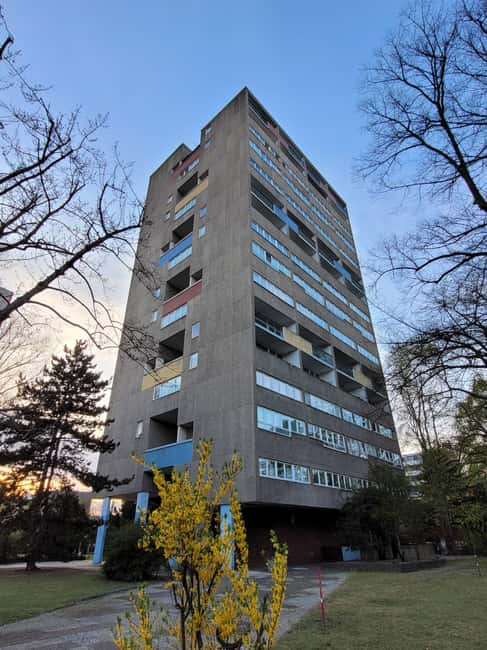
- From villas to concrete: See how Hansaviertel changed from an upper-middle-class district into a postwar modernist showcase.
- Interbau 1957: Learn how West Berlin used architecture to make a political point during the Cold War.
- Major modernist names: Encounter work linked to Gropius, Niemeyer, Aalto, and other influential designers.
- A quieter Berlin: Walk between the Tiergarten and Spree, away from the city’s busiest sightseeing routes.
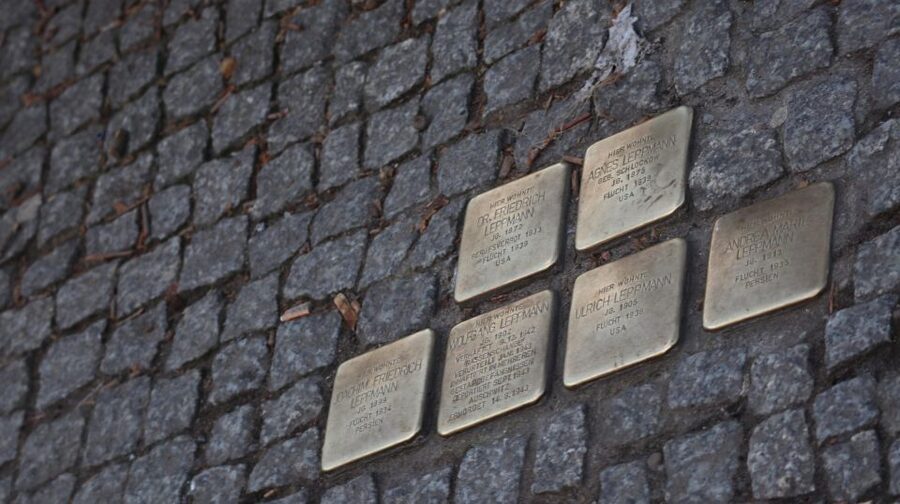
- History beyond buildings: Visit a memorial connected to Jewish life destroyed by Nazi persecution and wartime bombing.
- Good value at $23: A live guide, two-hour format, and unusual subject make this a strong choice for architecture and history fans.
Why Hansaviertel tells Berlin’s story so well
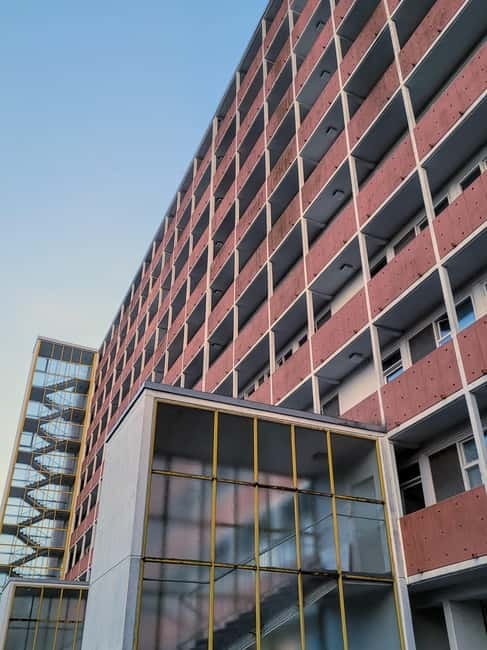
Berlin often presents its history through major monuments, museums, and broad avenues. Hansaviertel works differently. Here, history appears in a residential neighborhood, where leafy streets and apartment blocks reveal changing ideas about who should live in a city and how that city should be rebuilt.
The district lies between the Spree and the Tiergarten, close to the centre of Berlin but removed from the usual sightseeing circuit. That location matters. You get a more residential view of the city, with trees, open space, and buildings designed for everyday life rather than ceremony.
The tour begins with the older Hansaviertel. During Berlin’s rapid growth in the late 19th century, this area became an enclave for wealthy and established residents. Villas, gardens, and decorated façades gave it a refined character. The district was not created as a modernist experiment at first. Its original identity was tied to private homes, social status, and the expanding capital of the German Empire.
That earlier layer gives the later buildings more meaning. Without it, the postwar blocks can look like an isolated collection of clever designs. With it, you see Hansaviertel as a place repeatedly reshaped by politics, war, and competing ideas about modern life.
More architecture tours in Berlin:
- Potsdam: Guided Walking Tour of UNESCO Site and Architecture
★ 4.7 · 49 reviews - Private Taxi Tour City East & West History and Architecture 3-4h
★ 5.0 · 42 reviews - Karl-Marx-Allee Tour: Life and Architecture in East Berlin
★ 5.0 · 19 reviews
The first walk: villas, residents, and a changing district
At the meeting point, look for the guide with the orange umbrella in front of the Berlin-Tiergarten S-Bahn station. The entrance is the Siegmunds Hof and Bachstraße exit, next to the Biergarten der Tiergartenquelle. This is a practical starting point because the S-Bahn gives you a simple way to reach the area.
The early part of the walk introduces Hansaviertel’s 19th-century character. You can expect attention to villas, gardens, and the district’s former social role. Rather than treating the old architecture as a decorative warm-up, the guide explains how Berlin’s population boom shaped the neighborhood.
Names connected with the area include Rosa Luxemburg, Nelly Sachs, and Käthe Kollwitz. Each name helps widen the story beyond architecture. You are not only looking at façades. You are considering the writers, artists, and political figures who formed part of Berlin’s urban life.
This is one of the tour’s strongest features. The buildings become clues to the people who lived nearby and to the social world that existed before the Second World War. I find this approach more useful than a simple list of construction dates because it gives you a sense of what the neighborhood meant before it was damaged and rebuilt.
The route also brings you near the Spree and the Tiergarten. The riverside and park setting provide breathing room, and the greenery softens the harder architectural subjects. You should still wear comfortable shoes. Although the area is calm, this is a walking tour with periods of standing, so it is not the right choice if you want a mostly seated activity.
A quiet memorial to Jewish life destroyed
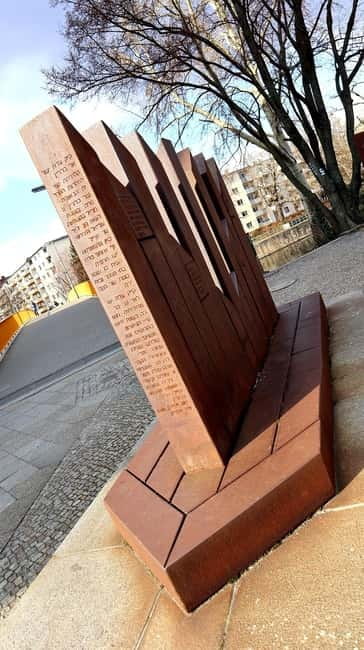
One of the most serious parts of the tour is a stop at a memorial marking the site of an important Jewish community. That community was destroyed by Nazi persecution, and the surrounding area was also damaged during the Allied bombing raids.
The stop adds a necessary human dimension to the tour. Hansaviertel is not presented as a blank piece of land waiting for modern architects. It was a lived-in district with established communities, memories, and losses. The postwar buildings came after that destruction, not outside it.
You should expect the tone to change here. The tour moves from urban development and architectural style to persecution, absence, and the damage caused by both dictatorship and war. This is not a decorative memorial stop added to fill time. It explains what was lost before reconstruction began.
For me, this is also where the tour avoids an easy story about progress. Interbau 1957 is often discussed as a bold new beginning, but the memorial reminds you that new beginnings can be built over painful absences. That tension stays with you as the walk turns toward the modernist quarter.
Interbau 1957 and the Cold War city

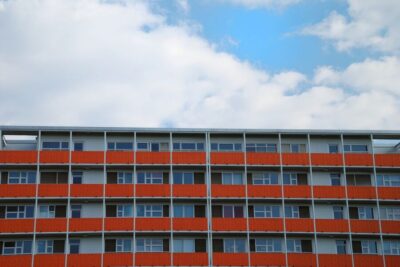
The decisive moment came in 1957, when West Berlin hosted Interbau, an international architecture exhibition. The Hansaviertel became a showcase for new ideas about housing, planning, light, open space, and modern urban life.
The timing was not accidental. West Berlin was a political outpost during the Cold War, and architecture became part of the argument between East and West. The rebuilt Hansaviertel offered a picture of a forward-looking democratic city. Its buildings were meant to show that postwar life could be open, comfortable, and modern.
The area had been heavily damaged during the war, leaving room for a dramatic redesign. Instead of restoring the former district in its old form, planners used the site for a new model. Apartment blocks were arranged with space around them, creating a different relationship between buildings, trees, streets, and residents.
That idea is worth paying attention to as you walk. The tour asks what modernism promised. Did a new building design create a better daily life? Could open space and functional housing support a more equal society? Did the buildings remain modern once the political moment passed?
These questions make the tour useful even if you are not an architecture specialist. You do not need to know technical terms before arriving. The guide provides the background, then gives you a way to read the neighborhood for yourself.
More neighbourhood tours in Berlin:
- Berlin: Hidden Backyards Guided Walking Tour
★ 4.8 · 5,360 reviews - Berlin: Spree Boat Tour to Müggelsee
★ 4.6 · 1,973 reviews - Berlin: Alternative Bike Tour of Kreuzberg & Friedrichshain
★ 4.7 · 548 reviews - Berlin: Mitte Culinary Food Tour
★ 4.5 · 447 reviews
Meeting Gropius, Niemeyer, Aalto, and their peers
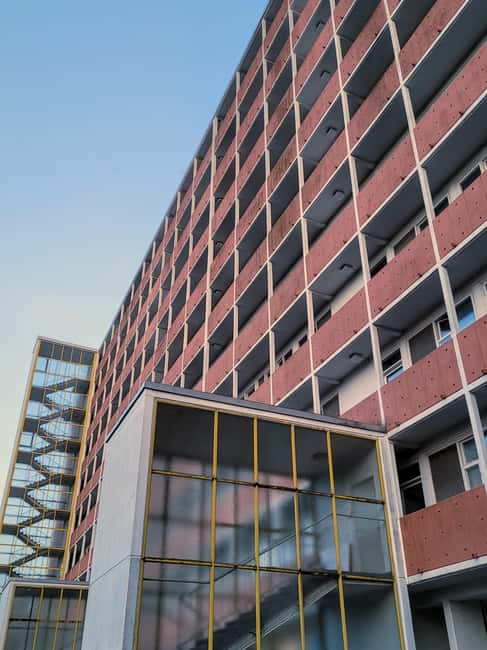
Hansaviertel’s appeal comes partly from the names attached to its buildings. The tour highlights designs by Walter Gropius, Oscar Niemeyer, Alvar Aalto, and other major modernist architects.
Gropius is closely linked with the clean, functional approach associated with modern architecture. Niemeyer is known for expressive forms and a willingness to treat structure as something more than a plain box. Aalto brought a human touch to modernism, with attention to materials, comfort, and the way people experience buildings.
The point is not simply to tick off famous architects. The guide explains how different designers responded to the same postwar challenge. You can compare their ideas as you move through the district, noticing that modernism was never one single style.
Some buildings may strike you as graceful. Others may seem severe or even provocative. That variety is part of the pleasure. The neighborhood does not offer a tidy row of identical blocks. It shows several approaches to the question of how a modern city should house its residents.
You will also be encouraged to consider how these designs function now. Are the buildings still convincing? Do the open spaces feel generous or exposed? Does the neighborhood still look like the future imagined in 1957? The tour does not require you to admire every building, which is a good thing. Architecture is more interesting when you can question it.
What the guide adds to the buildings
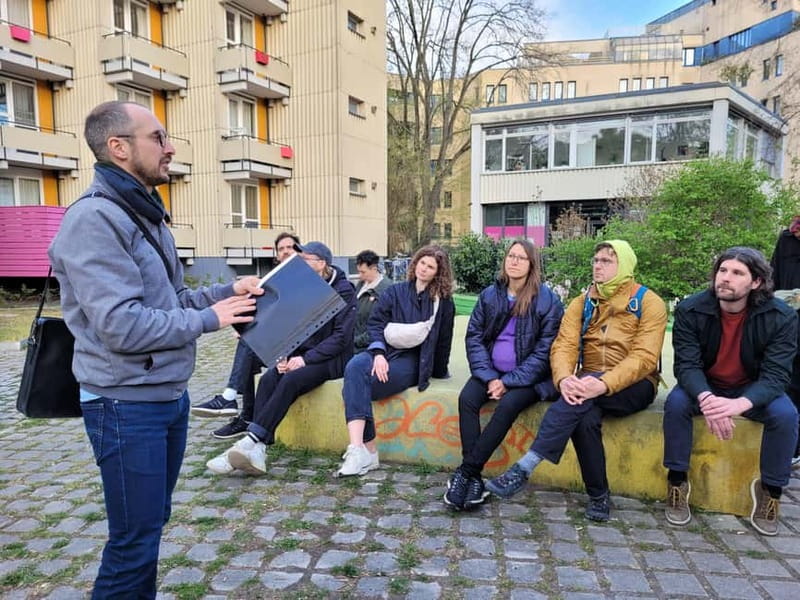
A self-guided walk would let you see many of the same structures, but it would be harder to understand their connections. The guide supplies the political setting, the earlier history, and the human stories that turn a collection of buildings into a coherent route.
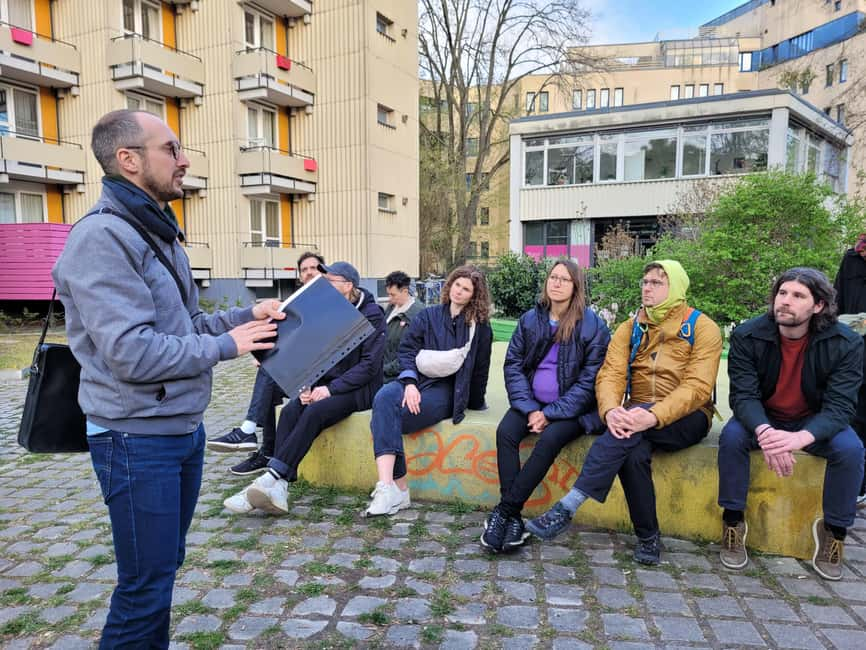
Morgan is named as one of the guides, and the experience is offered in English or German. The available feedback describes Morgan as lively, able to handle a broad range of questions, and willing to follow useful side discussions without losing the thread of the tour.
That matters for this subject. Modernist architecture can become dry if the explanation stays at the level of architects and dates. A good guide helps you connect design choices to daily life, Cold War competition, social change, and the damage left by war.
The format also leaves room for questions. If you want to ask about a particular building, the role of an architect, or the difference between the older and newer Hansaviertel, this tour seems better suited to that than a tightly scripted sightseeing circuit.
Duration, meeting point, and comfort
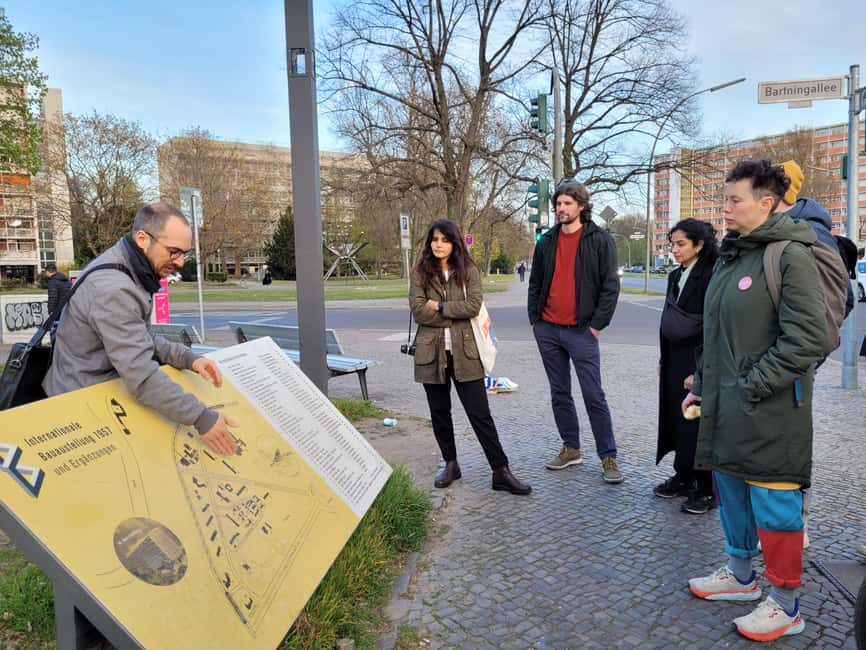
The activity is described as lasting two hours, with about 1.5 hours devoted to the guided Hansaviertel walk. The start and end points are close together. You meet in front of the Berlin-Tiergarten S-Bahn station, by the Biergarten der Tiergartenquelle, and finish at Hansaplatz.
The orange umbrella is the visual marker to look for. Arrive with water and comfortable shoes, especially if you are planning a full day of sightseeing afterward.
The tour is wheelchair accessible, though it remains a walking experience with standing. If you use a wheelchair or have mobility concerns, it is sensible to confirm the current route and conditions when booking, since the information provided does not describe every surface or crossing.
The suggested age is 14 and older. There is no strict age restriction stated, but the content deals with Nazi persecution, Jewish loss, war, Cold War politics, and architectural theory. Younger children may find the discussion demanding. All minors must be with an adult.
Is $23 a fair price?
At $23 per person, this is a reasonable price for a two-hour guided walk in central Berlin. You are paying for a local guide rather than museum admission, transport, food, or access to interiors. The value comes from interpretation.
If you already know modernist architecture well, you may prefer to explore independently and spend the money elsewhere. For most visitors, though, the cost is modest compared with a larger city tour, and the subject is unusually focused.
The price is strongest for people who want more than a quick photograph. You get the older district, the memorial, the Interbau story, and the work of several major architects in one compact route. Since food and drinks are not included, plan to buy those separately before or after the walk.
Free cancellation up to 24 hours ahead and the option to reserve now and pay later make the booking fairly flexible. Those policies are useful if your Berlin schedule is still changing.
Who should book this Hansaviertel walk?
I would choose this tour if you enjoy buildings, urban planning, political history, or the way ordinary neighborhoods reveal major events. It also suits repeat visitors who have already seen Berlin’s headline sights and want a quieter district with a clear story.
It is a good match for architecture students, design fans, history-minded adults, and older teenagers. The tour can also add depth to a first Berlin visit, especially if you want to understand how the city rebuilt itself after the war.
I would skip it if you want interiors, museum collections, or a fast tour of famous Berlin landmarks. The main attraction is the neighborhood itself, and much of the value comes from listening carefully as you walk.
Should you book it?
Book it if you want to see how Berlin’s architecture reflects loss, politics, and hope. Hansaviertel gives you 19th-century villas, a memorial to destroyed Jewish life, and a Cold War modernist project within one compact area.
At $23, the tour offers good value, especially with Morgan’s lively, question-friendly style and the chance to see work connected with Gropius, Niemeyer, and Aalto. Bring water, wear practical shoes, and expect serious history alongside striking buildings. If that combination sounds more appealing than another pass by the Brandenburg Gate, this is a smart addition to your Berlin plans.
FAQ
Where does the Hansaviertel tour start?
It starts in front of the Berlin-Tiergarten S-Bahn station, at the Siegmunds Hof and Bachstraße exit, next to the Biergarten der Tiergartenquelle.
How do I identify the guide?
Look for the guide holding an orange umbrella.
Where does the tour finish?
The walk finishes at Hansaplatz.
How long does the activity last?
The activity lasts two hours. The guided Hansaviertel portion is listed as 1.5 hours.
Which languages are available?
The tour is offered in English and German.
Is the tour wheelchair accessible?
Yes, the activity is described as wheelchair accessible.
What should I bring?
Bring comfortable shoes and water.
Is the tour suitable for children?
The tour is recommended for ages 14 and up because of its historical content. Minors must be accompanied by an adult.
Newest Berlin reviews
- Where It All Began: Berlin’s Queer & Trans History Tour★ 4.9 · 6 reviews
- Understanding Kreuzberg: The roots of local (sub)culture★ 4.9 · 11 reviews
- Berlin: guided canoe | kayaktour★ 4.1 · 7 reviews
- Private Potsdam City Tour in an authentic vintage van★ 5.0 · 14 reviews
- Warnemünde Shore Excursion: Private Sachsenhausen and Berlin Tour★ 5.0 · 12 reviews
- Ultimate E-Bike Tour of Berlin with Beer Garden Stop★ 5.0 · 4 reviews
- In the Forbidden City – Potsdam Walking Tour★ 5.0 · 17 reviews
- Private Walking Tour of Potsdam and Sanssouci★ 5.0 · 24 reviews
Berlin Neighborhood Tours, compared.

Alternative Bike Tour of Kreuzberg & Friedrichshain
Read our review →
Berlin Off-the-Beaten-Path Walking Tour: Kreuzberg, Mitte and Friedrichshain
Read our review →

Hansaviertel “The City of Tomorrow” Guided Tour
Read our review →Browse the lists this tour appears in