
Reviewed · BERLIN ARCHITECTURE TOURS
Private walking Tour: Berlin Architecture Tour
Berlin’s architecture is really a political story told in stone, glass, concrete, and empty space. This private tour connects grand Prussian buildings, socialist apartment blocks, postwar modernism, and the shiny new city that grew after reunification. You’ll see how East and West Berlin once expressed two rival systems through their buildings.
I especially like the custom route and the chance to ask a guide to focus on design, urban planning, or political history. I also like the personal scale: you can walk or bike, stop for photographs, and adjust the pace instead of trailing behind a large group. The main drawback is price, $191.87 per person, which is a serious outlay unless your group values expert commentary and private transportation.
Key points to know
- A private four-hour overview: Your guide can adapt the route to your interests and hotel location.
- East meets West: Compare communist-era housing and postwar Western architecture with Berlin’s restored historic center.
- Strong photo stops: Museum Island, Gendarmenmarkt, the Philharmonie, Potsdamer Platz, and Oberbaum Bridge all offer very different views.
- Several neighborhoods in one outing: The route reaches Mitte, the government quarter, Potsdamer Platz, Kreuzberg, Friedrichshain, and Hackescher Markt.
- Foot or bike format: You can choose to do the tour on foot or by bicycle.
- Hotel pickup and drop-off: This saves time, though the amount of sightseeing time depends partly on where your hotel is located.
Berlin architecture explained as a political map
This is not simply a parade of handsome buildings. The useful idea behind the tour is comparison. Berlin’s architecture changed sharply after World War II, when the city was divided between the Soviet-controlled East and the Western Allied sectors. Each side rebuilt according to its own political message, economic system, and idea of modern life.
In East Berlin, you may see broad avenues, socialist housing, and monumental public buildings designed to present order and collective purpose. In the former West, you encounter bold modern structures, cultural institutions, and experimental rebuilding on land shaped by wartime destruction and the Berlin Wall.
A private guide can connect those pieces in a way a map cannot. Guides such as Ariel, Sara, Thomas, Tom, Daniel, Heiko, and Tarek have led past versions of this tour, with particular praise for clear explanations, historical context, and flexibility. Guide availability is not guaranteed, but you can ask when booking if a particular guide is important to you.
The four-hour duration gives you a useful first look at a wide section of Berlin. It does not allow long interior visits at every stop. Think of this as an orientation with expert interpretation, not a museum tour with extended time inside each building.
More architecture tours in Berlin:
- Potsdam: Guided Walking Tour of UNESCO Site and Architecture
★ 4.7 · 49 reviews - Private Taxi Tour City East & West History and Architecture 3-4h
★ 5.0 · 42 reviews - Karl-Marx-Allee Tour: Life and Architecture in East Berlin
★ 5.0 · 19 reviews
Museum Island, where Berlin begins with a grand gesture
Museum Island is a natural starting point because it places several major architectural styles close together. The Altes Museum gives you a crisp neoclassical beginning, with its broad columns and formal portico facing the Lustgarten.
The Pergamon Museum has monumental classical facades, though the tour schedule allows only about 20 minutes in this area. The Bode Museum changes the mood with its dome and curved baroque profile. The Neues Museum adds an important modern note because its restoration combines surviving historic elements with contemporary work after severe wartime damage.
I like this stop for the way it lets you compare buildings without much walking between them. You can frame the Spree, domes, colonnades, and restored facades in a short stretch. The limitation is simple: admission is listed as free for the stop, but the tour does not promise entry into the museums. Expect an exterior architecture lesson unless your guide arranges something else.
The Berliner Dom is also included later in the route, giving you another chance to examine monumental Berlin from the outside. Its huge dome, heavy stonework, symmetrical design, and Baroque and Renaissance Revival details make it one of the city’s most recognizable buildings.
Gendarmenmarkt and the art of a planned square
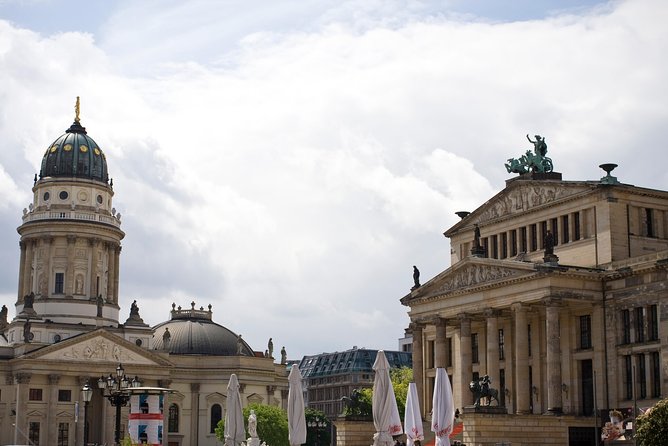
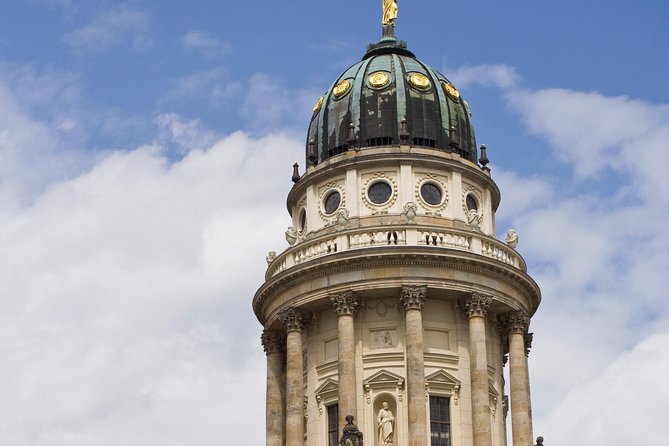
Gendarmenmarkt is one of Berlin’s finest urban compositions. Three major buildings frame the square: the French Cathedral, the German Cathedral, and Schinkel’s Konzerthaus.
The two cathedrals create a visual balance, while the concert hall provides the central classical focus. A statue of poet Friedrich Schiller occupies the middle of the square. Your guide can explain how the buildings relate to one another and why this spot is more than a pretty photo background.
The scheduled stop is about 15 minutes, so this is a quick architectural reading rather than a full historical tour. Still, it is enough time to understand the composition, take photographs, and hear the lesser-known details that private guiding makes easier to ask about.
The square works especially well if you care about proportion and urban design. Instead of studying one isolated building, you see how a group of buildings creates a civic room.
Friedrichstrasse and the rebuilt center
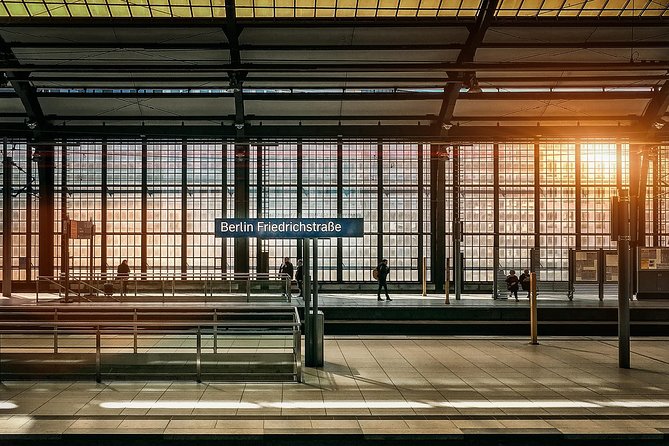
Friedrichstrasse brings the tour into modern central Berlin. This major shopping and cultural street mixes references to the city’s Golden Twenties with newer offices, restaurants, boutiques, coffee shops, and department stores.
Galeries Lafayette is the best-known commercial landmark along the route. Here, your guide can discuss the urban renewal schemes that reshaped central Berlin after reunification. The important point is not just what was built, but how planners tried to create a new city center after decades of division.
This is one of the places where private guiding earns its keep. A casual walk can leave you with a collection of polished facades. A good explanation can show how commercial architecture, public space, and Berlin’s attempt to reconnect its historic core fit together.
Friedrichstrasse can feel more commercial than authentic, particularly if you prefer old neighborhoods and rough edges. That is part of the story, though. Berlin’s rebuilt center is not uniformly charming, and the guide can help you understand the choices behind its appearance.
Other Berlin experiences to weigh up
- Discover Berlin Half-Day Walking Tour
★ 5.0 · 9,624 reviews - Berlin: Third Reich and Cold War 2 Hour Walking Tour
★ 4.9 · 6,830 reviews - Berlin: Discover Berlin Walking Tour
★ 4.9 · 5,998 reviews - Berlin’s Best: 2 Hour Walking Tour Third Reich and the Cold War
★ 5.0 · 5,486 reviews
The Philharmonie and West Berlin’s cultural answer
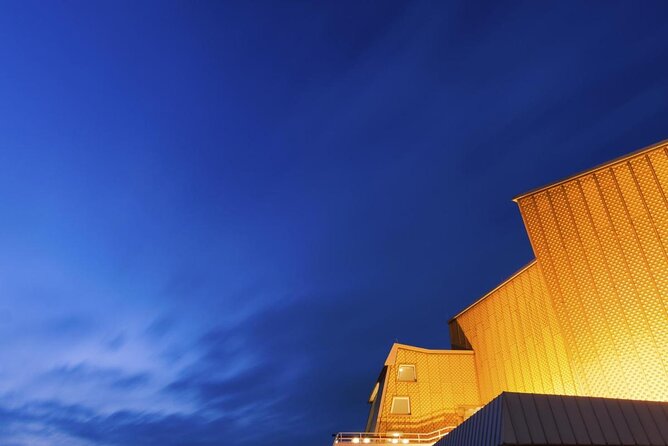
At the Kulturforum, the Berliner Philharmonie gives you a sharp change of scale and style. Its tent-like, asymmetrical exterior looks nothing like the neoclassical buildings around Museum Island or Gendarmenmarkt.
The concert hall was part of West Berlin’s postwar cultural district, developed after many important cultural institutions were left on the other side of the Wall. The Kulturforum brought museums, libraries, concert halls, and research institutions together near the edge of West Berlin.
You get about 15 minutes here, enough to admire the striking exterior and pose for photographs. The building’s interior is famous for placing the orchestra at the center, with seating arranged around it, but this tour does not promise a concert or interior visit. The exterior alone is worth seeing if you care about 20th-century architecture.
I find this stop especially useful because it shows that Cold War Berlin was not only about walls and checkpoints. It was also about creating competing cultural capitals, each with its own museums, concert halls, and public institutions.
Reichstag and the idea of transparent government
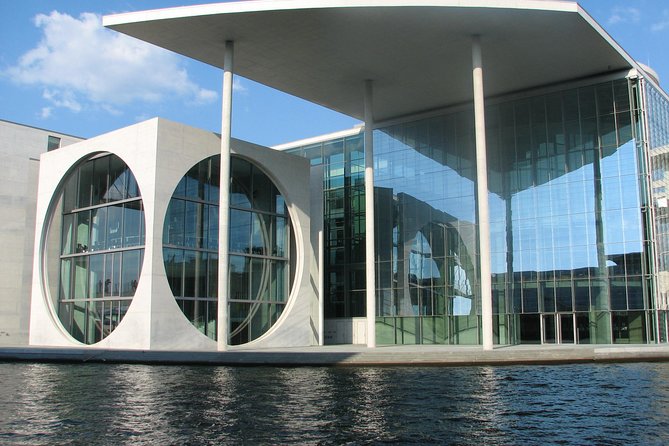
The Reichstag combines an ornate 19th-century facade with Norman Foster’s modern glass dome. That contrast is the point. The historic building represents imperial Germany and parliamentary tradition, while the glass addition suggests openness and public access after reunification.
The stop is listed at about 10 minutes, so do not count on a full visit to the dome. The tour data lists the stop as free but does not include a dome reservation or interior admission. You should treat the Reichstag as an exterior landmark unless your guide confirms otherwise.
Even from outside, the building makes a strong lesson in Berlin’s habit of putting old and new side by side. The guide can explain how restoration and redesign changed the meaning of the building without erasing its past.
Potsdamer Platz, from wasteland to business district
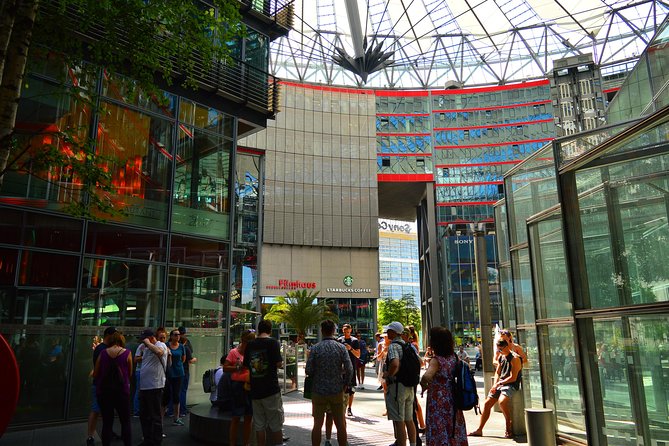
Potsdamer Platz is perhaps the clearest example of Berlin’s post-Wall reinvention. Before World War II, it was a major urban crossroads. After wartime destruction and Cold War division, it became a largely empty zone near the Wall. Today, it is lined with offices, hotels, public spaces, and dramatic high-rise architecture.
The Sony Center’s sweeping glass roof is the most memorable feature. The DB Tower adds a sleek glass vertical form, while Panoramapunkt offers a city view if you choose to visit separately. The tour includes about 20 minutes here, which is enough to understand the basic transformation and photograph the modern skyline.
This area is not old Berlin, and it does not pretend to be. Some people like its confidence and scale. Others find it corporate and less personal than Kreuzberg or Hackescher Markt. I recommend seeing it precisely because the contrast makes Berlin’s rebuilding easier to understand.
Kreuzberg and Friedrichshain, where the city feels lived in
Kreuzberg brings a different kind of architecture. Historic Altbau apartment buildings, industrial conversions, contemporary structures, and street-level businesses create a less formal setting than the government quarter.
The Oberbaum Bridge is the key visual landmark, with red brick towers and Gothic-inspired arches crossing the Spree toward Friedrichshain. It is a particularly good photography stop and a reminder that bridges can carry political meaning as well as traffic.
The route then continues into Friedrichshain, a former East Berlin district with prewar apartment blocks, socialist-era buildings, and newer development. The Altbau facades often feature tall windows, ornate details, and high ceilings. Many have been restored and adapted for apartments, cafes, and shops.
The East Side Gallery adds a direct link to the Berlin Wall. Murals painted on a surviving section turn a former barrier into an open-air art site. The scheduled time in both Kreuzberg and Friedrichshain is about 30 minutes each, so your guide will need to keep the route moving.
These neighborhoods are important because they show everyday Berlin rather than only official monuments. You get apartment buildings, street life, old industrial traces, and the visible mix of preservation and change.
Pariser Platz and Hackescher Markt
Pariser Platz gathers several contrasting buildings around the Brandenburg Gate. The gate’s neoclassical columns give the square its formal identity, while the Hotel Adlon, French Embassy, American Embassy, Academy of Arts, and DZ Bank add different versions of classical, minimalist, and contemporary design.
Frank Gehry’s work inside the DZ Bank adds a modern counterpoint to the more restrained facades around the square. This is another place where the guide can point out how central Berlin regulates new construction around historic landmarks.
Hackescher Markt finishes the route with Hackescher Höfe, a group of interconnected courtyards built in 1906. August Endell’s art nouveau design uses colored tiles, curved lines, ironwork, and decorative brickwork. Each courtyard has its own feel, yet the complex also shows how beauty and practical urban use can work together.
The stop lasts about 20 minutes. It is a fitting final chapter because it moves away from grand state buildings and into a more intimate urban setting of shops, courtyards, and restored early 20th-century design.
Is $191.87 per person a fair price?
At $191.87 per person, this is not a budget sightseeing walk. The value depends heavily on group size and your interest in architecture. A couple who wants specialist attention may find the cost reasonable, especially with hotel pickup and drop-off. A larger private group may benefit from group discounts, though the exact savings are not provided.
You are paying for a private English-speaking guide, a custom route, and the ability to ask questions throughout the day. The strongest benefit is not simply reaching ten locations. It is understanding why those locations look so different and how Berlin’s political divisions shaped them.
The price is harder to justify if you only want photographs or a quick list of landmarks. You can see many of these places independently using public transportation. The tour makes sense when you want context, efficient routing, and a guide who can adjust the emphasis to your interests.
Practical details before you book
The tour lasts about four hours and begins with a meeting at your central Berlin hotel lobby. Hotel pickup and drop-off are included. Since the route covers many districts, your hotel’s location may affect how much of the four hours is spent sightseeing rather than getting into position.
You can choose to do the tour on foot or by bike. Ask about the preferred format when booking, particularly if your group has different comfort levels or wants more ground covered. The tour is offered in English and is private, so only your group participates.
Food and drinks are not included. Wear comfortable footwear for the walking format, and keep in mind that the stop timings are fairly short. Most people can participate, and service animals are allowed. The tour is near public transportation, which is useful if you decide to continue exploring after the drop-off.
Free cancellation is available up to 24 hours before the start time. Cancellations or changes made inside that window are not refunded.
Who should book this private Berlin tour?
I would recommend it to first-time visitors who want a strong city orientation, design professionals, students, photographers, and anyone who likes buildings with a political story attached. It is also a smart choice for families or small groups who want to set their own pace.
The experience may not suit you if you want long museum visits, a relaxed cafe break, or a single neighborhood explored in depth. The route is broad and ambitious. You will see many places, but most stops are short.
Several guides associated with the tour have been praised for clear communication, historical insight, and flexible pacing. Sara, an architect, has led a route that included a hotel meeting point and a walk toward Museum Island. Thomas was praised for explaining what architects were trying to achieve, while Heiko helped make the tour useful as a first-day orientation. Those details point to the tour’s real strength: a good guide can turn a busy list of sights into a readable story.
Should you book it?
Book this tour if you want Berlin’s architecture explained as part of the city’s political and social story. The combination of Museum Island, Gendarmenmarkt, the Philharmonie, Reichstag, Potsdamer Platz, Kreuzberg, Friedrichshain, and Hackescher Markt gives you an unusually wide view in four hours.
Skip it if $191.87 per person feels too high for an exterior-focused tour or if you prefer to explore slowly on your own. For everyone else, especially a small group that wants a flexible first look at Berlin, the private format and strong guide focus make this a useful investment.
FAQ
How long does the Berlin architecture tour last?
The tour lasts approximately four hours.
Is the tour private?
Yes. Only your group participates in the activity.
Is hotel pickup included?
Yes. Hotel pickup and drop-off are included, with the tour beginning at a central Berlin hotel lobby.
Is the tour offered in English?
Yes. The tour is offered in English.
Can I take the tour by bike instead of walking?
Yes. You can choose to do the tour on foot or by bike.
Which Berlin sights are included?
Stops include Museum Island, Gendarmenmarkt, the Berliner Philharmonie, the Reichstag Building, Potsdamer Platz, Berliner Dom, Kreuzberg, Friedrichshain, Pariser Platz, and Hackescher Markt.
Are food and drinks included?
No. Food and drinks are not included.
Can I cancel for a full refund?
Yes, if you cancel at least 24 hours before the experience begins. Cancellations made less than 24 hours in advance are not refunded.
Newest Berlin reviews
- Where It All Began: Berlin’s Queer & Trans History Tour★ 4.9 · 6 reviews
- Berlin: guided canoe | kayaktour★ 4.1 · 7 reviews
- Understanding Kreuzberg: The roots of local (sub)culture★ 4.9 · 11 reviews
- Private Potsdam City Tour in an authentic vintage van★ 5.0 · 14 reviews
- Warnemünde Shore Excursion: Private Sachsenhausen and Berlin Tour★ 5.0 · 12 reviews
- Ultimate E-Bike Tour of Berlin with Beer Garden Stop★ 5.0 · 4 reviews
- In the Forbidden City – Potsdam Walking Tour★ 5.0 · 17 reviews
- Private Walking Tour of Potsdam and Sanssouci★ 5.0 · 24 reviews
Berlin Architecture Tours, compared.
Guided Walking Tour of UNESCO Site and Architecture
Read our review →
Private Taxi Tour City East & West History and Architecture 3-4h
Read our review →
Karl-Marx-Allee Tour: Life and Architecture in East Berlin
Read our review →
Browse the lists this tour appears in