
Reviewed · BERLIN THIRD REICH TOURS
Berlin: Jewish Walking Tour including World War II
Berlin’s Jewish story is not confined to one memorial or museum. This private walk connects Moses Mendelssohn, the New Synagogue, Eastern European Jewish immigration, and Nazi persecution across Mitte, where streets and buildings still carry the marks of that past. Tal, a certified Berlin guide with academic experience in German Jewish history, leads the route.
I like the tour’s wide time span, moving from the community’s re-establishment in the 17th century to modern Berlin. I also like its personal scale: a private group lets you ask questions and request added stops. The main caution is the price, $318 per person, which is a serious outlay for a walking tour, and the published details give conflicting information about accessibility and the ending point.
Key points at a glance
- Moses Mendelssohn’s Berlin: Visit the old cemetery where the major Jewish thinker is buried and learn about the community’s early growth.
- The Jewish quarter around Hackescher Markt: Trace the arrival of Eastern European Jews and the tensions within Berlin’s Jewish society.
- Otto Weidt’s workshop: Enter the museum dedicated to the man who tried to protect Jewish workers during the Holocaust.
- The Block of Women: Hear the story behind the 1943 protest by non-Jewish women demanding the release of their Jewish relatives.
- The New Synagogue: See the building from outside and connect its golden age with the destruction and loss of World War II.
- Optional extensions: Add the Kindertransport Memorial, Schönhauser Allee Cemetery, or the Grunewald deportation memorial for an extra fee and more time.
Why this walk matters in Berlin
Many Berlin history tours focus on the Nazi period alone. This one takes a longer view. You begin with Jewish life taking shape in Berlin, follow its growth and internal debates, and then face the destruction of the Holocaust before considering what exists today.
That order matters. It shows you a community that was not simply a prelude to tragedy. Berlin’s Jewish residents built schools, religious institutions, businesses, cultural groups, and family lives over centuries. The Nazi period destroyed much of that world, but it did not erase the years that came before or the community’s continued presence in the city.
Tal’s background is useful here. Alongside professional work connected to the Charité hospital’s handling of its 1930s and 1940s past, Tal has studied German Jewish history at an academic level. That gives the walk a broader frame than a series of dates and memorials. You can expect attention to arguments within the community, including disagreements over the introduction of an organ in worship and unease among established German Jews about the arrival of Eastern European Jews.
The tone is serious, but the tour is not presented as a silent memorial march. Personal stories and specific places give the subject human scale.
More Jewish history tours in Berlin:
- Nazi Berlin and the Jewish Community Tour
★ 4.8 · 55 reviews - Path of Resistance: Berlin’s Hidden Holocaust Stories
★ 5.0 · 33 reviews - Private Tour: Jewish Heritage Walking Tour of Berlin
★ 5.0 · 29 reviews
Starting at Hackescher Markt
The meeting point is in front of Starbucks near Hackescher Markt. It is an easy central place to find, but allow a few minutes to get oriented before the start. The walk then uses Mitte as an open-air classroom.
Hackescher Markt became an important area for Jewish life, particularly for Eastern European Jews who came to Berlin after pogroms. The term Ostjuden, or Eastern Jews, is part of the tour’s vocabulary. You will hear how these newcomers were viewed by established German Jews, some of whom felt embarrassed by their arrival or feared that prejudice toward Eastern Europeans would damage their own position.
This is one of the tour’s useful distinctions. Jewish Berlin was not one uniform group with one shared outlook. Language, origin, religious practice, social class, and ideas about modern life all shaped the community.
The first guided stop lasts about 15 minutes. It is a short introduction, but it sets up the rest of the walk by showing why this particular part of Mitte became so important.
The Block of Women and a 1943 protest
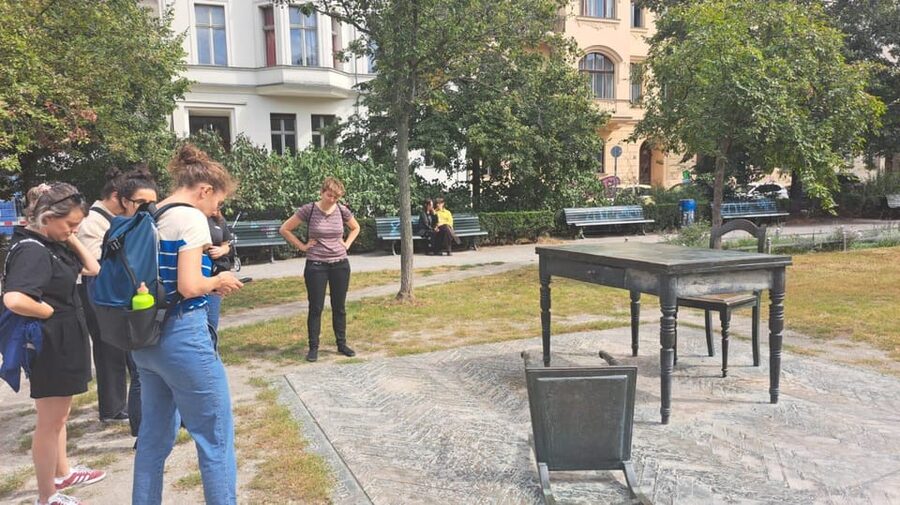
The stop known as the Block of Women takes about 20 minutes. It recalls the 1943 protest by non-Jewish women whose Jewish husbands and relatives had been arrested.
The story is powerful because it shows an unusual act of public pressure during the Nazi period. The women demanded the release of their family members, and the protest succeeded. That does not soften the wider horror of Nazi persecution, but it gives you a more precise picture of how individual choices and public action could matter.
This stop also helps prevent the Holocaust from becoming a collection of large numbers without faces. You are looking at a place connected to families, marriages, fear, and courage. Tal’s use of personal stories is especially valuable here.
The memorial is outdoors, so the quality of the experience depends partly on the guide’s explanation. This is not a museum visit with labels and exhibits. It is a place where the spoken account supplies the context.
Otto Weidt’s workshop for the blind
The Otto Weidt Workshop for the Blind is one of the strongest parts of the route. The guided visit lasts about 30 minutes, and admission is included except on days when the museum is closed.
Otto Weidt operated a workshop that employed blind and deaf Jewish people. During the Holocaust, he tried to protect his workers from deportation and murder. The museum gives the story a physical setting rather than presenting it only as a biography.
You should not expect a large museum visit. The value comes from the connection between the small workshop and the choices made inside it. A guide can explain how Weidt used his position to help people and what risks such efforts involved.
I like that this stop complicates the usual division between heroes and victims. It focuses on the people he tried to save, the practical problems they faced, and the limited but real ways one person could resist. It is also a welcome change of pace after several outdoor memorial stops.
Photography rules matter here. Flash photography is not allowed, and smoking is not allowed during the activity.
More Third Reich history tours in Berlin:
- Berlin: Third Reich and Cold War 2 Hour Walking Tour
★ 4.9 · 6,830 reviews - Berlin’s Best: 2 Hour Walking Tour Third Reich and the Cold War
★ 5.0 · 5,486 reviews - Third Reich Berlin: Hitler and WWII Walking Tour
★ 5.0 · 3,301 reviews - Berlin: Third Reich, Hitler, and WWII Walking Tour
★ 4.9 · 1,133 reviews
The old cemetery and Moses Mendelssohn
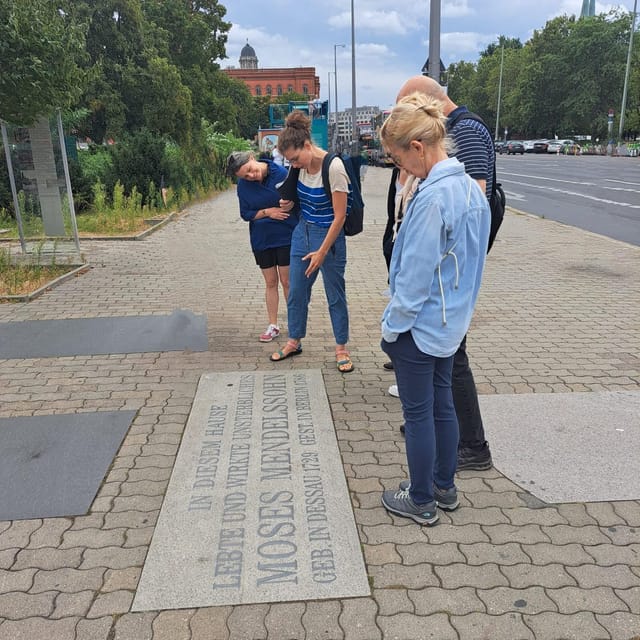
The old Jewish cemetery is another central stop. It is the first cemetery of Berlin’s Jewish community, and Moses Mendelssohn is buried there. The guided visit takes about 20 minutes, and entry is included except on Jewish holidays and Saturdays.
Mendelssohn is important not only as a philosopher but also as a figure connected to the changing place of Jews in European society. Starting with him gives the tour a way to discuss education, religious identity, and the relationship between Jewish tradition and the wider German world.
The cemetery is not simply a list of graves. It gives you a direct sense of the community’s age and continuity. At the same time, the visit is subject to religious access restrictions, so confirm that it will be open on your chosen date.
Bring a head covering or kippah. The tour specifically advises this, along with comfortable shoes, water, sunscreen, and a hat.
The first synagogue and the New Synagogue
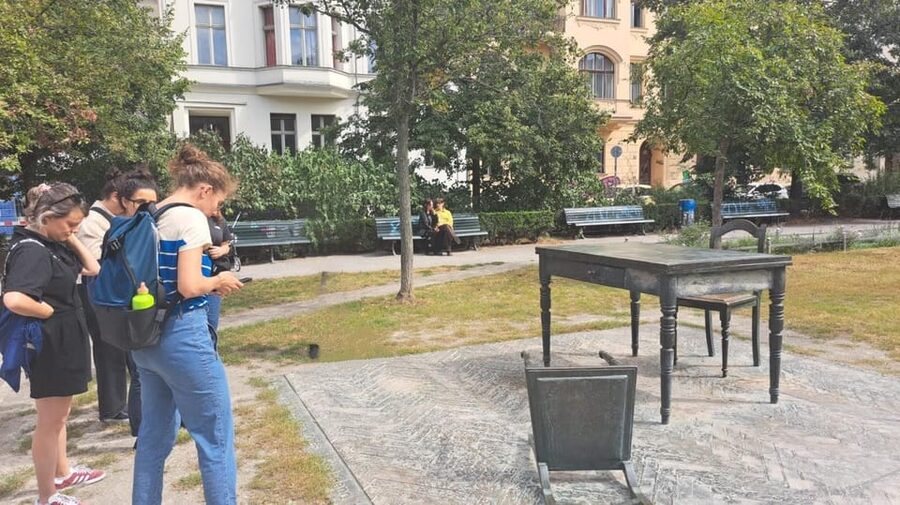
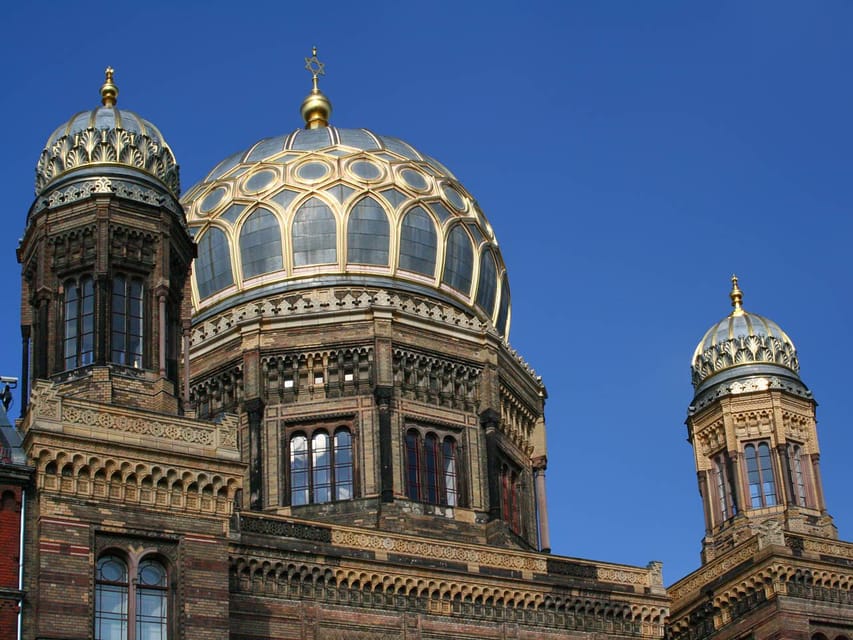
The walk also visits the site of Berlin’s first synagogue and the area around the New Synagogue. The New Synagogue visit is listed as an outside stop lasting about 30 minutes. The building’s golden dome and ornate design point to a period when Berlin’s Jewish community had money, confidence, and a major public presence.
The guide uses the New Synagogue to explain both achievement and destruction. It represented the community’s high point, yet the story does not end with architectural pride. The building was damaged during the Nazi period and later divided by war and political change.
Admission to the Centrum Judaicum, the museum inside the New Synagogue complex, is not included. That distinction is important. You will see and discuss the building from outside during the standard walk, but you need a separate ticket if you want to enter the museum.
This is one place where the private format helps. You can ask Tal about religious practice, architecture, the organ controversy, or the way German Jewish identity changed over time. If you already know the basic Holocaust chronology, this part may be more rewarding than a general sightseeing stop because it focuses on the community’s internal life.
A walk through institutions, schools, and memory
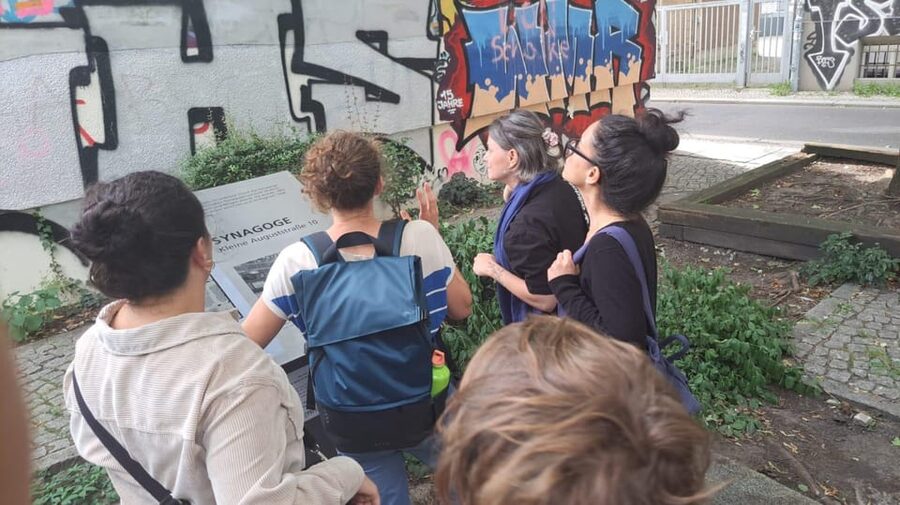
Other stops cover Jewish institutions in Mitte, including the Mendelssohn School and the girls’ school. These locations help you see Jewish life as an organized social world, not only a religious one.
Schools reveal how families prepared children for modern professional and civic life. They also bring gender into the story, since the presence of a girls’ school points to the community’s investment in women’s education.
The tour’s total walking time runs about 3.5 to 4 hours, with a short break. That is long enough for a serious historical route but short enough to fit into a day of Berlin sightseeing. You will be outside for much of it, so check the forecast and dress for the weather.
The route includes several emotionally heavy subjects. The break matters more than it might sound. It gives you a chance to pause, get water, and absorb what you have heard.
Optional stops beyond the main route
You can extend the walk for extra time and cost. These additions make sense if Jewish Berlin is a main reason for your visit.
At Schönhauser Allee Cemetery, you can see the final resting places of prominent figures from the community’s golden era. The Kindertransport Memorial at Friedrichstraße Station shifts attention to children sent out of Nazi-controlled Europe. The Grunewald Deportation Memorial recalls the deportation of Berlin’s Jews.
Each extension changes the balance of the tour. The main route gives you a broad story in central Mitte. The added sites allow more time with burial traditions, rescue efforts, and deportation. Ask Tal to shape the extension around your interests rather than treating every optional stop as essential.
Because the standard walk already lasts close to four hours, adding sites may make for a demanding half-day. Comfortable footwear is not optional.
How much value do you get for $318?
At $318 per person, this is expensive compared with a large public walking tour. The price makes more sense if you want a private group, a guide who can handle detailed questions, and a route shaped around your interests.
The fee covers the walking tour, Tal’s guiding, admission to the Otto Weidt Museum when it is open, and admission to the old cemetery when access is permitted. It does not cover food, drinks, or the separate ticket for the Centrum Judaicum.
For two or three people, the cost may feel high. For a family, study group, or private party splitting the price, the personal attention becomes more worthwhile. The ability to add Schönhauser Allee Cemetery, Friedrichstraße, or Grunewald also gives you more control than a fixed group route.
I would not choose this tour simply because it includes famous sights. Choose it because you want a sustained conversation about Jewish Berlin, including its internal divisions and modern continuation.
Who should book this tour?
This walk suits you if you want context rather than quick photographs. It is particularly useful for visitors who have already seen Berlin’s major World War II memorials and want to understand the Jewish community that existed before the Nazi period.
It also suits students, families with older children, history-focused visitors, and anyone interested in the difference between German Jewish and Eastern European Jewish experience. Tal speaks English and Hebrew, and the private format leaves room for questions.
It may be less suitable if you want a light sightseeing outing or dislike long discussions at memorials. The subject is painful, and the route takes several hours on foot.
The accessibility information needs careful attention. The activity is described as wheelchair accessible in one place, but it is also marked as not suitable for wheelchair users or people with mobility impairments elsewhere. Since the route includes walking between outdoor sites and cemetery access, contact the provider before booking if mobility is a concern.
The published details also describe the activity as ending at the memorial Jewish cemetery while separately saying it ends back at the meeting point. Confirm the exact finish location before you go, especially if you have an evening reservation nearby.
Should you book it?
Book this tour if you want Berlin’s Jewish past presented as a long, complicated human story, not just a sequence of Holocaust sites. Tal’s academic and professional background, the private format, the Otto Weidt Museum, and the old cemetery give the walk real substance.
Skip it if $318 per person feels too steep for a walking tour, or if you prefer a short general introduction. For the right audience, though, the cost buys time, flexibility, and a guide who can connect Mendelssohn, Eastern European immigration, Jewish institutions, Nazi persecution, and Berlin today.
FAQ
How long does the Jewish walking tour last?
The tour lasts about 3.5 hours, with the full experience sometimes described as 3.5 to 4 hours. It includes a short break.
Where does the tour start?
The meeting point is in front of Starbucks near Hackescher Markt in Berlin Mitte.
Where does the tour finish?
The route lists the memorial Jewish cemetery as the final stop. The activity information also says it ends back at the meeting point, so confirm the exact finishing location with the provider.
Is the tour private?
Yes. It is offered for a private group.
Which languages does Tal speak?
The tour is available in English and Hebrew.
Is admission to the Otto Weidt Museum included?
Yes, admission is included when the museum is open. The museum may be closed on some days.
Is admission to the New Synagogue museum included?
No. The separate Centrum Judaicum museum ticket is not included.
Is entry to the old cemetery included?
Yes, except on Jewish holidays and Saturdays, when access is not included or may not be available.
Can the tour be extended?
Yes. Optional extensions can include Schönhauser Allee Cemetery, the Kindertransport Memorial at Friedrichstraße Station, and the Grunewald Deportation Memorial. These require additional time and cost.
What should I bring?
Wear comfortable walking shoes and dress for the forecast. Bring water, sunscreen, and a hat, and bring a head covering or kippah. Flash photography and smoking are not allowed.
More Walking Tours in Berlin
- Discover Berlin Half-Day Walking Tour
★ 5.0 · 9,624 reviews - Berlin: Discover Berlin Walking Tour
★ 4.9 · 5,998 reviews - Berlin: Hidden Backyards Guided Walking Tour
★ 4.8 · 5,360 reviews - Berlin: Alternative Berlin Walking Tour
★ 4.6 · 1,204 reviews
Newest Berlin reviews
- Where It All Began: Berlin’s Queer & Trans History Tour★ 4.9 · 6 reviews
- Understanding Kreuzberg: The roots of local (sub)culture★ 4.9 · 11 reviews
- Berlin: guided canoe | kayaktour★ 4.1 · 7 reviews
- Private Potsdam City Tour in an authentic vintage van★ 5.0 · 14 reviews
- Warnemünde Shore Excursion: Private Sachsenhausen and Berlin Tour★ 5.0 · 12 reviews
- Ultimate E-Bike Tour of Berlin with Beer Garden Stop★ 5.0 · 4 reviews
- In the Forbidden City – Potsdam Walking Tour★ 5.0 · 17 reviews
- Private Walking Tour of Potsdam and Sanssouci★ 5.0 · 24 reviews
Berlin Third Reich Tours, compared.
Berlin’s Best: 2 Hour Walking Tour Third Reich and the Cold War
Read our review →
Third Reich Berlin: Hitler and WWII Walking Tour
Read our review →

Berlin Third Reich Sites: Half-Day Walking Tour
Read our review →
Guided Bike Tour of the Berlin Wall and Third Reich
Read our review →
Hitler’s Germany: Berlin During the Third Reich & WWII
Read our review →
Private Walking Tour Berlin Third Reich Hitler and World War II
Read our review →Browse the lists this tour appears in