
Reviewed · BERLIN WALL TOURS
Walking on the Wall: 3-Hour Tour in Berlin
Berlin’s Wall is easiest to understand when you stop treating it as a single slab of concrete. This walking tour follows the former border through abandoned bridges, memorial grounds, the old death strip, and a lively public park. The most striking detail is Rabbit Field, where the space once used as a deadly border zone is now tied to a much gentler local story.
I like the small group limit of 12, which gives you a better chance to hear the guide and ask questions. I also like the route’s mix of major sights and easy-to-miss remains, especially the inner wall and former death strip. The main drawback is that you need decent walking stamina, and the unusual starting point can leave you wondering if you are in the right place.
Key points at a glance
- See more than the famous concrete: The route includes Liesenbrücken, the Berlin Wall Memorial, Mauerpark, and Rabbit Field.
- Learn how the border really worked: The guide explains the inner wall, outer wall, death strip, watch systems, and daily life in divided Berlin.
- Expect a personal tour: Groups are limited to 12 people, and Behzad is frequently named as the guide.
- Plan for three hours on foot: The pace is generally relaxed, with time for questions and a possible refreshment stop.
- Pay a modest price for interpretation: At $24.03 per person, the value comes from the guide’s context rather than paid admissions.
- Book ahead in busy periods: This experience is often reserved about 45 days in advance.
Why walking the former Wall route works

The Berlin Wall is not one neat sightseeing attraction. It once cut through streets, yards, railway lines, cemeteries, and neighborhoods. Today, the route is broken into memorials, open spaces, art, bits of wall, and ordinary city blocks.
That can make a self-guided visit confusing. You may see a strip of pavement or a metal line in the street without knowing what it marks. A guide can connect those small clues to the larger story, showing you where the border ran and explaining how its design changed over time.
This tour also gives you a useful contrast between remembrance and everyday Berlin. You begin with places that feel abandoned or solemn, spend substantial time at the national memorial, then finish around Mauerpark, where the former border zone is now used for recreation, flea-market shopping, and street music.
For a first visit, that contrast is valuable. You do not just look at a wall. You see what happened to the space after the wall disappeared.
More Berlin Wall tours in Berlin:
- Skip-the-Line: Berlin Wall Museum at Checkpoint Charlie
★ 4.1 · 2,041 reviews - Cold War, Berlin Wall, Spies and the East Side Gallery
★ 5.0 · 1,024 reviews - THE WALL: asisi Panorama Berlin Ticket
★ 4.5 · 580 reviews
Starting at Liesenbrücken
The tour begins at Ida-von-Arnim-Straße 2 in Berlin. It is not the kind of meeting point that immediately announces a major historical site, so give yourself time to find it and check your confirmation before setting out.
That slightly odd beginning makes sense once the walk starts. Liesenbrücken is an abandoned bridge in the path of the former Wall. The bridge gives the guide a chance to explain how the border affected transport, movement, and the shape of the surrounding city.
You spend about 30 minutes here. It is a short stop, but it helps you understand the first important lesson of the tour: the Wall did not simply divide two sides of a street. It cut through infrastructure that had been built for a connected city.
The setting also gives the tour an atmospheric opening. Instead of beginning with a crowded monument and a large group, you start with a quieter remnant. You can focus on the guide’s explanation and get a sense of Berlin’s divided past before reaching the main memorial complex.
The Berlin Wall Memorial on Bernauer Straße
The longest stop is the Berlin Wall Memorial, where you spend about 90 minutes. This is the heart of the tour and the place where the physical remains and human stories come together most clearly.
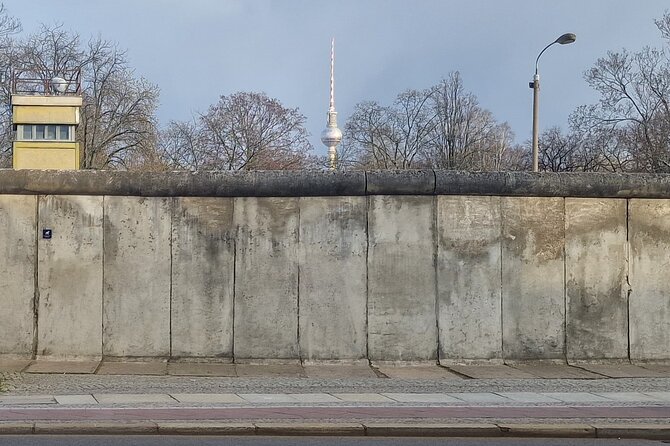
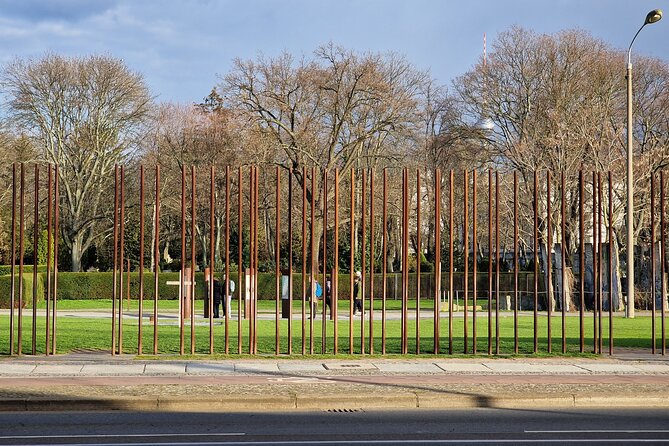
The memorial follows roughly 1.4 kilometers of the former border strip along Bernauer Straße. Its national monument includes a 70-meter section of reconstructed border fortifications, built from parts connected with the Wall’s former defensive system.
The important point is that the memorial does not present only the outer concrete wall. It helps you see the broader border arrangement, including the space between barriers, observation points, and the difficult conditions faced by anyone trying to cross.
You also encounter the outdoor exhibition, the Chapel of Reconciliation, the Documentation Centre, the Window of Remembrance, and the visitor facilities. The nearby Nordbahnhof S-Bahn station has another exhibition connected with the site.
Because the memorial is spread out, a guide is particularly useful here. You can easily walk past a marker or look at a section of wall without grasping why it matters. Behzad’s approach, as described in the tour details, focuses on connecting visible remains with the lives of people who lived beside the border.
This is also the point where the tour becomes more personal. You learn about the division between East and West Germany, the effect of the Wall on nearby residents, and the dangers faced by people who tried to cross. The guide’s role is not just to recite dates. It is to explain how an international political conflict reached right into homes, streets, and families.
The Window of Remembrance is one of the memorial’s most serious elements. It commemorates people who died at the Berlin Wall. Expect this part of the walk to feel quieter and more reflective than the opening stop.
If you want to study every display in detail, 90 minutes may not be enough. The tour gives you a guided overview, not unlimited museum time. That is a reasonable tradeoff for a three-hour route, but history enthusiasts who want to read every panel should plan another visit.
Understanding the inner wall and death strip
One of the most useful parts of the walk is the explanation of the inner wall. Many first-time visitors imagine one large concrete barrier. In fact, the border system included more than the famous outer wall, and the area between barriers was a controlled zone.
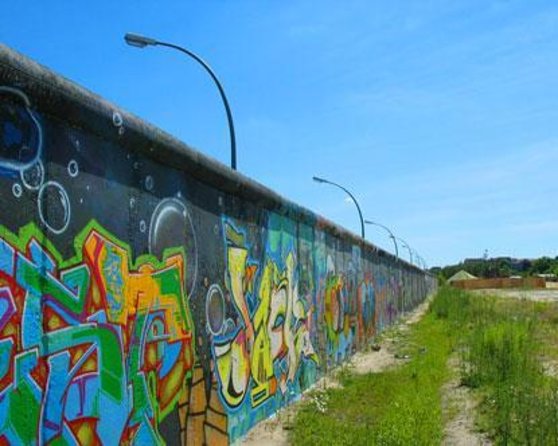
The space between the inner and outer walls is often described as the death strip. It was designed to expose escape attempts and make crossing difficult. Once you see the remaining layout, the Wall’s purpose becomes much clearer.
This is where a guided walk earns its price. A photograph or surviving slab cannot easily show you how the border functioned. The guide can point out the relationship between the barriers and explain why certain open areas, paths, and structures mattered.
The tour also brings attention to historical traces that you might miss alone. Some parts are not dramatic at first glance. A small remnant, a line in the ground, or an altered section of street can carry more meaning once you know what you are seeing.
Behzad is the guide most often associated with this experience. His style is described as engaging, patient, and ready to answer questions, including unusual ones from the group. That matters on a subject that can become heavy or overly technical. A good guide keeps the facts clear without turning the walk into a lecture.
More three-hour experiences in Berlin:
- Berlin Highlights 3-Hour Bike Tour
★ 5.0 · 948 reviews - Berlin Highlights: 3-Hour Bike Tour
★ 4.9 · 809 reviews - Berlin: 3-Hour Street Art Tour
★ 4.7 · 778 reviews - Berlin: 3-Hour Secret Food Tour
★ 4.8 · 269 reviews
A short pause before Mauerpark
A three-hour walk needs a break, and the tour has included a short stop for coffee, snacks, or a beer. One account specifically praised a coffee stop on a chilly morning, while another mentioned a beer and snack break.
Treat this as a useful pause rather than a formal meal stop. It gives you time to use the toilet, warm up, and ask the guide about something that came up earlier. The exact refreshment choice may depend on the day and the group.
Wear proper walking shoes. The route is not described as strenuous, but you will be on your feet for most of three hours. Berlin weather can also change quickly, and winter conditions may make the open memorial areas feel cold. Bring a layer and consider a rain jacket.
The pace is generally described as leisurely, with rest time built in. Still, moderate physical fitness is recommended. If you have trouble standing or walking for long periods, this may not be the right way to see the Wall.
Mauerpark and the city after division
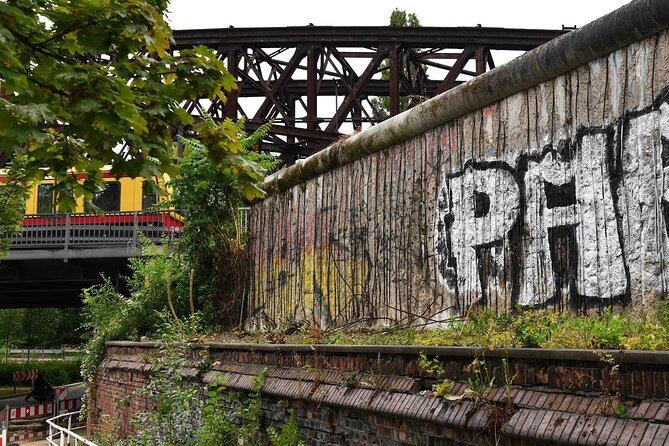
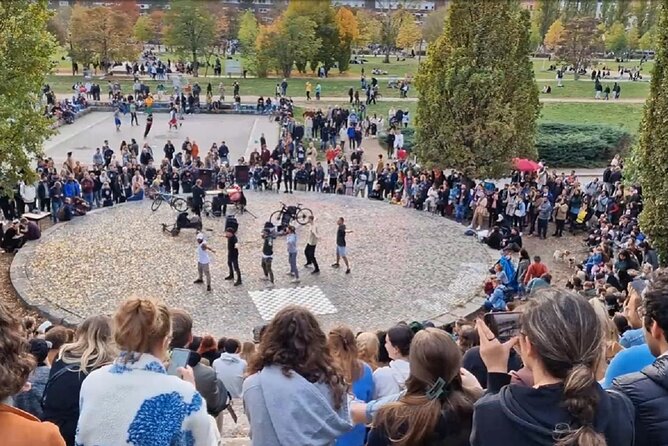
The route continues to Mauerpark, a public park following the former Wall line along Schwedter Straße. You spend about 30 minutes here.
Mauerpark gives you a completely different view of the border. The area is now associated with local recreation, a flea market, street musicians, and open public life. That everyday use is part of the historical lesson. A place once controlled as a border zone has become a place where people gather freely.
This stop also shows why Berlin’s Wall story cannot end with the date of its fall. The city had to decide what to preserve, what to remove, and how to use the empty strip left behind. Mauerpark is an example of the space becoming part of ordinary urban life.
The park can feel more active than the memorial section, especially when local events are taking place. That change of mood is welcome, but it may also make the final explanation harder to hear if the area is noisy. Stay close to the guide and do not wander off during the talk.
Rabbit Field and the former death strip
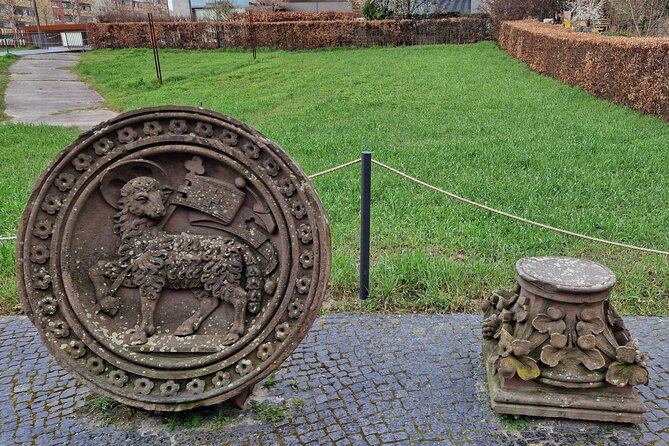
Rabbit Field is the final stop. It lies in the former death strip and offers one of the tour’s most unusual details.
The name points to the rabbits that came to live in the restricted open zone around the Wall. That small, surprising story gives the site a human scale without making light of the danger that once surrounded it. The contrast is powerful: a space designed for surveillance and escape prevention is now remembered through an image of animals moving freely.
You spend about 30 minutes here. The stop works best after the memorial because you already understand the border layout. Without that context, Rabbit Field might seem like a curious local detail. With it, you can see the relationship between the former security zone and the present-day city.
The walk ends at Mauerpark, near Bernauer Straße 63. That is useful for planning the rest of your day. You are not returned to the starting point, so think of the experience as a one-way route through northern Berlin.
Price, group size, and overall value
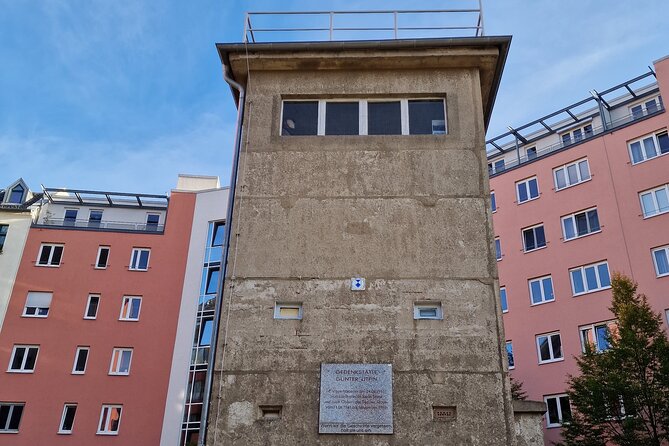
The listed price is $24.03 per person. Since the stops themselves have free admission, you are paying mainly for the guide, the route design, and the explanation that connects scattered remains.
I consider that a fair price for three hours, particularly with a group capped at 12. A large group can make a historical walking tour frustrating because you may struggle to hear, especially at a busy park or memorial. A smaller group also makes it easier to ask about family stories, escape attempts, architecture, or the way Berlin changed after reunification.
The value is strongest if you are visiting Berlin for the first time or if you know the basic Wall story but want to understand the physical setting. If you already have detailed knowledge and plan to spend several hours reading every memorial panel, you may prefer to explore independently.
This tour is often booked around 45 days ahead. That does not mean every date sells out, but it does suggest that you should reserve early if your Berlin schedule is fixed.
The experience requires a minimum number of participants. If that number is not met, the tour can be canceled and you will be offered another date or a full refund. One reported problem involved late notice after someone had already reached the meeting point, so keep an eye on your email before leaving for the start.
Free cancellation is available up to 24 hours before the start time. Changes or cancellations made less than 24 hours ahead are not refundable.
Who should book this walking tour
I would choose this tour for first-time Berlin visitors, history-minded families, and anyone who wants a clear introduction to the Wall without spending a full day inside museums.
It also suits older teenagers and young adults. The subject is serious, but the guide adds stories, questions, and local details that can make the past easier to grasp than a textbook account. One family used the walk as a way to give a teenager a stronger history lesson outside school, and that is exactly the kind of visitor who can benefit.
The tour is a good fit if you enjoy walking at a moderate pace and prefer personal explanation to audio guides. English is the offered language, and service animals are allowed.
I would think twice if you need step-free access, cannot stand for long periods, or want a tightly timed visit with no chance of a refreshment pause. The start can also feel unclear, so arrive early and confirm the meeting point.
Should you book Walking on the Wall?
Book it if you want to understand how the Wall occupied real streets and affected ordinary life. The route covers the essential memorial area but also adds Liesenbrücken, the inner wall, the former death strip, Mauerpark, and Rabbit Field.
The best reason to go is not simply to see surviving concrete. It is to learn how the border worked and why small traces still matter. At $24.03, a three-hour, small-group walk offers solid value, especially with a guide such as Behzad who can answer questions and point out details you might otherwise pass.
Skip it only if you prefer to read every exhibit at your own pace or if a three-hour walk would be uncomfortable. For most first-time visitors who want a thoughtful introduction to divided Berlin, this is a practical and memorable choice.
FAQ
How long is the Walking on the Wall tour?
The tour lasts approximately three hours.
What language is the tour offered in?
The tour is offered in English.
How much does the tour cost?
The listed price is $24.03 per person.
Where does the tour begin?
The meeting point is Ida-von-Arnim-Straße 2, 10115 Berlin, Germany.
Where does the tour end?
The tour ends at Mauerpark near Bernauer Straße 63, 13355 Berlin, Germany.
How many people can join the tour?
The group has a maximum of 12 people.
What places are included?
The route includes Liesenbrücken, the Berlin Wall Memorial, Mauerpark, and Rabbit Field.
Is admission to the stops included?
Admission is free at Liesenbrücken and the Berlin Wall Memorial. The Rabbit Field stop is listed as included, and no separate admission charge is listed for Mauerpark.
Is the tour physically demanding?
You should have a moderate level of physical fitness because the experience involves about three hours of walking and standing.
Can I cancel for a full refund?
You can cancel up to 24 hours before the start time for a full refund. If the tour is canceled because the minimum number of participants is not reached, you will be offered another date or experience, or a full refund.
More Walking Tours in Berlin
- Discover Berlin Half-Day Walking Tour
★ 5.0 · 9,624 reviews - Berlin: Third Reich and Cold War 2 Hour Walking Tour
★ 4.9 · 6,830 reviews - Berlin: Discover Berlin Walking Tour
★ 4.9 · 5,998 reviews - Berlin’s Best: 2 Hour Walking Tour Third Reich and the Cold War
★ 5.0 · 5,486 reviews
Newest Berlin reviews
- Where It All Began: Berlin’s Queer & Trans History Tour★ 4.9 · 6 reviews
- Understanding Kreuzberg: The roots of local (sub)culture★ 4.9 · 11 reviews
- Berlin: guided canoe | kayaktour★ 4.1 · 7 reviews
- Private Potsdam City Tour in an authentic vintage van★ 5.0 · 14 reviews
- Warnemünde Shore Excursion: Private Sachsenhausen and Berlin Tour★ 5.0 · 12 reviews
- Ultimate E-Bike Tour of Berlin with Beer Garden Stop★ 5.0 · 4 reviews
- In the Forbidden City – Potsdam Walking Tour★ 5.0 · 17 reviews
- Private Walking Tour of Potsdam and Sanssouci★ 5.0 · 24 reviews
Berlin Wall Tours, compared.
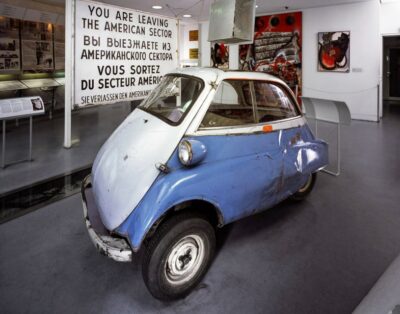
Skip-the-Line: Berlin Wall Museum at Checkpoint Charlie
Read our review →
Cold War, Berlin Wall, Spies and the East Side Gallery
Read our review →
Guided Bike Tour of the Berlin Wall and Third Reich
Read our review →

Browse the lists this tour appears in