
Reviewed · BERLIN COLD WAR TOURS
Private Taxi Tour of Berlin East and West and Neighbourhood approx. 4-6h
Berlin makes more sense when you see both halves of the city together. This private taxi tour links the Brandenburg Gate, Reichstag, former Wall sites, East Side Gallery, Potsdamer Platz, Kreuzberg, Friedrichstrasse, and the grand western boulevards while Gunter Bauer explains how war, dictatorship, division, and reunification changed each place.
I like the door-to-door pickup and the sheer ground covered without wearing out your feet. I also like the personal touch: Gunter contacts you before the tour, asks what matters to you, and often takes photos at the stops. The main drawback is that four to six hours can feel rushed, especially if you want to enter museums or spend time at every landmark.
Key points to know before booking
- See both sides of Berlin in one private vehicle, from the Reichstag and Brandenburg Gate to East Side Gallery and Stalin-era Karl-Marx-Allee.
- Gunter Bauer leads the tour, providing historical context, local stories, route changes, and help with photography.
- Pickup inside Berlin’s S-Bahn ring is included, while airport and outer-city pickup costs extra.
- Most sights are viewed from outside, with selected walks at places such as Brandenburg Gate, Hackesche Höfe, and the Berlin Wall.
- The tour suits short stays and limited mobility, since you can cover a large area with little walking.
- The route is ambitious, so tell Gunter your priorities before departure and remind him during the tour if a particular stop matters most.
Why a taxi is useful in a spread-out city
Berlin’s sights are not gathered around one compact old town. The Reichstag sits near the Spree, Museum Island lies farther east, the East Side Gallery follows the river, and Charlottenburg and the Kurfürstendamm are well to the west. A taxi lets you connect these pieces quickly.
That matters most if you have only one full day, are traveling with older relatives, or cannot walk and stand for long periods. The vehicle is air-conditioned, private, and equipped with WiFi. Parking fees and the taxi fare are included in the quoted price, along with the guiding service.
At $179.82 per person, the price makes the most sense for a small group that values time and personal attention. A larger group can make the per-person cost more attractive if a group discount applies. For one or two people, it is not a budget sightseeing option, but it can replace several taxi rides and help you avoid losing time navigating Berlin’s wide streets and many transit connections.
The vehicle has drawn one practical complaint: four people may find it small. If your party includes four adults with luggage or a preference for extra space, ask about the vehicle before booking. The tour is private, but private does not necessarily mean spacious.
More Cold War tours in Berlin:
- Berlin: Third Reich and Cold War 2 Hour Walking Tour
★ 4.9 · 6,830 reviews - Berlin’s Best: 2 Hour Walking Tour Third Reich and the Cold War
★ 5.0 · 5,486 reviews - Skip-the-Line: Berlin Wall Museum at Checkpoint Charlie
★ 4.1 · 2,041 reviews
Reichstag, Brandenburg Gate, and the new government quarter
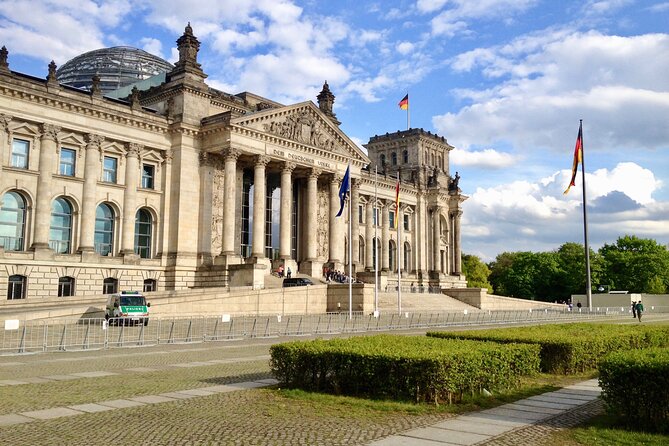
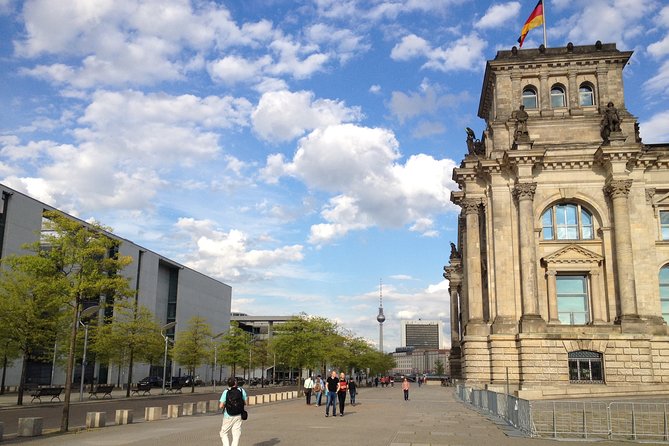
The tour often begins around the Reichstag, the former parliament building with its famous glass dome. The building’s past is unusually layered. It was damaged by fire, ignored during the Cold War because it sat only a few meters from the Wall, wrapped by Christo in the 1990s, and rebuilt for the reunified German parliament.
The dome is especially meaningful. It replaced a more ordinary roof concept and now lets the public look down toward the parliamentary chamber. If you want to go inside or visit the roof terrace, ask about opening days and advance tickets. The tour can show you the building and explain it, but a drive-by does not replace a proper visit.
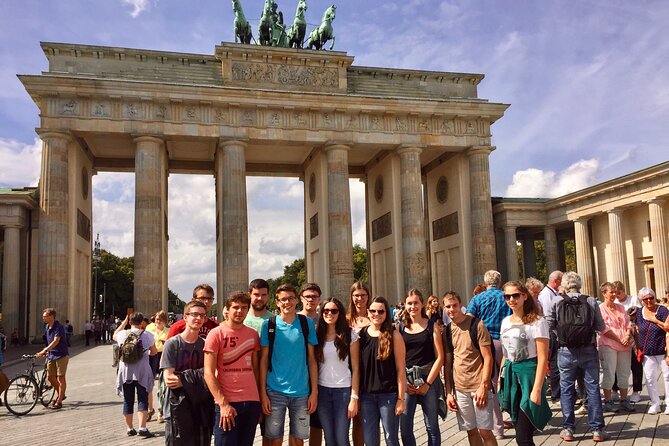
Nearby, Brandenburg Gate occupies Pariser Platz, Berlin’s formal front room. War and postwar demolition left the gate isolated for decades. A wall blocked it from the west, fencing cut it off from the east, and the nearby Hotel Adlon was eventually demolished. After reunification, the square was rebuilt with modern buildings that preserve the old street dimensions.
You normally get a short walk here. Five minutes is enough for photographs, but not for a full look at the embassies, Academy of the Arts, and surrounding architecture. If Brandenburg Gate is a top priority, say so before the tour begins.
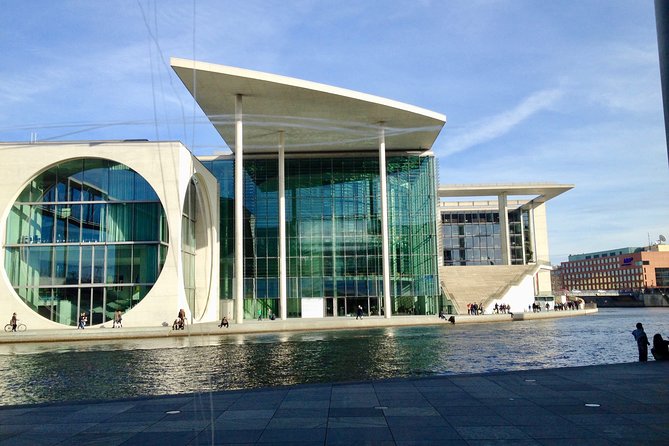
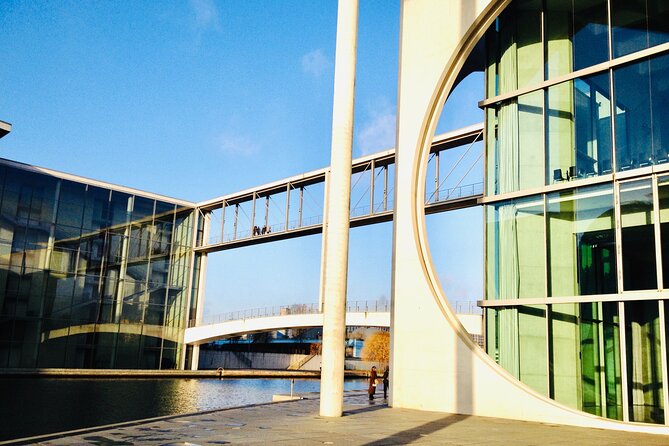
The route also passes the modern parliamentary buildings along the Spree. The long Paul-Löbe building contains committee rooms where much of the actual parliamentary work takes place. Its glass design makes the building feel open from the outside. The large Chancellery nearby is immense, with hundreds of offices and an official apartment that is not used by the chancellor.
You also see the Federal Press Conference building, recognizable by its large central window, and Bellevue Palace in the Tiergarten, the official Berlin residence of the federal president. These stops are mainly explanatory. They are useful for understanding how the new capital functions, but they are not usually places where you linger.
Potsdamer Platz and Berlin’s rebuilt center
Potsdamer Platz once carried enormous traffic and nightlife. Before the Second World War, around 100,000 vehicles passed through daily, and the area was packed with restaurants and entertainment. The Wall later cut through this central location, leaving a scar in the middle of Berlin.
After reunification, developers rebuilt it with large corporate projects. You pass the Sony Center, Mercedes-Benz buildings, hotels, theaters, and the glass tower associated with Deutsche Bahn. The architecture is bold, but the district can feel planned rather than lived-in. That contrast is part of the lesson: Berlin rebuilt quickly, but new buildings cannot automatically recreate an old urban life.
A particularly good story concerns the surviving section of the old Hotel Esplanade. Rather than destroy it, engineers moved part of the historic structure about 75 meters and built around it. The tour is strongest when Gunter connects such physical details to the city’s political past.
The nearby Kulturforum offers another view of postwar West Berlin. Its buildings include the Philharmonie, the New State Library, the Picture Gallery, and Ludwig Mies van der Rohe’s New National Gallery. The gallery’s steel roof is supported from the outside, leaving the main exhibition hall without interior columns or permanent walls.
You may also pass the future or newly developed additions around the Kulturforum. This is an area best appreciated through architecture and urban planning rather than a quick checklist of monuments.
Unter den Linden, Gendarmenmarkt, and Museum Island
Unter den Linden is Berlin’s grand east-west boulevard. It began as a route from the royal palace toward the hunting grounds, now the Tiergarten. Aristocratic palaces once lined it. Today you see the State Library, Humboldt University, State Opera, and other major institutions beneath the linden trees.
At Bebelplatz, the buildings of the Forum Fridericianum gather around an elegant open square. The State Opera, St. Hedwig’s Cathedral, the former Royal Library, and Humboldt University form the setting. A glass panel in the pavement points to an empty library below, a memorial to the Nazi book burning of May 10, 1933.
That small memorial is easy to miss. It rewards a short walk and a guide who explains what you are seeing. The nearby university began as the royal Friedrich Wilhelm University and later took the name Humboldt. Several buildings here began as palaces before taking on public roles.
The Neue Wache, or New Guardhouse, once held the castle guard. Today it is a memorial to victims of war and tyranny, with an enlarged version of Käthe Kollwitz’s sculpture of a mother mourning her dead son. The site often receives official wreaths, but its meaning is personal and quiet.
Gendarmenmarkt is one of Berlin’s most graceful squares. The German and French cathedrals flank the former theater, now the concert hall. Despite their names, the two domed buildings are not cathedrals in the usual sense. They were meetinghouses given grand towers under Frederick II. The French church still serves a French-speaking Reformed congregation, while the German cathedral houses an exhibition on German parliamentary history.
You normally get only about five minutes here, which is enough for a look but not a visit inside. Restoration work or events can also affect what you see.
Other Berlin experiences to weigh up
- Berlin: Private Reichstag and Glass Dome Tour
★ 4.8 · 2,226 reviews - Berlin Private Complete History All Day Walking Tour
★ 5.0 · 474 reviews - Private Walking Tour Berlin Third Reich Hitler and World War II
★ 5.0 · 360 reviews - Private Berlin: Iconic Sights and Hidden Gems Walking Tour
★ 5.0 · 292 reviews
Jewish Berlin, the armory, and the palace reborn
The New Synagogue on Oranienburger Strasse is recognizable by its golden dome and Moorish-style details. It once held thousands of worshippers and reflected a period when Prussian Jews had gained civil rights and wanted a public place that expressed their faith and culture.
Security is strict. Expect airport-style checks if you visit the exhibition inside. The tour can explain the building from the street, but it cannot substitute for the interior displays on Jewish life in Berlin.
The German Historical Museum occupies the former armory, a building once designed for weapons and military stores. Its exterior and courtyard contain severe sculptural details, including replicas of dying warriors’ death masks. The site is a reminder that Berlin’s grand architecture often carries both artistic value and uncomfortable political meaning.
Across the river, the rebuilt Berlin Palace now houses the Humboldt Forum. For decades, the site held a parking lot after the East German government demolished the war-damaged palace. The reconstructed exterior follows old photographs and records, while the interior is modern and contains non-European collections and material connected with Humboldt University.
The roof terrace offers one of the best broad views over central Berlin. If this view is important to you, ask Gunter in advance about tickets and opening times. One family received pre-booked access, but this is not listed as part of the standard inclusions, so confirm the arrangement rather than assuming it is automatic.
Nearby, the Red City Hall and Nikolaiviertel show two different versions of old Berlin. The red-brick city hall remains a working civic building. Nikolaiviertel, by contrast, is a carefully reconstructed old-town setting from the 1980s. Only a few original structures survived, including the Nikolaikirche and Knoblauchhaus, but the area gives you a feel for the city’s medieval core and offers cafés by the Spree.
Hackesche Höfe and Friedrichstrasse
Hackesche Höfe is one of the better short walking stops. Its restored Art Nouveau courtyards once mixed workshops, small factories, printing businesses, and homes. Today the workshops have largely become shops and galleries, but the courtyards retain their decorative façades and connected layout.
You can see products from the Royal Porcelain Manufactory and the familiar East Berlin Ampelmännchen figure. Ten minutes here is enough to walk through several courtyards and take photographs. It is not enough for serious shopping or a relaxed café stop.
Friedrichstrasse gives you another example of Berlin’s changing fortunes. The street runs south from its somewhat worn northern section toward Kreuzberg. Former commercial ambitions, postwar damage, redevelopment, and new construction all meet here. The tour may pass the area around Tacheles and newer buildings rising on former vacant land.
The old Palace of Tears beside Friedrichstrasse Station is worth noting. During the division of Berlin, this station was the only East Berlin station with a direct onward route to the West for certain international trains. East Berliners who left often did so without a return ticket, and relatives said painful goodbyes in the station’s controlled halls.
If traffic is heavy, this stop may be dropped. You can also pay for extra time on site, but ask about the cost before agreeing.
Tiergarten, the Victory Column, and West Berlin
The Tiergarten began as a royal hunting ground. Later, Peter Lenné reshaped it into an English-style public park, adding paths, lakes, views, and the Landwehr Canal. The Second World War left the park badly damaged, and Berliners even planted potatoes near the Reichstag. Allied assistance helped with replanting.
The Victory Column was originally closer to the Reichstag and had three decorated drums honoring victories over Denmark, Austria, and France. It was moved during the Nazi period and enlarged with another drum. From the road, it is a useful marker of Berlin’s imperial and military past.
The route continues past the Nordic embassies, which share a modern wooden complex, and toward Bellevue Palace. You then reach the Zoological Garden, one of Germany’s oldest major zoos, with roughly 16,000 animals and 1,600 species. The famous elephant and lion gates are easy to identify from the street, but zoo entry is not part of this tour.
West Berlin becomes more visible around the Kaiser Wilhelm Memorial Church. The damaged tower and west portal were preserved after the war rather than demolished. Egon Eiermann’s modern church was built beside the ruin, with thousands of blue glass blocks creating a subdued interior.
The nearby Tauentzien and KaDeWe show the commercial side of West Berlin. KaDeWe covers about 60,000 square meters and is especially famous for its gourmet floor. You can stop for food or return later, but the tour does not include lunch.
Checkpoint Charlie, the Wall, and Kreuzberg
The Wall story becomes direct at Niederkirchnerstrasse, the Topography of Terror, and Checkpoint Charlie. A surviving Wall section sits beside the documentation center, where former Nazi security agencies planned and carried out persecution. The exhibition combines excavated remains with photographs and written material.
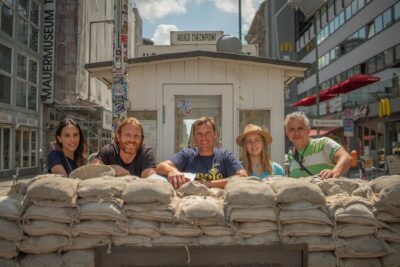
Checkpoint Charlie is mostly a symbolic site today. The guardhouse is a replica, and the original barriers are elsewhere. Its importance comes from the October 1961 tank confrontation, when American and Soviet forces faced one another after a dispute over access to East Berlin.
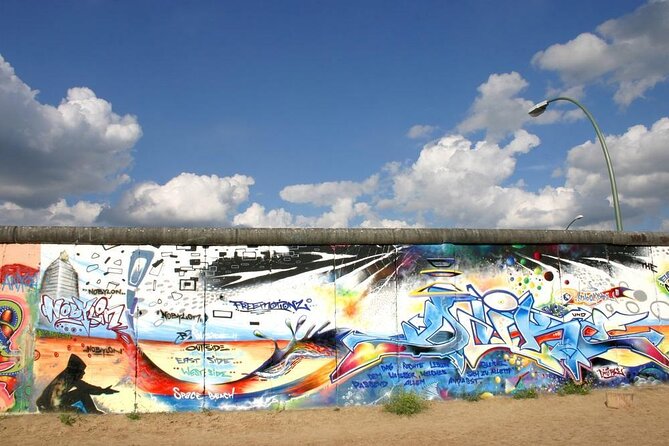
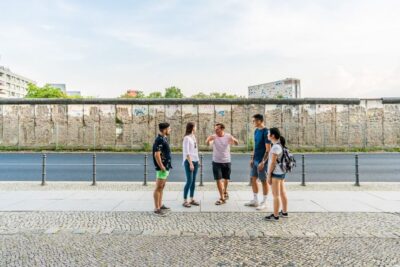
The East Side Gallery provides the largest surviving stretch of the Wall, about 1,600 meters. Murals include the famous Trabant breaking through the Wall and the Brezhnev-Honecker kiss. The paintings have been repaired several times, and weather and vandalism continue to take a toll.
You may also cross Oberbaum Bridge, a red-brick landmark linking Friedrichshain and Kreuzberg. Its towers, coats of arms, subway line, road deck, and river traffic show several layers of Berlin at once.
Kreuzberg offers a different mood. Small restaurants, old apartment buildings, alternative culture, and newer rents occupy streets once threatened by highway plans. The planned motorway would have erased much of today’s urban fabric. This is one of the places where a driving tour helps you see how political choices shaped ordinary neighborhoods.
If time allows, the route may continue along Karl-Marx-Allee, formerly Stalin-Allee. Its enormous workers’ housing blocks were meant to display socialist power. They also became the setting for the June 17, 1953 uprising, when workers protested increased targets and lower wages before Soviet tanks crushed the revolt.
What the guide adds to the ride
Gunter’s strongest quality is his command of Berlin’s many historical layers. He explains not only what a building is, but also who used it, what stood there before, and how East and West treated the site differently.
His style is energetic and talkative. You will receive a lot of information, sometimes almost continuously, so a good night’s sleep helps. His English is generally strong, though a few customers have needed him to repeat points.
The pre-tour contact is valuable. Send a short list of must-see places, places you have already visited, and any mobility needs. Gunter has adapted routes for families, taken photographs at stops, helped locate a particular souvenir, found a local restaurant, and provided an umbrella during bad weather.
Still, do not assume every requested stop will fit. The published route includes dozens of possible sights, and traffic, road closures, weather, and time spent walking can change the order. If you want more time at the Wall, the palace roof, or a museum, say so clearly and repeat the priority during the tour.
Who should book this Berlin taxi tour?
I would choose it for a first visit, a short stay, a family group, or anyone who finds long walking tours difficult. It is also useful if you want a citywide orientation before spending the next few days inside museums and memorials.
I would be more cautious if you have already seen Berlin and want detailed museum visits. The route covers a great deal, but most stops are brief and viewed from outside. A walking tour in one district, followed by independent museum time, may suit you better.
The tour offers free cancellation up to 24 hours before the start. Pickup within the S-Bahn ring is included, while BER airport and locations outside the ring cost extra. Child seats are available for toddlers and older children, and service animals are allowed.
Should you book it?
Book this tour if your priority is seeing the whole city with a personal guide, not spending hours inside one attraction. Gunter can connect Reichstag politics, Nazi crimes, the Berlin Wall, socialist architecture, royal Berlin, and modern redevelopment in one long afternoon.
Before paying, confirm the vehicle size, your pickup address, your three highest priorities, and whether any desired roof or museum entry requires a separate ticket. With those points settled, this is a practical and unusually efficient introduction to Berlin, especially for visitors who want the city’s divided past explained while comfortably moving through both East and West.
FAQ
How long does the private Berlin taxi tour last?
The tour lasts approximately four to six hours. The exact length depends on traffic, weather, walking time, and how long you spend at selected stops.
What does the price include?
The price includes private transportation, an air-conditioned vehicle, parking fees, WiFi on board, and the city tour. Taxi and guiding taxes are included.
Where is pickup included?
Pickup is included from locations within Berlin’s S-Bahn ring, roughly five kilometers around Brandenburg Gate. Pickup from BER airport or outside the ring costs extra.
Is the tour private?
Yes. Only your own group participates in the activity.
Does the tour include food?
No. Lunch is not included. Gunter may help point you toward a restaurant, but meals are your responsibility.
Can children join the tour?
Yes. A toddler seat for children from six months to three years and a booster seat for older children are available. A Maxi-Cosi baby seat can be brought on request.
Will I enter the museums and landmarks?
The tour mainly combines exterior explanations with selected short walks. Entry to museums, the zoo, and other attractions is not listed as included, so ask about any specific interior visit before booking.
Can I cancel the booking?
You can cancel for a full refund if you cancel at least 24 hours before the scheduled start time. Cancellations or changes made less than 24 hours before the start are not accepted for a refund.
Newest Berlin reviews
- Where It All Began: Berlin’s Queer & Trans History Tour★ 4.9 · 6 reviews
- Berlin: guided canoe | kayaktour★ 4.1 · 7 reviews
- Understanding Kreuzberg: The roots of local (sub)culture★ 4.9 · 11 reviews
- Private Potsdam City Tour in an authentic vintage van★ 5.0 · 14 reviews
- Warnemünde Shore Excursion: Private Sachsenhausen and Berlin Tour★ 5.0 · 12 reviews
- Ultimate E-Bike Tour of Berlin with Beer Garden Stop★ 5.0 · 4 reviews
- In the Forbidden City – Potsdam Walking Tour★ 5.0 · 17 reviews
- Private Walking Tour of Potsdam and Sanssouci★ 5.0 · 24 reviews
Berlin Cold War Tours, compared.
Berlin’s Best: 2 Hour Walking Tour Third Reich and the Cold War
Read our review →
Skip-the-Line: Berlin Wall Museum at Checkpoint Charlie
Read our review →
Cold War, Berlin Wall, Spies and the East Side Gallery
Read our review →
Listening Station Teufelsberg Tour with Transfer
Read our review →Browse the lists this tour appears in