
Reviewed · BERLIN WALL TOURS
Cold War, Berlin Wall, Spies and the East Side Gallery
Berlin’s Cold War story becomes far more powerful when you follow it on foot, from the Palace of Tears to the Wall’s former death strip and the painted blocks of the East Side Gallery. This tour links the big political story with ordinary lives, failed escapes, surveillance, and the quiet fear of crossing from East to West.
I like the route for two reasons. First, it combines famous sights with places many visitors would miss, especially Karl-Marx-Allee and Friedrichshain. Second, the guides make the past personal. Paul, Xavier, Klaus, Tina, and others are praised for clear storytelling, photos, humor, and, in some cases, firsthand memories of East Germany.
The main drawback is pace. You cover a lot of ground in three hours and use public transport between sites, so this is not a slow museum visit. You must also buy an AB public transport day pass separately, and much of the tour takes place outdoors in changing Berlin weather.
Key points at a glance
- Start at the Palace of Tears: See the former border crossing where families faced painful farewells.
- Walk Karl-Marx-Allee: Read the grand socialist boulevard as political theater in stone and tile.
- Connect 1953 with 1989: Learn how the workers’ uprising and the Wall’s fall shaped modern Berlin.
- Use Berlin’s public transport: A separate AB day pass is required between several stops.
- See two sides of the Wall: Compare preserved border areas with the colorful East Side Gallery.
- Expect strong storytelling: Guides such as Paul, Xavier, Klaus, Tina, and Nikolai are praised for personal stories and thoughtful answers.
Why this Cold War route works
Many Berlin history tours focus on one memorial or one section of the Wall. This route gives you a broader picture. You begin at a border crossing, move into the former East Berlin city center, walk through socialist Friedrichshain, and finish beside the Wall turned art gallery.
That order helps you understand Berlin as a functioning city, not just a collection of memorials. The Wall divided streets, railway lines, families, workplaces, and entire neighborhoods. The tour shows how that division looked in daily life and how the East German government tried to present its system as orderly, modern, and successful.
The subject can be heavy, especially when the guide discusses informants, escape attempts, imprisonment, and the death strip. Still, the experience is designed as a walking tour rather than a formal lecture. Guides use photographs, questions, personal stories, and occasional humor to keep the group involved.
The 4.8 rating from 254 reviews reflects a consistent strength: the quality of the guiding. Names change by departure, but past guides have included Paul, Jamie G, Maria, Xavier, Klaus, Tina, Nikolai, Jim, Eran, and others. The most praised guides explain events in a clear order, answer a steady stream of questions, and help you picture what life felt like behind the Iron Curtain.
More East Side Gallery tours in Berlin:
- Berlin: 2.5-Hour East Side Boat Cruise with Commentary
★ 4.4 · 2,016 reviews - Berlin: East Side Gallery Spree Cruise in a Solar Catamaran
★ 4.0 · 1,039 reviews - Cold War, Berlin Wall, Spies and the East Side Gallery
★ 5.0 · 1,024 reviews
Beginning at the Palace of Tears
The usual meeting point is outside Friedrichstrasse train station, on the square beside the Tränenpalast, or Palace of Tears. Look for a guide with a yellow name badge and yellow umbrella.
The building served as a border crossing for people leaving East Berlin after visiting relatives in the West. Its name comes from the tearful farewells that took place there. You spend about 20 minutes in the area, using it as an introduction to the practical cruelty of the border.
This is a strong starting point because it puts human emotion before military hardware and political dates. The Cold War was not only about presidents, missiles, and competing ideologies. It also meant a short visit could end with a family being separated at a checkpoint.
The meeting point is easy to reach, but give yourself time to find the correct side of the station. The tour may also be available with optional pickup from your accommodation. If you choose that option, you are asked to wait in the hotel lobby five minutes before the start.
Alexanderplatz and the public face of East Berlin
After a short train ride of about five minutes, the group reaches Alexanderplatz. You spend around 20 minutes here, looking at the square and the surrounding GDR-era architecture.
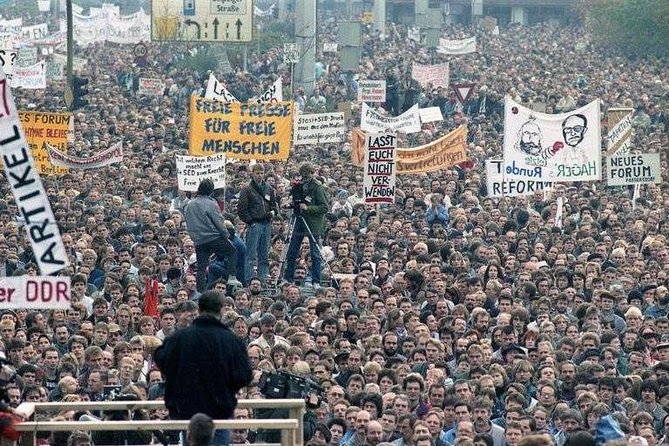
Alexanderplatz was one of East Berlin’s main public spaces. It was built to project the confidence of the socialist state, yet it also became a place where dissatisfaction could be seen and heard. The guide explains how the square fit into daily life and how public demonstrations later challenged the government.
The value of this stop is the contrast between appearance and reality. Wide open spaces and monumental buildings can suggest order and strength, but they do not tell you how people felt inside the system. Listen for the details about surveillance, official messages, and the gap between government propaganda and ordinary experience.
If you already know Alexanderplatz as a shopping and transport hub, the tour gives it a second identity. You begin to see the architecture as evidence of a political project, not simply as an urban backdrop.
Karl-Marx-Allee and socialist grandeur
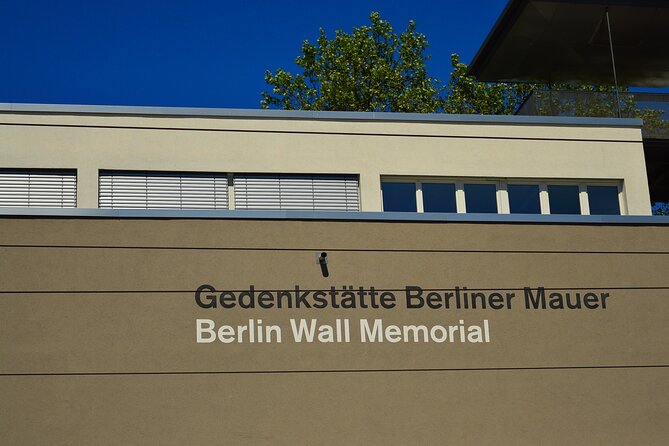
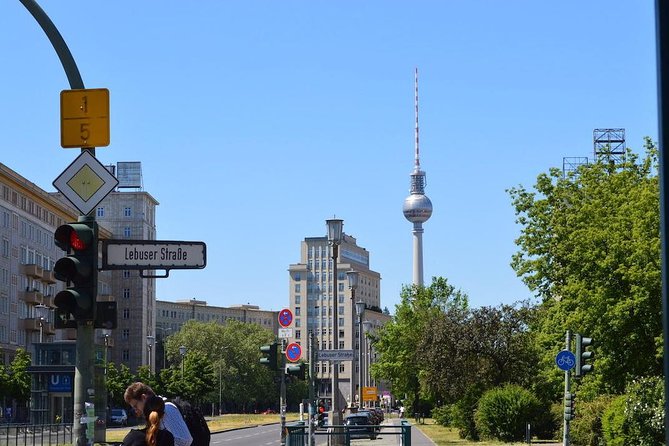
The walk along Karl-Marx-Allee is one of the most distinctive parts of the tour. You spend about 20 minutes examining this immense boulevard, which was designed as a showcase of socialist power.
The scale is the point. Monumental apartment blocks, broad sightlines, and decorative details were meant to tell East German citizens and foreign visitors that the new state could build a modern society. The boulevard was not just housing. It was a carefully planned message.
Your guide connects the architecture with the 1953 workers’ uprising. Construction workers in East Berlin protested against increased work demands, and the unrest grew into a wider challenge to the communist government. Soviet forces helped suppress the uprising, but the event exposed the weakness beneath the official image of unity.
This section rewards people who enjoy architecture, because the buildings help explain politics without requiring a museum label at every step. It also adds needed balance to a tour that could otherwise focus only on the Wall. You see how the East German state tried to win support through grand design, while also relying on control and fear.
The boulevard is outdoors and exposed. Comfortable shoes matter, and weather-appropriate clothing is not optional in Berlin. The tour continues in rain, so pack a waterproof layer rather than hoping for perfect skies.
More Berlin Wall tours in Berlin:
- Skip-the-Line: Berlin Wall Museum at Checkpoint Charlie
★ 4.1 · 2,041 reviews - THE WALL: asisi Panorama Berlin Ticket
★ 4.5 · 580 reviews - Berlin: Guided Bike Tour of the Berlin Wall and Third Reich
★ 4.7 · 499 reviews - Berlin: Cold War Walking Tour on Berlin Wall Route
★ 4.8 · 437 reviews
Friedrichshain and the Wall’s former border zone
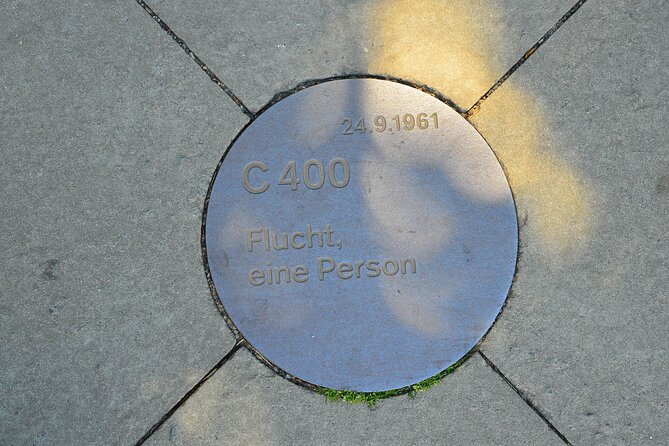
After another short train journey, of about six minutes, the group reaches Friedrichshain. The guide spends about 20 minutes connecting the neighborhood with the Wall, escape attempts, and life in divided Berlin.
This is where the tour’s spy and escape stories become especially useful. You hear about people who tried to flee through tunnels, across rooftops, and through dangerous border areas. The stories show how much planning and courage an escape required, and how heavily the state watched its own citizens.
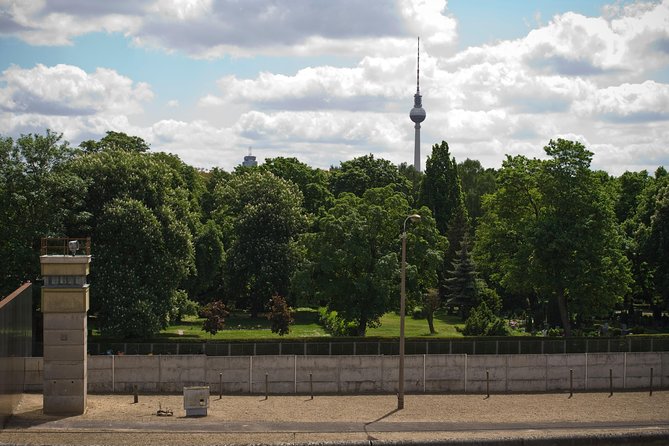
The former death strip is not an intact stretch of wilderness or a single dramatic wall. Much of Berlin has changed. Roads, apartments, railway lines, and new buildings now occupy areas once controlled by guards. A good guide helps you read what remains and understand what has disappeared.
You may hear about the Stasi, East Germany’s secret police, and the network of informants used to monitor people. The important point is not simply that surveillance existed. It is how surveillance affected trust. Friends, neighbors, colleagues, and even family members could become sources of information.
This part can be emotionally demanding, but it gives the tour its human scale. You are not only looking at concrete. You are considering the choices people made when staying meant accepting restrictions and leaving could mean prison, injury, or death.
Seeing the Berlin Wall beyond the postcards
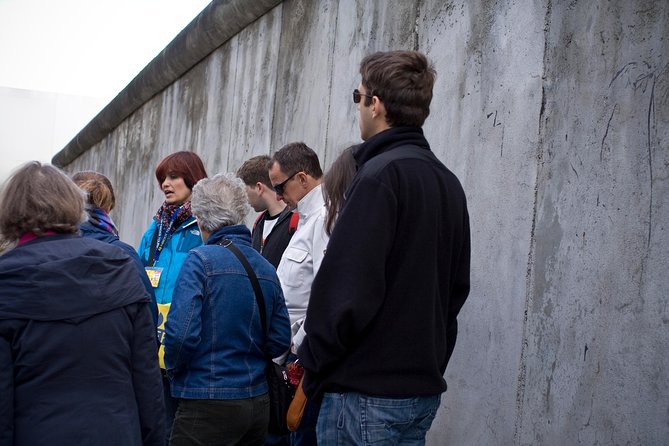
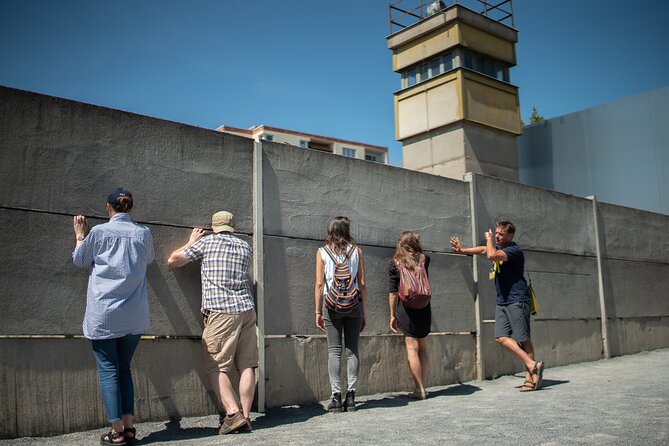
The Wall section lasts about 16 minutes, though the guide may spend more or less time depending on the group and conditions. You see surviving sections and learn how the border system worked, including the space between barriers that became known as the death strip.
A short surviving wall fragment can be misleading. It is easy to look at a concrete panel and imagine that the Wall was one simple barrier. In fact, the border was a system of walls, fences, watchtowers, patrol roads, lights, and controlled spaces. The tour helps you picture that wider zone.
This is also the point where the stories of escape take on physical meaning. A tunnel, rooftop, or stretch of open ground might sound abstract in a classroom. On the street, you can better understand the distances, sightlines, and obstacles involved.
The tour does not treat the Wall as a relic from a distant age. Its effects shaped families and neighborhoods for decades, and the decisions made during the Cold War still influence how Berlin remembers the 20th century.
Finishing at the East Side Gallery
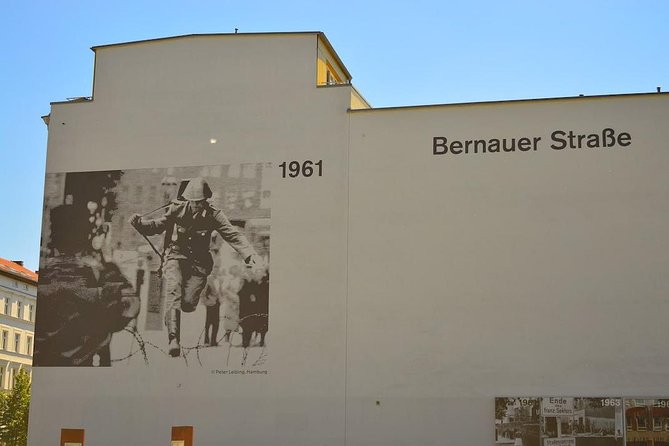
The final major stop is the East Side Gallery, where you walk along a long preserved section of the Berlin Wall covered in murals. You spend roughly 20 minutes here.
The gallery shows how Berlin turned a symbol of repression into a public art project. The paintings are colorful and often playful, but the concrete beneath them still carries the weight of the border. That tension is what makes the stop work.
The East Side Gallery is also more crowded and visually busy than some of the earlier sites. You may find it harder to hear if the group is large or if nearby activity is loud. Guides who use microphones or tablets with historic photographs can make a difference. One past group specifically found a microphone useful when numbers grew.
Do not expect a long art-focused visit. The guide uses the murals as part of the wider political story, then the tour ends with drop-off options toward Bernauer Straße. If you want time for photographs or a close look at individual paintings, you may prefer to return later on your own.
The pace, transport, and group experience
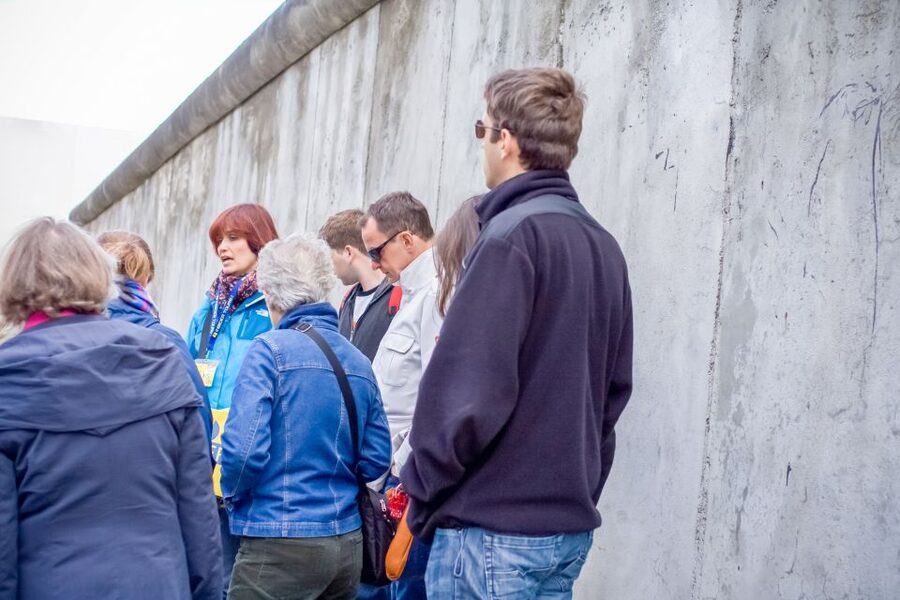
This is a three-hour tour, but it is not three hours of continuous walking. You use Berlin’s trains between several locations, and an AB day pass is required. The ticket is not included, though on-site staff can help you buy one on the day.
That transport is both useful and realistic. Berlin’s Cold War sites are spread across the city, and using the train lets you connect places that would be tiring to reach on foot. It also gives you a brief look at how Berlin functions today, as a reunited city whose old divisions remain visible in fragments.
The exact group size depends on the selected option. Private and small-group departures are available. A smaller group is helpful if you want to ask questions about escape stories, architecture, or the Stasi without holding up a large crowd.
The route is listed as wheelchair accessible, but you should still check the precise departure option if you have mobility needs. You will be outside, walking between stops, entering transport stations, and changing locations several times.
The guides make or break the experience
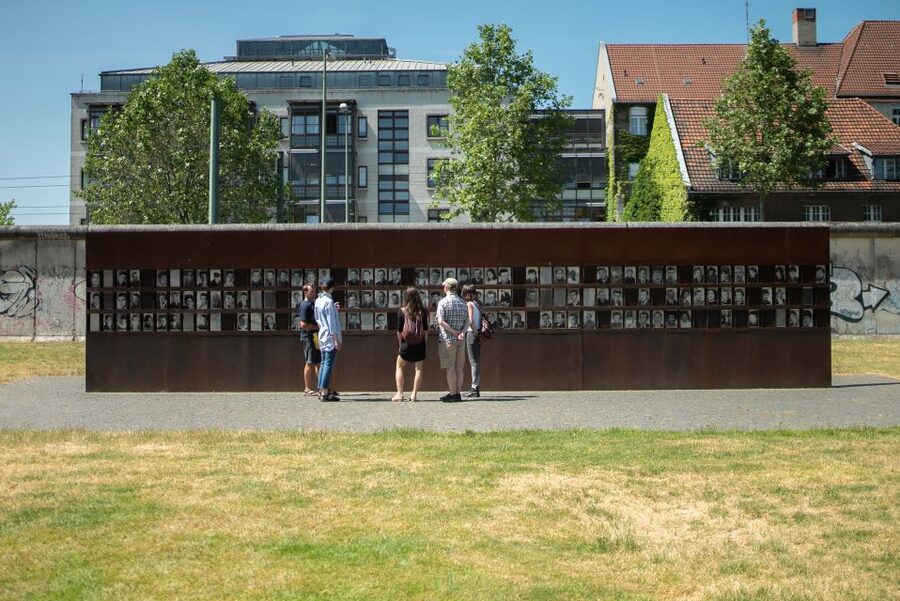
The strongest part of this tour is the guide’s delivery. You need someone who can explain a complicated chain of events without burying you in dates, and the guide names associated with the tour suggest a broad team with different strengths.
Paul is praised for turning unfamiliar material into a clear story. Xavier is noted for answering questions, checking on the group, and using humor without losing sight of the subject. Klaus is praised for personal insight, while Nikolai is associated with firsthand memories of growing up in communist East Germany.
Other guides, including Jim, Tina, Maria, Eran, Jamie G, and Jasper, are described as engaging and well prepared. One guide used an iPad with photographs to show how places looked before and after reunification. That is a useful tool in a city where modern buildings often cover the old border line.
Because the guide assigned to your departure can vary, I would book this for the route and subject first, not for one particular person. Still, the repeated praise for storytelling is a strong sign that the company takes the guiding seriously.
Is $18 a good value?
At $18 per person, the tour is priced well for three hours with a live guide and several locations across Berlin. You are paying for interpretation and planning, not admission to a major indoor attraction. The separate AB day pass adds to the total cost, but that pass also covers your transport between the stops.
The value is strongest if you are new to Berlin’s Cold War story. A guide gives you context that plaques and surviving wall fragments cannot provide. You also avoid spending time working out how the different sites connect.
If you already know the subject in detail, you may find parts familiar. One past participant wanted more emphasis on war and high-level politics and less attention to the Wall itself. That is a fair warning. This experience focuses on divided Berlin, border life, escape attempts, surveillance, and reunification rather than offering a full military history of the Cold War.
Who should book this Berlin tour?
I would choose this tour if you want a clear introduction to East Berlin and the Berlin Wall, especially if you prefer stories about people and places over a museum-heavy day. It suits first-time visitors, families with older children, history students, and anyone who wants to understand why Berlin looks the way it does.
It also works well after a general city tour. You will recognize Alexanderplatz and the central streets, then see them through the lens of division and socialism.
You should think twice if you dislike walking, public transport, outdoor tours, or emotionally serious subjects. The route is active, weather continues regardless of forecasts, and the amount of ground covered means some stops are brief.
Canceling is free up to 24 hours before the start, and you can reserve now and pay later. Those terms help if your Berlin plans are still shifting, but the more important choice is practical: wear good shoes, bring a camera, carry your AB ticket, and arrive ready to listen.
Should you book it?
Book this tour if you want Berlin’s Cold War story explained in the places where it happened. The combination of the Palace of Tears, Alexanderplatz, Karl-Marx-Allee, Friedrichshain, the former death strip, and East Side Gallery gives you a useful three-hour overview without requiring a full day.
I would not book it expecting a quiet museum experience or a detailed survey of every Cold War crisis. Book it for personal stories, escape attempts, socialist architecture, and a guide who can make the city’s invisible border easier to see. At $18, that is a strong deal, provided you are comfortable with the pace and the extra public transport cost.
FAQ
Where does the tour begin?
The usual meeting point is outside Friedrichstrasse train station, on the square beside the Palace of Tears. Look for the guide wearing a yellow name badge and holding a yellow umbrella.
How long does the tour last?
The tour lasts three hours. Check the available departure times when booking.
Is public transportation included?
No. You need an AB public transport day pass to travel between the sites. Staff can help you purchase it on the day.
Which languages are available?
The tour is available in English and German.
Is the tour wheelchair accessible?
The activity is listed as wheelchair accessible. Check the exact departure option if you need specific mobility arrangements.
What should I bring?
Wear comfortable shoes and weather-appropriate clothing, and bring a camera. The tour operates in all weather conditions.
More museums and galleries in Berlin
- Berlin: Natural History Museum Entrance Ticket
★ 4.6 · 3,382 reviews - Berlin: Museum Island Multiple Museum Entry Ticket
★ 4.4 · 2,007 reviews - Berlin: Interactive DeJa Vu Museum Entrance Ticket
★ 4.1 · 1,338 reviews - Berlin: “Pergamonmuseum. The Panorama” Exhibition Tickets
★ 4.6 · 1,245 reviews
More Cold War tours in Berlin
- Berlin: Third Reich and Cold War 2 Hour Walking Tour
★ 4.9 · 6,830 reviews - Berlin’s Best: 2 Hour Walking Tour Third Reich and the Cold War
★ 5.0 · 5,486 reviews - Berlin: Cold War Era History Guided Bike Tour
★ 4.8 · 413 reviews - East Berlin and the Wall: Walking Tour
★ 4.9 · 407 reviews
Newest Berlin reviews
- Where It All Began: Berlin’s Queer & Trans History Tour★ 4.9 · 6 reviews
- Understanding Kreuzberg: The roots of local (sub)culture★ 4.9 · 11 reviews
- Berlin: guided canoe | kayaktour★ 4.1 · 7 reviews
- Private Potsdam City Tour in an authentic vintage van★ 5.0 · 14 reviews
- Warnemünde Shore Excursion: Private Sachsenhausen and Berlin Tour★ 5.0 · 12 reviews
- Ultimate E-Bike Tour of Berlin with Beer Garden Stop★ 5.0 · 4 reviews
- Potsdam Highlights – Private sightseeing tour by minibus★ 5.0 · 3 reviews
- In the Forbidden City – Potsdam Walking Tour★ 5.0 · 17 reviews
Berlin Wall Tours, compared.
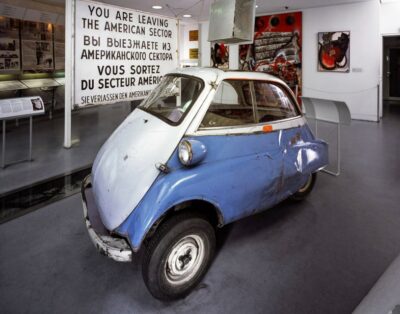
Skip-the-Line: Berlin Wall Museum at Checkpoint Charlie
Read our review →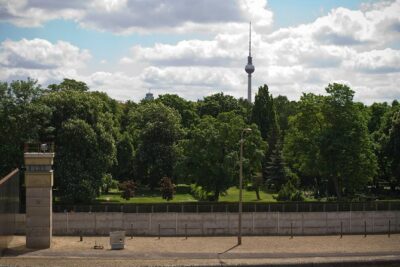
Cold War, Berlin Wall, Spies and the East Side Gallery
Read our review →
Guided Bike Tour of the Berlin Wall and Third Reich
Read our review →
Browse the lists this tour appears in