
Reviewed · BERLIN WALL TOURS
Explore The Berlin Wall: Cold War Berlin and Behind the Berlin Wall
Berlin’s Wall is easy to misunderstand if you only visit a few famous slabs of concrete. This three-hour tour connects the surviving pieces into a story of escape, control, and sudden political change, moving from the Berlin Wall Memorial to Checkpoint Charlie, an old watchtower, and the rebuilt Potsdamer Platz.
I like two things right away. First, the guide brings you to places you might miss on your own, including the preserved Wall cross-section and the last surviving BT-style watchtower. Second, guides such as Ciaran, Eugen, Paul, Steve, and Aurel explain the human side with escape stories, old photographs, and clear answers to questions.
The main drawback is simple: you will walk quite a bit, and the tour can involve the U-Bahn or tram. In cold, wet weather, that matters. The itinerary also moves quickly, so anyone wanting long museum visits should plan separate time afterward.
Key points to know before you book
- The Berlin Wall Memorial gets the most time: You spend about 80 minutes at the best-preserved section, including a full Wall and death-strip cross-section.
- The tour links several parts of Berlin: Checkpoint Charlie, Niederkirchnerstrasse, a watchtower, and Potsdamer Platz show how the border changed over time.
- Guides make the difference: Ciaran, Eugen, Paul, Steve, and Aurel are praised for clear explanations, personal warmth, and handling detailed questions.
- You get more than a standard photo stop: The focus is on escape attempts, life in East and West Berlin, and the Cold War forces behind the Wall.
- Expect a small group: The stated maximum is listed as both 15 and 21 people, so confirm the current group size when booking.
- At $32.67, the value is strong: You pay for a focused three-hour history lesson with an expert guide, while the main sites themselves do not charge admission.
Why this tour works better than chasing Wall fragments alone
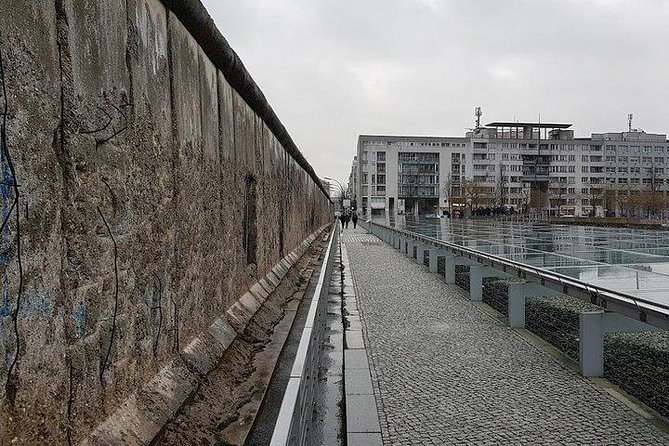
Berlin’s Wall did not survive as one continuous monument. Pieces remain in different parts of the city, and some are easy to overlook beside modern buildings, roads, and office blocks. This tour solves that problem by giving you a route and a connecting story.
That connection is the real value. At the memorial, you see the physical structure of the border. At Checkpoint Charlie, you hear about the confrontation between American and Soviet forces in 1961. At Potsdamer Platz, you see how a once-empty border zone became a major business and entertainment district after reunification.
The guide’s role is not just to point at concrete. Ciaran is praised for bringing old photographs, including images connected with his family’s visits to the Wall in the early 1980s. That kind of before-and-after comparison helps you understand how much Berlin changed, rather than simply hearing that the Wall fell.
Steve is described as a public historian who explains the complicated relationship between East and West Berlin in plain language. Paul is praised for making the Cold War easier to follow. Eugen is noted for detailed answers and a friendly manner. Aurel brings a personal connection to the subject and explains the politics and conditions of the period.
The guide assigned to your departure may vary, but the consistent strength is the human explanation. You can ask about escape attempts, transport, politics, daily life, and the Cold War beyond the exact stops listed on the route.
More Berlin Wall tours in Berlin:
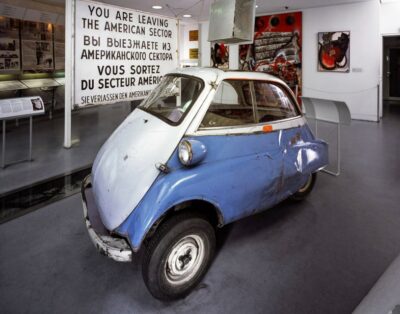
- Skip-the-Line: Berlin Wall Museum at Checkpoint Charlie
★ 4.1 · 2,041 reviews - Cold War, Berlin Wall, Spies and the East Side Gallery
★ 5.0 · 1,024 reviews - THE WALL: asisi Panorama Berlin Ticket
★ 4.5 · 580 reviews
Starting at the Berlin Wall Memorial
The tour begins at Birchys Berlin Tours on Ebertstraße 24 at 10:00 a.m. From there, the first major stop is the Berlin Wall Memorial, where you spend about one hour and 20 minutes.
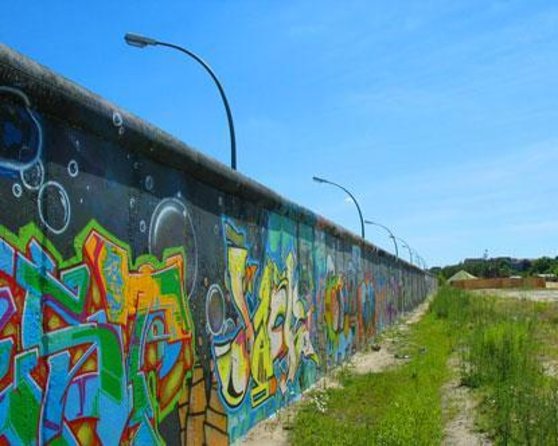
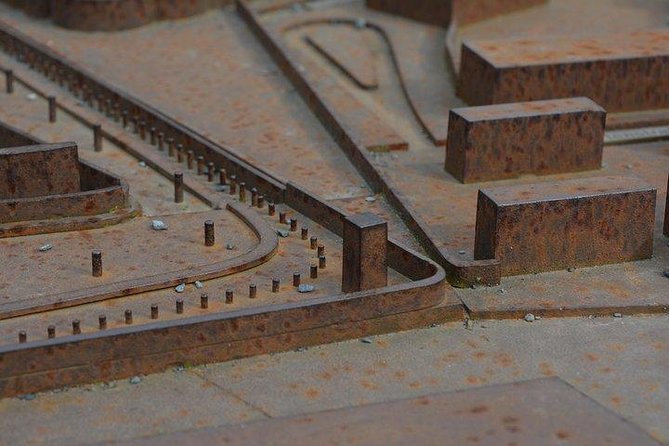
This is the most important stop for understanding how the border actually worked. The memorial stretches for more than a kilometer and includes the only preserved complete cross-section of the Wall and death strip. You can see that the barrier was not simply one wall dividing a street. It was a controlled border zone built to prevent East Berliners from reaching the West.
That physical evidence gives the tour weight. Photographs and stories can tell you that escape was dangerous, but the preserved section helps you picture the fences, open space, watch positions, and barriers that made a crossing so difficult.
This is also where the tour deals most directly with personal loss. The memorial marks the site of tragic deaths as well as daring escapes. Your guide can place individual events within the larger political story, which keeps the visit from becoming a collection of disconnected facts.
You should expect an outdoor visit rather than a quiet indoor museum experience. Wear shoes suitable for walking and bring protection from the weather. The tour does not include snacks or bottled water, so carry your own, especially if you want something during the three-hour outing.
The long stop here is a good choice. The Wall Memorial is the place where you need time to look, listen, and ask questions. If you have already read about the Wall, you will have room to test your understanding. If the subject is new to you, this section gives you the basic framework for the rest of the morning.
Checkpoint Charlie and the tense border between superpowers
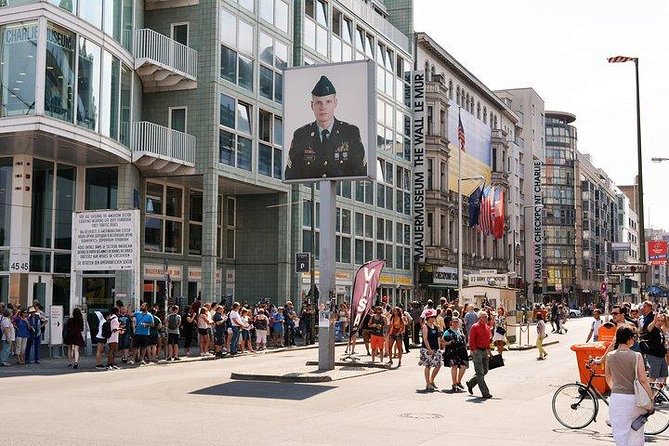
The next stop is Checkpoint Charlie, with about 15 minutes set aside. It is the most famous crossing point in Berlin, and also one of the city’s most visited photo stops.
The value here is not only the checkpoint sign or the familiar name. In autumn 1961, American and Soviet forces faced one another at this location. That confrontation showed how a dispute over Berlin could become a direct crisis between the two major Cold War powers.
Your guide also covers failed and successful escape attempts connected with the checkpoint. The short stop means you will not spend a long time examining the area, so listen closely and use the guide’s explanation to understand what the site represented.
Checkpoint Charlie can feel more commercial and crowded than the Wall Memorial. That is an important contrast, not a reason to skip it. The site shows how a place of serious political danger can become a busy modern city stop. The guide helps separate the historical importance from the present-day surroundings.
If you want extensive time for photos or nearby displays, plan to return on your own. During this tour, the point is to place Checkpoint Charlie within the wider Cold War story, not to make it the entire morning.
Niederkirchnerstrasse and the Topography of Terror
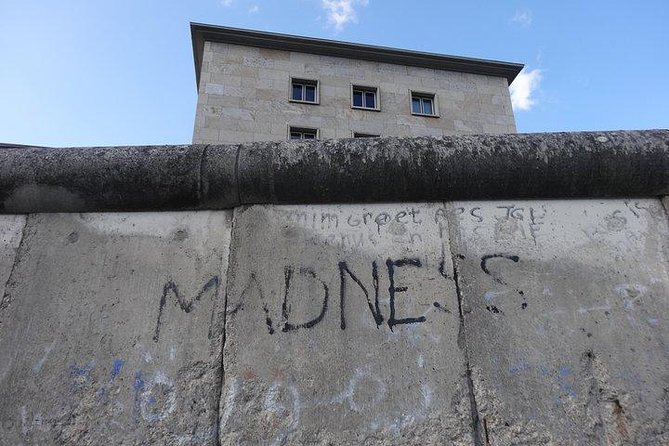
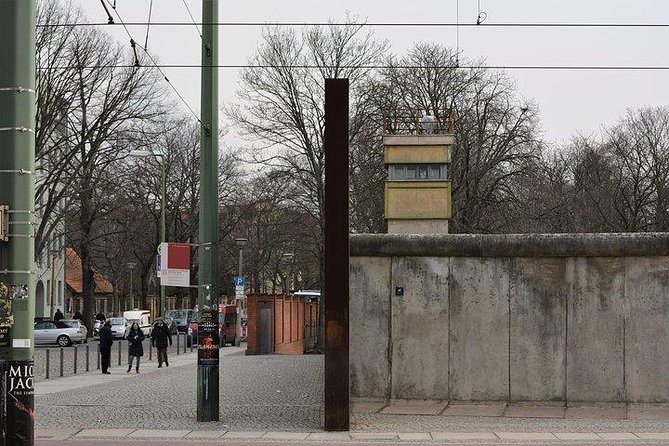
The tour then visits the Topography of Terror area for about 10 minutes. The remaining Wall section on Niederkirchnerstrasse is the only surviving fragment in this part of Berlin.
This stop adds another layer to the city’s history. The Wall stands beside the former Luftwaffe headquarters, a building later used by East Germany as the House of Ministries. You are looking at a place where different periods of German history sit close together, from Nazi rule to the divided city and then reunification.
The stop is brief, but the setting makes it useful. You see how the Wall was inserted into an existing city rather than built in an empty field. Modern Berlin has grown around these traces, and your guide helps you read what remains.
The area is also connected with one of the more remarkable escapes into West Berlin. That story gives the concrete section a human focus. You are not just looking at a surviving piece of barrier. You are standing near a place where people took enormous risks to cross it.
Because the visit lasts only about 10 minutes, do not expect a full visit to the Topography of Terror documentation center. If you want to study the exhibits there, return separately. The tour’s purpose at this stop is to connect the Wall with the older political structures surrounding it.
More Cold War tours in Berlin:
- Berlin: Third Reich and Cold War 2 Hour Walking Tour
★ 4.9 · 6,830 reviews - Berlin’s Best: 2 Hour Walking Tour Third Reich and the Cold War
★ 5.0 · 5,486 reviews - Berlin: Cold War Walking Tour on Berlin Wall Route
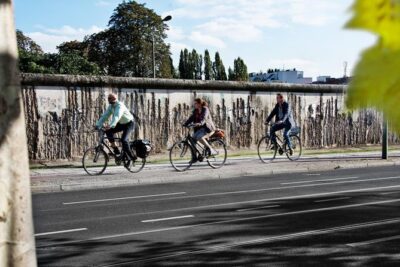
★ 4.8 · 437 reviews - Berlin: Cold War Era History Guided Bike Tour
★ 4.8 · 413 reviews
The rare surviving GDR watchtower
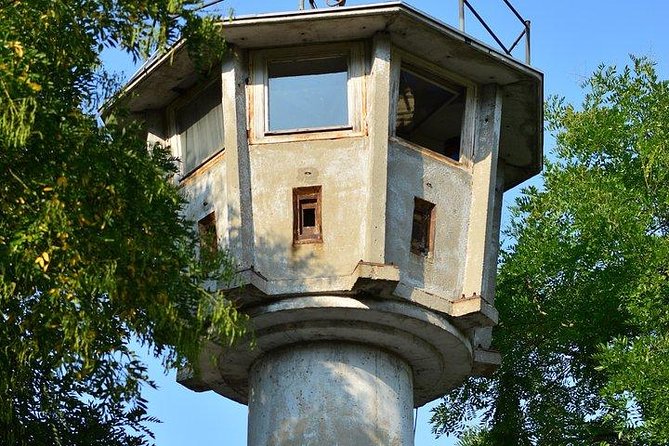
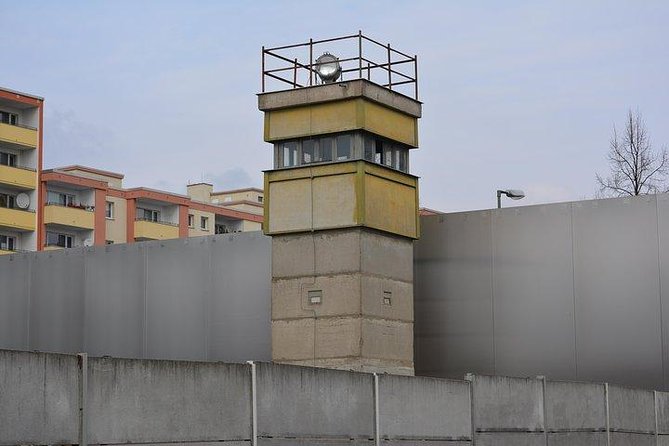
The next stop is a GDR watchtower, with about 15 minutes scheduled. It is described as the last surviving BT-variant watchtower that once surrounded West Berlin, preserved through private initiative.
This is one of the more unusual parts of the route. Wall fragments are common enough in Berlin that you may see them without understanding the complete border system. A watchtower helps explain the surveillance and control that surrounded the barrier.
You may be able to ascend the tower, though that possibility is not guaranteed. If access is open, the climb gives the structure extra impact. Even without entering, seeing a full watchtower is different from viewing a short section of wall beside a pavement.
The stop is compact, so your guide’s explanation matters. Ask questions if you want to understand how this type of tower fit into the border. The tour is especially good for people who want more than the familiar image of a painted Wall segment.
Potsdamer Platz and the city after reunification
The final listed stop is Potsdamer Platz, where you spend about 10 minutes. This area once formed part of, and bordered, the death strip. Today it is a high-rise business and entertainment quarter.
The contrast is striking. Instead of a controlled border zone, you see modern buildings, offices, and public spaces. The point is not that Berlin forgot its past. It is that reunified Berlin rebuilt a central part of the city that had been left divided and largely empty.
This is a useful closing scene because it shows change rather than ending with a barrier. The Wall Memorial explains division. Potsdamer Platz shows the physical and commercial rebirth that followed reunification.
Again, the stop is short. Use it as a final perspective rather than expecting a full architectural tour. You will have time to take in the contrast, hear the guide’s explanation, and then return to the meeting point.
What the guide adds to the experience
The tour’s strongest feature is the guide, and the named guides bring different strengths. Ciaran is praised for energy, detailed answers, and making the subject appealing to families and teenagers. His use of old photographs is especially helpful because Berlin’s present-day streets can look nothing like the divided city shown in those images.
Eugen is noted for precise explanations, patience, and a friendly manner. He also takes groups around the city by subway and tram, showing Wall-related places that are not obvious from a standard walking route.
Paul is praised for making Berlin’s complicated history easier to follow. His approach suits you if you want the Cold War explained without getting lost in names, dates, and competing political positions.
Steve brings a public historian’s approach, linking the Wall to the wider Cold War and explaining the differences between East and West Berlin. Aurel is praised for combining strong subject knowledge with a personal connection to the period.
You cannot choose your guide from the information provided, but the praise is consistent on three points: clear delivery, strong command of the subject, and patience with questions. That matters because the Wall’s story is not simple. A good guide keeps the tour moving while still explaining why each stop matters.
Walking, public transport, and group size
Although the tour lasts about three hours, it is not three hours of standing in one place. You will walk between sites, and past groups have used different forms of public transport during the route. The exact transport mix may depend on the guide and the day.
Wear comfortable shoes. If you have limited mobility, ask before booking, since the tour covers several outdoor locations and includes walking between stops. Most people can take part, and service animals are allowed.
The group is intended to be small. The supplied details list a maximum of 15 people in one place and 21 in another, so there is a discrepancy worth checking at booking. Even the larger figure is manageable for a guided city tour, but a smaller group will make it easier to hear the guide and ask questions.
One past outing had only three people, allowing the guide to spend as much time as the group wanted at each stop. You should not count on a private-feeling tour every day, but the stated limits suggest a more personal format than a large bus excursion.
The meeting point is central, and the experience ends back there. You receive confirmation when you book and can show either a paper or electronic voucher.
Is $32.67 a fair price?
At $32.67 per person, this is a strong value if you want a guided introduction to Cold War Berlin. The main locations listed here do not require an admission fee, and the watchtower admission is included. So you are paying mainly for the guide’s time, route planning, interpretation, and the convenience of linking distant Wall sites in one morning.
That is better value than paying for a guide who only points out the obvious remains. The route covers the memorial, a major checkpoint, a Wall fragment beside important government buildings, a watchtower, and a rebuilt city center. It also includes the stories that make those places meaningful.
The price is less compelling if you prefer to explore slowly, read every museum panel, or spend a long time at one site. Several stops last only 10 or 15 minutes. You are buying a connected overview, not a series of full museum visits.
I would use this tour as a foundation. It gives you the structure and vocabulary to return to the Berlin Wall Memorial or Topography of Terror on your own later.
Who should book this Berlin Wall tour?
This is a particularly good choice if you are interested in World War II’s aftermath, the Cold War, political borders, or the daily reality of divided Berlin. It also suits families with older children and teenagers because escape stories and old photographs make the subject easier to picture.
You do not need a background in German history. The guides explain the main ideas clearly, and you can ask questions as you go. If you already know the basics, you will still find value in the lesser-known escape sites, the watchtower, and the guide’s ability to connect separate events.
It may not suit you if you dislike walking, want a fully indoor activity, or prefer to spend your morning inside museums. The route is outdoors and moves at a steady pace.
The experience is offered in English. It is booked, on average, well ahead of the date, so popular travel periods may require planning. Free cancellation is available up to 24 hours before the start time. If the minimum number is not reached, the operator offers another date or experience, or a full refund.
Should you book it?
Book this tour if you want Berlin’s Wall explained as a living political border, not just a line of painted concrete. The Berlin Wall Memorial is the anchor, while Checkpoint Charlie, the watchtower, and Potsdamer Platz add the missing pieces.
I would especially recommend it early in your Berlin visit. The route helps you understand the city, and you can return later to the sites that deserve more time. At $32.67, with a three-hour route and expert English-speaking guides, it offers a useful mix of history, local movement, and practical orientation.
Skip it only if you want a slow museum morning or if extensive walking would make the day difficult. For history buffs, curious families, and anyone trying to make sense of Berlin’s divided past, this is an easy tour to justify.
FAQ
How long does the Berlin Wall tour last?
The tour lasts approximately three hours.
Where does the tour start?
It starts at Birchys Berlin Tours, Ebertstraße 24, 10117 Berlin, Germany, at 10:00 a.m.
Where does the tour end?
The activity ends back at the meeting point.
What language is the tour offered in?
The tour is offered in English.
What places are included?
The route includes the Berlin Wall Memorial, Checkpoint Charlie, the Topography of Terror area, a GDR watchtower, and Potsdamer Platz.
Is admission included?
Admission to the GDR watchtower is included. The other listed stops have no admission ticket charge as part of the itinerary.
Can I cancel for a full refund?
Yes. You can cancel at least 24 hours before the local start time for a full refund. Changes or cancellations made less than 24 hours before the start time are not accepted or refunded.
Newest Berlin reviews
- Where It All Began: Berlin’s Queer & Trans History Tour★ 4.9 · 6 reviews
- Understanding Kreuzberg: The roots of local (sub)culture★ 4.9 · 11 reviews
- Berlin: guided canoe | kayaktour★ 4.1 · 7 reviews
- Private Potsdam City Tour in an authentic vintage van★ 5.0 · 14 reviews
- Warnemünde Shore Excursion: Private Sachsenhausen and Berlin Tour★ 5.0 · 12 reviews
- Ultimate E-Bike Tour of Berlin with Beer Garden Stop★ 5.0 · 4 reviews
- In the Forbidden City – Potsdam Walking Tour★ 5.0 · 17 reviews
- Private Walking Tour of Potsdam and Sanssouci★ 5.0 · 24 reviews
Berlin Wall Tours, compared.
Skip-the-Line: Berlin Wall Museum at Checkpoint Charlie
Read our review →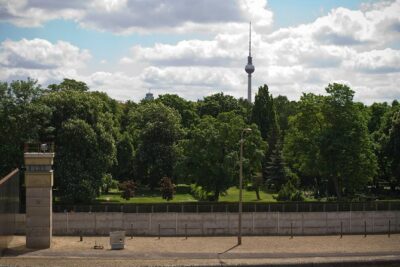
Cold War, Berlin Wall, Spies and the East Side Gallery
Read our review →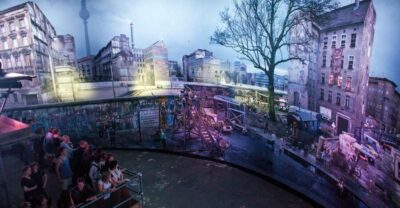
Guided Bike Tour of the Berlin Wall and Third Reich
Read our review →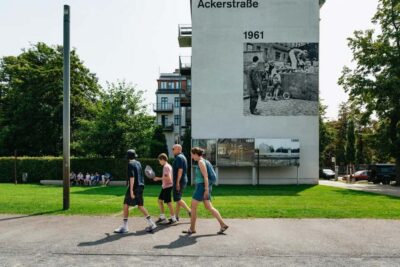
Browse the lists this tour appears in