
Reviewed · BERLIN WALL TOURS
Berlin Wall: City Tour of Divided Germany
Berlin’s Cold War story becomes clearest when you follow the old border on foot. This two-hour tour links Friedrichstraße station, the Brandenburg Gate, Potsdamer Platz, and Checkpoint Charlie, showing how a political split cut through streets, neighborhoods, and ordinary routines.
I like the route’s strong sense of place and its focus on daily life, not just famous dates. I also like the small-group feel reported on some outings, plus the personal stories associated with guides Stephan and Stefan. The main consideration is language: the tour is offered in German only, and the subject can feel briskly packed into two hours.
Key points to know
- Start at the Palace of Tears: Meet outside Tränenpalast at Friedrichstraße station, on Reichstagufer.
- Follow the former border: The route connects the station, parliament district, Brandenburg Gate, Potsdamer Platz, and Checkpoint Charlie.
- See where the Wall cut through daily life: The tour explains the border’s effect on travel, work, neighborhoods, and families.
- Visit major Cold War landmarks: Stops include the former death strip, the Holocaust memorial, the Tiergarten Triangle, and the longest remaining stretch of the Wall.
- German-language guiding only: Personal accounts and detailed explanations are central to the experience.
- Good value at $21: You get a focused two-hour city tour, with free cancellation up to 24 hours before departure and a reserve-now, pay-later option.
Why this Berlin Wall route works
Many Berlin history walks begin with a famous monument and then scatter into disconnected facts. This one has a clear thread: you start at a former border crossing and follow the line of division through the center of the city.
That shape matters. Berlin’s Wall did not sit in a distant museum. It ran beside train stations, government buildings, public squares, memorials, and major roads. As you move from stop to stop, the Wall’s effect becomes easier to grasp. The tour is less about staring at a few surviving concrete panels and more about reading the city around them.
I find that approach useful for first-time visitors who know the basic story but want to understand how the split worked in practice. You get landmarks, but you also get the human scale: who could cross, who could not, where people changed trains, and how the border affected the rhythm of the city.
The $21 price is reasonable for a two-hour guided route through central Berlin. A guide can point out former border lines that are easy to miss, explain why a modern building occupies a particular site, and connect several locations that you might otherwise visit as separate sights.
More Berlin Wall tours in Berlin:
- Skip-the-Line: Berlin Wall Museum at Checkpoint Charlie
★ 4.1 · 2,041 reviews - Cold War, Berlin Wall, Spies and the East Side Gallery
★ 5.0 · 1,024 reviews - THE WALL: asisi Panorama Berlin Ticket
★ 4.5 · 580 reviews
Beginning at Friedrichstraße and the Palace of Tears
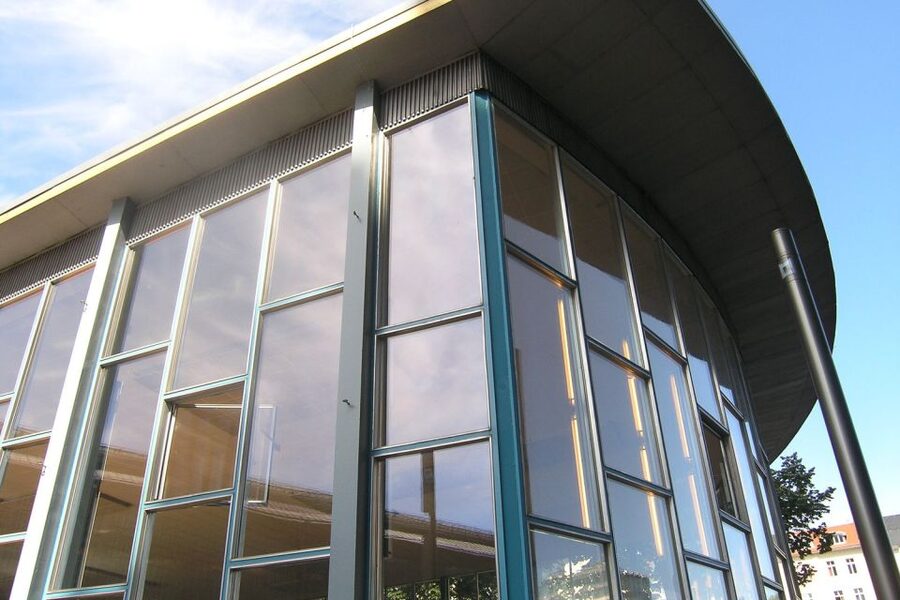
The meeting point is the entrance to Tränenpalast, known in English as the Palace of Tears, in front of Friedrichstraße station on Reichstagufer. The building has only one entrance, so you do not need to search for a side door or wander around the station complex looking for the group.
This is a smart place to begin. Friedrichstraße was the single border station during the Cold War, making it a place where the division was felt in a very direct way. The station was part of everyday transport, yet crossing through it could mean a tense encounter with border controls, paperwork, and farewells.
The name Palace of Tears comes from the goodbyes associated with the border crossing. That gives the opening stop an emotional weight before the walk even reaches the Wall itself. You are not beginning with an abstract political lecture. You are starting at a place connected to people leaving one side of the city and returning to the other.
Arrive ready to walk and wear comfortable shoes. The route covers several central locations, and the most useful parts often happen outdoors, where the former border line is visible in relation to today’s streets.
Along the Spree toward the government district
From Friedrichstraße, the route follows the Spree toward Berlin’s parliament and government district. This section helps explain a point that is easy to miss in a standard sightseeing tour: the border did not stop at the edge of the historic center. It ran partly along an area that now contains important government buildings.
The contrast is sharp. Today, this part of Berlin presents a unified national capital. During the Cold War, the city was split between two hostile political systems, and the border could pass close to major civic spaces. The tour uses that contrast to show how much the city’s meaning has changed since reunification.
I like this portion because it gives the Wall a wider setting. You are not only looking for fragments of concrete. You are seeing how the frontier shaped the location and use of public buildings, streets, and open ground.
The route also gives you a chance to connect Berlin’s political present with its divided past. If you are mainly interested in architecture, you may find this section less dramatic than Checkpoint Charlie or the Brandenburg Gate. Its value is in the explanation, not in a single spectacular object.
The Brandenburg Gate at the former border
The Brandenburg Gate is one of Berlin’s most recognizable sights, but its Cold War meaning is more important than its postcard value here. The former border ran at the gate, making it a powerful symbol of the city’s separation and later reunification.
A guide can help you see the gate in two time periods at once. In photographs of divided Berlin, it appears behind barriers and within a tense border zone. In the modern city, it sits in an open civic space where people move freely between the former eastern and western sides.
This stop works especially well if you are seeing the Brandenburg Gate for the first time. A regular sightseeing visit can leave you with a fine photograph but little sense of why the place mattered so much. The tour supplies that missing context.
Expect this to be a busy part of central Berlin. The landmark itself is not a quiet, private discovery. The value comes from understanding what the gate represented and how the border changed the way people saw it.
More Cold War tours in Berlin:
- Berlin: Third Reich and Cold War 2 Hour Walking Tour
★ 4.9 · 6,830 reviews - Berlin’s Best: 2 Hour Walking Tour Third Reich and the Cold War
★ 5.0 · 5,486 reviews - Berlin: Cold War Walking Tour on Berlin Wall Route
★ 4.8 · 437 reviews - Berlin: Cold War Era History Guided Bike Tour
★ 4.8 · 413 reviews
The Holocaust memorial and the former death strip
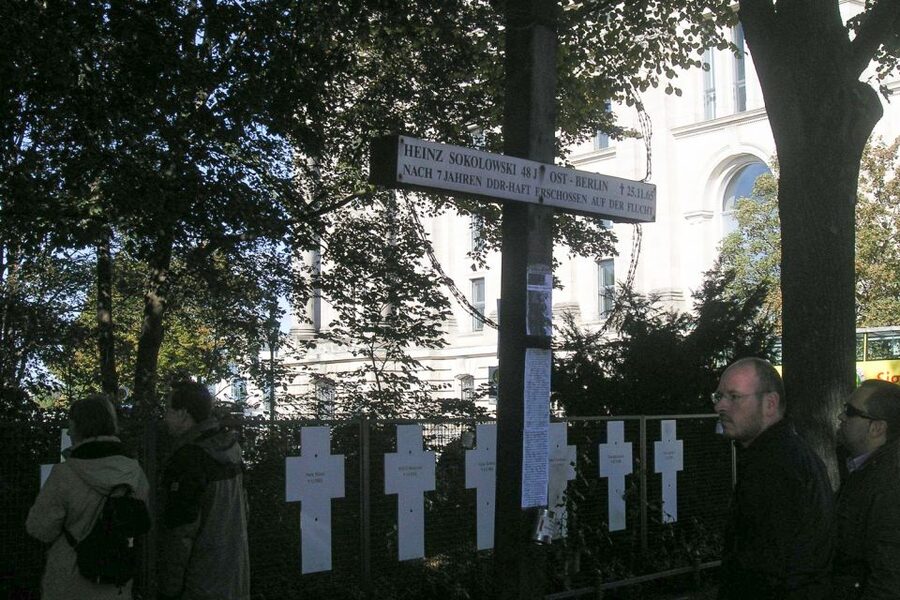
The walk continues from the Brandenburg Gate to the Holocaust memorial at the site of the former death strip. This is one of the more serious sections of the tour because it brings together two different chapters of Berlin’s 20th-century past.
The memorial commemorates the murder of Europe’s Jews, while the former death strip recalls the system used to prevent people from crossing the Berlin Wall. The tour places these sites within the same central setting without treating them as interchangeable. You get a clearer sense of how Berlin’s public spaces carry several layers of memory.
This part calls for attention and respect. The route is not only about dramatic escape stories or Cold War spectacle. It also asks you to consider how the city remembers dictatorship, persecution, war, division, and the people affected by them.
The former death strip can be difficult to picture because much of central Berlin has changed. That is exactly why a guide is useful here. The explanation helps you identify where the border zone once ran and how much open space and security infrastructure stood between the two sides.
Potsdamer Platz and the Tiergarten Triangle
At Potsdamer Platz, the division becomes especially visible in the former Tiergarten Triangle. This location is useful because it shows the Wall as a barrier cutting through a major urban area rather than as a line at the edge of town.
Potsdamer Platz is now associated with modern buildings and redevelopment. The tour uses that changed setting to point out how sharply the area was split during the Cold War. On one side was West Berlin, while the surrounding border zone helped define the edge between the two political systems.
I find this stop helpful for visitors who struggle to imagine the old city from surviving fragments alone. Contemporary Berlin can look unified and polished, but the route shows you where the break once ran through it.
This is also a place where the pace may feel quick. There is a lot to absorb, and the walk covers several major themes in a short time. If you want long, quiet stops at each location, two hours may feel tight. If you prefer a compact overview that keeps moving, the timing works well.
The longest remaining stretch of the Wall
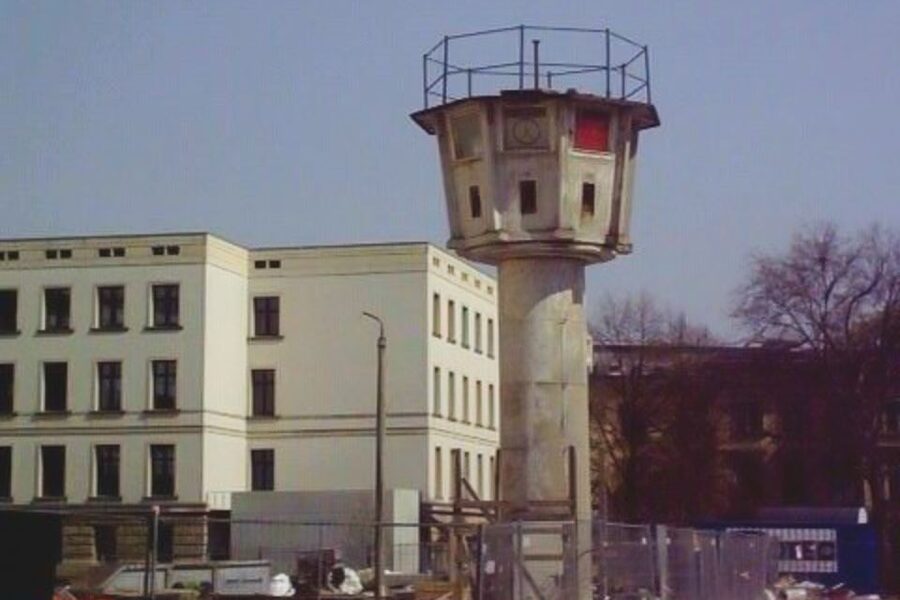
The tour then reaches the longest remaining stretch of the Berlin Wall. This is where the physical structure becomes the main subject again.
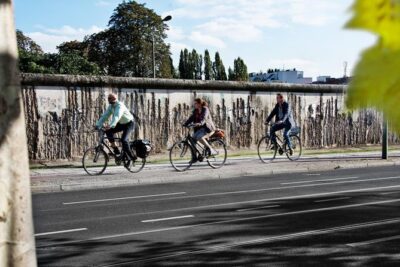
A surviving section can make the division easier to grasp than a painted line or modern marker. The Wall’s length, height, and solid presence show why it was more than a political boundary. It controlled movement and changed how people experienced their own city.
The stop also gives you a chance to compare the Wall as a real barrier with the Wall as a later symbol. Much of Berlin’s surviving Wall has become associated with art and public memory, but the tour keeps the focus on the system that once stood behind it and the lives shaped by it.
Do not expect the entire original border to remain intact. The point of this stop is the surviving section itself, placed within a city that has changed around it. The guide’s explanation connects the concrete remains to the larger route you have already followed.
Checkpoint Charlie and the end of the route
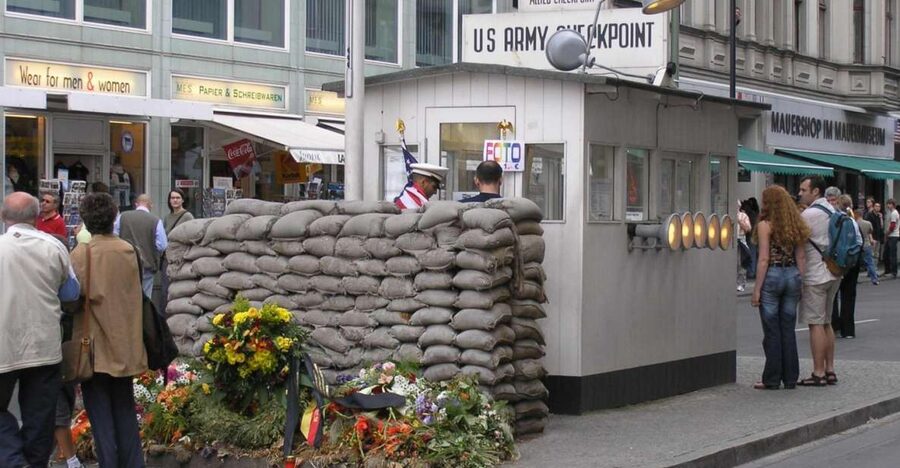
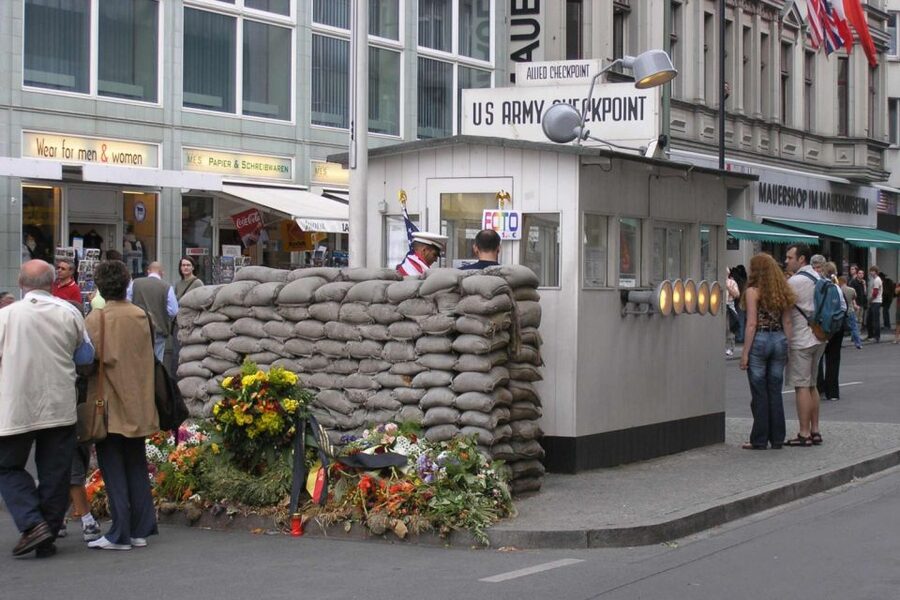
Checkpoint Charlie is the final major landmark named for the route. Its fame comes from its role as a crossing point between East and West Berlin and from the stories tied to Cold War confrontation, escape attempts, and international tension.
The site is now one of Berlin’s best-known attractions, which also makes it one of the least private. You will find a highly recognizable setting, but the atmosphere is more public and commercial than solemn. That is not a reason to skip it. It is a reason to arrive with realistic expectations and use the guide’s historical framing to separate the famous image from the complicated past.
Ending at Checkpoint Charlie gives the tour a strong final marker. You begin at a functioning border station, then follow the former division through the heart of Berlin, and finish at another famous crossing point. The route has a useful narrative shape rather than ending at an unrelated sight.
The guide makes the difference
The tour is conducted in German, so you should book it only if you can follow a German-speaking guide comfortably. The descriptions emphasize personal stories and less obvious details, which means the experience depends heavily on listening rather than simply taking photographs.
Guides named Stephan and Stefan have led this walk. One German-language outing was extended by an hour, and another was described as especially focused with a small group. You should not assume every departure will be extended or identical in size, but these details suggest that the format can be personal and flexible.
The strongest praise centers on the guides’ personal accounts, clear explanations, and information that is not always obvious from the street. That is important for this subject. Berlin’s Wall memorials can tell you where something happened, but a good guide helps explain what the place meant to people living through the division.
Who should book this tour
I would choose this tour if you want a concentrated introduction to divided Berlin and prefer history explained on location. It suits first-time visitors, couples, families with older children, and anyone who wants to connect major sights with the former border.
It is also a good choice if you have only a short time in Berlin. In two hours, you see a series of major sites without committing half a day to a museum. The route gives you enough background to decide which places deserve a longer return visit.
You may want something else if you need an English-language tour, dislike walking between stops, or prefer a single museum with detailed exhibits. The route is also not designed as a full survey of every Wall site in Berlin. It is a focused central-city walk.
At $21, the value is strongest when you want interpretation, not just access to landmarks. The city tour is the included service, and no separate attraction admissions are listed. Free cancellation up to 24 hours before departure and the reserve-now, pay-later option add useful flexibility when your Berlin plans are still taking shape.
Should you book the Berlin Wall city tour?
Book it if you want to understand how division affected ordinary city life and you can follow German comfortably. The route covers the former border from the Palace of Tears to Checkpoint Charlie, with major stops at the Brandenburg Gate, the Holocaust memorial, Potsdamer Platz, and the remaining Wall.
I especially like the combination of clear geography and personal storytelling. You see where the split ran, then hear why those places mattered. Bring comfortable shoes, allow time to listen, and expect a serious history walk rather than a light sightseeing loop.
FAQ
Where does the tour meet?
Meet at the entrance of Tränenpalast, the Palace of Tears, in front of Friedrichstraße station on Reichstagufer, 10117 Berlin, Germany.
Does Tränenpalast have more than one entrance?
No. Tränenpalast has only one entrance, which makes the meeting point easier to identify.
How long does the tour last?
The scheduled duration is two hours.
What language is the tour conducted in?
The tour is conducted in German. German is the only language specified for this activity.
What places are included along the route?
The route includes Friedrichstraße station, the Spree, the parliament and government district, the Brandenburg Gate, the Holocaust memorial, Potsdamer Platz, the former Tiergarten Triangle, the longest remaining stretch of the Wall, and Checkpoint Charlie.
What is included in the price?
A city tour is included. No separate attraction admission is specified as part of the included service.
How much does the tour cost?
The listed price is $21 per person.
What should I bring?
Bring comfortable shoes. The activity connects several central Berlin locations.
Can I cancel for a full refund?
Yes. You can cancel up to 24 hours in advance for a full refund.
Can I reserve the tour and pay later?
Yes. The reserve-now, pay-later option lets you book without paying immediately.
More sightseeing tours in Berlin
- Berlin: 1-Hour City Tour by Boat with Guaranteed Seating
★ 4.3 · 16,993 reviews - Explore Berlin: See All The Iconic Sights & Some Hidden Gems
★ 5.0 · 4,429 reviews - Berlin: City Sightseeing Hop-On Hop-Off Bus Tour
★ 4.1 · 4,233 reviews - Berlin: Hop-On Hop-Off Sightseeing Bus with Boat Options
★ 4.3 · 4,012 reviews
Newest Berlin reviews
- Where It All Began: Berlin’s Queer & Trans History Tour★ 4.9 · 6 reviews
- Understanding Kreuzberg: The roots of local (sub)culture★ 4.9 · 11 reviews
- Berlin: guided canoe | kayaktour★ 4.1 · 7 reviews
- Private Potsdam City Tour in an authentic vintage van★ 5.0 · 14 reviews
- Warnemünde Shore Excursion: Private Sachsenhausen and Berlin Tour★ 5.0 · 12 reviews
- Ultimate E-Bike Tour of Berlin with Beer Garden Stop★ 5.0 · 4 reviews
- In the Forbidden City – Potsdam Walking Tour★ 5.0 · 17 reviews
- Private Walking Tour of Potsdam and Sanssouci★ 5.0 · 24 reviews
Berlin Wall Tours, compared.
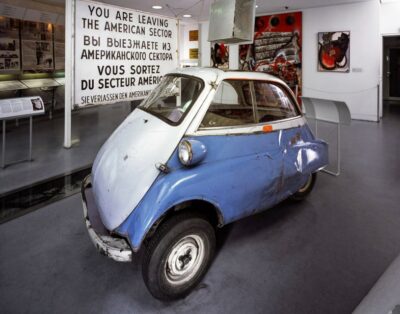
Skip-the-Line: Berlin Wall Museum at Checkpoint Charlie
Read our review →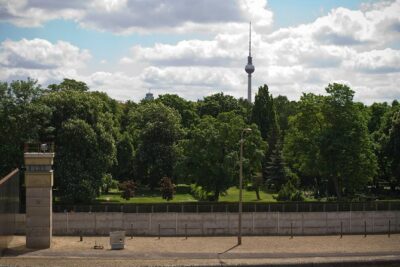
Cold War, Berlin Wall, Spies and the East Side Gallery
Read our review →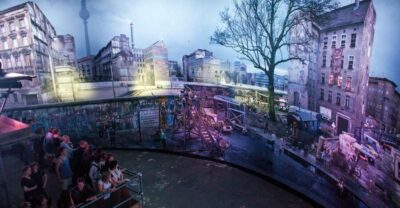
Guided Bike Tour of the Berlin Wall and Third Reich
Read our review →
Browse the lists this tour appears in