
Reviewed · BERLIN COLD WAR TOURS
Berlin East Side Tour 2.5 hour cruise with commentary
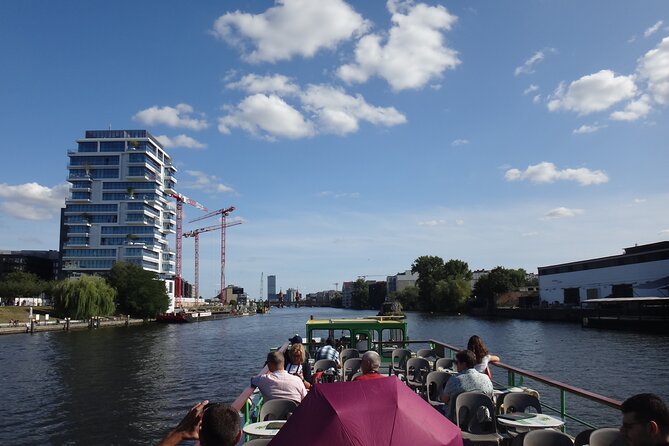
Berlin is easier to understand from the Spree. This 2.5-hour cruise connects the grand center, Cold War landmarks, modern government buildings, and the eastern waterfront in one slow-moving ride. I like the fresh view of the East Side Gallery and Molecule Man, and I like that the boat passes through the Mühlendammschleuse, the lock near Berlin’s historic founding area.
The main drawback is the length. If you want a quick look at central Berlin, the one-hour cruise may suit you better. The upper deck gives the best views, but commentary can be harder to hear there, and hot weather or a crowded boat can make the ride less comfortable.
Key points to know before boarding
- The route reaches farther east: You see the East Side Gallery, Oberbaum Bridge, Molecule Man, Osthafen, and the area around the Uber Arena.
- The central sights come from a new angle: Berlin Cathedral, Museum Island, the Reichstag, Chancellery, and House of World Cultures all pass by from the river.
- The lock is part of the experience: The boat spends time at Mühlendammschleuse, where the Spree drops about 1.51 meters.
- Commentary is bilingual: English and German narration cover architecture, city history, and many everyday buildings.
- Upper-deck seating matters: Views are better outside, but reserved tables may be available separately at the dock.
- The boat returns to its starting point: Board at Alte Börse on Burgstraße at 2:45 pm and finish at the same pier.
Why this longer Berlin cruise is worth considering
The best reason to choose this cruise is its range. A short Spree ride can show you the city center, but this longer trip keeps going into eastern Berlin, where the city’s story shifts from royal Berlin to divided Berlin and then to the rebuilt capital of today.
You sit down, watch the city slide past, and let the route do the organizing. That matters in Berlin, where major sights are spread across a wide area. From the water, you can connect Museum Island with the government quarter, then follow the river toward the Berlin Wall remains and the newer eastern waterfront.
At about $36.04 per person, this is not the cheapest way to see Berlin. I see the price as reasonable if you value the two-and-a-half-hour duration, the bilingual explanation, and the farther-reaching route. The longer ride costs more than a one-hour trip, but it also reaches places the shorter boats may not.
The tradeoff is that this is a sightseeing cruise, not a hop-on, hop-off boat. You cannot get off at the East Side Gallery for a quick walk or stop to explore the Oberbaum Bridge. If you want time on land, use this as an orientation ride and return later by public transport.
More East Side Gallery tours in Berlin:
- Berlin: 2.5-Hour East Side Boat Cruise with Commentary
★ 4.4 · 2,016 reviews - Berlin: East Side Gallery Spree Cruise in a Solar Catamaran
★ 4.0 · 1,039 reviews - Cold War, Berlin Wall, Spies and the East Side Gallery
★ 5.0 · 1,024 reviews
Starting at Alte Börse on Burgstraße
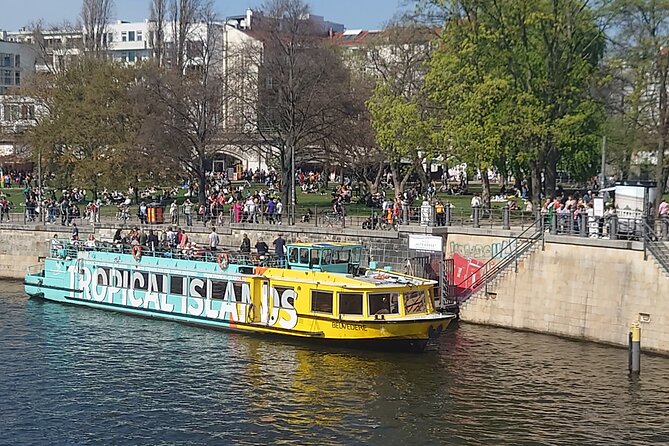
The departure point is the Alte Börse pier at Burgstraße 27 in central Berlin. The boat returns here at the end, so you do not need to arrange a second pickup across town.
The scheduled start is 2:45 pm. Plan to arrive early enough to find the pier and board without a rush. The boat can carry up to 55 people, which keeps the group smaller than a large sightseeing vessel, but popular departures can still fill the better seats.
You will find an onboard bar serving food and drinks for an additional charge. A toilet is also available. Food and drinks are not included in the ticket, and one important practical point is that outside food may not be allowed onboard. If you want a snack, check the onboard supply before settling in.
Berlin Cathedral, Humboldt Forum, and Museum Island
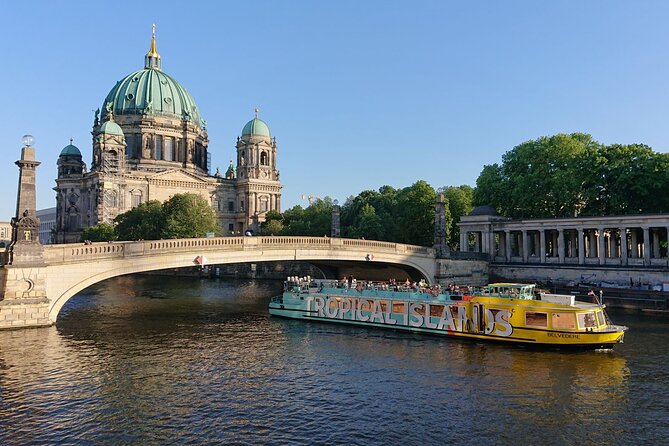
The opening stretch gives you some of Berlin’s strongest central views. Berlin Cathedral rises beside the Lustgarten with its large dome and elaborate Neo-Renaissance and Neo-Baroque design. Built between 1894 and 1905, it is Germany’s largest Protestant church by area and a major Hohenzollern burial site.
From the river, you see the cathedral as part of a larger group rather than as an isolated building. The relationship between the church, the Lustgarten, Museum Island, and the former palace site becomes clearer from the water.
Nearby, the Humboldt Forum occupies a reconstruction of the Berlin Palace exterior. Inside are the Ethnological Museum, the Museum of Asian Art, Berlin city displays, and Humboldt University’s Humboldt Laboratory. The cruise does not replace a museum visit, but the river view helps you understand how this huge complex fits into the old center.
Museum Island itself contains five major museums: the Old Museum, New Museum, Old National Gallery, Bode Museum, and Pergamon Museum. The group was built between 1830 and 1930 and became a UNESCO World Heritage site in 1999. You will not tour the collections from the boat, of course, but this is one of the most useful stretches for getting your bearings.
Mühlendammschleuse and Berlin’s earliest beginnings
The boat reaches Mühlendammschleuse, a working lock on the Spree-Oder waterway. The lock overcomes a drop of about 1.51 meters, and the stop can take roughly 20 minutes.
This is not dead time. You watch the boat enter the lock, wait as the water level changes, and then continue along the river. The slow pause also gives the commentary room to explain the area’s early importance.
Mühlendamm is tied to the beginnings of Berlin and Cölln, the two settlements that later grew into Berlin. The crossing once helped connect the towns and collect customs duties. It is a useful reminder that Berlin began at the river, not simply around the grand buildings you see in the historic center.
The lock is one reason the longer cruise feels different from a quick city ride. You are not only passing sights. You are following the practical waterway that helped shape the city.
More Cold War tours in Berlin:
- Berlin: Third Reich and Cold War 2 Hour Walking Tour
★ 4.9 · 6,830 reviews - Berlin’s Best: 2 Hour Walking Tour Third Reich and the Cold War
★ 5.0 · 5,486 reviews - Skip-the-Line: Berlin Wall Museum at Checkpoint Charlie
★ 4.1 · 2,041 reviews - Berlin: Cold War Walking Tour on Berlin Wall Route
★ 4.8 · 437 reviews
East Side Gallery and the Oberbaum Bridge
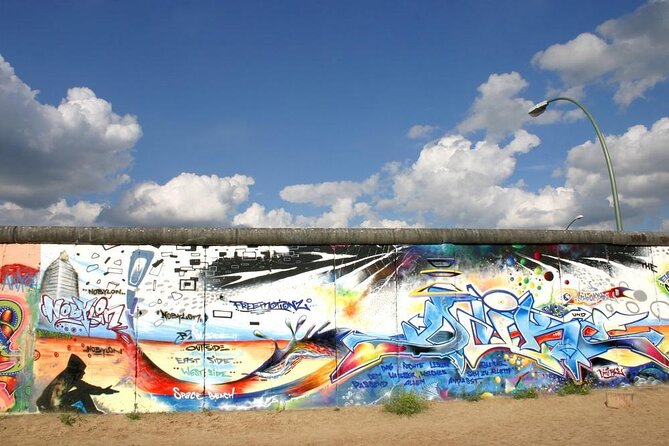
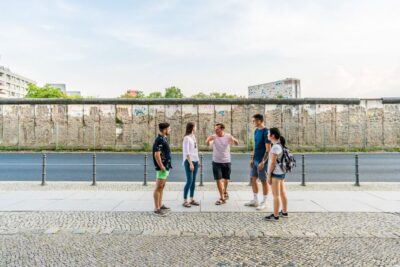
The eastern stretch brings the most recognizable Berlin Wall stop. The East Side Gallery runs along a 1,316-meter section of the former wall between Ostbahnhof and Oberbaum Bridge. In 1990, 118 artists from 21 countries painted more than 100 works on the wall’s former East Berlin side.
The murals you see today are replicas made in 2009, not all of the original paintings. That detail matters, but it does not make the gallery less important. The art records the political changes of 1989 and 1990, and the long wall remains one of Berlin’s clearest public reminders of division and reunification.
From the boat, you see the wall from the river side, while the actual border once ran along the Kreuzberg bank of the Spree. The gallery is on what was called the hinterland wall, the barrier that closed off the border area to East Berlin. That perspective helps explain why the riverside location can feel slightly confusing when you visit on foot.
The cruise passes beneath or near the Oberbaum Bridge, one of Berlin’s most striking bridges. Its red brick towers and pointed details give it a strong medieval appearance, though the current bridge replaced earlier structures. The water view is especially useful here because you see the full span instead of only one approach.
If you want to photograph the murals, sit on the side facing the wall and keep your camera ready. Seating may not always be easy to change once the boat is underway.
Molecule Man and Berlin’s changing eastern waterfront
Farther along, three giant figures form Jonathan Borofsky’s Molecule Man in the Spree. Installed in 1999 near the meeting point of Kreuzberg, Alt-Treptow, and Friedrichshain, the sculpture is best seen from the water. The river places you close to its centerline, giving the work a stronger sense of scale than a distant street view.
This part of the cruise also shows Berlin’s changing eastern waterfront. You pass the former Osthafen area, newer buildings, the Badeschiff, and the area around the Uber Arena. The alternative cultural center Holzmarkt 25 is another riverside reference point.
Here, the commentary can feel less like a list of famous monuments and more like an introduction to present-day Berlin. You see working river space, new construction, cultural projects, and old industrial traces side by side.
That mix is also why some parts of the cruise may feel less exciting if you expect one landmark after another. Much of the route includes ordinary buildings and modern developments. I find that useful, but you may prefer a shorter trip if your attention fades after the headline sights.
Nikolaiviertel and the television tower
As the boat returns toward central Berlin, the Nikolaiviertel comes into view. It is regarded as Berlin’s oldest settlement area, centered on the Nikolaikirche. Much of the district was destroyed during World War II and rebuilt between 1980 and 1987 for Berlin’s 750th anniversary.
The rebuilt quarter uses historic-looking town houses along with adapted prefabricated buildings on an almost medieval street plan. From the water, you get the broad setting rather than the small lanes and restaurants you would see on foot. Pair this view with a later walking visit if you want to judge the reconstruction for yourself.
The Berlin television tower is hard to miss. At 368 meters, it is Germany’s tallest building and one of the country’s most visited sights. Completed in 1969, it was an important East German symbol and remains one of the strongest markers of the city skyline.
The river view lets you place the tower alongside the older buildings of Mitte. That contrast is one of the cruise’s most useful visual lessons: Berlin’s skyline is not one period, but many periods sharing the same horizon.
Government Berlin from the Spree
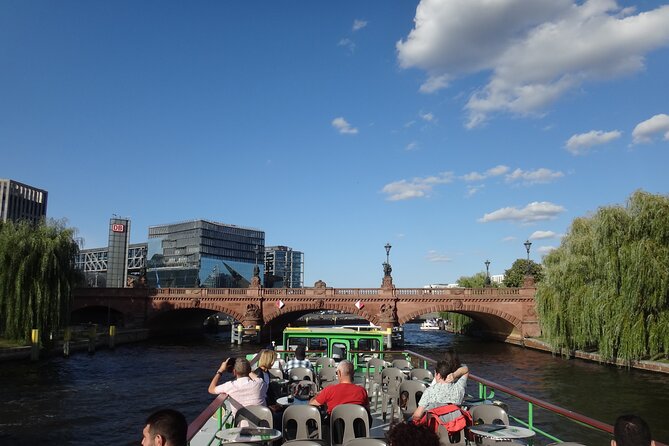
The route then turns toward the government district, where the sights become more recent and more formal. You pass Schiffbauerdamm, a street named for the shipbuilding businesses once found along the river, and the Weidendammer Bridge, a listed structure crossing Friedrichstrasse.
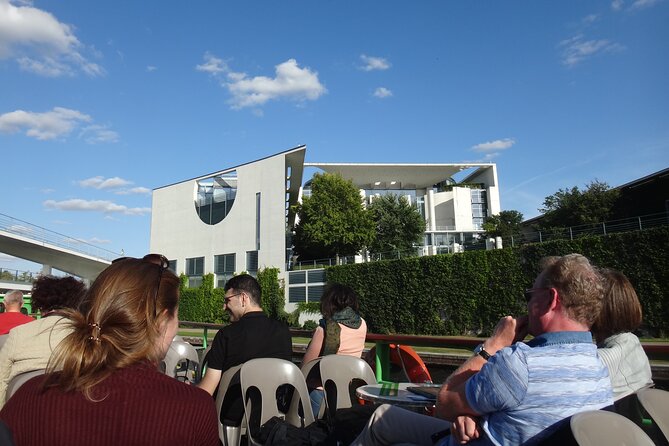
The Reichstag is the star of this section. Built between 1884 and 1894 for the German parliament, it suffered major damage in the 1933 fire and during World War II. Norman Foster redesigned it in the 1990s, adding the glass dome that now marks the building.
From the water, you see the Reichstag as part of the working government center rather than as a stand-alone photo stop. The nearby Kronprinzenbrücke links Mitte with Tiergarten and crosses into the area around the federal institutions.
The Federal Chancellery follows. Its modern building, completed as part of the government district’s redevelopment, faces the Paul-Löbe-Haus across a central forum. The broad, modern architecture can feel stark compared with Museum Island, but it shows how Berlin rebuilt itself as Germany’s capital after reunification.
The House of World Cultures, in the former Congress Hall, provides a lighter architectural note. Berliners often call the building the Pregnant Oyster because of its curved form. It hosts international contemporary art and discussions focused especially on non-European cultures and societies.
Palace of Tears and the final central sights
The Palace of Tears was the departure hall at Friedrichstrasse station’s former border crossing. Trains left here for West Berlin and, via West Berlin, for West Germany. East German citizens generally could not make the same journey freely, so departures often meant tearful farewells to visiting relatives from the West.
The building now houses an exhibition about the border crossing. From the boat, you receive the setting and the name, but you need a separate visit to see the displays inside. If Cold War history is a priority, note the building and return on foot after the cruise.
The Bode Museum closes the central sightseeing loop. It is part of Museum Island and houses the Sculpture Collection, Museum of Byzantine Art, and Coin Cabinet. Its Neo-Baroque design was created between 1898 and 1904, when it was known as the Kaiser Friedrich Museum.
This final section can feel information-heavy. The commentary covers both history and architecture, and the English explanation follows the German version. Several people find the English clear, while others feel the German-first order means the boat has already passed part of a sight before the English details begin.
Seats, commentary, and the best time to go
The upper deck offers the best views and the easiest photography. On a clear day, it is a pleasant place to watch the city, but direct sun can make it hot. The lower salon protects you from poor weather, though the views are less open, and one reported equipment problem left the space uncomfortably warm.
Seats may be connected in rows of three, partly to keep aisles clear for staff and emergency access. If you want a particular table or a forward-facing seat, ask at the dock about reserved upper-deck seating. Reserved places may not be obvious from the online booking process.
Commentary is live in English and German. It covers a lot of ground, including buildings that are not famous but help explain Berlin’s growth. The tone and clarity can vary, so I would choose the upper deck for scenery and the lower salon when hearing every word matters more.
A clear, mild afternoon is the safest choice. Bad weather does not cancel the sightseeing value, but it can push you inside for much of the ride. The boat moves slowly enough for photographs, and that pace is relaxing, though it may feel too slow if you want constant action.
Who should book this Spree cruise?
I recommend it for a first or second day in Berlin, especially if you want to see many districts without spending the afternoon walking between them. It suits adults, architecture fans, photographers, and anyone interested in how Berlin’s royal, divided, modern, and government-era buildings fit together.
Families with very young children should think twice about the full 150 minutes. The last half hour may feel long, especially if children are more interested in movement than commentary. The one-hour city cruise is a better fit for a short attention span.
This is also not the easiest outing for someone with limited mobility. The available information specifically notes that wheelchair access may be difficult. Service animals are allowed, and the boat has a toilet, but ask the operator about your exact needs before booking.
You can cancel free of charge up to 24 hours before departure for a full refund. Changes or cancellations inside that window are not accepted for a refund.
Should you book it?
Book this cruise if you want a slow, broad look at Berlin from the water, with enough time to reach the East Side Gallery, Molecule Man, the eastern waterfront, and the government quarter. The lock, the bridge views, and the changing architecture give the route more substance than a simple central-city loop.
Skip it if you want a fast highlights tour, a walk through the East Side Gallery, or a history lecture focused mainly on the Cold War. At $36.04, the value depends on using the full route. Choose a good-weather afternoon, arrive early for a useful seat, and treat the cruise as a city orientation rather than a substitute for exploring Berlin on foot.
FAQ
Where does the Berlin East Side Tour start?
It starts at the Alte Börse pier operated by BWSG at Burgstraße 27, 10178 Berlin.
What time does the cruise depart?
The scheduled start time is 2:45 pm.
How long does the cruise last?
The cruise lasts approximately 2 hours and 30 minutes, or 150 minutes.
Does the boat return to the starting point?
Yes. The activity ends back at the meeting point on Burgstraße.
Is commentary available in English?
Yes. Live commentary is provided in English and German.
What sights can I see from the boat?
The route passes Berlin Cathedral, Humboldt Forum, Museum Island, Mühlendammschleuse, East Side Gallery, Oberbaum Bridge, Molecule Man, Nikolaiviertel, the television tower, Reichstag, Federal Chancellery, House of World Cultures, Palace of Tears, Weidendammer Bridge, and Bode Museum.
Are food and drinks included?
No. Food and drinks are available from the onboard bar at your own expense.
Can I cancel for a full refund?
Yes, if you cancel at least 24 hours before the scheduled start time. Cancellations made less than 24 hours in advance are not refunded.
More boat trips in Berlin
- Berlin: 1-Hour City Tour by Boat with Guaranteed Seating
★ 4.3 · 16,993 reviews - Berlin: Boat Tour Along the River Spree
★ 4.4 · 11,252 reviews - Berlin: 3.25-Hour Spree & Landwehrkanal Boat Tour
★ 4.6 · 4,311 reviews - Berlin: Hop-On Hop-Off Sightseeing Bus with Boat Options
★ 4.3 · 4,012 reviews
Newest Berlin reviews
- Where It All Began: Berlin’s Queer & Trans History Tour★ 4.9 · 6 reviews
- Understanding Kreuzberg: The roots of local (sub)culture★ 4.9 · 11 reviews
- Berlin: guided canoe | kayaktour★ 4.1 · 7 reviews
- Private Potsdam City Tour in an authentic vintage van★ 5.0 · 14 reviews
- Warnemünde Shore Excursion: Private Sachsenhausen and Berlin Tour★ 5.0 · 12 reviews
- Ultimate E-Bike Tour of Berlin with Beer Garden Stop★ 5.0 · 4 reviews
- In the Forbidden City – Potsdam Walking Tour★ 5.0 · 17 reviews
- Private Walking Tour of Potsdam and Sanssouci★ 5.0 · 24 reviews
Berlin Cold War Tours, compared.
Berlin’s Best: 2 Hour Walking Tour Third Reich and the Cold War
Read our review →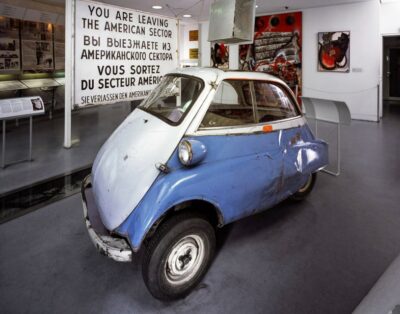
Skip-the-Line: Berlin Wall Museum at Checkpoint Charlie
Read our review →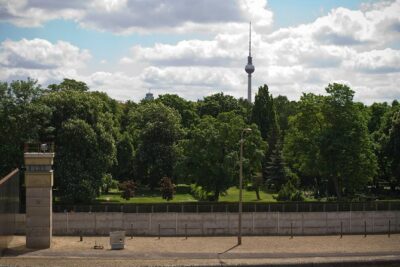
Cold War, Berlin Wall, Spies and the East Side Gallery
Read our review →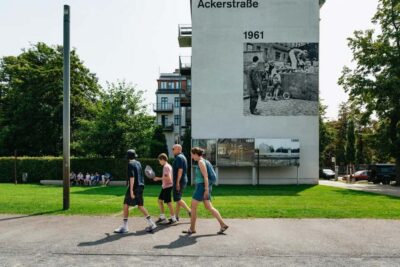
Listening Station Teufelsberg Tour with Transfer
Read our review →Browse the lists this tour appears in