
Reviewed · BERLIN WALL TOURS
Cold War and Berlin Wall Tour in Italian
Berlin’s Cold War story becomes clearest when you move through the places where it happened. This Italian-language walking tour connects the Berlin Wall Memorial, Alexanderplatz, Karl-Marx-Allee, and East Side Gallery in one well-planned route, with a stop at a former ghost station along the way.
I like the strong mix of political history and physical evidence, especially the Wall Memorial and the Stalinist buildings on Karl-Marx-Allee. I also like that the guide helps you link the peaceful demonstrations at Alexanderplatz with the Wall’s fall, rather than treating each sight as an isolated photo stop.
The main drawback is practical: this is a long walking tour with public transport between some locations, and the tour price does not include those fares. The final stop is at East Side Gallery, so you’ll need to arrange your own way back.
Key points to know before you book
- The route covers several major Cold War sights: You’ll see the Wall Memorial, Alexanderplatz, the TV Tower from outside, Karl-Marx-Allee, and East Side Gallery.
- The tour is conducted in Italian: This is a useful choice if you want serious historical detail without relying on your English or German.
- The Berlin Wall Memorial gets the most time: About 50 minutes are set aside for the Wall’s construction, escape attempts, and the people killed while trying to cross.
- A former ghost station adds an unusual angle: At Berlin-Nordbahnhof, you’ll hear how certain subway stations were sealed during the division of the city.
- The group can include up to 25 people: That is small enough for a guided walk, though it is not a private tour.
- The tour ends at East Side Gallery: Transportation, food, drinks, and hotel pickup are not included, so plan for the return journey.
Why this route gives you Berlin’s Cold War story
Many Berlin history walks focus heavily on the Wall itself. This one gives you a wider view. You begin near Potsdamer Platz, pass through a former divided transit system, visit the Wall Memorial, and then follow the political and architectural story eastward.
That order works well because it moves from separation to protest and finally to the Wall’s surviving art. You’ll see how the division affected daily transport, city planning, housing, public space, and travel. By the time you reach East Side Gallery, the murals have more meaning than they would on their own.
The tour lasts about three and a half hours. That is enough time for a useful overview without turning into a full-day commitment. I would set aside extra time afterward if you want to inspect the East Side Gallery at a slower pace, since the guided visit there is listed at about 20 minutes.
You meet at Potsdamer Platz 10 at 10:00 a.m., near the S-Bahn and U-Bahn station. Look for the blue bicycle and the VIVE BERLIN TOURS flag. This is a clear meeting point in a central part of Berlin, but give yourself a few minutes to find the exact marker in the busy square.
More Berlin Wall tours in Berlin:
- Skip-the-Line: Berlin Wall Museum at Checkpoint Charlie
★ 4.1 · 2,041 reviews - Cold War, Berlin Wall, Spies and the East Side Gallery
★ 5.0 · 1,024 reviews - THE WALL: asisi Panorama Berlin Ticket
★ 4.5 · 580 reviews
Berlin-Nordbahnhof and the city’s ghost stations
One of the more unusual stops is Berlin-Nordbahnhof. Here, the guide explains the former ghost stations, subway stations in East Berlin that were closed or heavily controlled while trains from West Berlin passed through.
This is a smart addition to the route. The Berlin Wall is easy to understand as a concrete barrier, but the subway story shows how division reached underground. Stations, routes, and platforms became part of the border system. You’ll spend only about 10 minutes here, so expect an introduction rather than a long station visit.
The stop is especially useful if you want to understand how strange daily movement through divided Berlin could be. A train could pass through the eastern part of the city while passengers from the West were not allowed to get off. The guide’s explanation gives context that is difficult to pick up from street signs alone.
Berlin Wall Memorial: the most serious stop
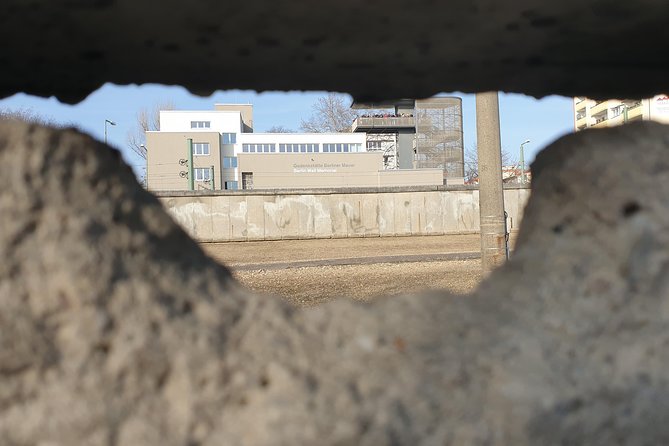
The tour gives about 50 minutes to the Memorial of the Berlin Wall, the longest and most important stop on the route. This is where the physical design of the Wall becomes easier to understand.
You’ll learn how the border system was built and how its different parts worked together. The focus includes escape methods and the tragic stories of people who died trying to cross. The memorial is not simply a preserved wall segment. It helps you see the border as a controlled zone, with barriers and surveillance systems designed to stop movement.
I especially like this part of the tour because it keeps the human cost in view. Political dates can feel remote, but the stories of escape attempts bring the subject back to individual choices and risks. The guide’s role matters here. Italian commentary lets you ask questions and follow the explanation without constantly translating terms in your head.
Allow for an emotional shift at this stop. The later murals at East Side Gallery are colorful and often hopeful, but the Wall Memorial deals directly with fear, separation, and death. If you prefer a light sightseeing walk, this tour may feel more serious than expected.
Alexanderplatz and the protests that changed Berlin
At Alexanderplatz, the focus turns from border controls to the German Democratic Republic, or GDR. You’ll see the square’s characteristic East German architecture and hear about the major public demonstration held here in 1989.
This stop lasts about 15 minutes, so the guide will concentrate on the key political points. The value is in connecting the square to the peaceful pressure that helped lead to the Wall’s fall. Alexanderplatz was not just a broad city plaza. It became a place where large numbers of people publicly challenged the East German government.
You’ll want to look around while the guide speaks. The architecture here can feel imposing, and it reflects the government’s effort to project order and authority. The tour does not treat the buildings as decoration. It explains how the setting fit into the GDR’s public image and how the same space later became linked with protest.
More Cold War tours in Berlin:
- Berlin: Third Reich and Cold War 2 Hour Walking Tour
★ 4.9 · 6,830 reviews - Berlin’s Best: 2 Hour Walking Tour Third Reich and the Cold War
★ 5.0 · 5,486 reviews - Berlin: Cold War Walking Tour on Berlin Wall Route
★ 4.8 · 437 reviews - Berlin: Cold War Era History Guided Bike Tour
★ 4.8 · 413 reviews
The Berlin TV Tower from street level
The Berlin TV Tower is a short stop of about 10 minutes, and the visit is outside only. You will not go up the tower or visit its viewing areas as part of this experience.
That limitation is worth knowing before you book. If you want a high view over Berlin, you’ll need a separate visit. Here, the tower matters because it was one of the most impressive structures built in the GDR and remains Berlin’s tallest building.
From street level, the guide places it within the wider story of East German power and ambition. It is a quick stop, but it helps explain why this part of the city looks so different from the former West Berlin districts. I see it as a useful visual marker rather than a major attraction visit.
Karl-Marx-Allee and Stalinist city planning
The walk then reaches Karl-Marx-Allee, where about 20 minutes are set aside for the boulevard and its buildings. This is one of the best places on the route to see the GDR’s early architectural style.
The broad avenue is lined with buildings from the Stalinist era. The scale is deliberate. The architecture was meant to project strength, order, and a new socialist society. Your guide will explain the beginnings of the GDR and show how the boulevard fits that political period.
This section adds needed context to the Wall story. The division of Berlin was not only about checkpoints and concrete. Governments also used housing, avenues, monuments, and public buildings to shape how citizens experienced the city. Karl-Marx-Allee lets you read that message in the buildings themselves.
You may find this stop more interesting if you pay attention to the contrast between the formal boulevard and the smaller details around it. The tour gives you a framework for looking, which is helpful because an architecture stop can otherwise pass quickly without much meaning.
East Side Gallery: the Wall becomes a public canvas
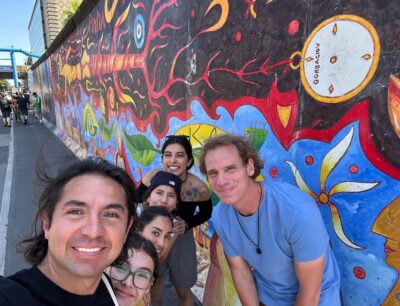
The final stop is East Side Gallery, where about 20 minutes are planned. This is the longest remaining section of the Berlin Wall and the best-known part because of its murals.
The paintings turn the Wall into a symbol of freedom, but the concrete structure still matters. You are looking at a surviving section of the border that once divided Berlin. The artwork adds a later layer, showing how the Wall was reinterpreted after its political purpose ended.
The guide can explain why this section is so famous, but you may want to stay longer after the tour to look at the murals at your own pace. Twenty minutes is enough for an introduction and several photographs, not a detailed study of every painted panel.
The tour ends here in the East Side Gallery area, listed as 10243 Berlin. Since there is no hotel drop-off, ask the guide which public transport to take when you finish. That final advice is useful because the route ends away from the starting point.
What the Italian guide adds
The strongest reason to choose this experience is the language. You are not simply joining a general walking tour and hoping to catch the main points. The commentary is provided in Italian from start to finish.
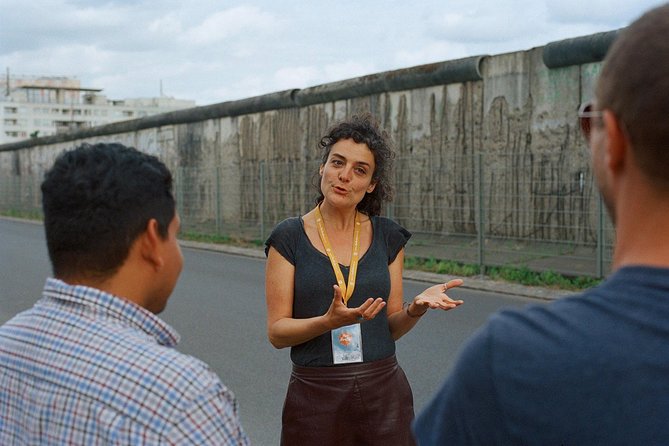
Guide Antonella has been specifically praised for making the emotions of 1989 feel immediate. That is a useful clue about the tone you can expect: not just dates and names, but an effort to explain what the fall of the Wall meant to people living through it.
The tour is also designed around spoken explanation. Admission is free at the listed stops, and there is no museum ticket included because the focus is on outdoor sites and the guide’s interpretation. If you learn best by listening while looking at real places, this format should suit you.
A maximum of 25 people keeps the group from becoming enormous, though you should not expect the intimacy of a private walk. Stay close to the guide at street crossings and transit connections. The route covers several districts, so the group may need to move at a steady pace.
Price, timing, and what you actually receive
At about $27.87 per person, the tour is reasonably priced for three and a half hours of guided history in a major European capital. You are paying mainly for the Italian commentary, route planning, and the ability to connect several sites without researching the city’s Cold War story yourself.
There are no entrance tickets bundled into the price, so the value depends on how much you want a guide. If you already know Berlin’s Cold War history and are comfortable finding each location alone, you could visit the outdoor sights independently. You would then need to plan the sequence, work out the public transport, and supply your own explanations.
For someone who wants a clear narrative in Italian, the cost is easier to justify. The tour covers multiple parts of Berlin that are not clustered around one square. That saves planning time and prevents the day from becoming a series of disconnected monuments.
The experience is booked, on average, 24 days ahead, which suggests you should not leave it until the last moment if the date matters. Confirmation arrives when you book, and free cancellation is available if you cancel at least 24 hours before the local start time. Cancellations or changes inside that window are not refunded.
Who should choose this walking tour
I would recommend it most strongly to:
- Italian-speaking visitors who want detailed commentary in their own language
- First-time Berlin visitors who want several Cold War sights connected in one route
- People interested in political history, architecture, and the human stories behind the Wall
- Anyone who prefers a guided walk to researching subway routes and memorial sites alone
- Visitors who have about half a day for a focused introduction to divided Berlin
It may be less suitable if you want a slow photography walk, a museum visit, or a tour with transport included. The TV Tower is viewed only from outside, and the East Side Gallery stop is fairly short. You also need to handle transportation between attractions and after the tour.
Most participants can take part, and service animals are allowed. The tour is near public transport, but the supplied details do not give a specific accessibility assessment for every pavement, station, or transfer. If you have mobility concerns, contact the operator before booking.
Should you book this Italian Cold War tour?
Book it if you want Berlin’s divided past explained in Italian and prefer a route that connects the Wall with the city’s subway system, public squares, architecture, and street art. The Berlin Wall Memorial is the central reason to go, while Alexanderplatz and Karl-Marx-Allee add the political and architectural setting.
Skip it if you mainly want to visit the East Side Gallery at leisure, ride the TV Tower, or avoid walking and public transport. For the right audience, though, the price buys more than a list of sights. It gives you a coherent story, from ghost stations and border deaths to the protests of 1989 and the Wall’s later life as a canvas.
FAQ
Where does the tour start?
The tour starts at Potsdamer Platz 10, 10785 Berlin, near the S-Bahn and U-Bahn station. Look for the blue bicycle and the VIVE BERLIN TOURS flag.
What time does the tour begin?
The stated start time is 10:00 a.m.
How long does the tour last?
The tour lasts approximately 3 hours and 30 minutes.
Is the tour conducted in Italian?
Yes. The experience includes an Italian-speaking guide.
What sights are included?
The route includes Berlin-Nordbahnhof, the Memorial of the Berlin Wall, Alexanderplatz, the Berlin TV Tower from outside, Karl-Marx-Allee, and East Side Gallery.
Can I go inside the Berlin TV Tower?
No. The TV Tower is visited from outside only.
Does the tour include public transportation?
No. Transportation to and from the attractions is not included.
Does the tour include food or drinks?
No. Food and drinks are not included.
Where does the tour finish?
The tour finishes at East Side Gallery in Berlin, at the listed 10243 Berlin location. The guide can advise you about public transport afterward.
What is the cancellation policy?
You can receive a full refund if you cancel at least 24 hours before the local start time. Cancellations or changes made less than 24 hours before the start are not refunded.
Newest Berlin reviews
- Where It All Began: Berlin’s Queer & Trans History Tour★ 4.9 · 6 reviews
- Understanding Kreuzberg: The roots of local (sub)culture★ 4.9 · 11 reviews
- Berlin: guided canoe | kayaktour★ 4.1 · 7 reviews
- Private Potsdam City Tour in an authentic vintage van★ 5.0 · 14 reviews
- Warnemünde Shore Excursion: Private Sachsenhausen and Berlin Tour★ 5.0 · 12 reviews
- Ultimate E-Bike Tour of Berlin with Beer Garden Stop★ 5.0 · 4 reviews
- In the Forbidden City – Potsdam Walking Tour★ 5.0 · 17 reviews
- Private Walking Tour of Potsdam and Sanssouci★ 5.0 · 24 reviews
Berlin Wall Tours, compared.
Skip-the-Line: Berlin Wall Museum at Checkpoint Charlie
Read our review →
Cold War, Berlin Wall, Spies and the East Side Gallery
Read our review →
Guided Bike Tour of the Berlin Wall and Third Reich
Read our review →
Browse the lists this tour appears in