
Reviewed · HISTORICAL TOURS
Berlin History Walking Tour with a French-Speaking Guide
Berlin reveals its past in plain sight. On this three-hour French-language walk, you move from Potsdamer Platz and Checkpoint Charlie to the former Führerbunker site, the Holocaust Memorial, Brandenburg Gate, and Museum Island. The route connects Nazi Germany, the Cold War, reunification, and today’s Berlin without sending you from one isolated monument to another.
I like the strong first-day value: for $27.81, you get a local guide, a useful overview, and a route through many of central Berlin’s major sights. I also like the human side of the tour. Guides named Anouk, Martin, Arthur, Paul, Jean-Charles, and Céline have been praised for clear explanations, humor, patience, and practical restaurant or sightseeing advice.
The main consideration is that this is a fully walking tour, and a group can include up to 25 people. There are no audio receivers, so you may need to stay close to the guide, especially around busy streets or in windy weather.
Key points to know before booking
- A serious history route: Learn about Nazi Germany, the Holocaust, the Berlin Wall era, and reunification in one morning.
- A useful first look at Berlin: The route links many central landmarks instead of focusing on just one period.
- French-speaking guidance: The tour operates in French, with guides including Anouk, Martin, Arthur, Paul, and Céline.
- A fully walking experience: Expect roughly three hours on foot, with short stops and pauses for explanation.
- Convenient morning timing: Meet at 10:00 a.m. at Potsdamer Platz and finish near Museum Island in time for lunch.
- Good value for the price: At $27.81, the tour is a low-cost way to get historical context and orientation before exploring more on your own.
Why this route works for a first morning in Berlin
Berlin is not a city you understand from a single grand square. Its story is scattered across open spaces, rebuilt streets, empty lots, memorials, and buildings that survived war or political change. This walking route helps you connect those pieces.
The tour begins at Potsdamer Platz and ends near Museum Island. That gives you a clear west-to-east path through central Berlin, rather than a random collection of stops. You see how a former divided zone became a modern business district, pass places tied to Nazi rule and the Cold War, then finish among Berlin’s older cultural buildings.
I would use this tour early in a stay, especially if it is your first visit. The guide can give you the basic framework you need for later visits to museums, memorials, and historic neighborhoods. You will not receive an exhaustive account of every period in Berlin’s past, but you should come away with a useful map of the city and a sense of how its major chapters fit together.
The morning start is practical. Meeting at 10:00 a.m. lets you settle into the city first, then finish around lunchtime. Some groups have taken closer to three and a half hours, so do not schedule a tight appointment immediately afterward.
More history tours in Berlin:
- Berlin: Natural History Museum Entrance Ticket
★ 4.6 · 3,382 reviews - Berlin: World Heritage Cruise to Potsdam
★ 4.5 · 1,435 reviews - Berlin Historical Highlights Walking Tour
★ 4.9 · 657 reviews
Potsdamer Platz and the modern face of Berlin
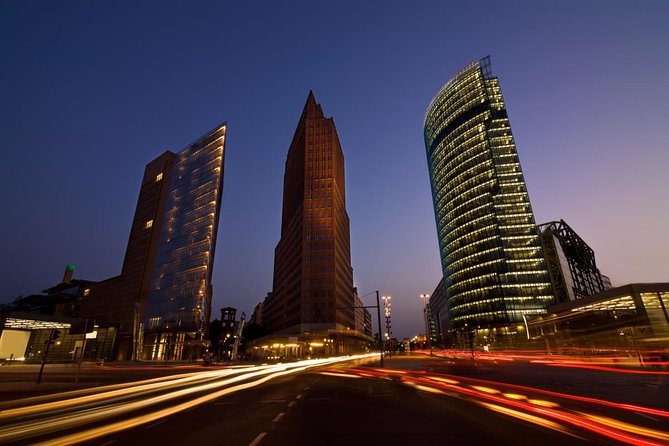
Potsdamer Platz is an effective starting point because it makes Berlin’s physical changes easy to see. The meeting point is at Potsdamer Platz 10, at the corner of Gabriele-Tergit-Promenade.
The area is known for modern architecture and large commercial buildings, including the Sony Center. It also carries the memory of division and wartime destruction. Your guide uses this setting to explain how central Berlin was reshaped after the war and after reunification.
You should allow a few minutes to find the exact meeting corner. Potsdamer Platz is a large, busy area, and the group may be easier to spot than the address itself. Arrive ready to walk, not to linger over coffee.
The stop is listed for about ten minutes, but its real value is as an opening lesson. You begin with the city Berlin built after division, then move backward and forward through its past.
Checkpoint Charlie and the Cold War
At Checkpoint Charlie, the guide explains the former crossing point between East and West Berlin. The site became one of the best-known symbols of the Cold War, when the two political systems confronted each other across the divided city.
The stop itself is brief, about ten minutes. That is enough for a clear explanation and a look at the location, but not enough for a detailed study of the Berlin Wall or daily life in East Berlin. If the Cold War is your main interest, treat this as an introduction and plan separate time for a museum or memorial afterward.
Checkpoint Charlie can also feel more commercial than solemn. That contrast is worth noticing. The place has become a major sightseeing stop, yet its meaning comes from the fear, restrictions, and political tension that shaped Berlin for decades.
I like having this stop early in the route because it gives context to Brandenburg Gate later. You begin to see that Berlin’s famous landmarks changed meaning as rulers, governments, and borders changed around them.
The former Führerbunker site and the problem of remembering
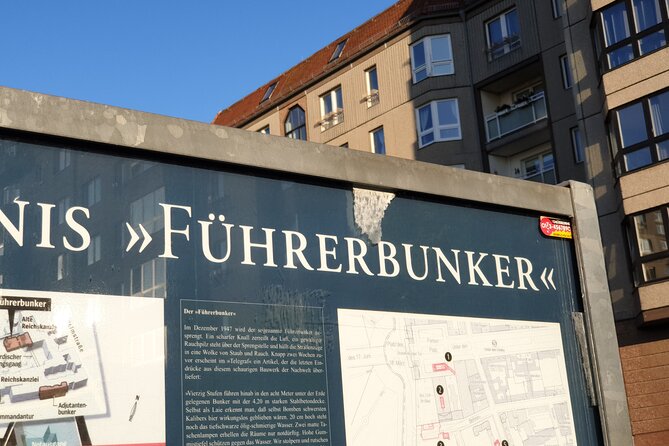
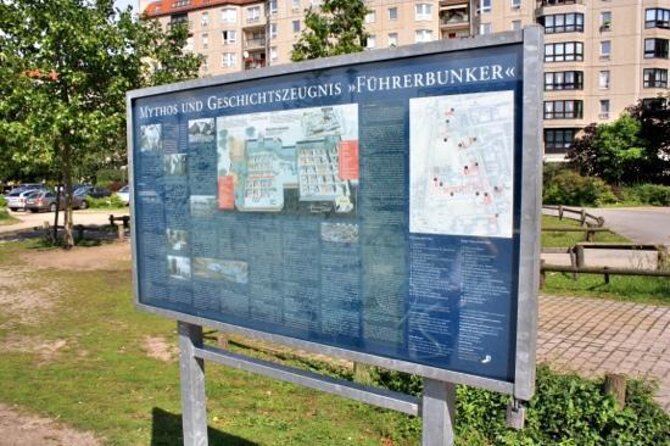
The tour then visits the site where Hitler spent his final days. The bunker itself is not presented as a dramatic attraction. The guide explains where it was, what happened there, and why the location looks the way it does today.
That restraint matters. There is no grand entrance or preserved room to tour. The historical lesson comes from the absence of the bunker and from the way modern Berlin has chosen to mark, or not over-mark, a place tied to Nazi leadership and the final days of the war.
The stop lasts about ten minutes. It is short, but the subject is heavy. You may find that the guide’s explanation helps you understand why the site is treated as a place of historical evidence rather than a shrine or spectacle.
This is one of the tour’s more useful teaching moments. Berlin does not erase its past, but it also does not turn every dark site into a monument. A good guide can explain that tension clearly. Several guides on this tour have been praised for giving precise answers and handling questions carefully, though one lower-rated experience reported historical inaccuracies. I would listen closely and use the tour as an introduction, then verify details through Berlin’s museums and official memorial sites if you want a more academic account.
Other Berlin experiences to weigh up
- Berlin: Reichstag, Dome and Government District Guided Tour
★ 4.7 · 18,288 reviews - Berlin: Government District around the Reichstag Guided Tour
★ 4.7 · 8,447 reviews - Berlin: Hidden Backyards Guided Walking Tour
★ 4.8 · 5,360 reviews - Berlin: 1-Hour Boat Tour with Bilingual Live Guide
★ 4.7 · 3,629 reviews
The Holocaust Memorial, where space carries the message
The Memorial to the Murdered Jews of Europe is one of Berlin’s most powerful stops. Its field of concrete slabs creates a changing sense of height, space, and uncertainty as you walk among them.
The tour allows about fifteen minutes here. That is enough to hear the memorial’s purpose and discuss the Nazi murder of Europe’s Jews, but it is not enough for a long personal visit. I recommend returning on your own if you want to spend quiet time walking through the memorial or visiting the information center.
The guide’s role is especially valuable at this stop. The memorial’s design can feel abstract if you do not know the historical purpose behind it. A French-speaking explanation can help you connect the physical setting with the scale of the crime and with Germany’s effort to confront that history in the center of its capital.
Expect a serious tone. This is not a quick photo stop, even though many people take pictures here. Dress for the weather, since the memorial is outdoors and the tour operates in rain or cold.
Brandenburg Gate, from royal entrance to reunification symbol
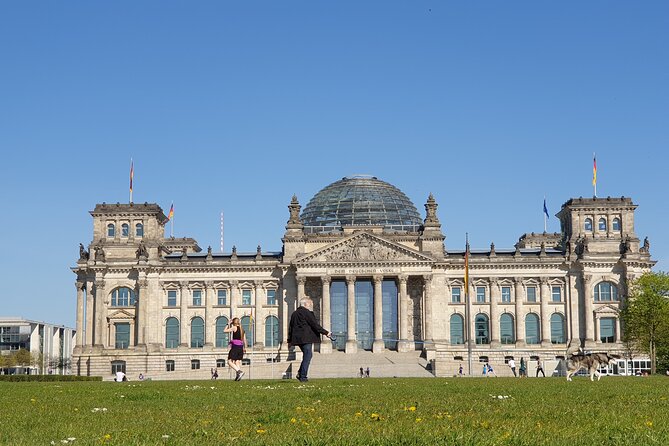
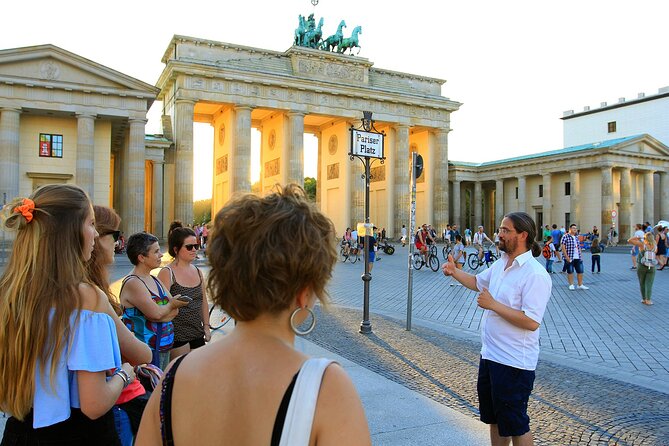
Brandenburg Gate is likely to be one of the most familiar sights on the route, but its story is more complicated than its postcard image suggests. The guide traces its meaning from a symbol of royal power to a landmark caught in the Cold War division, then to a public symbol of German reunification.
The stop lasts about ten minutes. You get the essential story and time to look at the gate, but you will not have a long architectural lecture. Its location also helps you understand the political geography of Berlin. The gate was once near the divided city’s border, and its present role reflects the end of that division.
I like this stop because it shows how one building can carry several meanings over time. Berlin’s history is not a straight line from monarchy to democracy. The same places have been reused, contested, damaged, rebuilt, and reinterpreted.
The area can be crowded, so stay close to the guide and listen for meeting instructions. Since no audio receivers are supplied, the group may be harder to follow if you drift behind.
Unter den Linden and Bebelplatz
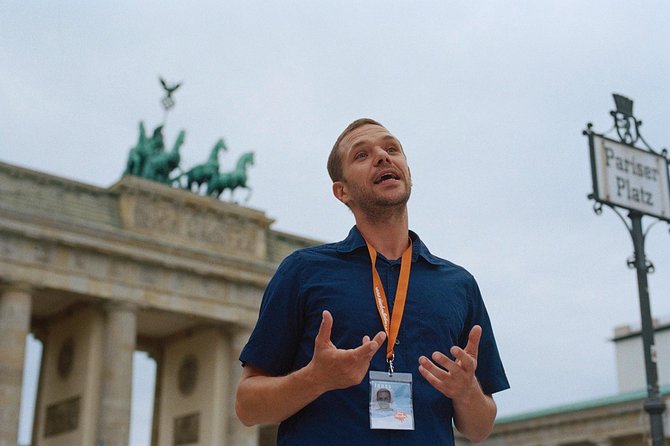
From Brandenburg Gate, the walk continues along Unter den Linden, Berlin’s grand historic avenue. The guide points out how different building periods appear along the street and explains the damage left by war.
The avenue once led toward the emperor’s palace, so it offers an easy lesson in Berlin’s older political order. Look at the buildings as layers rather than as one uniform street. Imperial ambitions, wartime destruction, socialist rebuilding, and modern restoration all appear in this part of the city.
The walk along Unter den Linden lasts about twenty minutes. This is one of the longer moving sections, so comfortable shoes matter. You are not simply crossing from one monument to another. The avenue gives the guide time to explain how Berlin’s architecture reflects changes in government and public life.
At Bebelplatz, the focus shifts to the Nazi book burning of 1933. The square is also home to Humboldt University and the Catholic Cathedral. That mix makes the stop particularly striking. A place associated with censorship and dictatorship is surrounded by institutions connected to education, religion, and public debate.
The stop is listed at about ten minutes. You will get the main story and see the square’s major landmarks, but you may want to return later if you want to study the memorial to the book burning more closely.
Museum Island and the walk’s eastern finish
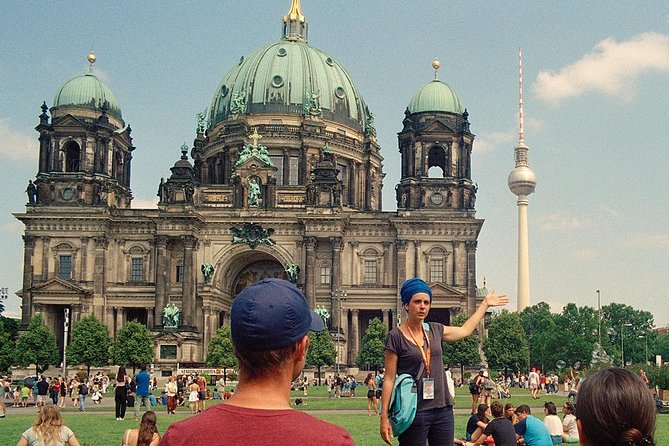
The tour ends near Museum Island, close to Alexanderplatz. You see the Berliner Dom and the reconstructed Humboldt Forum, two buildings that help introduce Berlin’s architectural and cultural center.
This is a sensible ending point. You finish near museums, public transport, and places where you can continue exploring at your own pace. The tour does not include museum admission, food, drinks, or transportation to and from the route, so plan your next step before you arrive.
The end point is especially useful if you want lunch nearby or hope to visit a museum afterward. Since the walk can run longer than three hours, leave some flexibility in your schedule.
Museum Island also gives you a chance to shift from political history to art, archaeology, architecture, and the debates surrounding reconstruction. The tour does not attempt to cover all of that in detail. It simply leaves you in the right place to continue.
French-speaking guides and the group experience
The tour is conducted in French, which is its main advantage for French-speaking visitors. A guide can explain complex events in the language you understand best, then answer questions without forcing you to translate every detail in your head.
Guide quality matters greatly on a history walk. The named guides associated with this experience include Anouk, Martin, Arthur, Paul, Jean-Charles, and Céline. The strongest praise focuses on clear explanations, strong speaking skills, humor, warmth, and an ability to respond to individual questions.
One guide was credited with keeping a good pace, neither too fast nor too slow. Another was praised for offering advice about less familiar sights and restaurants. Those details can be useful when you are trying to plan the rest of your stay.
Groups can reach 25 people. That is not enormous, but it is large enough to affect the experience. Without headsets, you should stand near the guide, especially at road crossings or crowded squares. One participant specifically wished the group had audio equipment. The provider has indicated that avoiding such equipment helps keep the price accessible, but you should know the tradeoff before booking.
Price, pace, and physical demands
At $27.81 per person, this tour offers good value if you want orientation and historical context rather than private guiding. You are paying for a local French-speaking guide and a carefully connected route through central Berlin. You are not paying for transport, meals, or entry to a collection of museums.
The three-hour format is long enough to cover the main story but short enough to fit into a morning. The route includes several brief stops and longer walking sections. You should have a moderate level of fitness and be comfortable walking outdoors in all weather.
Wear supportive shoes and bring water. There is no promise of sheltered seating at every stop. Berlin weather can change quickly, and the tour operates in rain or cold, so dress accordingly.
The tour is also a useful choice for solo visitors. You have a fixed route, a guide to answer questions, and an easy way to get oriented without committing to a private tour. Families may appreciate the reasonable price, though younger children may find the historical subjects and walking pace demanding.
Free cancellation is available if you cancel at least 24 hours before the 10:00 a.m. start time. Changes or cancellations inside that window are not accepted for a refund.
Who should book this Berlin history walk?
I would book this tour if you are visiting Berlin for the first time, want French-language guidance, and prefer a broad introduction before choosing which museums or memorials deserve more time.
It is also a good fit if you want to understand the links between Nazi history, the Cold War, reunification, and modern Berlin. The route covers those subjects in a logical order, with enough landmark variety to keep the morning moving.
I would hesitate if you want a small private group, audio equipment, extensive time inside each site, or a specialist-level lecture on one period. The tour moves quickly, and some stops are only ten or fifteen minutes long.
For most first-time visitors who can manage a full morning on foot, I think the $27.81 price is fair. Book it near the beginning of your stay, keep your afternoon open for Museum Island or another memorial, and stay close enough to hear the guide. That is the best way to get the most from this practical introduction to Berlin.
FAQ
How long does the Berlin history walking tour last?
The tour lasts approximately three hours, though some departures may take closer to three and a half hours.
What language is the tour conducted in?
The tour operates in French with a professional French-speaking local guide.
Where does the tour begin?
The meeting point is Potsdamer Platz 10, 10785 Berlin, at 10:00 a.m.
Where does the tour end?
The tour ends next to Museum Island, near Alexanderplatz, at Museumsinsel, 10178 Berlin.
Is transportation included?
No. Transportation to and from the attractions is not included. The experience itself is a walking tour.
What happens if I need to cancel?
You can receive a full refund if you cancel at least 24 hours before the local start time. Cancellations or changes made less than 24 hours before the tour are not accepted for a refund.
More Walking Tours in Berlin
- Discover Berlin Half-Day Walking Tour
★ 5.0 · 9,624 reviews - Berlin: Third Reich and Cold War 2 Hour Walking Tour
★ 4.9 · 6,830 reviews - Berlin: Discover Berlin Walking Tour
★ 4.9 · 5,998 reviews - Berlin’s Best: 2 Hour Walking Tour Third Reich and the Cold War
★ 5.0 · 5,486 reviews
Newest Berlin reviews
- Where It All Began: Berlin’s Queer & Trans History Tour★ 4.9 · 6 reviews
- Understanding Kreuzberg: The roots of local (sub)culture★ 4.9 · 11 reviews
- Berlin: guided canoe | kayaktour★ 4.1 · 7 reviews
- Private Potsdam City Tour in an authentic vintage van★ 5.0 · 14 reviews
- Warnemünde Shore Excursion: Private Sachsenhausen and Berlin Tour★ 5.0 · 12 reviews
- Ultimate E-Bike Tour of Berlin with Beer Garden Stop★ 5.0 · 4 reviews
- In the Forbidden City – Potsdam Walking Tour★ 5.0 · 17 reviews
- Private Walking Tour of Potsdam and Sanssouci★ 5.0 · 24 reviews
Historical Tours, compared.

Berlin Private Complete History All Day Walking Tour
Read our review →


Small group Potsdam: A Journey Through History and Palaces
Read our review →Browse the lists this tour appears in