
Reviewed · BERLIN WALL TOURS
Wall Tour Berlin – Fates, Heroes & Love Stories
Berlin’s Wall was not just a slab of concrete. It was a 40-kilometer border through a living city, backed by watchtowers, floodlights, patrols, and orders that could turn an escape attempt into a death sentence. This two-hour walk brings that human cost into focus through real stories of families, border guards, escapees, churchgoers, and young people used by the East German state.
I like two things here: the route uses the Berlin Wall Memorial rather than treating the Wall as a photo stop, and the guide ties large political events to intimate stories of fear, courage, despair, and love. The short price of $19.66 per person also gives you a useful history lesson without the cost of a museum-heavy half day.
The main concern is reliability. Two severe one-star reports describe groups waiting at the meeting point with no guide appearing, followed by poor communication. The overall score is 4.1 from nine reviews, so the experience can be compelling, but I would confirm the meeting details shortly before setting out.
Key points about the Berlin Wall walk
- Ghost stations and border construction: Begin near Nordbahnhof and learn how divided Berlin affected its underground and suburban rail system.
- Bernauer Strasse’s human cost: See the former border strip, the memorial window, and the houses where people jumped toward freedom and died.
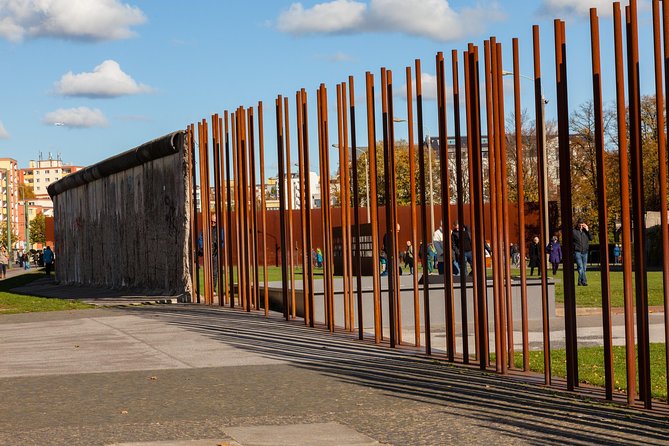
- A viewing platform with context: Look across the preserved border area instead of trying to picture the Wall from a single fragment.
- Escape stories with sharp detail: Hear about tunnel escapes, border guard Conrad Schumann, and the GDR’s use of propaganda.
- The Church of Reconciliation: Learn how a church caught inside the border strip was treated after the frontier closed.
- A compact route to Mauerpark: Finish near Bernauer Strasse and Oderberger Strasse, with the M10 tram available toward Berlin Central Station.
Why this route makes the Berlin Wall easier to understand
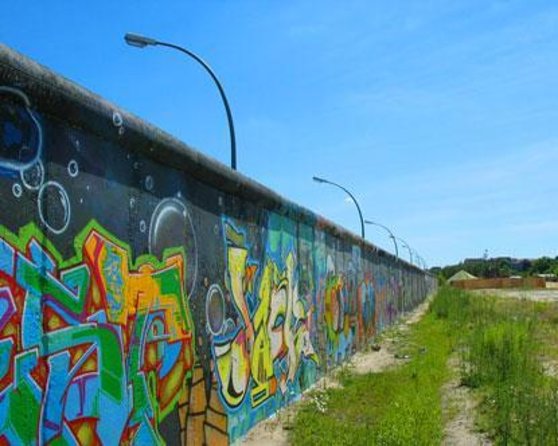
A remaining section of concrete can look strangely harmless. The power of this walk is that it explains the machinery around it: the border strip, patrol systems, controlled crossings, demolished buildings, blocked transport, and the people caught on the wrong side.
The tour begins with a brief explanation of the divided city and then builds its story in order. You move from the Wall’s construction to deaths and escape attempts, then to the pressure that finally led to its collapse. That sequence helps you understand why August 13, 1961, changed daily life so quickly, and why November 1989 did not simply erase the damage.
The subject is heavy. You will hear about people who died trying to cross, people who jumped from windows in panic, and young people used for political purposes. The guide also includes love stories, which may sound like a small detail, but it matters. Private relationships did not stop because a government drew a frontier through streets and neighborhoods.
The route is also more useful if you have little background. I would choose it early in a Berlin visit, since it gives you a framework for later visits to the Wall Museum, the Stasi Museum, or other Cold War sites. If you already know the subject well, the value will depend heavily on the guide’s storytelling and the detail of the personal cases selected.
More Berlin Wall tours in Berlin:
- Skip-the-Line: Berlin Wall Museum at Checkpoint Charlie
★ 4.1 · 2,041 reviews - Cold War, Berlin Wall, Spies and the East Side Gallery
★ 5.0 · 1,024 reviews - THE WALL: asisi Panorama Berlin Ticket
★ 4.5 · 580 reviews
Starting near Nordbahnhof and the ghost stations
Your listed meeting point is Elisabeth-Schwarzhaupt-Platz, 10115 Berlin. The first part of the route is described at the entrance to the Nordbahnhof S-Bahn station on Gartenstrasse, where the guide explains the so-called ghost stations of East Berlin.
This is an excellent opening because it shows that the Wall was not only a physical barrier. Rail lines crossed the political frontier, and some stations were closed or heavily controlled during the GDR era. Trains could pass through parts of East Berlin without allowing passengers to get off. The word ghost suggests empty platforms, but the real point is surveillance and separation.
There is a small practical wrinkle: the published meeting point and the first stop are named separately. I would check the exact pickup instructions on your mobile ticket and contact the provider before leaving your hotel. That is especially important because two reports describe a no-show at the agreed meeting place. The tour is limited to 25 people, but a smaller group is not worth much if nobody arrives.
Bernauer Strasse shows the Wall as a system
At the beginning of the Berlin Wall Memorial, you receive the basic explanation of how the frontier could be built at all. The guide then turns to the lie told by East German leader Walter Ulbricht on June 15, 1961, followed less than two months later by the sealing of the border on August 13.
The important lesson is speed. Residents did not wake up to a fully finished concrete wall. Streets, rail links, doorways, and family routines were cut apart first. The border grew into a controlled strip with multiple obstacles, guard positions, and open zones that made crossing difficult.
You then reach a viewing platform overlooking the former border area on Bernauer Strasse. This is one of the most useful points on the route. From above, you can see the relationship between the street, memorial remains, open ground, and the former border line. Without that wider view, it is easy to mistake a surviving wall segment for the whole frontier.
I like this stop because it asks you to look at space, not just listen to dates. The former border was wide and organized. It was designed to remove cover, expose movement, and make a desperate run visible.
The memorial window and the people behind the numbers
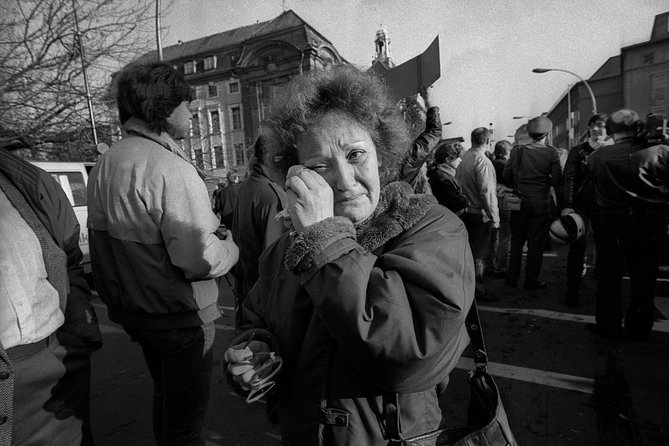
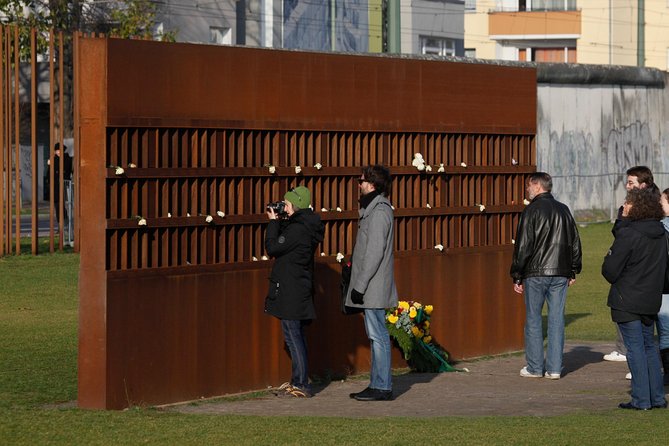
The memorial window focuses on those who died at the Berlin Wall. At least 140 people are known to have died between 1961 and 1989, though the precise number of victims remains uncertain.
That uncertainty is worth explaining carefully. Political borders create paperwork, secrecy, disputed cases, and different ways of counting. A guide who handles this well can keep the figures from becoming empty statistics. The purpose of the memorial is not simply to report a number, but to restore individual lives to a place where the state tried to make people disappear.
Along Bernauer Strasse, residential buildings once stood with windows and exits opening toward West Berlin, while the buildings themselves were in East Berlin. The resulting tragedies were almost impossible to imagine from a modern street view. Residents were trapped in their own homes, and some jumped from windows in fear and desperation.
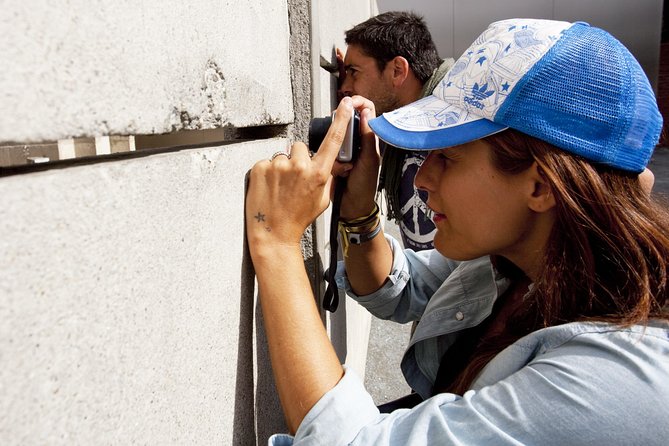
You will have time to look at photographs and videos here. That pause is valuable. This is not a stop to rush through while taking a quick picture. If you are sensitive to accounts of death or state violence, prepare yourself for an emotionally difficult section.
A different sort of day out in Berlin:
- Berlin: Reichstag, Dome and Government District Guided Tour
★ 4.7 · 18,288 reviews - Berlin: 1-Hour City Tour by Boat with Guaranteed Seating
★ 4.3 · 16,993 reviews - Berlin: Boat Tour Along the River Spree
★ 4.4 · 11,252 reviews - Discover Berlin Half-Day Walking Tour
★ 5.0 · 9,624 reviews
The Church of Reconciliation and divided worship
The route continues toward Ackerstrasse and the chapel of the Church of Reconciliation. The original church stood inside the border strip, even though people from East and West Berlin had once worshipped there together.
The church’s position reveals how blunt the Wall was. It did not respect parish boundaries, familiar paths, or shared institutions. A place built for community became inaccessible because it was located in a militarized zone.
This stop adds a religious and civic layer to the story. The division was not only about political systems or escape routes. It disrupted worship, neighborhoods, schools, workplaces, and ordinary contact between people who had lived near one another.
The chapel is also a reminder that the memorial is not a single preserved wall. It is a collection of sites, traces, and stories along a former border. You get more from it if you listen for what disappeared, not only for what remains.
Passenger agreements and the misuse of young people
The guide then explains passenger agreements made between West Berlin’s Senate and the GDR. These agreements were intended to make the Wall somewhat more permeable, allowing controlled movement under specific conditions.
This part helps you avoid a simple picture of a border that was either completely open or completely sealed. Rules changed, exceptions existed, and movement could be permitted while still being closely controlled. The system remained restrictive, but it was not static.
The tour also addresses how the GDR used children and young people for propaganda. That subject adds an uncomfortable layer to the story because it concerns education, loyalty, and the shaping of public opinion, not only guards and concrete.
I find this kind of material especially useful for families and older students, provided the guide presents it with care. It shows how authoritarian systems try to make political division feel normal to the next generation.
Tunnels, propaganda, and the risks of escape
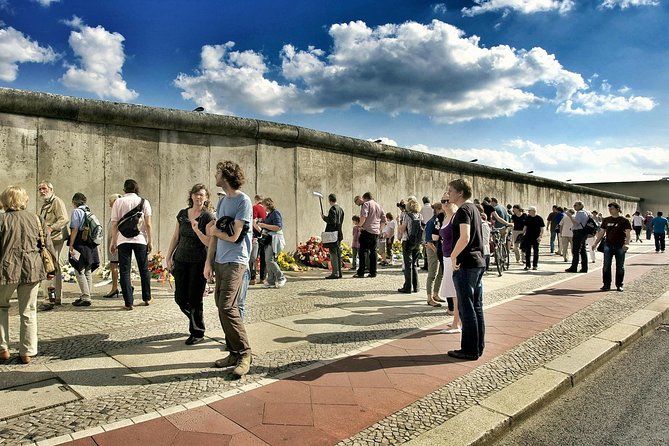
The 1960s brought many tunnel escapes, and the route visits a legendary tunnel near the border house. Tunnel stories can sound like adventure tales, but the conditions were dangerous, secret, and uncertain. The guide explains how the GDR used the story for propaganda and how political authorities tried to control the meaning of escape attempts.
This is a good balance to the official history. A government could describe an escape as criminal, foreign-directed, or dishonest, while the person underground might have seen it as the only path left. The same event could be presented as a victory or a threat depending on which side controlled the microphone.
You also hear about Conrad Schumann, the border guard whose jump to the West became one of the most famous images connected with the Wall. His life after the escape, and the fact that he remained wanted until the end of the GDR, add personal weight to a photograph many people have seen without knowing the full story.
The subject can easily become a string of dramatic anecdotes. A strong guide will connect each escape to the wider border system and explain what the image leaves out. That is where the walking format earns its keep.
Kidnappings and the loudspeaker war
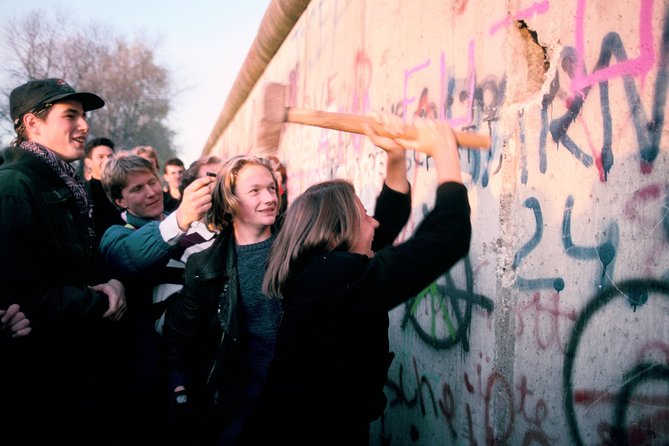
The route includes accounts of kidnappings organized by criminal groups acting on orders from the GDR. Former members of the National People’s Army and People’s Police were particular targets, and one kidnapping ended in death.
This is a darker and less familiar part of the story. It shows that the conflict continued beyond the visible border. Pressure could reach people in the West, and former state employees could remain at risk even after leaving East Germany.
You also hear about the loudspeaker war between East and West Berlin. Both sides used loudspeakers to make life difficult for the other, turning sound itself into a political weapon.
These stops broaden the tour beyond the familiar images of walls, barbed wire, and escape ladders. The Cold War was fought through propaganda, intimidation, and psychological pressure as well as through military alliances.
Finishing at Mauerpark
The walk ends at Mauerpark, near Bernauer Strasse and Oderberger Strasse. The final subject is the fall of the Wall, presented as a story with its own chain of events rather than as an inevitable happy ending.
That is a sensible place to finish. Mauerpark is a public space where the former border no longer functions as a barrier, yet the history is still underfoot. From the endpoint, you can take the M10 tram toward Berlin Central Station.
The route lasts about two hours and includes many short stops. That keeps the pace moving, but it also means no single location receives a long museum-style presentation. You should view this as a guided introduction to the Bernauer Strasse memorial area, not as a substitute for spending an entire afternoon reading every display.
Is $19.66 good value?
At $19.66, I consider the tour fairly priced if you want structure and explanation. Every stop has free admission, so you are paying for the guide, the route, and the human stories that connect the sites. The price is low compared with a private tour and reasonable for a two-hour introduction.
The value depends on the guide more than on entry tickets. A good storyteller can help you understand why a closed station, a church, a row of windows, or a tunnel matters. A weak guide would leave you with facts you could gather from signs.
The group can include up to 25 people. That is not a private experience, but it is still a manageable size for an outdoor walking tour. Bring a mobile ticket, wear practical shoes, and allow enough time to find the meeting point. The tour needs good weather, and it can be canceled if the minimum number of participants is not reached.
Free cancellation is available until 24 hours before the start time. Inside that window, the payment is not refunded, so do not book it as a loose placeholder in a changing schedule.
Who should book this walk?
I would choose it for a first visit to Berlin, history-minded families with older children, students, and anyone who wants the Berlin Wall explained through individual lives rather than only political dates.
It is also a good fit if you prefer a compact outdoor tour and want to combine it with other sights afterward. The ending near Mauerpark makes it easy to continue exploring the surrounding area or catch the M10 toward the main train station.
I would be more cautious if you need a fully dependable guided start without any meeting-point uncertainty. The two reports of groups being left without a guide are serious, even though other reports describe a lively, moving tour that made the two hours pass quickly. Confirm the location and provider contact details before you go.
Should you book Wall Tour Berlin?
Book it if you want a short, low-cost walk that connects ghost stations, border deaths, escape tunnels, propaganda, and the Wall’s fall in one clear route. The strongest reason to go is the human focus, especially the stories connected with Bernauer Strasse.
Do not book it without checking the start details if your schedule is tight. The content appears worthwhile, but the no-show complaints mean reliability deserves attention. If the meeting point is confirmed, this is a practical way to give Berlin’s divided past shape, scale, and human meaning.
FAQ
How long does Wall Tour Berlin last?
The tour lasts approximately two hours.
How much does the tour cost?
The listed price is $19.66 per person.
Where does the tour start?
The listed meeting point is Elisabeth-Schwarzhaupt-Platz, 10115 Berlin, Germany. The first stop is described at the entrance to Nordbahnhof S-Bahn station on Gartenstrasse, so confirm the exact meeting instructions before departure.
Where does the tour end?
The tour ends near Bernauer Strasse and Oderberger Strasse, at Mauerpark. From there, you can take the M10 tram toward Berlin Central Station.
What is the maximum group size?
The tour has a maximum of 25 participants.
Is the tour available with a mobile ticket?
Yes. A mobile ticket is provided, and booking confirmation is received at the time of booking.
Can I cancel for a full refund?
Yes, if you cancel at least 24 hours before the experience starts. Cancellations or changes made within 24 hours are not refunded. If poor weather or an insufficient number of participants causes cancellation, you are offered another date or experience, or a full refund.
Newest Berlin reviews
- Where It All Began: Berlin’s Queer & Trans History Tour★ 4.9 · 6 reviews
- Understanding Kreuzberg: The roots of local (sub)culture★ 4.9 · 11 reviews
- Berlin: guided canoe | kayaktour★ 4.1 · 7 reviews
- Private Potsdam City Tour in an authentic vintage van★ 5.0 · 14 reviews
- Warnemünde Shore Excursion: Private Sachsenhausen and Berlin Tour★ 5.0 · 12 reviews
- Ultimate E-Bike Tour of Berlin with Beer Garden Stop★ 5.0 · 4 reviews
- In the Forbidden City – Potsdam Walking Tour★ 5.0 · 17 reviews
- Private Walking Tour of Potsdam and Sanssouci★ 5.0 · 24 reviews
Berlin Wall Tours, compared.
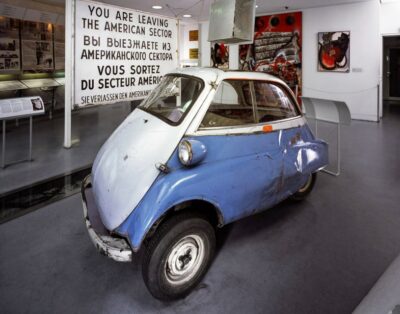
Skip-the-Line: Berlin Wall Museum at Checkpoint Charlie
Read our review →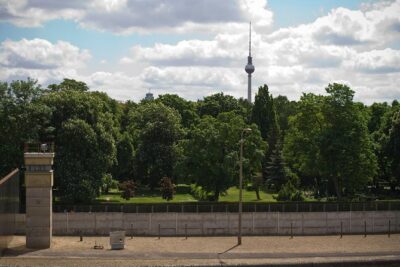
Cold War, Berlin Wall, Spies and the East Side Gallery
Read our review →
Guided Bike Tour of the Berlin Wall and Third Reich
Read our review →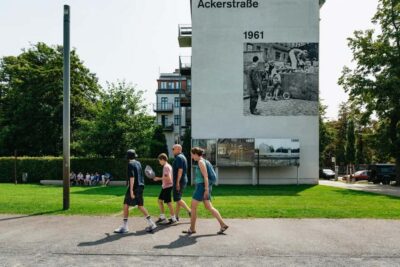
Browse the lists this tour appears in