
Reviewed · JEWISH BERLIN TOURS
Jewish Berlin Extended (private Walking tour – 5 Hours)
Berlin’s Jewish story comes into sharp focus through places that are easy to miss on your own: a synagogue ruin, a quiet protest memorial, a workshop where Otto Weidt tried to protect his Jewish employees, and Gleis 17, where Berlin Jews were deported. The human stories give the walk its force.
I like the private format, since your guide can answer questions and adjust the pace. I also like the clear route through central Berlin, linking ordinary streets with sites of courage, loss, and remembrance. The main drawback is simple: five hours on foot, with several stops devoted to difficult subjects, can feel demanding if you want a light sightseeing outing.
Key points to know before booking
- A five-hour private walk gives your group direct time with the guide and avoids a fixed group pace.
- Guide Ariel uses illustrations to explain events and answer questions in detail.
- Gleis 17 is the emotional center, with four monuments connected to the deportation of Berlin’s Jews.
- The tour covers both famous and modest sites, including Hackesche Höfe, the Missing House, and Otto Weidt’s workshop.
- Hotel pickup is available, but public transport tickets, food, drinks, and gratuities are extra.
- The route ends at the New Synagogue, while the tour begins at Hackescher Markt unless hotel pickup is arranged.
Why this five-hour walk matters
This is not a tour about one building or one chapter of Berlin’s past. It follows the story of Jewish life in Berlin from its early beginnings through persecution, deportation, survival, and the city’s long effort to remember what happened.
I value that approach. Memorial sites can feel disconnected when you see them one by one. Here, the guide links them together. You move from the remains of an old synagogue to a protest by non-Jewish women, then to the story of a man who risked his life for Jewish workers. Later, the route reaches a deportation memorial that asks you to consider how Germany remembers its past.
The private setup matters most on a subject like this. You can stop to ask about a name, a date, or a detail that catches your attention. The guide does not need to rush through a script meant for a large group. Ariel, one of the named guides, is described as using illustrations during his explanations and taking time with questions.
That said, the walk is not a casual stroll with a few historical comments. Much of the subject matter involves discrimination, deportation, and murder. You should book it because you want serious historical context, not because you are searching for an easy afternoon of sightseeing.
More Jewish history tours in Berlin:
- Nazi Berlin and the Jewish Community Tour
★ 4.8 · 55 reviews - Path of Resistance: Berlin’s Hidden Holocaust Stories
★ 5.0 · 33 reviews - Private Tour: Jewish Heritage Walking Tour of Berlin
★ 5.0 · 29 reviews
Starting at Denkmal Alte Synagoge Berlin-Mitte
The tour begins with the remains of one of Berlin’s oldest synagogues. The stop lasts about 15 minutes and has no admission charge.
The site is valuable because it introduces Jewish life in Berlin before the better-known twentieth-century events. Your guide explains the early beginnings of the community and helps you read what is left of the building as more than a fragment of masonry.
Do not expect a grand interior visit here. The attraction is the story connected to the remains, and the guide’s explanation does much of the work. This is a good opening because it places Jewish Berlin within the city’s longer story rather than beginning only with the Nazi period.
If you are arranging your own arrival, Hackescher Markt is the stated starting point. Hotel pickup is also offered from your hotel lobby, so confirm that option when booking.
Rosenstraße and a rare act of public protest
At Denkmal Rosenstraße, you spend about 15 minutes with the monument to the women’s protest. The guide explains how gentile women protested for the release of their Jewish husbands who had been taken for transport to the camps.
This stop adds an important complication to a story that can otherwise feel dominated by silence and helplessness. It focuses on people who did resist, and on a public act that had real stakes for the families involved.
The monument is free to visit, but the setting is not a large museum. You will rely on the guide to explain the event and its meaning. That is exactly where a private tour helps. You can ask for more detail instead of moving on after a brief caption.
Hackesche Höfe, where daily life meets historical change
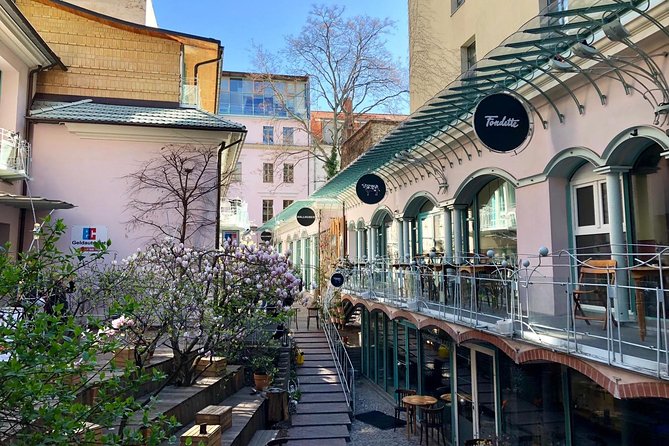
The stop at Hackesche Höfe lasts about 15 minutes. The guide discusses the site’s history, making this a shorter, more urban pause within the larger route.
Hackesche Höfe is useful because it connects Jewish Berlin with an actual neighborhood rather than treating the subject as a collection of memorials. You see the city around you while hearing how the site fits into Berlin’s Jewish past.
The information provided does not promise entry into every courtyard or a detailed architectural tour, so keep your expectations focused. This is a context stop, not a long building visit. Its value comes from placing the surrounding streets into the larger story.
Other Berlin experiences to weigh up
- Discover Berlin Half-Day Walking Tour
★ 5.0 · 9,624 reviews - Berlin: Third Reich and Cold War 2 Hour Walking Tour
★ 4.9 · 6,830 reviews - Berlin: Discover Berlin Walking Tour
★ 4.9 · 5,998 reviews - Berlin’s Best: 2 Hour Walking Tour Third Reich and the Cold War
★ 5.0 · 5,486 reviews
Otto Weidt’s workshop and the choices of one man
The Museum Blindenwerkstatt Otto Weidt receives about 20 minutes. Here, you hear how Otto Weidt tried to save his Jewish employees from the death camps, risking his own life in the process.
This is one of the tour’s most personal stops. Instead of discussing a large institution, the story centers on a workplace and the decisions made by one person trying to protect others. It gives the history a human scale without pretending that one act could erase the wider persecution.
The scheduled time is brief, so ask questions as they arise. The tour description identifies the site and its story, but it does not include a separate museum admission or promise a long indoor visit. The emphasis is on the guide’s account and the place itself.
I find this stop especially useful for families and first-time visitors who need a clear example of how individual choices mattered. It also keeps the tour from becoming only a sequence of dates and deportation records.
The old Jewish Cemetery and the Missing House
The Memorial Jewish Cemetery is another 15-minute stop. You see what remains of Berlin’s oldest Jewish cemetery and hear about the people buried there.
This stop asks you to think about absence. A cemetery is not only a place of death. It is evidence of a community that lived, worked, worshiped, and built families in Berlin long before the city’s twentieth-century catastrophe.
The next stop, the Missing House, lasts only five minutes. The monument marks the absence left by a building and invites discussion about what that absence means. It is a very short visit, but that brevity may be part of its effect. You do not linger over a large exhibition. You see a gap in the city and consider who is no longer there.
Together, these stops make a useful pair. The cemetery points to people who once belonged to Berlin. The Missing House points to the physical space left behind after lives and buildings were destroyed or removed.
The New Synagogue and what remains behind the facade
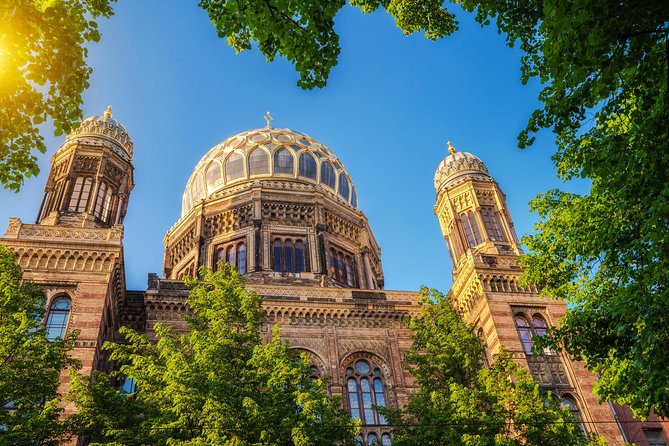
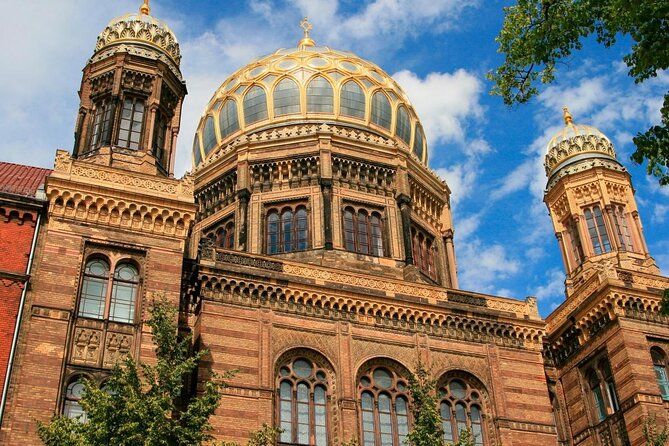
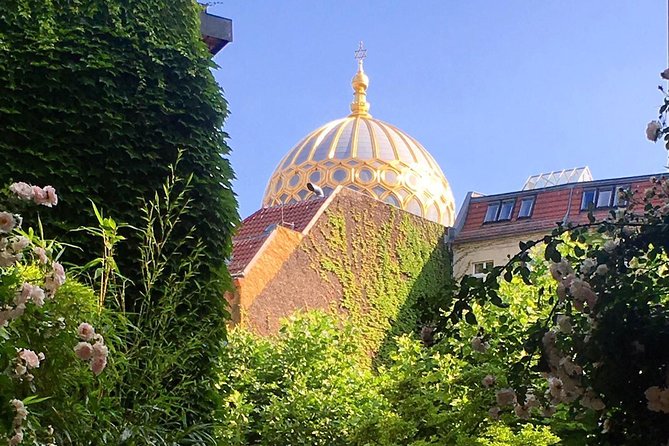
The route includes Stiftung Neue Synagoge Berlin, also called Centrum Judaicum, for about 15 minutes. The tour ends at the New Synagogue on Oranienburger Strasse.
The exterior is one of the city’s most recognizable Jewish landmarks, but you should not assume that the grand facade means the original building survives intact inside. One detailed account of the tour noted the contrast clearly: beyond the striking exterior are offices, a yard, and a small chapel on the third floor.
That detail changes how you look at the building. The facade can appear triumphant at first glance, but the limited remains behind it tell a sadder story. The guide’s explanation helps you separate what has been restored, what has survived, and what has been lost.
Because this is the endpoint, it also gives you a chance to continue independently afterward. The stated end point is New Synagogue Berlin, Centrum Judaicum, at Oranienburger Strasse 28 to 30.
Gleis 17, the tour’s hardest and strongest stop
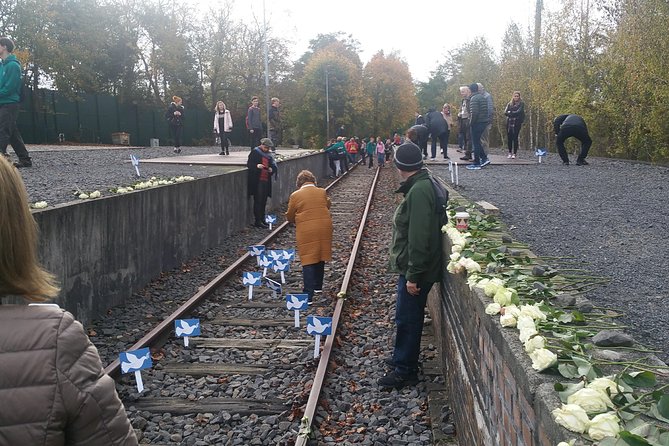
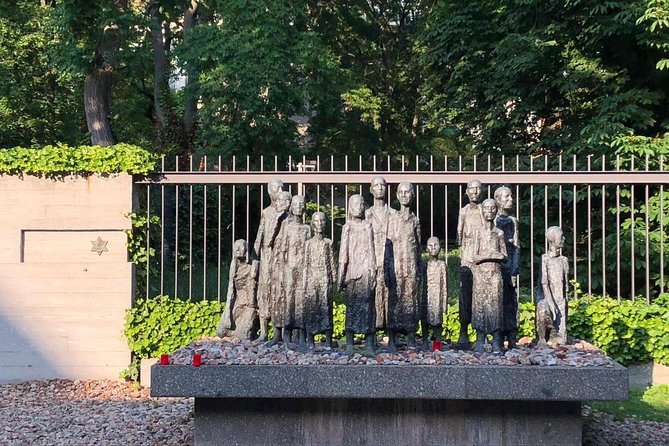
Gleis 17 Memorial receives about 45 minutes, the longest scheduled stop. You see four monuments at the site and discuss the deportation of Berlin’s Jews to the camps, along with the changing culture of memory in Germany.
This is the place where the tour’s separate threads come together. Earlier stops show community life, protest, rescue, and absence. Gleis 17 confronts the machinery of deportation and the question of how a city records such crimes afterward.
The extended time is important. A quick photograph would miss the point. You have room to listen, ask questions, and consider why the memorial takes the form it does. The guide also discusses how remembrance in Germany has changed over the years, giving the site a present-day meaning as well as a historical one.
I would plan this stop for your most attentive part of the day. The subject is heavy, and the setting calls for quiet reflection. If you need a break during long walks or difficult material, tell your guide. This is one of the advantages of booking a private tour.
How the private format changes the experience
The tour is for your group alone, with a maximum group size of 15. That is a major difference from a standard city walk. A group of two or four gets a much more personal exchange, while a full group of 15 still remains smaller than a typical large excursion.
The guide can answer questions about specific people and events rather than giving only a general speech. Ariel’s use of illustrations is another practical benefit. Visual material can help you understand places that have been altered, destroyed, or reduced to a memorial.
The five-hour length also allows the tour to tell a connected story. A shorter walk might cover the New Synagogue and one memorial, but it would have less room for the cemetery, Rosenstraße, Otto Weidt, and Gleis 17.
The tradeoff is stamina. You should expect a substantial amount of walking and standing, even though the exact distance is not provided. Comfortable shoes are sensible, and you should allow enough time for the full five hours rather than scheduling a tight appointment immediately afterward.
Price, pickup, and what you actually receive
The price is $624.79 per group of up to 15 people. That is expensive for one or two people, but the calculation changes if you are sharing it with family or friends. A group of 10, for example, pays far less per person than a couple booking alone.
The price includes all fees and taxes. It does not include gratuities, food, drinks, or a public transportation ticket. Since the experience is described as a walking tour, you should not treat transport as included simply because hotel pickup is offered.
Pickup from your hotel lobby is available, while the listed starting point is Hackescher Markt. Ask for the exact pickup arrangement before the day of the tour. The stated operating hours are 8:00 AM to 8:00 PM daily.
Confirmation is provided at booking. Service animals are allowed, and the activity is near public transportation. The provided information says most people can participate, but it does not give a route distance or detailed step-free access information. If mobility is a concern, ask the provider for specifics before paying.
Free cancellation is available if you cancel at least 24 hours before the start time. Cancellations inside that window are not refunded, and changes made within 24 hours are not accepted.
Who should book this Berlin Jewish history tour
I would recommend this experience to anyone who wants a focused account of Jewish Berlin rather than a general city tour. It suits visitors with a serious interest in history, memorial culture, and the personal stories behind public sites.
It is also a strong choice for a private family group. The guide can explain difficult subjects at the right level and pause when children or older relatives need more context. The private format is useful for school, community, or cultural groups too, especially when discussion matters as much as sightseeing.
I would think twice if you have only a short time in Berlin or prefer indoor museums with long displays and artifacts. Several stops are outdoor monuments or remains, and the tour relies heavily on spoken explanation. You should also be ready for emotionally difficult material.
Should you book it?
Book this tour if you want to understand how Jewish life, persecution, resistance, and remembrance connect across Berlin. The strongest reasons are the private attention, Ariel’s detailed explanations with illustrations, and the full 45 minutes at Gleis 17.
The price makes the most sense for a shared group of friends or family. For a couple, it is a significant splurge, but the five-hour route covers far more than a short memorial walk and gives you a guide who can respond to your questions.
Skip it if you want a relaxed sightseeing loop or if you would rather spend the day inside museums. For the right audience, though, this is a serious, carefully paced way to meet Berlin’s Jewish past in the streets where much of it unfolded.
FAQ
How long is the Jewish Berlin tour?
The tour lasts approximately five hours.
Is this a private tour?
Yes. Only your group participates, with up to 15 people.
Is hotel pickup available?
Yes. Pickup is offered from the lobby of your hotel. The listed starting point is Hackescher Markt in Berlin.
Where does the tour end?
The tour ends at New Synagogue Berlin, Centrum Judaicum, at Oranienburger Strasse 28 to 30, 10117 Berlin.
Are admission fees included?
All fees and taxes are included. The listed stops have no admission charge. Food, drinks, gratuities, and public transportation tickets are not included.
What is the cancellation policy?
You can receive a full refund if you cancel at least 24 hours before the experience begins. Cancellations or changes made less than 24 hours before the start time are not accepted and are not refunded.
Newest Berlin reviews
- Where It All Began: Berlin’s Queer & Trans History Tour★ 4.9 · 6 reviews
- Understanding Kreuzberg: The roots of local (sub)culture★ 4.9 · 11 reviews
- Berlin: guided canoe | kayaktour★ 4.1 · 7 reviews
- Private Potsdam City Tour in an authentic vintage van★ 5.0 · 14 reviews
- Warnemünde Shore Excursion: Private Sachsenhausen and Berlin Tour★ 5.0 · 12 reviews
- Ultimate E-Bike Tour of Berlin with Beer Garden Stop★ 5.0 · 4 reviews
- In the Forbidden City – Potsdam Walking Tour★ 5.0 · 17 reviews
- Private Walking Tour of Potsdam and Sanssouci★ 5.0 · 24 reviews
Jewish Berlin Tours, compared.
Path of Resistance: Berlin’s Hidden Holocaust Stories
Read our review →
Private Tour: Jewish Heritage Walking Tour of Berlin
Read our review →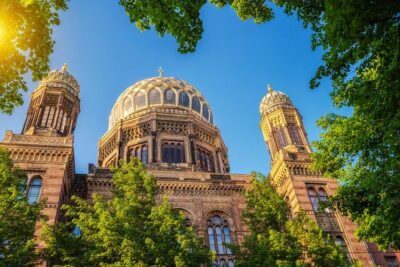
Jewish Berlin: Walking tour The Old Jewish Quarter (private 3 Hours tour)
Read our review →
Path of Resistance: Berlin’s Hidden Holocaust Stories
Read our review →
Browse the lists this tour appears in