
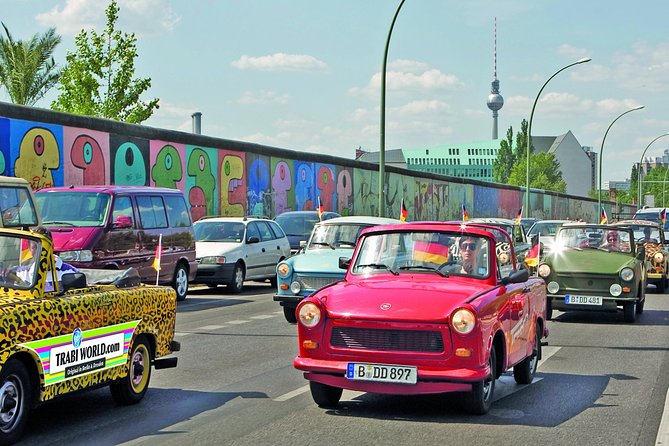
Reviewed · BERLIN WALL TOURS
Berlin Wall Self-Drive Trabi Tour
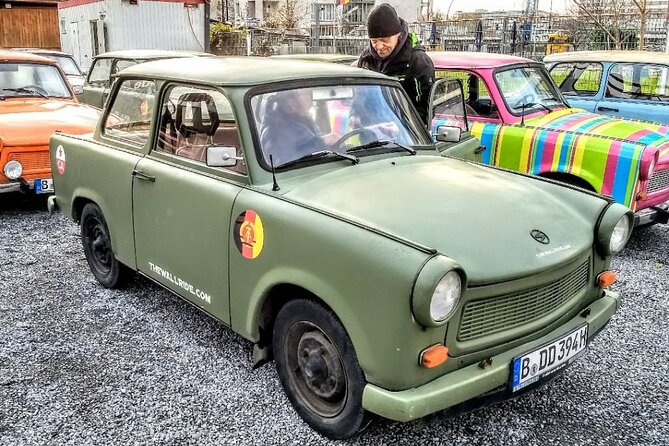
Berlin’s past comes alive in an unlikely little package: a 600cc Trabant, with its column-mounted gearshift, basic controls, and cheerful East German colors. You follow a guide-led convoy through central Berlin, passing the Berlin Wall and major Cold War sites while the guide explains how the divided city worked.
I like the chance to drive rather than simply look out a bus window, and I like the souvenir Trabant driver’s license, which every participant can take home. The catch is clear: these are manual cars, Berlin traffic is busy, and a hesitant driver may find the experience stressful at first.
Key points to know before you book
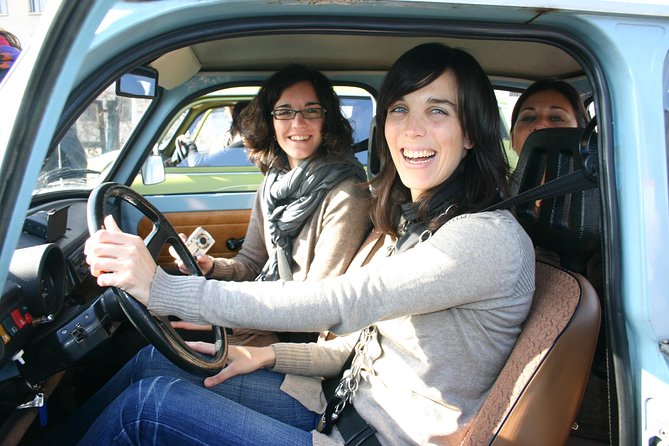
- You drive an authentic manual Trabant: Expect a small, old-fashioned car with a column gearshift, no power steering, and no servo-assisted brakes.
- The route links Berlin’s Cold War landmarks: You pass the East Side Gallery, Checkpoint Charlie, Bernauer Strasse, Alexanderplatz, the Brandenburg Gate area, and the Red Town Hall.
- The convoy is part of the fun: Your guide leads from the front and uses a radio system for commentary, though sound quality can vary.
- Only four people share each car: The vehicle limit is 350 kilograms, and the compact cabin can feel snug, especially for tall adults.
- You need a license and confidence: Every driver must show a license for a non-automatic car, and the tour is for ages 18 and up as drivers.
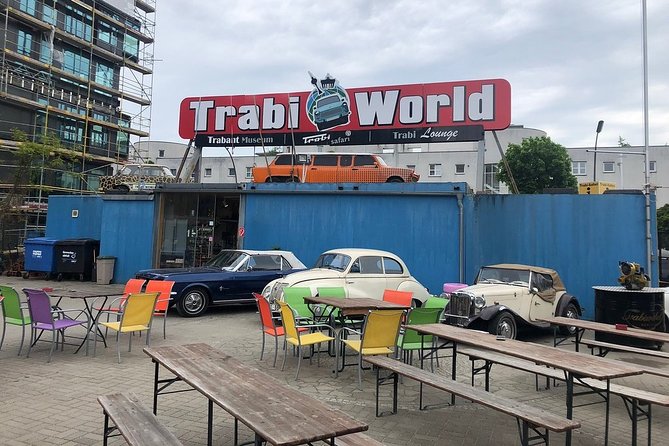
- The tour ends where it begins: Meet at TrabiWorld Berlin on Zimmerstrasse, then return the car there after roughly two hours and 15 minutes.
Why a Trabant makes Berlin’s history more memorable
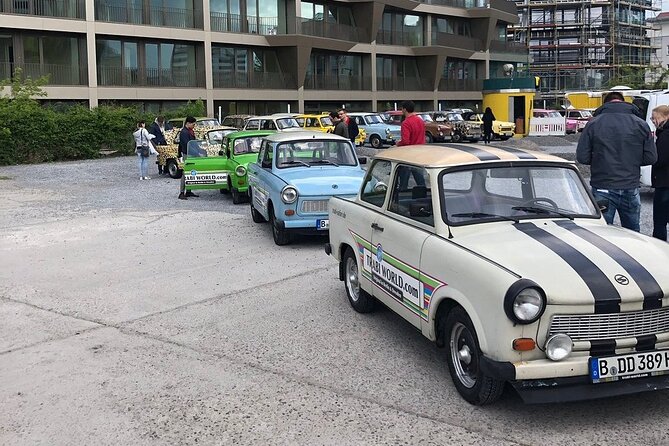
The Trabant was made in East Germany, so it is more than a novelty car. It is a small piece of the political story you are seeing on the streets. Driving one past former border points gives the Cold War setting a physical edge that a standard sightseeing ride cannot quite match.
The car itself takes some getting used to. You shift with a column-mounted stick, and the old controls demand more attention than a modern rental car. There is no automatic option. You may kangaroo forward while learning, especially at the start, but the guide waits for the convoy to catch up and the basic mechanics usually become easier once you are moving.
The cars are painted in different colors, chosen on a first-come basis. You do not pick from a guaranteed color list, so arrive ready to accept the car available. That small uncertainty is part of the old-school charm, but it matters if you have your heart set on a particular shade.
The experience is not a quiet private drive. You are in a convoy of Trabants, connected to the guide by radio. People along the streets may wave or photograph the cars, and the whole group becomes a moving bit of Berlin street theater. That attention adds fun, though anyone who dislikes being noticed should know what to expect.
More Trabi safari drives in Berlin:
- Berlin: 75-minute Trabi Safari
★ 4.8 · 2,854 reviews - Berlin Self-Drive Trabi Tour with Guide
★ 4.5 · 410 reviews - Private Tour: Berlin by Trabant Stretch-Limousine
★ 5.0 · 186 reviews
Starting at TrabiWorld on Zimmerstrasse
The meeting point is TrabiWorld Berlin, Zimmerstrasse 97-100, 10117 Berlin. The start time is 11:30 a.m., and the activity ends back at the same place. Hotel pickup and drop-off are not included, so you need to make your own way to the meeting point.
The first stage takes about 10 minutes. You receive a welcome and safety briefing, meet the guide, and get familiar with the car before entering city traffic. This is the moment to ask about the gear pattern, the radio, and changing drivers later in the tour.
The group can contain up to 12 people, divided among Trabants with no more than four occupants in each. The four-person limit sounds generous, but the cars are small. Three tall adults and a shorter passenger can fit, as one group discovered, but you should not expect modern-car legroom.
Children up to age 17 can join free when accompanied by at least one adult. If a child seat is needed, you must bring it yourself. Drivers must be at least 18 and show proof of a valid license for a manual, non-automatic vehicle. The tour permits service animals and is near public transportation.
Getting used to the 600cc Trabant
The first few minutes are the real test. The Trabant has a manual transmission, no power steering, and no servo-assisted brakes. If you regularly drive a manual car, you will still need a short adjustment period. If you are new to stick shifting, the start can feel daunting, especially at a crowded junction.
One useful feature is the chance to switch drivers during the tour. The exact timing depends on the guide and traffic, but couples can often share the driving. That makes the price easier to justify for two people, since both can take part rather than leaving one person as a passenger for the whole route.
The guide leads at a steady pace and waits when drivers fall behind. That matters in Berlin, where cars, bikes, scooters, and pedestrians compete for road space. You should still be calm and alert. This is not a closed driving course, and the city does not stop for the convoy.
The radio commentary adds context as you drive. Several guides have led this experience, including Heinrich and Tomas. Commentary is given in English, with some sessions also offering German. Sound quality can vary inside the old cars, especially toward the back, so sit where you can hear the speaker clearly and pay attention when the guide begins talking.
There is also a practical risk to consider. The operator requires an EUR 850 co-payment in the event of an accident. Read the terms carefully before driving and take the car’s age, the city traffic, and your own comfort with manual driving seriously.
From central Berlin to the Brandenburg Gate area
Once the convoy gets moving, the tour passes several important central sights and traffic intersections. The route gives you a quick overview rather than long stops at each place. Think of it as a guided city circuit with short visual encounters, not a walking tour with time to enter museums or monuments.
The Brandenburg Gate area is one of the key sights. The famous neoclassical monument once sat beside the divided city and later became a powerful symbol of reunification. Seeing it from a Trabant connects the monument with the everyday streets around it, though you will not have much time to stop, explore, or take detailed photographs.
The route also includes Berlin’s Red Town Hall, built in the 19th century. Its red brick facade and central location make it easy to spot from the road. Again, the value is in the broad sweep of the drive. You collect landmarks and historical clues, then return later on foot if one catches your interest.
This portion works well early in a Berlin visit. You get your bearings across several neighborhoods without committing to a full day of sightseeing. The tradeoff is that the guide must keep the convoy moving, so you should not book this expecting extended time at every landmark.
More Berlin Wall tours in Berlin:
- Skip-the-Line: Berlin Wall Museum at Checkpoint Charlie
★ 4.1 · 2,041 reviews - Cold War, Berlin Wall, Spies and the East Side Gallery
★ 5.0 · 1,024 reviews - THE WALL: asisi Panorama Berlin Ticket
★ 4.5 · 580 reviews - Berlin: Guided Bike Tour of the Berlin Wall and Third Reich
★ 4.7 · 499 reviews
East Side Gallery and the surviving Wall
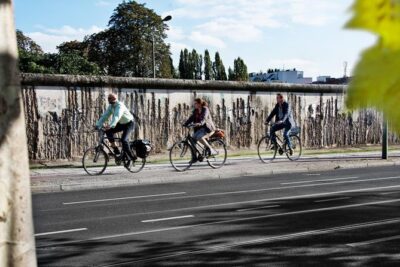
East Side Gallery is one of the most visual parts of the route. It occupies a 1,316-meter remnant of the Berlin Wall covered with murals painted directly on the concrete. The open-air gallery turns a former barrier into a long public art site.
The stop is brief, listed at about five minutes. That is enough for a quick look, but not enough to study a large number of murals or walk the full length. If East Side Gallery is high on your personal list, return independently after the tour with more time.
The short stop still has value because the guide can explain the Wall’s role while you are seeing an actual surviving section. You are not only hearing about division in a classroom-like setting. You are passing a physical remnant in the same city where the barrier once split streets, families, and daily life.
The Trabant adds another layer here. It was an ordinary car in East Germany, and the convoy of colorful examples beside the Wall creates a striking link between former daily life and present-day memory. The scene can feel playful, but the historical setting keeps it from being simple car nostalgia.
Alexanderplatz, the Red Town Hall, and Berlin’s eastern center
The route includes the public square associated with Berlin’s TV tower, Alexanderplatz. The tower is one of the city’s best-known landmarks, and the square gives you a sense of the former East Berlin center.
You pass through a mix of large public spaces and traffic routes rather than isolated postcard corners. That is useful because Berlin’s divided past was not confined to one preserved strip. It shaped transport lines, squares, civic buildings, and ordinary neighborhoods.
The Red Town Hall nearby adds another recognizable marker. You may not linger, but the sequence of sights helps you place East Berlin’s political and civic center in relation to the Wall and other Cold War locations.
This is one reason I would take the tour near the beginning of a Berlin stay. Use the drive as a first look, note the places that interest you, then return later by train or on foot. The tour gives you a map in your head, even if it does not give you enough time to inspect each stop.
Checkpoint Charlie and Bernauer Strasse
A former border crossing is also included, widely known as Checkpoint Charlie. It was one of the best-known crossing points between East and West Berlin. Today, the area is a busy city sight, so the tour provides context while placing you in the streets where the border once carried real political weight.
You should keep your expectations realistic. Passing a former checkpoint in a convoy is not the same as spending an hour at a museum or memorial. The guide supplies a historical explanation, but you will have to return on your own if you want detailed exhibits or extended reading.
The route also reaches the central memorial site connected with German division at Bernauer Strasse. This area preserves a particularly direct record of the Wall, including the way it cut through streets and separated residents. It is among the more serious parts of the drive, and it gives the Cold War theme a stronger human focus.
Taken together, these sights create a useful contrast. East Side Gallery shows how the Wall was later treated as a canvas. Checkpoint Charlie recalls international confrontation. Bernauer Strasse presents the division as a local fact that altered homes and streets. The tour moves quickly, but the sequence gives the history shape.
What the convoy is like in real city traffic
The main practical question is not how attractive the Trabant looks. It is how comfortable you are operating an old manual car in central Berlin.
You will share roads with modern cars, bicycles, scooters, and pedestrians. Busy intersections can be the hardest moments, particularly if you have never driven a column-shift manual before. A calm driver who accepts a few imperfect gear changes will have a better time than someone determined to operate the car flawlessly.
The guide does not simply vanish into the distance. The convoy is led carefully, and the guide waits for slower drivers. That helps, but it does not remove the need to watch traffic and follow local road rules.
Exhaust can also drift into the cars from the Trabants ahead. One passenger found it hard on the throat, so you may prefer to sit farther back in the convoy if that is possible. The effect will vary, but it is worth knowing before you book a vintage-car experience rather than a modern sightseeing vehicle.
The radio system is useful but not perfect. The guide’s commentary can be heard from the back seat, yet sound may be unclear in some cars. Sit close to the speaker when possible, and do not assume you will catch every word while shifting, turning, and watching traffic.
Is $119.48 per person good value?
At $119.48 per person, this is not the cheapest way to see Berlin. Public transportation and walking will cost far less, and a conventional bus tour may cover more sights with less effort.
You are paying for three things: the car, the guide-led route, and the chance to drive an unusual part of Berlin’s past. If two people share a car and both get time behind the wheel, the experience offers stronger value. If you only want a checklist of landmarks, the price may feel high for a roughly two-hour-and-15-minute circuit.
The small group size helps. With no more than 12 people and four to a car, the experience feels more personal than a large coach ride. You also get the souvenir Trabant driver’s license, even if you do not drive, which gives you a modest keepsake without an extra charge.
The biggest value comes from the combination of history and participation. You are not just looking at a Trabant parked beside a shop. You are operating one in the city, following the same broad streets that connect Berlin’s divided past. For a first visit, that unusual angle can make the cost worthwhile.
Who should book this Trabant tour?
I would choose this for a couple or small group that enjoys hands-on sightseeing, odd vehicles, and Cold War history. It suits someone who wants a funny story to tell later, not just another photograph in front of a landmark.
It is also a good choice for a first full day in Berlin if you want an overview before exploring on foot. The tour points out enough places to help you plan later visits to East Side Gallery, Checkpoint Charlie, or Bernauer Strasse.
I would be cautious if you are an anxious driver, dislike manual transmissions, or want a slow and detailed history tour. You can ride rather than drive, but the movement of the car and the city traffic remain part of the experience. Tall passengers should also think carefully about sharing the compact cabin for more than two hours.
The tour is offered in English, and the guide may speak German as well. Children can ride free with an adult, but drivers must be 18 or older. Bring any required child seat yourself.
Should you book the Berlin Wall Self-Drive Trabi Tour?
Book it if you want Berlin’s Cold War story delivered with a steering wheel, a noisy little engine, and a convoy that attracts attention wherever it goes. The strongest parts are the authentic Trabant, the guide’s live historical commentary, the chance to switch drivers, and the route linking East Side Gallery, Checkpoint Charlie, Bernauer Strasse, and central Berlin.
Skip it if you want a polished vehicle, quiet sightseeing, or long stops at each monument. The manual gearbox, city traffic, variable radio sound, compact cabin, possible exhaust, and EUR 850 accident co-payment are real considerations.
For the right person, this is a memorable two-hour introduction to Berlin. You will not see every landmark in depth, but you will understand the city’s divided past from behind the wheel of a car that belongs to that story.
FAQ
Where does the Berlin Wall Self-Drive Trabi Tour start?
It starts at TrabiWorld Berlin, Zimmerstrasse 97-100, 10117 Berlin, Germany. The activity ends back at the same meeting point.
What time does the tour start?
The scheduled start time is 11:30 a.m.
How long does the tour last?
The tour lasts approximately 2 hours and 15 minutes.
Do I need a manual driving license?
Yes. All drivers must provide evidence of a license that allows them to drive a non-automatic car. The Trabants are manual shift only.
How many people can ride in one Trabant?
Each Trabant can carry a maximum of four people and a total maximum weight of 350 kilograms.
Can children join the tour?
Children up to age 17 can join free when accompanied by at least one adult. Drivers must be at least 18 years old. If a child seat is needed, you must bring it yourself.
Newest Berlin reviews
- Where It All Began: Berlin’s Queer & Trans History Tour★ 4.9 · 6 reviews
- Understanding Kreuzberg: The roots of local (sub)culture★ 4.9 · 11 reviews
- Berlin: guided canoe | kayaktour★ 4.1 · 7 reviews
- Private Potsdam City Tour in an authentic vintage van★ 5.0 · 14 reviews
- Warnemünde Shore Excursion: Private Sachsenhausen and Berlin Tour★ 5.0 · 12 reviews
- Ultimate E-Bike Tour of Berlin with Beer Garden Stop★ 5.0 · 4 reviews
- In the Forbidden City – Potsdam Walking Tour★ 5.0 · 17 reviews
- Private Walking Tour of Potsdam and Sanssouci★ 5.0 · 24 reviews
Berlin Wall Tours, compared.
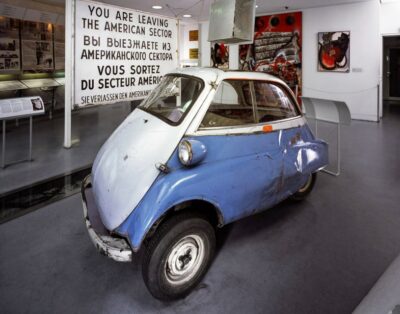
Skip-the-Line: Berlin Wall Museum at Checkpoint Charlie
Read our review →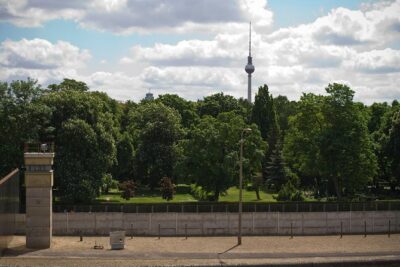
Cold War, Berlin Wall, Spies and the East Side Gallery
Read our review →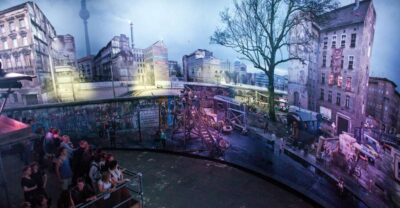
Guided Bike Tour of the Berlin Wall and Third Reich
Read our review →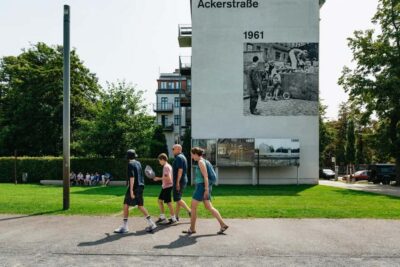


Browse the lists this tour appears in