
Reviewed · QUEER BERLIN TOURS
Where It All Began: Berlin’s Queer & Trans History Tour
Berlin’s queer history is not tucked away in a museum. It is written into street names, former clubs, police offices, memorials, and the spaces where people fought to live openly. This 3.5-hour walking tour links those places, from Karl-Heinrich-Ulrichs-Straße to Metropol, while tracing activism, persecution, nightlife, trans lives, and the Aids crisis.
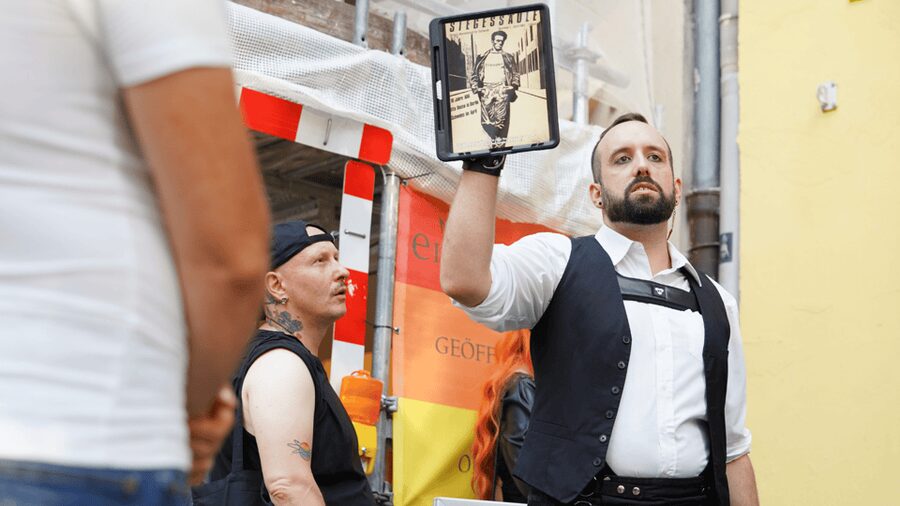
I like the small group of 10 and the iPad-based AR work, which can place old photographs and films over the streets you are standing on. I also like the focus on people often pushed to the margins of standard Berlin tours, including lesbian performers, trans activists, queer refugees, and East Berlin organizers. The main drawback is the pace: ten stops and a serious amount of material make this a mentally full afternoon, and bad weather can cancel the walk.
Key points to know before booking
- Ten stops across Schöneberg: The route connects major sites in Berlin’s queer past, ending at Metropol on Nollendorfplatz.
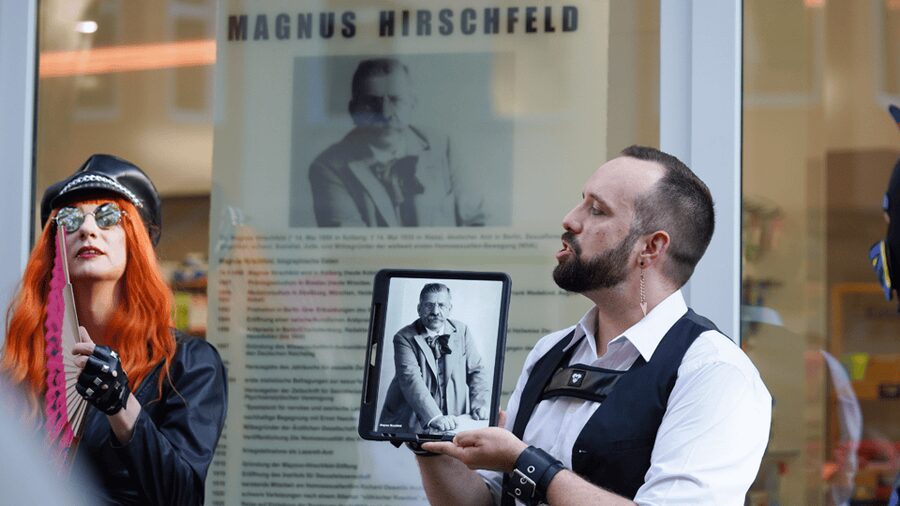
- An iPad adds visual context: Your guide can show more than 200 rare photos, videos, and archive items at the places they relate to.
- Jeff leads the experience: The guide is presented as a queer activist and gender scholar, and the tour uses personal, political, and cultural stories rather than a simple date-by-date lecture.
- The group is capped at 10: That makes questions easier and keeps the AR demonstrations visible to everyone.
- The subject matter is wide-ranging: Expect Nazi persecution, Paragraph 175, lesbian cabaret, trans nightlife, the Aids crisis, Pride, and gentrification.
- The price reflects a specialist tour: At $83.13 per person, this is more than a standard city walk, but it includes a focused subject, rare visual material, and a guide with a strong connection to the topic.
Why Berlin’s queer past works best on foot
The strongest idea behind this tour is that Berlin’s queer past is tied to ordinary city blocks. You are not only hearing about a club or activist group. You are seeing the street where it operated, the square where a community gathered, or the address connected with a figure who helped shape modern LGBTQIA+ rights.
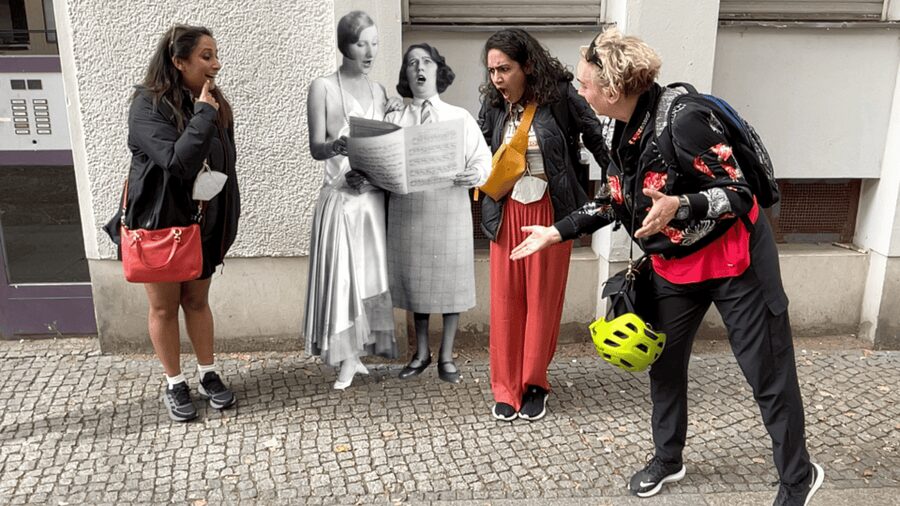
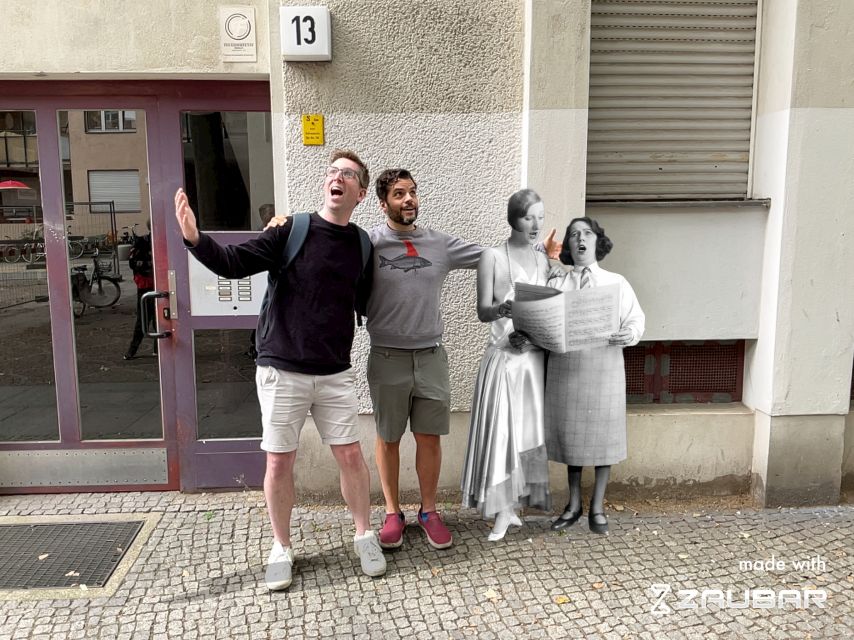
That setting gives the history weight. A photograph of a vanished bar is useful on its own, but seeing it on the same pavement where people once met adds another layer. The AR element should help here. Your guide can use the iPad to bring historic images and video into the present-day setting, rather than asking you to picture everything from words alone.
This is not a general tour of Berlin with a few queer references added. The entire route follows LGBTQIA+ lives and politics. That makes it a strong choice if you already know Berlin’s main landmarks and want a subject-specific experience.
The meeting point is Alnatura Super Natur Markt at Else-Lasker-Schüler-Straße 18. The walk begins at 2 p.m. and ends at Metropol, Nollendorfplatz 5. Wear comfortable shoes and allow the full three and a half hours. The information is dense, so I would not schedule a major museum or formal meal immediately afterward.
More queer history tours in Berlin:
- Berlin: Gay Berlin Out in Schöneberg Walking Tour
★ 4.8 · 281 reviews - Berlin’s Gay, Lesbian, and Queer Scene Small-Group Walking Tour
★ 4.5 · 66 reviews - Queer Berlin Walking Tour
★ 4.7 · 64 reviews
Karl-Heinrich-Ulrichs-Straße and the first rights arguments
The opening stop introduces Karl Heinrich Ulrichs, the person often called the world’s first gay rights activist. The street named for him provides a useful starting point because Ulrichs publicly argued for the decriminalization of homosexuality before the modern word homosexual had even entered common use.
This is more than a short biography. It shows that queer political thought did not begin in the late twentieth century. People were defining identity, challenging criminal laws, and asking society to recognize same-sex desire long before the language and organizations familiar today.
The stop lasts about five minutes, so expect an introduction rather than a long lecture. Its value is setting the frame for the rest of the afternoon: the tour treats queer people as historical actors who built ideas, institutions, and movements.
Nollendorfplatz and the danger of Nazi-era contradictions
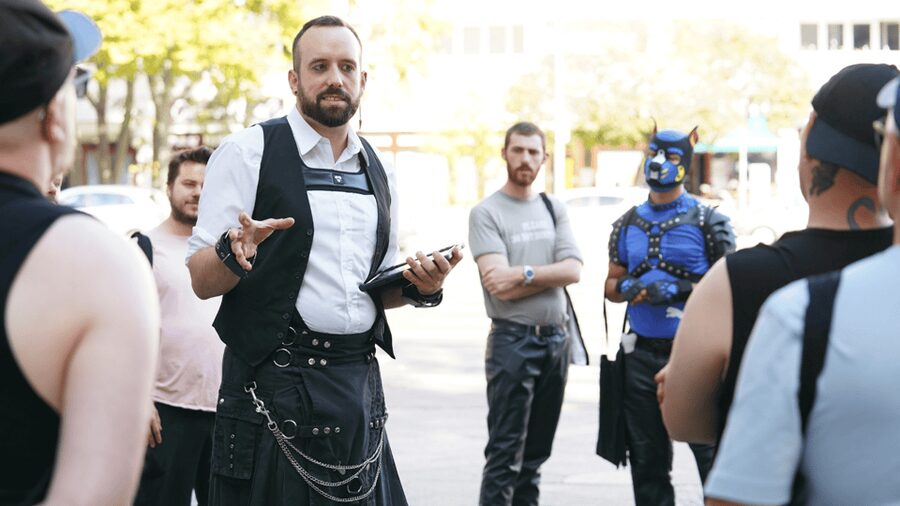
Nollendorfplatz is one of the central addresses on the route. Here, the tour tackles the persecution of LGBTQIA+ people under the Nazis, including the use of the pink triangle in concentration camps.
The story is not presented as a simple division between queer people and the Nazi regime. You will hear about Adolf Brand, right-wing gay activists, and Ernst Röhm, an openly gay Nazi whose position inside the party did not protect him. The Night of the Long Knives, when Röhm and others were executed, reveals the cruel contradictions of a movement that could tolerate or exploit certain queer men while pursuing wider persecution.
This is one of the heavier sections. It connects political power, public identity, and survival, and it does not reduce queer history to nightlife and personal freedom. If you prefer light sightseeing, the subject matter may feel intense. That seriousness is also one of the tour’s strengths.
Lesbian Berlin at Schwerinstraße 13
At Schwerinstraße 13, the focus shifts to lesbian life in the 1920s. The former site of Toppkeller helps explain why bars and clubs mattered so much. These were places where queer women could find companionship, recognition, and some measure of safety in a city that did not offer those things freely.
The stop also brings in Claire Waldoff, a lesbian cabaret singer whose songs became associated with defiance. Josephine Baker adds an international and bisexual dimension to the story. Her appeal crossed gender lines, and her career shows how performance could challenge social expectations even when performers still faced exploitation and scrutiny.
I like this section because it corrects the common habit of telling Berlin’s queer past mainly through gay male clubs. The stop lasts about 20 minutes, enough time to connect a physical address with culture, music, and community life.
More history tours in Berlin:
- Berlin: Natural History Museum Entrance Ticket
★ 4.6 · 3,382 reviews - Berlin: World Heritage Cruise to Potsdam
★ 4.5 · 1,435 reviews - Berlin Historical Highlights Walking Tour
★ 4.9 · 657 reviews - Berlin Private Complete History All Day Walking Tour
★ 5.0 · 474 reviews
Isherwood, police records, and the world behind Cabaret
At Nollendorfstraße 17, the tour turns to gay male life in 1920s Berlin and the surprising role of the police’s homosexual department. That detail points to the uneasy relationship between official surveillance and the size of the city’s queer population.
Christopher Isherwood gives the stop a literary thread. His Berlin experiences helped inspire Cabaret, but the tour goes beyond the familiar musical. It discusses Isherwood’s relationship with Heinz Neddermeyer and their escape from Nazi Germany as queer refugees.
This is useful if your idea of Cabaret is mostly songs, costumes, and nightlife. The real setting was also a place of risk, policing, political change, and forced departure. The stop lets you connect popular culture with the lives that shaped it.
Magnus Hirschfeld and a lost center of queer research
The stop at Magnus-Apotheke covers some of the most important institutional work on the route. Magnus Hirschfeld founded the Institute for Sexual Science and helped create the Scientific-Humanitarian Committee, described here as the world’s first organization dedicated to queer rights and gender studies.
You will hear about Hirschfeld’s theory of sexual intermediaries, the idea of Berlin’s third gender, and early gender-affirming surgeries involving Dora Richter, Lili Elbe, and Karl M. Baer. The discussion also returns to Paragraph 175, the law used to criminalize sex between men.
The destruction of the Institute by the Nazis gives this stop a painful edge. It was not only a building that disappeared. Research, records, objects, and a place where queer people could seek support were destroyed. The tour turns a street address into a reminder of how much evidence can be lost when a regime attacks both people and memory.
Eldorado and the contradictions of queer nightlife
The modern Denns BioMarkt marks the former site of Eldorado, one of Berlin’s best-known drag bars in the 1920s. The contrast between today’s shop and the former club is exactly the kind of detail that makes a walking tour worthwhile. The city changes, but the address can still open a door to the past.
Eldorado attracted drag performers and gender-nonconforming people. It was also visited by figures such as Ernst Röhm, whose presence exposes the contradictions of queer nightlife in the Weimar era. A person could take part in a queer social world and still support political forces that threatened others within that same world.
The stop lasts about 20 minutes. Expect discussion rather than a preserved interior, since the club itself is gone. The iPad’s historical photographs should be especially useful here, helping you see what the present-day building cannot show.
Postwar activism and Charlotte von Mahlsdorf
At Prinz Eisenherz, the route moves into the years after World War II. You will learn about Homosexuelle Aktion West-Berlin, one of the early queer rights organizations formed after the war, and SchwuZ, a club that became a major part of Berlin’s queer social life.
The stop also introduces Charlotte von Mahlsdorf, a trans woman who preserved Berlin’s queer history and created safe spaces in East Berlin. Her story broadens the tour beyond West Berlin’s better-known club culture. It also shows that queer life and activism continued on both sides of the divided city, even under very different political systems.
This section lasts about 15 minutes, so it works as a bridge between earlier rights campaigns and the club-centered activism of the 1970s and 1980s.
Chez Romy Haag and the trans club revolution
At Connection, the focus turns to West Berlin’s trans community. Chez Romy Haag, a trans-led nightclub, helped change how gender-diverse people could appear and socialize in public.
The importance of a venue like this was not only its entertainment. It offered a place where people could be seen on their own terms. The stop connects that earlier club culture with Berlin’s later reputation for queer nightlife, while keeping trans people at the center rather than treating them as an afterthought.
The tour gives this section about 15 minutes. That is enough for a clear overview, though you should not expect a full history of every trans organization or club in Berlin. The route is broad, and each stop has to share time with the next.
The Aids crisis at Internationale Stele GEGEN DAS VERGESSEN
The memorial called Internationale Stele GEGEN DAS VERGESSEN provides a serious pause. Here, you examine the Aids crisis in divided Berlin and the ways queer communities organized when public policy and medical understanding were often inadequate.
Rita Süssmuth appears as a politician who advocated for Aids awareness, an unusual position in a period marked by fear and stigma. The phrase describing the Berlin Wall as the condom of the GDR points to the sharp differences between East and West Berlin in how the crisis was handled.
This stop matters because it links health policy with queer activism. It also prevents the tour from treating the past as a steady march toward greater freedom. Progress was uneven, and survival often depended on community action.
Metropol, Pride, and the fight for Berlin’s future
The final stop is Metropol at Nollendorfplatz. The club connects older gay nightlife with Berlin’s techno scene and with places such as Berghain and Lab.Oratory.
The conversation then widens to SO36’s queer nights, Folsom Europe, Kreuzberg Pride, and the Dyke March. These events show how nightlife, protest, identity, and public space continue to overlap. The tour also addresses gentrification and the struggle to keep Berlin affordable, including the radical Tuntenhaus squat.
Ending here is smart. You finish with present-day questions rather than a tidy historical ending. Berlin’s queer spaces have survived persecution and political division, but they still face rising costs and pressure from redevelopment.
What the AR and small group add
The technology is not the reason to book this tour, but it helps the history land. With an iPad, your guide can show old photographs, films, and archive material at the locations under discussion. The tour includes more than 200 rare historical images and videos, so the visual material is a meaningful part of the experience rather than a small extra.
The Mixies feature lets you take personalized photos with AR elements. That will appeal to some people and feel less important to others. I would treat it as a playful side feature, not the main value of the tour.
The group limit of 10 is more important. A large crowd would make an iPad demonstration awkward and limit questions. In a small group, you should have a better chance to ask about a particular person, club, law, or period.
Is $83.13 a fair price?
At $83.13 per person, this is not a bargain city stroll. You are paying for a specialist route, a small group, a guide who works as a queer activist and gender scholar, AR presentation, and a substantial archive of images and video.
The price makes more sense if you care about the subject and want more than a quick overview. Ten stops over three and a half hours gives the tour room to cover politics, culture, gender, health, and nightlife. A general walking tour could be cheaper, but it would almost certainly spend less time on these subjects.
You should also budget for a possible café break. Coffee or tea is not included. The tour is offered in English, and a mobile ticket is provided. Confirmation comes at booking, public transportation is nearby, and service animals are allowed.
You can cancel for a full refund up to 24 hours before the 2 p.m. start. Since the walk requires good weather and a minimum number of participants, check your messages before setting out. If the operator cancels for those reasons, you are offered another date or a full refund.
Who should book this Berlin walk?
I would choose this tour if you want Berlin history told through LGBTQIA+ lives, or if you already know the city’s standard sights and want a more focused afternoon. It suits visitors interested in activism, queer theory, theatre, nightlife, trans history, Nazi persecution, and the Aids crisis.
It is also a strong choice for anyone who learns better from images than from a long spoken lecture. The old photographs and AR overlays give you something concrete to study.
I would skip it if you want a relaxed stroll with little walking, light entertainment, or only famous landmarks. The material can be painful, and the schedule is full. You should be ready to listen carefully, walk between stops, and think about difficult subjects.
FAQ
How long does the Berlin queer and trans history tour last?
The tour lasts approximately 3 hours and 30 minutes.
Where does the tour begin?
It begins at Alnatura Super Natur Markt, Else-Lasker-Schüler-Straße 18, 10783 Berlin, Germany.
Where does the tour end?
The tour ends at Metropol, Nollendorfpl. 5, 10777 Berlin, Germany.
What time does the tour start?
The scheduled start time is 2 p.m.
How many people can join the tour?
The group is capped at 10 people.
Is the tour offered in English?
Yes. The tour is offered in English.
What happens if the tour is canceled because of weather?
You are offered a different date or a full refund if poor weather causes the cancellation.
Newest Berlin reviews
- Where It All Began: Berlin’s Queer & Trans History Tour★ 4.9 · 6 reviews
- Understanding Kreuzberg: The roots of local (sub)culture★ 4.9 · 11 reviews
- Berlin: guided canoe | kayaktour★ 4.1 · 7 reviews
- Private Potsdam City Tour in an authentic vintage van★ 5.0 · 14 reviews
- Warnemünde Shore Excursion: Private Sachsenhausen and Berlin Tour★ 5.0 · 12 reviews
- Ultimate E-Bike Tour of Berlin with Beer Garden Stop★ 5.0 · 4 reviews
- In the Forbidden City – Potsdam Walking Tour★ 5.0 · 17 reviews
- Private Walking Tour of Potsdam and Sanssouci★ 5.0 · 24 reviews
Queer Berlin Tours, compared.
Berlin’s Gay, Lesbian, and Queer Scene Small-Group Walking Tour
Read our review →
Street Art & Berlin Gay, Queer, Trans History + Free Gay Map
Read our review →
Queer Berlin Tour: Birthplace of LGBTQ+ Movements
Read our review →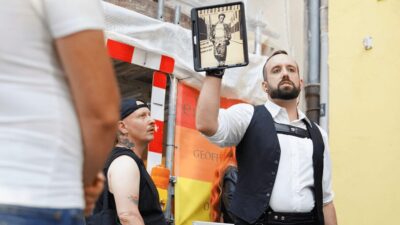
Where It All Began: Berlin’s Queer & Trans History Tour
Read our review →
Browse the lists this tour appears in