
Reviewed · JEWISH BERLIN TOURS
Path of Resistance: Berlin’s Hidden Holocaust Stories
Berlin’s Holocaust story is often told through grand memorials and political leaders. This walking tour takes a different route. You move through courtyards, streets, cemeteries, and former workplaces where ordinary people resisted Nazi rule in small but dangerous ways. The stories of Otto Weidt, the women of Rosenstraße, and Jewish families torn from their homes give the past a human scale.
I like the focus on lesser-known acts of courage, and I like the small group format, limited to 10 participants. Guides such as Tom and Hannah are praised for clear explanations, patience, and passion, which matters when the subject is painful and complex. The main drawback is that this is a serious, emotionally demanding tour, not a light sightseeing walk, and bad weather can make the 2.5-hour route harder.
Key points to know before you book
- Otto Weidt’s workshop: Visit the modest workplace where Weidt protected blind and deaf Jewish workers from deportation.
- Rosenstraße resistance: Hear how German women publicly demanded the release of their Jewish husbands.
- Bebelplatz book burning memorial: Learn how the 1933 attack on books signalled the Nazi assault on free thought.
- Small English-speaking group: The usual limit is 10 people, allowing time for questions and discussion.
- A walking route through old Berlin: The tour links Jewish memorials, the New Synagogue, Museum Island, Neue Wache, and Friedrichstraße.
- A guide-led history lesson: Historical maps, then-and-now photographs, and personal stories help connect present-day Berlin with the Nazi era.
Why this Berlin walking tour feels different
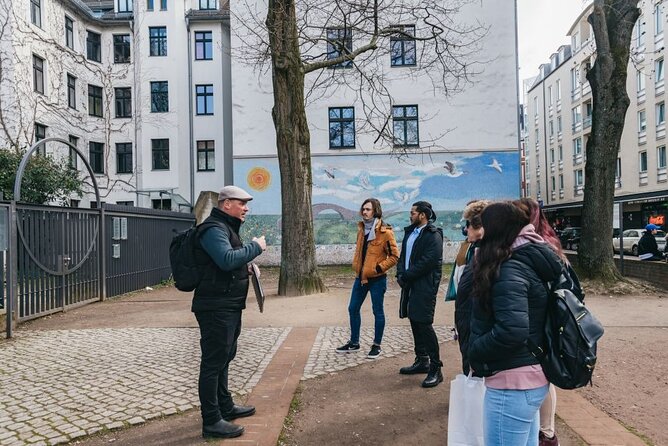
This is not mainly a tour of famous buildings. It is a walk through evidence of lives interrupted: a school, a cemetery, a workshop, a protest site, and the places from which people were deported.
That approach gives you a better sense of how persecution worked in daily life. Antisemitism did not appear only in speeches or laws. It entered schools, workplaces, homes, public spaces, and family relationships. The tour also asks a harder question: why did some people resist while others stayed silent?
That question gives the walk its balance. You hear about courage, but you also learn how the Nazi belief in Aryan superiority ranked people into supposed racial groups and turned prejudice into state policy. The result is more useful than a simple list of villains and heroes.
The guides use historical maps and then-and-now photographs to support the storytelling. I find that especially helpful in Berlin, where war damage and reconstruction can make it difficult to see what a street once meant. A photograph can show the former building or neighborhood, while the guide explains what happened there.
This is an English-language tour led by a local historian with a focus on World War II. The small group limit is listed as 10 people, though another description gives a maximum of 15, so check the booking details for the exact departure you choose.
More Jewish history tours in Berlin:
- Nazi Berlin and the Jewish Community Tour
★ 4.8 · 55 reviews - Private Tour: Jewish Heritage Walking Tour of Berlin
★ 5.0 · 29 reviews - Jewish Berlin: Walking tour The Old Jewish Quarter (private 3 Hours tour)
★ 5.0 · 27 reviews
Starting at the former Imperial Post Office
Arrive 10 minutes early at the former Imperial Post Office. The guide waits at the main entrance with a blue umbrella, a useful marker in a busy city.
The starting point places you near Berlin’s old Jewish quarter, so the tour can move into its main subject quickly. You do not spend the opening section waiting for a long transfer or sitting on a bus. From the first streets, the guide begins connecting present-day Berlin with the Jewish community that once lived, worked, studied, and worshipped here.
Wear comfortable shoes. The route is on foot for about two and a half hours, and the tour runs in all weather. Bring water, an umbrella, and protection from the sun or rain. There is no food or drink included, and you do not need a public transport ticket for the walk.
The New Synagogue and Jewish school
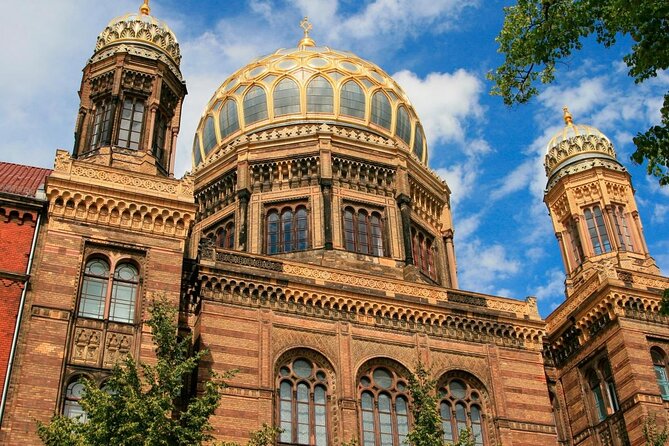
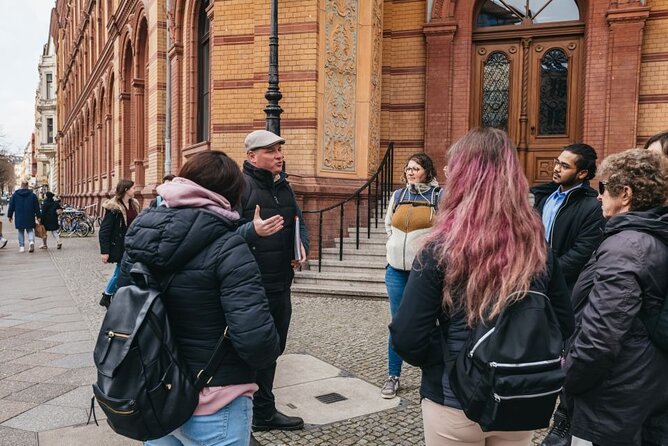
The first major stop is the New Synagogue Berlin, also known as the Jewish Centre. You receive a guided visit and about 15 minutes of explanation here.
The synagogue gives you an early sense of the size and importance of Berlin’s prewar Jewish community. Its presence is not just architectural. It helps show that Jewish life in Berlin was part of the city’s daily fabric, with religious, educational, professional, and family networks.
From there, the tour visits the Jüdisches Gymnasium Moses Mendelssohn. The school adds an important angle because it brings the story down to students and education. Nazi persecution did not only target adults at work or families in their homes. It also restricted Jewish children and attacked their place in public life.
The two stops work well together. The synagogue represents communal life, while the school makes that community easier to imagine through young people and teachers.
Grosse Hamburger Strasse and the people who vanished
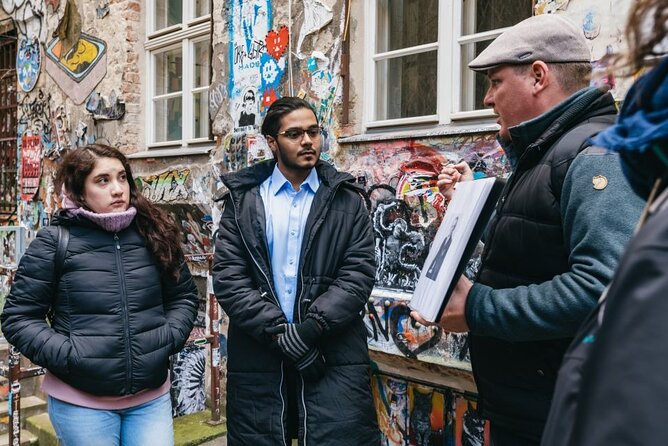
At Grosse Hamburger Strasse Cemetery, the tour turns toward memory and loss. The stop lasts about 15 minutes and is one of the quieter parts of the route.
Berlin’s old Jewish quarter contains many reminders that are easy to pass without noticing. A guide gives those sites names, dates, and human meaning. You learn to look for the traces left in pavements, walls, courtyards, and plaques rather than expecting one large memorial to explain everything.
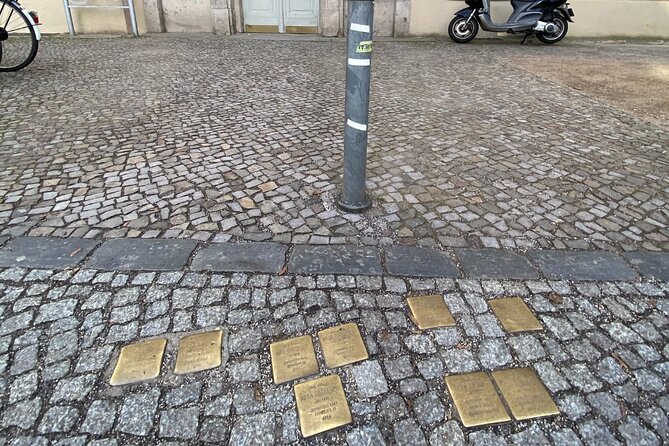
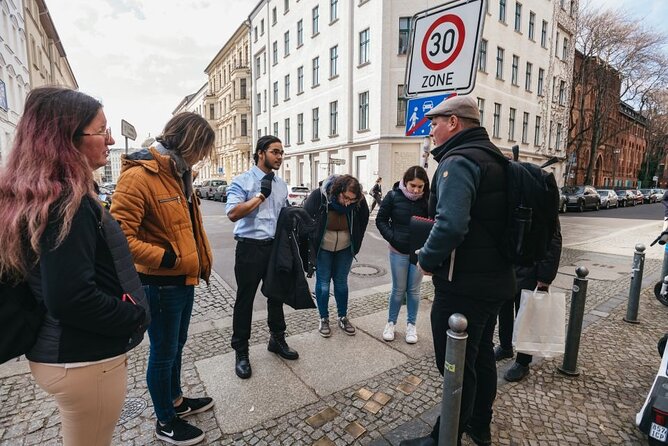
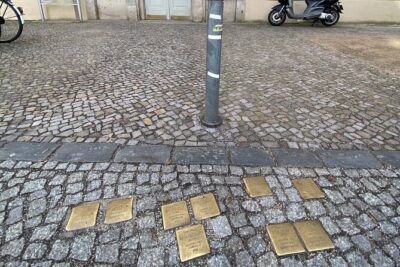
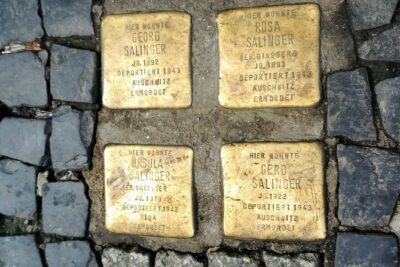
The tour also visits hidden Jewish memorials and Stolpersteine. These small brass plaques, set into sidewalks, mark the former homes of people persecuted by the Nazis. They are easy to miss if you are walking quickly. With a guide, they become part of a larger story about how deportation began with the removal of people from ordinary homes.
This section may be difficult for some people because the details are personal. That is also its value. Instead of treating the Holocaust as an abstract chapter, the walk shows how it reached specific addresses and families.
A different sort of day out in Berlin:
- Berlin: Reichstag, Dome and Government District Guided Tour
★ 4.7 · 18,288 reviews - Berlin: 1-Hour City Tour by Boat with Guaranteed Seating
★ 4.3 · 16,993 reviews - Berlin: Boat Tour Along the River Spree
★ 4.4 · 11,252 reviews - Discover Berlin Half-Day Walking Tour
★ 5.0 · 9,624 reviews
Otto Weidt’s workshop and quiet resistance
Otto Weidt’s Workshop for the Blind is the tour’s most intimate stop. You spend about 15 minutes learning how Weidt protected blind and deaf Jewish workers from persecution.
The setting matters. This was not a government office or a military headquarters. It was a modest workshop, and Weidt’s resistance took place through practical choices: shielding workers, helping them remain employed, and attempting to protect them from the machinery of Nazi persecution.
The story gives you a useful definition of resistance. It was not always an armed uprising or a public political act. Sometimes it meant hiding someone, falsifying information, finding food, or using a workplace to keep a vulnerable person out of Nazi custody.
The workshop is also a good example of why a small group helps. The subject calls for careful explanation, and the guide can pause for questions instead of delivering a rushed speech to a large crowd.
You also hear about Nicholas Winton, the British rescuer who helped hundreds of Jewish children escape the Holocaust. His story widens the tour’s focus beyond Berlin and shows that rescue networks could cross national borders, even as most of Europe was becoming more dangerous.
Rosenstraße and the women who protested
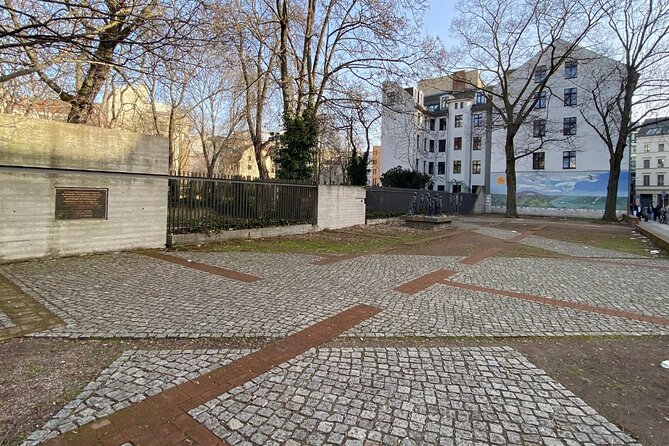
The stop known as the Block of Women recalls the Rosenstraße Protest. In 1943, German women stood up to Nazi authorities and demanded the release of their Jewish husbands.
This is one of the tour’s strongest examples of collective action. The women were not soldiers, underground agents, or famous political leaders. They were family members who gathered in public and refused to leave quietly.
The story is especially important because it complicates the idea that Germans had no way to object. Resistance carried real danger, and not every protest produced a broad change in policy. Still, the Rosenstraße events show that public pressure could matter, particularly when it involved German citizens and attracted attention.
The stop also helps you think about the different kinds of resistance discussed throughout the walk. There is personal protection at Weidt’s workshop, collective protest at Rosenstraße, and intellectual resistance at Bebelplatz. None should be treated as identical, but together they show that opposition took several forms.
Museum Island and Neue Wache
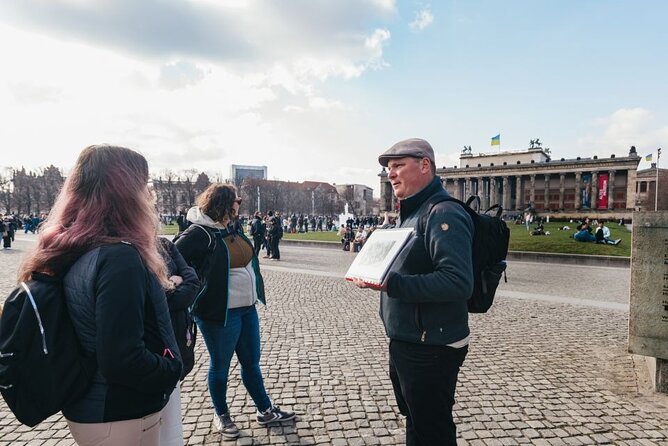
The route continues toward Museum Island, with about 20 minutes of guided sightseeing. This part gives you a wider view of Berlin’s political and cultural center.
Museum Island is one of the city’s best-known areas, but on this tour it is not treated as an isolated sightseeing stop. The guide uses the surrounding public spaces to explain how power, culture, memory, and national identity overlap in central Berlin.
You then visit Neue Wache for about 15 minutes. The building is a memorial space, and its solemn atmosphere changes the pace of the walk. After the personal stories of families and workers, the stop invites a broader reflection on war, suffering, and remembrance.
There is a lot to absorb by this point. The route does not pause for a meal, and the itinerary moves steadily from one site to the next. If you prefer a slow walk with long periods to explore independently, this may feel brisk. If you like a clear narrative with frequent stops, the pace should work well.
Bebelplatz and the 1933 book burning
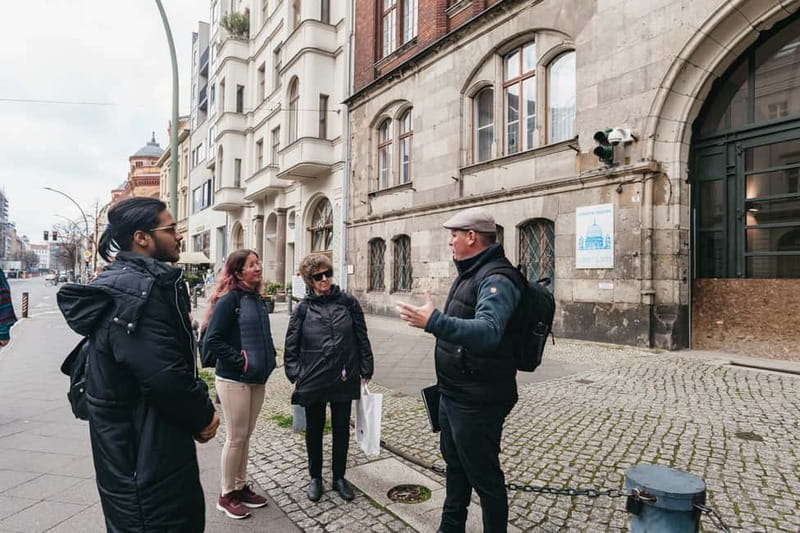
Bebelplatz is the tour’s major stop on the Nazi assault against intellectual freedom. It was the site of the infamous book burning on May 10, 1933.
The book burning was not a random act of vandalism. It signalled the Nazi campaign against writers, scholars, political opponents, and ideas that did not fit Nazi racial and political doctrine. The memorial at the square creates a stark contrast between the open public space above and the empty underground library visible below.
The point is not simply that books were burned. It is that public attacks on ideas can prepare the ground for attacks on people. The tour connects antisemitism, racial ideology, censorship, and state violence, helping you see how these forces developed together.
Bebelplatz is also a useful place for the guide to explain the Nazi belief in Aryan superiority and the classification of other groups as supposed sub-races. That explanation provides essential context for the stops focused on Jewish families, deportation, and resistance.
Trains to Life, Trains to Death
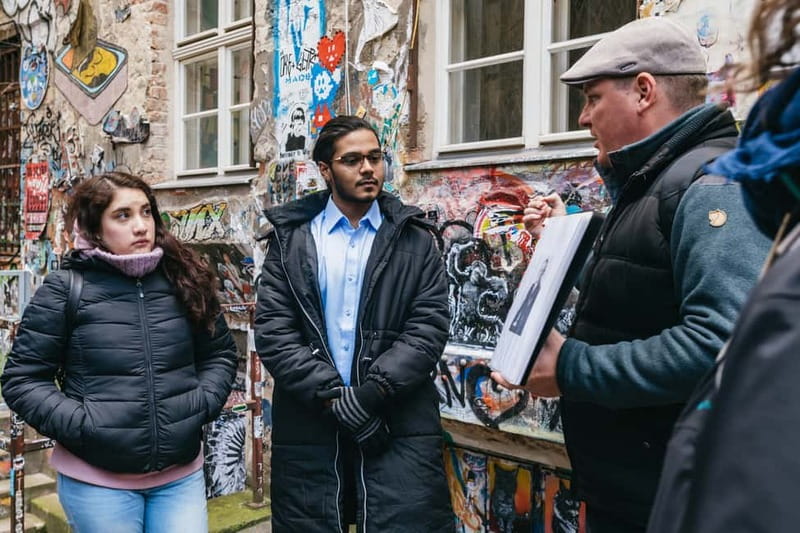
The stop called Trains to Life, Trains to Death adds another memorial layer to the walk. It recalls the contrast between children who escaped persecution and those who were sent toward death.
This is where the tour’s stories of rescue and deportation meet. You have already heard about Nicholas Winton and the children he helped save. Now the route returns to the many people who were not able to escape, showing the narrow line between survival and destruction.
The tour also visits a former deportation centre. That stop gives a physical setting to the process of removal. Deportation did not begin at the final destination. It involved gathering people, separating them from homes and workplaces, and moving them through Berlin’s transport system.
The memorials are effective because they resist easy closure. You are not given a neat ending. Instead, you finish with a clearer sense of both the rescue efforts that succeeded and the far greater number of people whom the Nazi state trapped.
What the 2.5-hour format means for you
Two and a half hours is long enough to cover many important sites but short enough to fit into a full Berlin day. You will walk continuously, with stops lasting roughly 10 to 20 minutes.
The route includes the New Synagogue, Moses Mendelssohn school, Grosse Hamburger Strasse Cemetery, Otto Weidt’s workshop, Rosenstraße, Museum Island, Neue Wache, Bebelplatz, the book-burning memorial, and Trains to Life, Trains to Death. That is a substantial amount of ground and information.
I would not book this immediately before a timed museum entry or a train departure. The walk has several stops, and discussion can extend when the group has questions. The route is described as ending at Berlin Friedrichstraße station, while the meeting information also says the activity ends back at the meeting point. Confirm the exact end point when booking, especially if you need to connect to transport.
The tour is wheelchair accessible, but weather remains a practical concern. Rain, heat, or cold will affect how comfortable you feel outdoors. The activity runs in all weather, so bring suitable clothing rather than hoping the forecast improves.
Is $56 a fair price?
At $56 per person, this is not the cheapest way to walk around central Berlin. You are paying for a specialist guide, access to museums and memorials, historical photographs and maps, and a carefully linked route rather than a general city stroll.
The value depends on how much interpretation you want. If you only need directions and a list of memorials, you can explore several of these sites on your own. If you want the connections between the sites, personal stories, and a chance to ask questions, the price is easier to justify.
The small group also matters. A limit of 10 people gives you a better chance to hear clearly and ask about difficult points. The included entry to museums and memorials adds value, though the supplied details do not specify every admission arrangement at each stop.
The strongest benefit is the specialist focus. This is not a broad Berlin overview with a short mention of the Holocaust. The entire walk is built around Jewish life, Nazi persecution, resistance, rescue, and remembrance.
Who should book this experience?
You should consider it if you want a serious history tour with human stories rather than only grand monuments. It suits first-time visitors who need context, as well as history enthusiasts looking for sites beyond the best-known memorials.
It is also a good choice if you prefer walking to bus tours and want time for questions. The guides are described as patient, professional, and engaged, and Tom and Hannah are specifically associated with clear, passionate presentations.
You may want another activity if you are looking for a relaxed introduction to Berlin or a tour focused mainly on architecture. This route includes many memorials and emotionally heavy subjects. It asks you to pay attention, reflect, and sometimes sit with uncomfortable facts.
Should you book the Path of Resistance walk?
Book it if you want to understand how Nazi persecution appeared in ordinary Berlin streets and how resistance could take the form of rescue, protest, protection, or intellectual defiance.
The strongest reasons are the small group, the expert English-speaking guide, Otto Weidt’s workshop, the Rosenstraße story, and the links between Bebelplatz, deportation, and the wider Nazi racial system. Plan for comfortable shoes and all-weather clothing, and leave room in your schedule afterward if you prefer time to process what you have heard.
At $56, it makes the most sense for you if interpretation matters more than simply checking off sights. For a thoughtful, focused look at Berlin’s Jewish history and acts of courage that are easy to miss, this is a worthwhile choice.
FAQ
How long does the tour last?
The walking tour lasts 2.5 hours.
What language is the tour conducted in?
The live tour guide speaks English.
Where does the tour start?
The tour meets at the former Imperial Post Office. Arrive 10 minutes early and look for the guide at the main entrance holding a blue umbrella.
Where does the tour end?
The route information gives Berlin Friedrichstraße station as the finish point. The meeting information also says the activity ends back at the meeting point, so confirm the exact end location when booking.
How large is the group?
The tour is described as a small-group experience limited to 10 participants. Another activity detail lists a maximum of 15, so check the specific departure information.
Is public transportation needed?
No. Public transport tickets are not included, but they are not required for this walking tour.
Is the tour wheelchair accessible?
Yes, the activity is listed as wheelchair accessible.
What should I bring?
Bring comfortable shoes, water, and an umbrella. The tour runs in all weather, so bring rain protection or sun coverage as needed.
Newest Berlin reviews
- Where It All Began: Berlin’s Queer & Trans History Tour★ 4.9 · 6 reviews
- Understanding Kreuzberg: The roots of local (sub)culture★ 4.9 · 11 reviews
- Berlin: guided canoe | kayaktour★ 4.1 · 7 reviews
- Private Potsdam City Tour in an authentic vintage van★ 5.0 · 14 reviews
- Warnemünde Shore Excursion: Private Sachsenhausen and Berlin Tour★ 5.0 · 12 reviews
- Ultimate E-Bike Tour of Berlin with Beer Garden Stop★ 5.0 · 4 reviews
- In the Forbidden City – Potsdam Walking Tour★ 5.0 · 17 reviews
- Private Walking Tour of Potsdam and Sanssouci★ 5.0 · 24 reviews
Jewish Berlin Tours, compared.
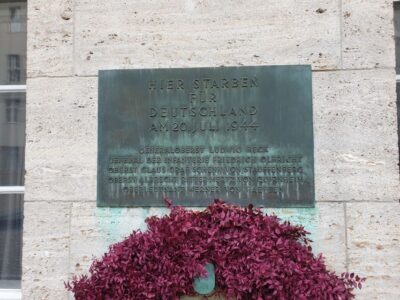
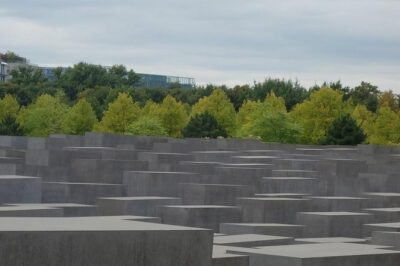
Private Tour: Jewish Heritage Walking Tour of Berlin
Read our review →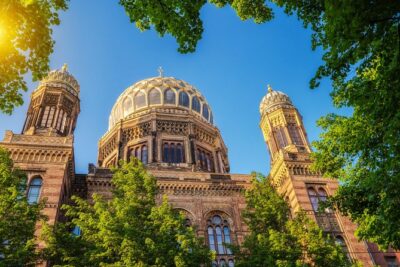
Jewish Berlin: Walking tour The Old Jewish Quarter (private 3 Hours tour)
Read our review →
Path of Resistance: Berlin’s Hidden Holocaust Stories
Read our review →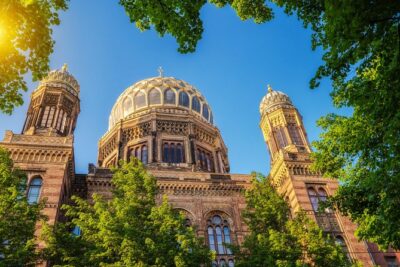

Browse the lists this tour appears in