
Reviewed · HISTORICAL TOURS
Historic center of Berlin – Tour in Italian
Berlin’s turbulent past is laid out almost like an open-air history book on this 3.5-hour walk. You move from Potsdamer Platz to Museum Island, passing Nazi ministries, the former Berlin Wall, Hitler’s bunker site, the Holocaust Memorial, Brandenburg Gate, and the grand avenue Unter den Linden.
I especially like the Italian-language commentary, which makes difficult subjects easier to follow, and the route’s strong contrast between modern Berlin and its wartime and Cold War scars. Guides named Paolo, Giulia, Fabio, Chiara, Elena, and Daniele have led recent departures, bringing stories, anecdotes, and clear explanations to the walk.
The main drawback is simple: this is a long outdoor tour with no included museum entries, food, or transport. You will see the Pergamon Museum and Berliner Dom from outside, but you need a separate ticket and extra time to go inside.
Key points to know before booking
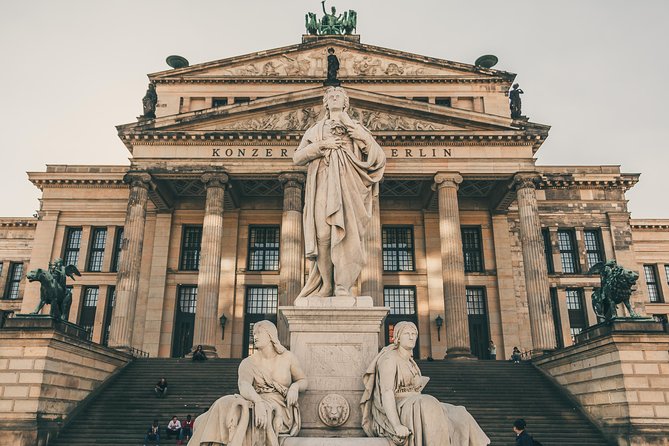
- A 3.5-hour route through central Berlin: The walk covers Potsdamer Platz, Checkpoint Charlie, the Holocaust Memorial, Brandenburg Gate, Unter den Linden, and Museum Island.
- Italian-speaking guidance: The tour is designed for Italian speakers, with guides including Paolo, Chiara, Elena, Daniele, Giulia, and Fabio.
- A history-focused experience: Nazi Germany, the Holocaust, the Berlin Wall, the Cold War, and reunification shape the entire route.
- Free outdoor sights rather than museum visits: Admission is not needed for the listed stops, but museum entry is not included.
- A group of up to 28 people: This is small enough for a guided city walk, though it is not a private tour.
- Good value at $27.91: You pay mainly for three and a half hours of organized context, navigation, and Italian commentary.
Why this route works for a first look at Berlin
Berlin can be confusing at first. Its major sights are spread through several districts, and many important places look ordinary until you know what happened there. A vacant lot may mark Hitler’s bunker. A plain government building may have housed both a Nazi ministry and East Germany’s Communist government. A line of stones may explain the murder of Europe’s Jews more powerfully than a grand monument.
This tour gives you that framework. It begins at Potsdamer Platz, a modern transport and business center, then moves through sites tied to dictatorship, war, division, and reunification. The walk ends on Museum Island, where you can continue your day with museums, the Berliner Dom, or a meal in central Berlin.
I like this order because it keeps the story moving through time. You begin with Berlin’s dramatic rebuilding, confront the Nazi era, examine the Cold War, then reach the symbols of a reunited Germany. The route is not just a parade of photo stops. It asks you to notice how the same city changed political meaning again and again.
The tour receives a 5 out of 5 rating from 143 reviews, with 100 percent recommending it. The strongest praise centers on the Italian guides’ preparation, courtesy, flexibility, and ability to add anecdotes. That matters here, since the quality of the explanation is more important than the physical sights themselves.
More history tours in Berlin:
- Berlin: Natural History Museum Entrance Ticket
★ 4.6 · 3,382 reviews - Berlin: World Heritage Cruise to Potsdam
★ 4.5 · 1,435 reviews - Berlin Historical Highlights Walking Tour
★ 4.9 · 657 reviews
Meeting at Potsdamer Platz and entering modern Berlin
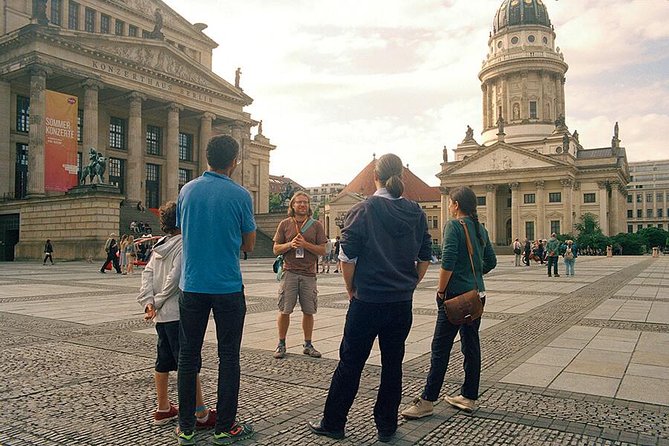
The meeting point is Potsdamer Platz 10, near the S-Bahn and U-Bahn station. Look for the blue bicycle and the Vive Berlin Tours flag. The start time is 10:00 in the morning, so arrive early enough to find the meeting point without rushing through the station.
Potsdamer Platz is a useful place to begin because it shows how much Berlin has changed. Once one of Europe’s busiest squares, it was heavily damaged in World War II and later cut apart by the Berlin Wall. Today, much of what you see is modern construction.
Your guide uses the square to introduce Berlin’s long story and explain how war and division reshaped the city. This is a good place to listen rather than simply take photographs. The modern buildings are part of the lesson: Berlin’s current appearance hides layers of destruction and rebuilding.
The first stop lasts about 15 minutes. The short time keeps the group moving, but it also means you should not expect an extended architectural tour of the square.
Sony Center and the city rebuilt
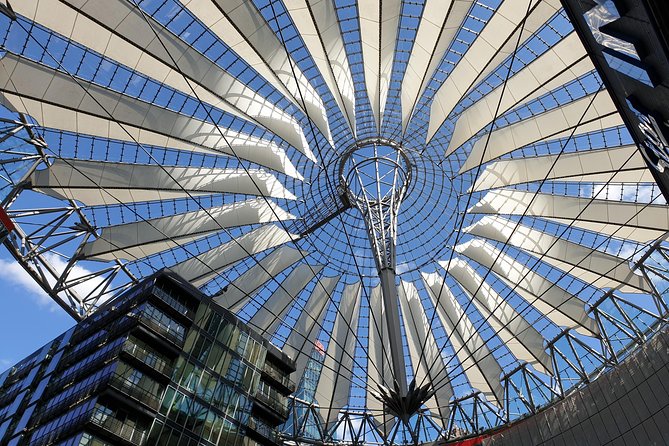
The Sony Center offers one of the tour’s clearest contrasts. Inside its contemporary complex, remnants of the old square have been preserved and placed beside modern architecture. You see how Berlin uses new construction to acknowledge what was lost.
This is not a museum visit, and the tour does not spend a long time inside. Instead, it gives you a quick visual introduction to the way Berlin rebuilt after World War II. If you enjoy architecture, the combination of preserved fragments and new design is one of the more unusual moments on the route.
The stop lasts around 10 minutes. Keep your expectations realistic: the value comes from the guide’s explanation and the contrast, not from a lengthy architectural presentation.
Topography of Terror and the original Berlin Wall
At the Topography of Terror, the tour reaches one of its most serious points. The site occupies the former headquarters area of the Gestapo and SS, the institutions that enforced Nazi terror. The guide explains how the dictatorship is remembered today and points out nearby buildings connected to that period.
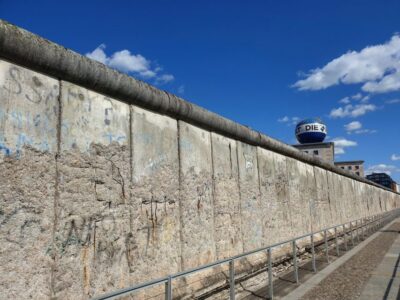
You can also see the former Nazi Aviation Ministry, the Martin Gropius Bau museum, and an original section of the Berlin Wall. That concentration of sites makes this a powerful stop. Within a short distance, you can connect Nazi rule, postwar division, and modern remembrance.
The outdoor portion of the Topography of Terror is free, but this walking tour does not include a separate museum visit. If you want a fuller examination of Nazi persecution, you may need to return later with more time.
A different sort of day out in Berlin:
- Berlin: Reichstag, Dome and Government District Guided Tour
★ 4.7 · 18,288 reviews - Berlin: 1-Hour City Tour by Boat with Guaranteed Seating
★ 4.3 · 16,993 reviews - Berlin: Boat Tour Along the River Spree
★ 4.4 · 11,252 reviews - Discover Berlin Half-Day Walking Tour
★ 5.0 · 9,624 reviews
Checkpoint Charlie and the Cold War city
Checkpoint Charlie was once a major crossing point between East and West Berlin. Today, the location is one of the city’s best-known Cold War stops, and the guide explains the construction of the Berlin Wall and the division of the city under Communist rule.
The site can feel more commercial and staged than some of Berlin’s memorials. That is worth knowing before you arrive. Its importance lies in the political story, not in expecting a preserved border post untouched by tourism.
The guide helps put the place in context. You learn why this crossing mattered and how the wall affected ordinary movement through the city. For a first-time visit, that background keeps Checkpoint Charlie from becoming just another quick photograph.
The Aviation Ministry and the machinery of power
The former Aviation Ministry is a huge, imposing building. It was constructed under the Nazi dictatorship for the ministry led by Hermann Göring. During the Cold War, it became the home of ministries in Communist East Germany. Today, it houses a ministry of the Federal Republic.
This is exactly the kind of place that benefits from a guided walk. The building’s exterior does not tell you that it has served three different political systems. Its continued use also gives you a sharp reminder that history in Berlin is often attached to ordinary working buildings, not only to museums and monuments.
The tour spends about 10 minutes here. You will not go inside, but the outside view and the guide’s explanation make the stop worthwhile.
The Führerbunker site and the Holocaust Memorial
The former Führerbunker site is another place where the physical setting is less dramatic than the history. Hitler spent his final days there, and the tour explains what happened at the site and why it is presented in its current form.
The location is intentionally understated. There is no grand monument announcing the bunker. The guide’s explanation helps you understand the significance without turning the site into a spectacle. This is a serious stop, and the tone stays focused on meaning and historical responsibility.
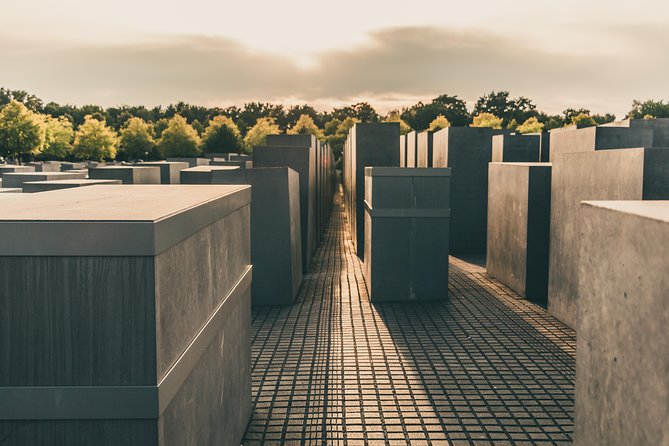
Nearby, the Memorial to the Murdered Jews of Europe creates a very different physical experience. Its field of concrete blocks is designed for personal reflection, and the guide shares the story behind the memorial and the crime it commemorates.
You get roughly 10 minutes at each stop, so this is an introduction rather than a full memorial visit. I recommend treating the Holocaust Memorial with care. Walk quietly, pay attention to how the space changes as you move through it, and save playful photographs for another part of Berlin.
Reichstag and Brandenburg Gate
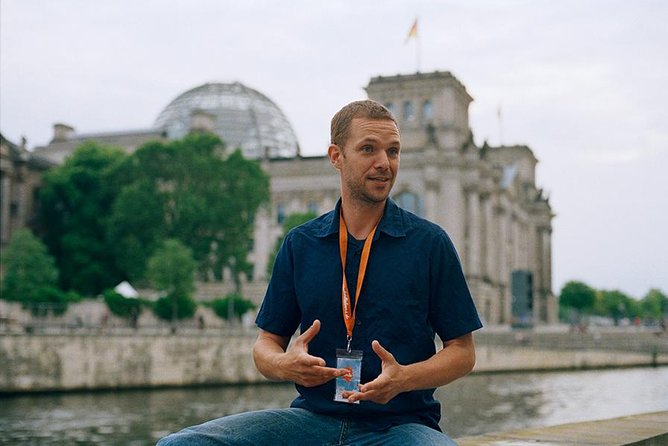
The Reichstag is the seat of Germany’s Parliament. The tour visits the building from outside, and the guide explains how you can arrange a visit to its dome. That advice is useful because the dome requires separate planning and is not part of this walking tour.
The building gives you a chance to discuss modern German government after the country’s authoritarian past. You can see how Berlin moved from dictatorship and division toward parliamentary democracy, even though the tour does not take you inside the Reichstag.
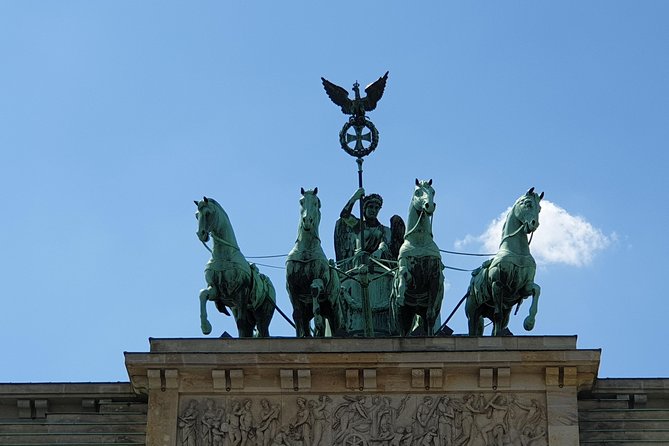
Brandenburg Gate is the most recognizable stop on the route. It began as a symbol of royal power, later became tied to the Cold War division, and now represents German reunification. Few monuments in Berlin carry so many political meanings.
The guide’s explanation is especially valuable here. Without context, the gate is an impressive neoclassical structure and a popular photo background. With context, it becomes a marker of Berlin’s changing identity.
Unter den Linden and Bebelplatz
From Brandenburg Gate, you walk along Unter den Linden, the grand avenue that once led toward the emperor’s palace. The guide points out different building periods and the damage left by war.
This section gives your legs a short change of pace after the heavier memorials. Look up as you walk. The avenue shows how Berlin’s imperial, wartime, Communist, and modern layers sit beside one another.
Bebelplatz brings the focus back to Nazi repression. It is known for the 1933 book burning, a propaganda act aimed at destroying ideas and silencing writers. The square also contains Humboldt University and the Catholic Cathedral, giving the setting a striking mix of academic, religious, and political associations.
The Book Burning Memorial is especially easy to miss without a guide. The memorial is placed in the square and recalls the burning of books in a restrained, meaningful way. The guide explains what happened and why the memorial matters today.
Humboldt University, Neue Wache, and the memory of war
Humboldt University is one of Berlin’s major academic institutions. The guide introduces its history and points out famous students. The stop is brief, about five minutes, so expect a concise explanation rather than a campus tour.
Neue Wache offers another compact but serious memorial. Inside is Käthe Kollwitz’s sculpture of a mother mourning her son, a soldier killed in battle. The image gives the tour a human scale after so much discussion of governments, armies, and political systems.
This stop is about the cost of war rather than one specific regime. It works well beside the nearby sites connected to Nazism and the Cold War because it shifts attention from political power to grief.
Berliner Dom and the final walk to Museum Island
Berliner Dom is an imposing church built under the emperor. The guide explains the role it was intended to play within the Lutheran tradition and points out its grand scale.
You see the church from outside. Entry is not included, so plan a separate visit if you want to explore the interior. The building’s location also helps you understand the importance of Museum Island as Berlin’s cultural center.
The tour finishes at Museum Island, a UNESCO World Heritage Site, near the Pergamon Museum at Bodestraße 1-3. The guide gives advice on how to continue exploring Berlin and explains which tickets may be most useful for the museums.
The Pergamon Museum is currently described as one of Berlin’s most famous museums, with treasures such as the Ishtar Gate of Babylon and the Pergamon Altar. Those collections are not part of this tour, and museum admission is not included. Still, ending here is practical: you can continue your sightseeing immediately instead of spending time getting back across town.
What $27.91 buys you
At $27.91 per person, this is a reasonably priced introduction to central Berlin. You are paying for three and a half hours of route planning, historical explanation, and Italian-language guidance. You are not paying for transport, meals, drinks, hotel pickup, or museum admission.
That distinction matters. If you want a guided overview before choosing which museums and memorials deserve more of your time, the price is strong. If you want to enter several attractions, you will need to budget separately.
The maximum group size is 28 people. That is not intimate, but it is manageable for a walking tour if the guide keeps the group together. A mobile ticket makes arrival simple, and the tour operates in all weather, so bring suitable clothing and comfortable shoes.
Because the walk lasts 3.5 hours, weather can affect your enjoyment. Rain, cold, or heat will be part of the experience rather than a reason for the tour to stop. The cancellation policy allows a full refund if you cancel at least 24 hours before the 10:00 start time. Changes or cancellations inside that window are not refunded.
Who should book this Italian Berlin walk?
I would choose this tour if you want Berlin’s main historical sights explained in Italian and you prefer a clear route over planning the whole morning yourself. It suits a first visit, especially if you want to understand the city before returning to selected museums.
It is also a good match for anyone who enjoys political and social history. The route deals with Nazi dictatorship, the Holocaust, World War II, the Berlin Wall, Communist rule, and reunification. The subject matter is serious, so this is not a light sightseeing stroll.
You might choose something else if you dislike long walks, need frequent indoor breaks, or want extensive time inside museums. The tour is also less suitable if your main interest is shopping, food, nightlife, or modern architecture rather than Berlin’s difficult past.
The Italian guides named in the available feedback include Paolo, Giulia, Fabio, Chiara, Elena, and Daniele. Their praised qualities are consistent: clear explanations, preparation, kindness, attention to the group, and engaging anecdotes. Your assigned guide may differ, but the format is built around that personal connection.
Should you book it?
Book this tour if you want a well-organized Italian introduction to Berlin’s central sights, especially the places connected to Nazism and the Cold War. At $27.91, it offers a lot of context for a half-day walk, and it ends in a useful location for continuing your visit.
Skip it if you want museum entry included, a private guide, or a shorter route. For most Italian-speaking visitors who want to understand why Berlin looks and feels the way it does, this is a practical first morning in the city.
FAQ
Where does the tour start?
The tour starts at Potsdamer Platz 10, 10785 Berlin, near the S-Bahn and U-Bahn Potsdamer Platz station. Look for the blue bicycle and the Vive Berlin Tours flag.
What time does the tour begin?
The stated start time is 10:00 am.
How long does the tour last?
The walking tour lasts approximately 3 hours and 30 minutes.
What language is the tour conducted in?
The tour is conducted in Italian with an Italian-speaking guide.
Where does the tour end?
The tour ends at the Pergamon Museum on Museum Island, at Bodestraße 1-3, 10178 Berlin.
Is museum admission included?
No. The route visits the exteriors of places such as the Reichstag, Berliner Dom, and museums. Museum tickets and other admission fees are not included.
What is included in the price?
Local taxes and a local guide are included.
What is not included?
Food, drinks, hotel pickup, and transportation to and from the attractions are not included.
What happens if it rains?
The tour operates in all weather conditions, so you should dress appropriately.
Newest Berlin reviews
- Where It All Began: Berlin’s Queer & Trans History Tour★ 4.9 · 6 reviews
- Understanding Kreuzberg: The roots of local (sub)culture★ 4.9 · 11 reviews
- Berlin: guided canoe | kayaktour★ 4.1 · 7 reviews
- Warnemünde Shore Excursion: Private Sachsenhausen and Berlin Tour★ 5.0 · 12 reviews
- Ultimate E-Bike Tour of Berlin with Beer Garden Stop★ 5.0 · 4 reviews
- Private Potsdam City Tour in an authentic vintage van★ 5.0 · 14 reviews
- In the Forbidden City – Potsdam Walking Tour★ 5.0 · 17 reviews
- Private Walking Tour of Potsdam and Sanssouci★ 5.0 · 24 reviews
Historical Tours, compared.

Berlin Private Complete History All Day Walking Tour
Read our review →


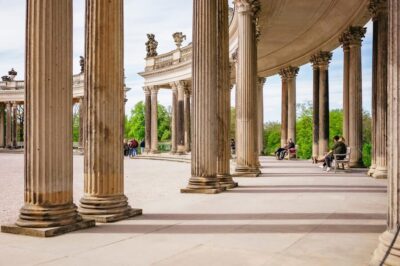
Small group Potsdam: A Journey Through History and Palaces
Read our review →Browse the lists this tour appears in