
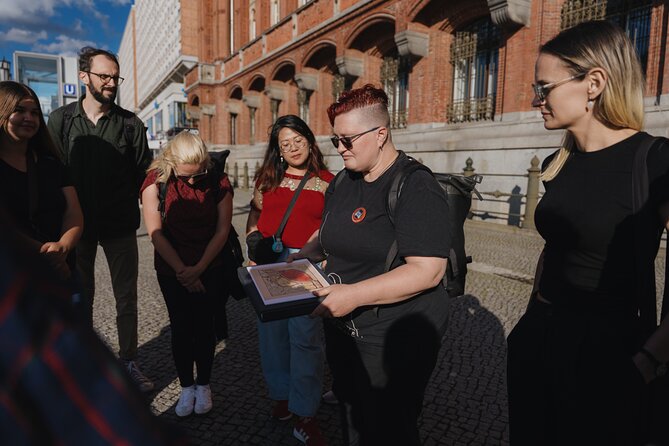
Reviewed · HISTORICAL TOURS
Berlin Protest History Tour: Rebels, Resistance, and Revolution
Berlin’s center is full of statues, grand facades, and open squares, but this tour asks a sharper question: who protested here, and what changed afterward? In two hours, you trace a line from medieval unrest and the 1848 revolution to Jewish resistance in 1943 and the fall of East German rule in 1989.
I like the small maximum group of 15, which should make it easier to hear the guide and ask questions. I also like the route’s focus on overlooked details, from the missing Berlin Wall in an East German history timeline to the 1989 T-shirt protest. The main drawback is pace: with many stops in only two hours, some subjects receive a quick treatment rather than a long discussion.
Key points at a glance
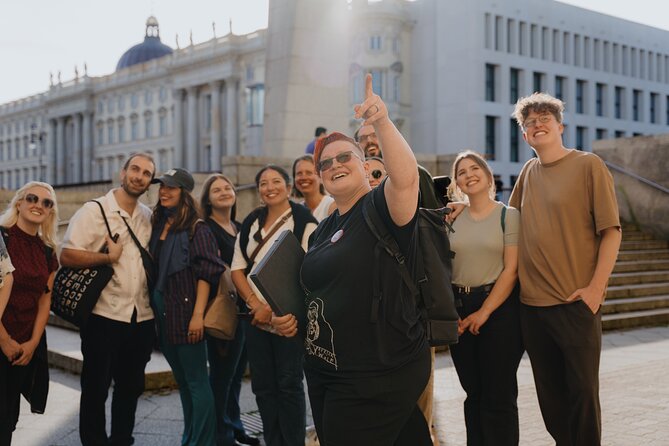
- Start at Rotes Rathaus: See Berlin’s story in terracotta reliefs, including an early uprising.
- Follow East Germany’s public memory: Compare socialist-era monuments, the Palace of the Republic, and the carefully edited timeline at Gasthaus Mutter Hoppe.
- Visit places tied to protest: The route includes the former Berlin Palace, Rosenstraße, and the 1989 opposition movement.
- Walk about 2 kilometers: The route is compact, mostly in central Berlin, and ends at Alexanderplatz.
- Expect an English tour for up to 15 people: Beyond and Beneath Tours provides the expert guide.
- Pay $30.04 for about two hours: Since every listed stop is free to enter, you are paying for research, storytelling, and interpretation rather than admission tickets.
Berlin’s protest story starts at the Red Town Hall
Meet at the sculpture Aufbauhelferin near Rotes Rathaus on Jüdenstraße. The Red Town Hall is easy to spot, and the opening stop gives you an immediate visual guide to Berlin’s past.
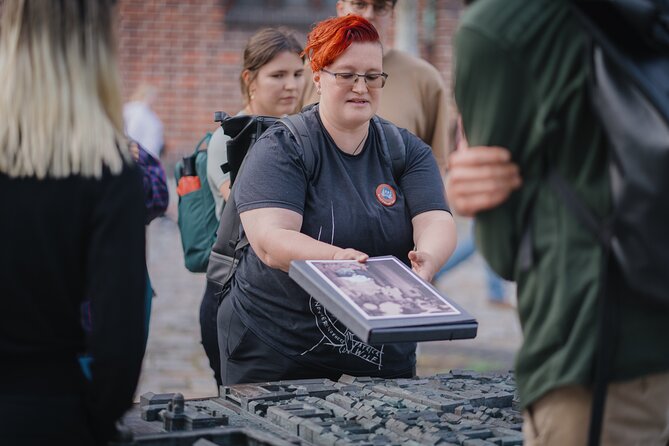
Terracotta panels run around the building in a timeline of the city. You will see scenes linked to Berlin’s origins and an early uprising that shaped the young city. This is a smart opening because you are not starting with a long lecture. You are looking at the evidence while the guide explains what it means.
I like this approach. Berlin history can feel like a stack of separate eras: Prussia, the German Empire, Nazism, East Germany, and reunification. The terracotta sequence gives you a basic framework before the walk moves into more difficult political subjects.
Allow about 15 minutes here. The stop is outside, and there is no admission fee. Since the meeting point is listed by a sculpture rather than simply the town hall, arrive with the exact location in hand.
More history tours in Berlin:
- Berlin: Natural History Museum Entrance Ticket
★ 4.6 · 3,382 reviews - Berlin: World Heritage Cruise to Potsdam
★ 4.5 · 1,435 reviews - Berlin Historical Highlights Walking Tour
★ 4.9 · 657 reviews
Nikolaiviertel and the polished version of East Berlin
The next stop is Nikolaiviertel, a short walk from the town hall. This quarter mixes old-looking streets with a reconstruction created for Berlin’s 750th anniversary during the East German period.
The tour treats the area as an example of socialist kitsch, a useful phrase for the way the government built a neat, decorative version of old Berlin. You will also see the last remains of the Palace of the Republic, once the seat of East Germany’s parliament and one of the era’s best-known entertainment venues.
That contrast gives the stop its value. The area is not simply old Berlin, and it is not simply East Berlin. It shows how governments use buildings and public spaces to tell people what their city is supposed to mean.
The scheduled visit lasts about 10 minutes. You should expect an exterior explanation rather than an extended museum visit. If you want a close look at the Palace of the Republic’s history, you will need to ask questions while you are there.
Gasthaus Mutter Hoppe and the history that was left out
At Gasthaus Mutter Hoppe, the focus turns to another historical timeline. This one presents the major moments of socialist East Germany.
The important detail is what the display does not show. The building of the Berlin Wall is absent, a telling omission in a country that worked hard to control its public story. The guide uses this small, easy-to-miss feature to explain how official history can be shaped through silence as much as through monuments.
You only spend about five minutes here, so this is one of the brisker stops. Still, it may be one of the most useful. You learn to look at public displays with a more careful eye. A timeline is never just a list of dates. It reflects the choices of the people who made it.
Marx and Engels in the middle of a contested city
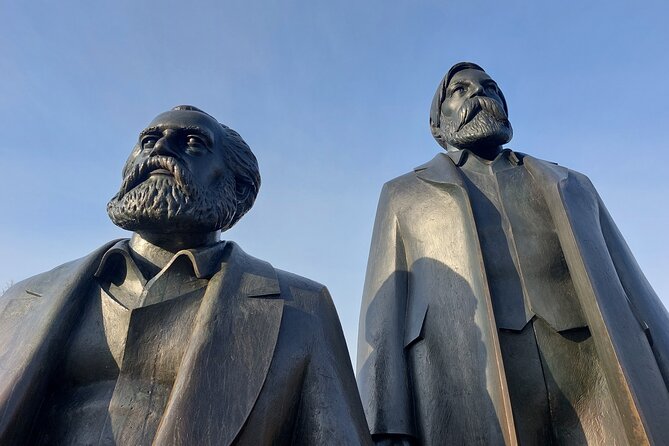
The walk continues to Marx-Engels-Forum, where the large statue of Karl Marx and Friedrich Engels sits in a public setting. The two men wrote The Communist Manifesto, and their monument has been debated for years.
This stop is less about the text of communist theory and more about what happens to political symbols after a government falls. The statue survived the end of East Germany, but its meaning changed. For some, it recalls oppression and state control. For others, it represents ideas about class and social justice that still matter.
I appreciate that the route does not reduce the monument to a simple good-or-bad judgment. A protest history tour works best when it shows how people can read the same place in different ways.
Plan on about 15 minutes here. The statue is outdoors and free to see.
A different sort of day out in Berlin:
- Berlin: Reichstag, Dome and Government District Guided Tour
★ 4.7 · 18,288 reviews - Berlin: 1-Hour City Tour by Boat with Guaranteed Seating
★ 4.3 · 16,993 reviews - Berlin: Boat Tour Along the River Spree
★ 4.4 · 11,252 reviews - Discover Berlin Half-Day Walking Tour
★ 5.0 · 9,624 reviews
The former palace and the 1848 revolution
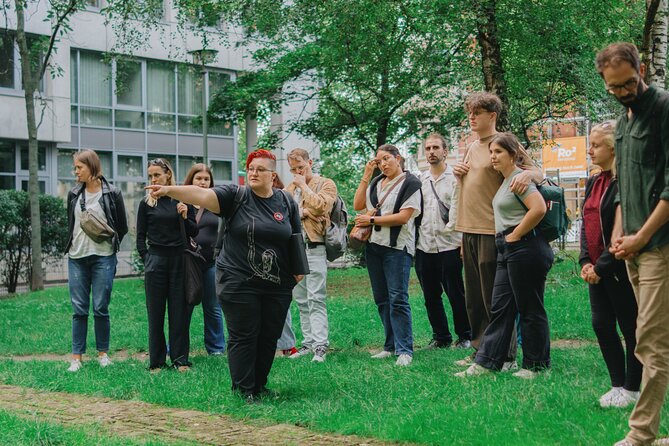
At the Humboldt Forum, you see the reconstructed Berlin Palace. The building is striking, but the reason it belongs on this route is political rather than decorative.
The original palace witnessed major protests and revolutions, especially the March Revolution of 1848. That uprising helped plant the early seeds of democracy in Germany. The stop connects a beautiful rebuilt building with the pressure that once gathered around it.
This is an important correction to the idea that German democracy appeared all at once after the Second World War. Political change had earlier roots, and the events of 1848 belong to that longer struggle.
The stop lasts about 20 minutes, the longest scheduled visit on the route. Use that time to ask how the rebuilt palace relates to the original and how public opinion has shifted around the site. The tour description supports the historical discussion, but it does not include an interior admission. Think of this as a guided exterior stop in the wider Humboldt Forum area.
Rosenstraße and an act of wartime civil disobedience
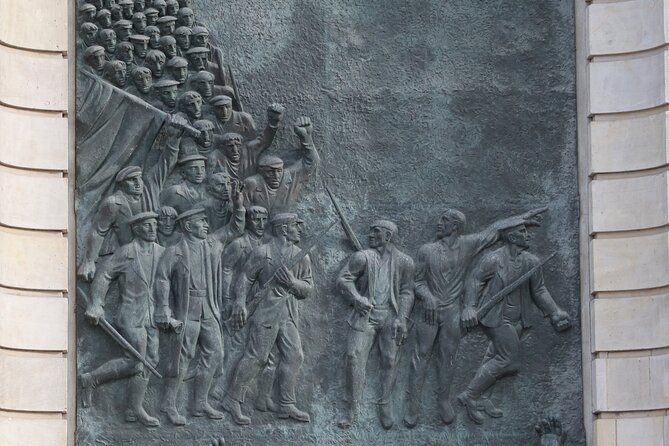
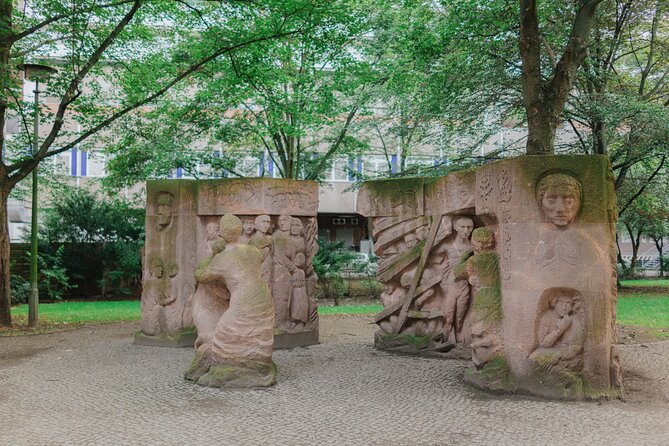
Rosenstraße brings the most emotionally serious subject on the walk. Here you see the monument to women who protested in the winter of 1943, demanding the release of Jewish men held by the Nazi regime.
The stop presents this as the only German protest against the Final Solution. You will also hear about Jewish life under Nazi rule and see the foundations of Berlin’s oldest synagogue.
This part of the route matters because it moves away from famous leaders and military events. You are looking at an act of civil disobedience carried out by ordinary people in a brutal time. The cold weather and the personal risk make the story especially direct.
Allow about 15 minutes. The subject deserves more time than a quick photograph, so listen closely and ask questions if you want more context. It is also a reminder that protest is not always a mass movement with banners and speeches. Sometimes it is a determined group refusing to leave.
St. Mary’s Church and a 1964 voice for civil rights
St. Mary’s Church is one of Berlin’s oldest churches. Its place on this route comes from a later event: Martin Luther King delivered a sermon here in 1964 to a huge crowd.
That detail broadens the tour beyond Berlin’s own political conflicts. King’s visit connects the city to the international struggle for civil rights and shows how a historic religious building could become a public forum for a modern political message.
You spend about 10 minutes at the church. The stop is brief, so you should not expect a full architectural tour or a long account of King’s wider work. Instead, it works as a compact link between local history and international protest.
The Television Tower also comes into view along this section. It is one of Berlin’s best-known landmarks and a symbol of communist power. The tower’s role here is visual as much as historical: it helps you read the skyline as a statement of East German authority.
The 1989 Peaceful Revolution at the Friendship Fountain
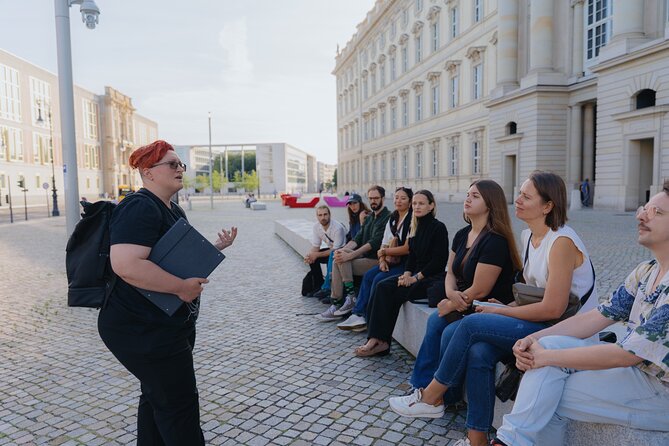
The walk then turns to the events that brought down East German rule. At the Brunnen der Völkerfreundschaft, or Fountain of International Friendship, you follow the story of the Peaceful Revolution of 1989.
The focus is on the chain of events that led to the fall of the Berlin Wall. You also hear about young East German oppositionists who staged a T-shirt protest by the fountain in autumn 1989.
That small act makes the larger revolution easier to understand. The end of the Wall was not only the result of speeches by famous politicians. Young people used simple, visible acts to challenge a government that controlled public expression.
The stop is scheduled for about 15 minutes. It is one of the route’s strongest links between place and event because the fountain gives you a precise setting for the story. You can picture the opposition activity happening in an ordinary public space rather than in a distant political room.
Alexanderplatz and the World Time Clock
The final stop is the Weltzeituhr, or World Time Clock, at Alexanderplatz. The rotating clock shows the time in 148 cities and became the most popular meeting point in East Berlin.
It is a fitting end. The clock presents the world in an orderly, controlled design, while Alexanderplatz became a major public setting for the events of 1989. The tour finishes by placing the earlier stories of dissent beside a symbol of East Germany’s public life.
The endpoint is convenient for continuing your day in central Berlin. The tour does not include admission to another attraction, and the World Time Clock is viewed from the square.
The scheduled visit lasts about 15 minutes. By then, you will have moved from the medieval city to socialist rule and the Peaceful Revolution without leaving the central district.
How the route works in real life
The full walk covers about 2 kilometers and lasts approximately two hours. That makes it manageable for most people who can take a normal city walk, but the many stops mean you will spend a fair amount of time standing outdoors.
The group limit is 15 people. That is a useful size for a history walk. You get more room to see plaques and monuments than in a large crowd, and the guide can usually respond to questions without losing the whole group.
The tour is offered in English and uses a mobile ticket. You do not need to buy entry tickets for the listed stops. The experience requires good weather, so check the forecast and dress for an outdoor walk. Service animals are allowed, and the route is near public transportation.
Beyond and Beneath Tours is associated with guides including Martina and Simone. Their approach centers on lesser-known details and careful historical research. If your booking confirms one of them, expect a storytelling style that connects small objects and overlooked sites to larger political events.
Is $30.04 a fair price?
At $30.04 per person, the price is reasonable if you want interpretation rather than a simple sightseeing walk. You are not paying for museum entry, transport, food, or a special venue. You are paying for the guide’s preparation and the way the sites are connected.
The value is strongest for someone who already knows the main Berlin sights but wants to understand what happened behind the facades. The tour adds meaning to places you might otherwise pass quickly, especially the two timelines, the Marx and Engels statue, and the Rosenstraße monument.
The price is less attractive if you want a broad introduction to Berlin’s major landmarks. This is a focused walk about protest, resistance, political memory, and revolution. It will not cover every famous building or provide a full survey of the city.
There are seven published ratings, with an overall score of 5. The strongest praise centers on thoughtful research, small but meaningful details, entertaining storytelling, and insights that even Berlin residents may not know. That matches the route itself, which favors specific stories over a long list of dates.
Who should book this walk?
I would choose this tour if you enjoy political history, modern European history, or the way public spaces carry competing meanings. It is also a good choice if you have already seen the Brandenburg Gate, Museum Island, and the Berlin Wall sites and want a different angle on the city.
It suits people who like questions more than postcard views. Why is a wall missing from a timeline? Why did a statue survive a political system? How can a small protest help explain a revolution? Those are the kinds of questions built into the route.
You may want another tour if you prefer indoor museums, architecture, or a slower pace at fewer locations. The route covers many subjects quickly, and the Rosenstraße section in particular may leave you wishing for more time.
Free cancellation is available until 24 hours before the start time. Changes or cancellations made later are not refunded, and poor weather can lead to a new date or a full refund.
Should you book Berlin Protest History Tour?
Book it if you want a compact, serious walk that gives familiar central Berlin sites a political edge. The small group, English guide, free-entry route, and reasonable price make it a sound choice for history-minded visitors and Berlin residents alike.
Skip it if you want a relaxed sightseeing stroll with little discussion. This tour asks you to pay attention to omissions, monuments, and acts of resistance. If that sounds appealing, the World Time Clock will mean more to you by the end than it did when you arrived.
FAQ
How long is the Berlin Protest History Tour?
The tour lasts approximately two hours.
What language is the tour offered in?
The tour is offered in English.
How much does the tour cost?
The listed price is $30.04 per person.
Where does the tour begin?
It begins at the Sculpture Aufbauhelferin near Rotes Rathaus on Jüdenstraße, 10178 Berlin.
Where does the tour end?
It ends at the World Time Clock, or Weltzeituhr, at Alexanderplatz.
How far does the walk cover?
The route covers about 2 kilometers.
What is the maximum group size?
The group can include a maximum of 15 participants.
Are admission tickets included?
All listed stops have free admission. The experience includes an expert guide, but it does not list paid attraction entry.
Can I cancel for a full refund?
Yes. You can cancel at least 24 hours before the start time for a full refund. Cancellations made less than 24 hours before the start time are not refunded.
Newest Berlin reviews
- Where It All Began: Berlin’s Queer & Trans History Tour★ 4.9 · 6 reviews
- Berlin: guided canoe | kayaktour★ 4.1 · 7 reviews
- Understanding Kreuzberg: The roots of local (sub)culture★ 4.9 · 11 reviews
- Private Potsdam City Tour in an authentic vintage van★ 5.0 · 14 reviews
- Warnemünde Shore Excursion: Private Sachsenhausen and Berlin Tour★ 5.0 · 12 reviews
- Ultimate E-Bike Tour of Berlin with Beer Garden Stop★ 5.0 · 4 reviews
- In the Forbidden City – Potsdam Walking Tour★ 5.0 · 17 reviews
- Private Walking Tour of Potsdam and Sanssouci★ 5.0 · 24 reviews
Historical Tours, compared.
Berlin Private Complete History All Day Walking Tour
Read our review →

Small group Potsdam: A Journey Through History and Palaces
Read our review →Browse the lists this tour appears in