
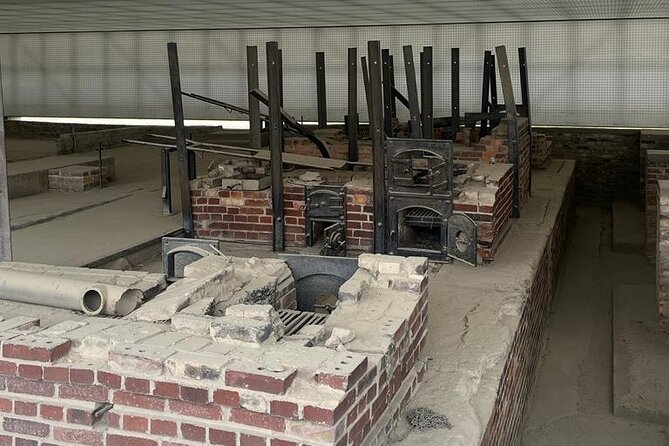
Reviewed · SACHSENHAUSEN CONCENTRATION CAMP TOURS
Never Again Sachsenhausen Concentration Camp
Sachsenhausen is not a quick photo stop. It is a serious half-day visit to a former concentration camp, where the empty grounds, surviving buildings, and stark models explain how the Nazis built a system for control and mass suffering. Guide Siobhán adds a clear, progressive, and feminist reading that links the site to racism, eugenics, women’s bodies, and the modern German far right.
I like two things here: the small group limit of 15, which allows room for questions, and the way the tour looks beyond the Nazi period to the later Soviet special camp and the memorial’s use as an anti-fascist propaganda site. The main consideration is the tone. This is not a neutral audio-guide substitute, and its present-day political connections may not suit everyone.
Key points to know before booking
- A four-hour visit to a difficult but important site: Expect a sober walk through Sachsenhausen’s former grounds, barracks, kitchen, and infirmary.
- Guide Siobhán brings a clear point of view: Her approach connects Nazi persecution with racism, control of women’s bodies, eugenics, and current far-right politics.
- The meeting point is central: You start and finish at Potsdamer Platz 10, with public transport to the memorial included in the tour plan but not in the price.
- A small group makes a difference: The maximum is 15 people, giving you a better chance to ask questions than on a large coach excursion.
- The $31.29 price includes a donation: You still need to pay for your ABC-zone public transport ticket, snacks, and bottled water.
- Free cancellation is available until 24 hours before departure: After that point, refunds and changes are not accepted.
Why Sachsenhausen requires more than a quick visit
Sachsenhausen can be reached from Berlin, but it feels far removed from the city’s cafés and grand monuments. That contrast is part of the point. You leave the center, follow the route toward the memorial, and enter a place designed to isolate people, strip away identity, and enforce obedience.
The tour begins with a walk from the train station to the visitors’ center. This is practical rather than theatrical. You have time to shift your attention away from ordinary sightseeing before the main explanations begin.
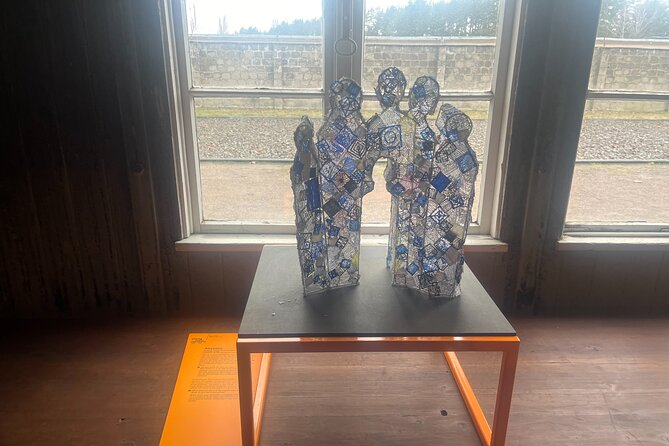
At the visitors’ center, detailed models show how the camp was laid out. These models matter because the original site is incomplete. Without them, it can be hard to understand the deliberate geometry of the grounds and the way buildings, fences, guard positions, and prisoner areas worked together.
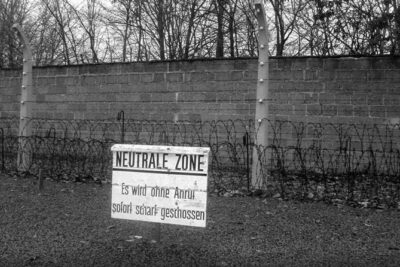
You are not simply looking at old structures. You are learning how architecture supported power. The camp was built as a model facility for the Nazi concentration-camp system, and its design helped turn confinement into a carefully managed process of surveillance and punishment.
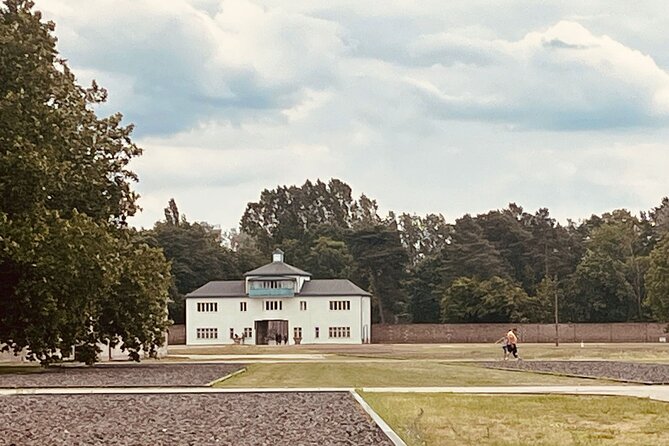
One unsettling detail is visible beyond the memorial grounds. The former SS training camp later became a Brandenburg police academy. That present-day use creates an uncomfortable collision between ordinary modern institutions and the site’s criminal past. It is exactly the kind of detail that makes Sachsenhausen harder to place safely in the past.
More Sachsenhausen memorial visits from Berlin:
- Berlin: Sachsenhausen Concentration Camp Tour in English
★ 5.0 · 5,711 reviews - Berlin: Sachsenhausen Concentration Camp Memorial Tour
★ 4.7 · 3,716 reviews - Sachsenhausen Concentration Camp Bus Tour in English from Berlin
★ 5.0 · 1,962 reviews
The barracks and kitchen reveal daily control
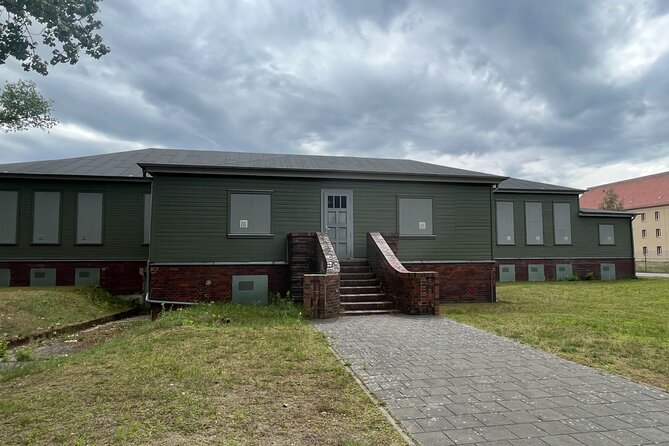
The route continues into the former prisoner area, where you explore the barracks and camp kitchen. Much of the experience here is self-directed, with Siobhán providing context rather than reading a long script at every step.
That format has a real benefit. You can pause, look closely, and take in the information at your own speed. The downside is that the experience may feel less tightly structured than a formal academic lecture. This is a guided walk with room for individual reflection, not a university seminar.
The barracks help explain how prisoners were forced into a system built around overcrowding, hierarchy, deprivation, and control. The kitchen may sound like a routine practical building, but sites like this show how food, work, schedules, and bodily needs could all be used to control prisoners.
The camp kitchen has also been attacked by Holocaust deniers and neo-Nazis. That fact gives the building a second layer of meaning. You are not only studying what happened there. You are also confronting the continuing effort by extremists to erase or distort the evidence.
Siobhán’s approach links these historical crimes to the rise of the AfD, a German far-right political group. That connection is one of the tour’s defining features. You will hear the past discussed as something that still shapes public life, rather than as a sealed chapter with no connection to current events.
I see this as useful if you want historical context tied to modern Germany. If you prefer a tour that avoids present-day politics altogether, you may find the approach too pointed. The political angle is not a side comment. It is part of the way this experience interprets the site.
The infirmary and the crimes of Nazi medicine
The infirmary is one of the hardest parts of the visit. Here, the focus shifts toward medical abuse, racism, eugenics, and the control of women’s bodies.
The building shows how Nazi doctors used prisoners as subjects for experiments and career advancement. The phrase lab rats is not an exaggeration of the moral failure involved. People who were already imprisoned and powerless were treated as material for medical ambition.
This section also makes clear that persecution was not limited to killing or forced labor. Nazi policy tried to classify, control, sterilize, test, and destroy people based on racist ideas about human worth. The emphasis on women’s bodies adds an important dimension that many general camp tours leave in the background.
You should expect disturbing material here. This is not a place for casual sightseeing, and the four-hour length means the subject has time to sink in. Siobhán is described as careful with the suffering represented at the site and attentive to how people in the group respond.
That care matters. A good guide at Sachsenhausen must explain the crimes without turning victims’ suffering into spectacle. The tone here aims for respect, while allowing a small amount of appropriate lightness at moments when the subject becomes almost unbearable. That does not make the visit cheerful. It helps you leave informed rather than emotionally flattened.
A guide with a clear feminist and political lens
The tour’s strongest feature is also the point you should consider most carefully. Siobhán does not present Sachsenhausen as a list of dates and buildings. She connects the camp to systems of racism, gender control, medical abuse, political propaganda, and modern extremism.
That approach gives the visit a wider frame. You learn about the camp itself, but you also examine how societies create categories of people, justify violence, and later try to control the story told about that violence.
The political perspective is described as progressive and feminist. It is not presented as heavy-handed, but it is unmistakable. If that matches your own interests, you may find the tour more thoughtful than a standard scripted explanation. If you want a strictly nonpolitical account, choose carefully.
The guide also adapts to the group. A family group containing teenagers and adults received explanations suited to both ages, and questions were answered directly. That flexibility is valuable at a site where children and younger teens may need context without graphic detail being pushed at them.
The small group helps here. With no more than 15 people, you are less likely to disappear into a crowd. You can ask about a building, a historical term, or a connection to modern Germany without waiting for a huge group to catch up.
A different sort of day out in Berlin:
- Berlin: Reichstag, Dome and Government District Guided Tour
★ 4.7 · 18,288 reviews - Berlin: 1-Hour City Tour by Boat with Guaranteed Seating
★ 4.3 · 16,993 reviews - Berlin: Boat Tour Along the River Spree
★ 4.4 · 11,252 reviews - Discover Berlin Half-Day Walking Tour
★ 5.0 · 9,624 reviews
What the four-hour schedule feels like
Four hours is enough to make the trip worthwhile, but it is not an all-day history course. The schedule covers the walk from the station, the visitors’ center, the models, the former prisoner buildings, the kitchen, and the infirmary.
Because the camp is outside central Berlin, part of the time goes toward reaching the memorial and returning to Potsdamer Platz. That is not wasted time. The change from city center to memorial site helps create a clear break in the day.
You should plan for a moderate level of physical fitness. The tour involves walking, and the physical setting may be demanding in ways that are not captured by a simple distance figure. Wear comfortable shoes and bring water. Bottled water and snacks are not included.
Public transport is also not included. You need an ABC-zone ticket for the route between Berlin and Sachsenhausen. This is an easy cost to overlook when comparing the $31.29 tour price with other activities, so add it to your budget.
The activity starts at Potsdamer Platz 10 and ends back at that same meeting point. A central start and finish make it easier to fit the visit into a day of sightseeing, though you should not plan a tight appointment immediately afterward. The exact pace can vary with questions, group needs, and the emotional weight of the material.
Is $31.29 good value?
At $31.29 per person, the tour is reasonably priced for a four-hour guided visit with a small group and a memorial donation included. You are paying for more than transportation directions. The value comes from having someone organize the route, explain the structures, connect the Nazi and Soviet periods, and place the memorial in present-day political context.
The donation is a useful part of the price. It means some of what you pay supports the memorial rather than covering only the tour operation.
Still, this is not an all-inclusive outing. You pay separately for the ABC public transport ticket, food, and water. The central meeting point is convenient, but there is no promise of hotel pickup, and the tour does not include snacks.
I would compare this price with the value of your time. A self-guided visit may cost less, but you would need to manage the route, absorb the models and exhibits alone, and decide how the different historical periods fit together. The guide is especially helpful if you want more than a basic audio narration.
Who should book this Sachsenhausen tour?
This experience suits you if you want a serious memorial visit with historical explanation and present-day connections. It is a good fit for adults, older teenagers, and families who can handle a difficult subject and want a guide willing to answer questions.
You will likely appreciate it most if you want:
- A small group rather than a large coach tour
- An English-language guide with a clear personal perspective
- More than a Nazi-era account alone
- Discussion of racism, eugenics, women’s bodies, and medical crimes
- Connections between historical fascism and current German politics
- A guide who can be sensitive without making the visit vague or bloodless
You may want a different format if you prefer an academic, neutral, heavily scripted presentation. The tour is informative, but it is not dense or formal in that way. Its strength is interpretation and discussion.
Also think about the emotional demands. Sachsenhausen is a place of mass suffering, and the infirmary section can be especially upsetting. You should not book it simply because you have a spare morning and want to fill it. Book it because you are ready to give the subject your attention.
Booking details that matter
The experience is offered in English and uses a mobile ticket. Confirmation is provided when you book, and service animals are allowed. The group maximum is 15 people, so booking ahead is sensible, particularly because the activity is typically reserved around 17 days before the date.
Free cancellation is available if you cancel at least 24 hours before the local start time. Cancellations or changes made inside that window are not accepted for a refund. The activity also requires a minimum number of people, so if it is canceled for that reason, you can choose another date or experience, or receive a full refund.
FAQ
Where does the Sachsenhausen tour begin and end?
The tour begins at Potsdamer Platz 10, 10785 Berlin, Germany, and ends back at the same meeting point.
How long does the experience last?
The activity lasts approximately four hours, including the visit to Sachsenhausen and the related travel from the central meeting point.
Is public transportation included?
No. You need to purchase your own public transport ticket for the ABC zone.
Is the memorial admission included?
Yes. The experience includes a donation for the Sachsenhausen memorial.
What language is the tour offered in?
The tour is offered in English.
How large is the group?
The maximum group size is 15 people. A moderate level of physical fitness is recommended, and service animals are allowed.
Should you book it?
Book this tour if you want Sachsenhausen explained as both a historical crime site and a warning about the present. The small group, central meeting point, memorial donation, and careful guidance from Siobhán give it strong value for $31.29, before transport costs.
Skip it if you want a purely neutral audio-style visit or if the political and feminist framing does not suit you. For everyone else, this is a serious, respectful way to face a difficult place without reducing it to a checklist of buildings and dates.
Newest Berlin reviews
- Where It All Began: Berlin’s Queer & Trans History Tour★ 4.9 · 6 reviews
- Understanding Kreuzberg: The roots of local (sub)culture★ 4.9 · 11 reviews
- Berlin: guided canoe | kayaktour★ 4.1 · 7 reviews
- Private Potsdam City Tour in an authentic vintage van★ 5.0 · 14 reviews
- Warnemünde Shore Excursion: Private Sachsenhausen and Berlin Tour★ 5.0 · 12 reviews
- Ultimate E-Bike Tour of Berlin with Beer Garden Stop★ 5.0 · 4 reviews
- In the Forbidden City – Potsdam Walking Tour★ 5.0 · 17 reviews
- Private Walking Tour of Potsdam and Sanssouci★ 5.0 · 24 reviews
Sachsenhausen Concentration Camp Tours, compared.
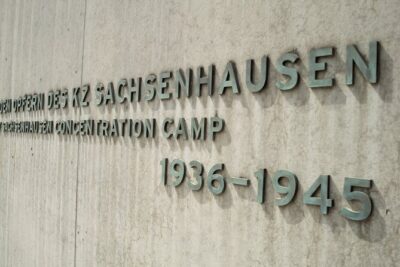
Sachsenhausen Concentration Camp Tour in English
Read our review →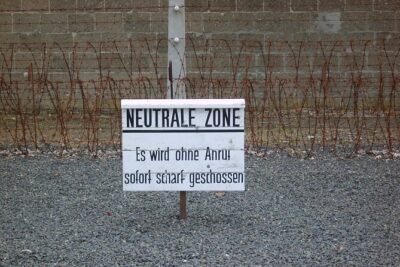
Sachsenhausen Concentration Camp Memorial Tour
Read our review →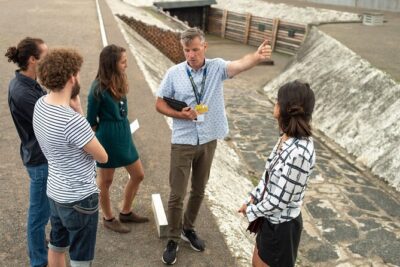
Sachsenhausen Concentration Camp Bus Tour in English from Berlin
Read our review →Sachsenhausen Concentration Camp Tour in English
Read our review →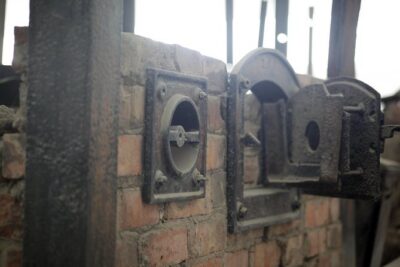
Sachsenhausen Concentration Camp Memorial Tour (Max. 15 Guests)
Read our review →
Sachsenhausen Concentration Camp and Potsdam Tour
Read our review →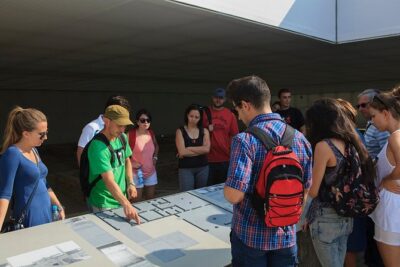
Visita en español al campo de concentración Sachsenhausen
Read our review →Browse the lists this tour appears in