
Reviewed · PRIVATE DRIVERS
Welcome/Farewell SightseeingTaxi Tour +Transfer from/to the airport
Berlin’s great advantage is that its history sits in plain view, and this private taxi tour lets you read the city as you move through it. You can go from Brandenburg Gate and the Reichstag to Museum Island, the Palace, Alexanderplatz, and the remains of divided Berlin without wrestling with luggage or a large group. Guide Gunter Bauer handles the driving and explains the city along the way.
I like the airport transfer built into the tour, since your first ride in Berlin can also give you a useful map of the city. I also like the freedom to stop for pictures, linger at places that catch your interest, or drive past sights that matter less to you. The main drawback is time: with only one to three hours, this is an orientation tour, not a full visit to Berlin’s museums or memorials.
Key points at a glance
- A private welcome or farewell tour: Only your group takes part, with pickup at BER Airport or your hotel.
- Berlin’s biggest sights in one ride: Brandenburg Gate, the Reichstag, Unter den Linden, Museum Island, Alexanderplatz, and Potsdamer Platz are all part of the route.
- A useful history lesson: Gunter Bauer connects Prussian Berlin, Nazi Germany, the Cold War, reunification, and modern Berlin.
- Flexible sightseeing: Some locations can be visited briefly, while others can be passed by according to your interests.
- Comfortable practical extras: The air-conditioned vehicle includes WiFi, parking fees, and a baby car seat on request.
- Good for first-day planning: You can use the tour to decide which places deserve a longer visit later.
Turning an airport ride into a Berlin introduction
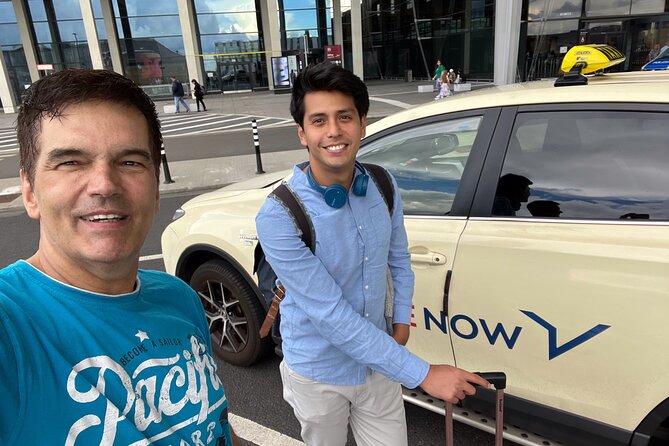
This experience works in two ways. As a welcome tour, Gunter Bauer meets you at BER Airport and takes you through central Berlin before leaving you at your accommodation. As a farewell tour, he collects you from your hotel, shows you more of the city, and finishes with the transfer to the airport.
That arrangement is particularly useful if you have limited time, a late arrival, or luggage that makes public transport awkward. It also gives you a city lesson before you begin sightseeing on foot. After seeing the main districts from the car, you can choose where to spend your next day.
The tour is private, so you are not sharing the vehicle with strangers. That matters here because the route contains many possible stops. You can ask for photographs at Brandenburg Gate, spend more time around the Berlin Palace, or skip a building that does not interest you.
The published duration is approximately one to three hours. The shorter version will be a brisk overview. The longer version gives you more time for explanations and brief stops, but it still cannot replace a museum visit or a long walk through the memorials.
More private drivers in Berlin:
- 5hours: Guide, Chauffeur & Photographer in Berlin private Tour
★ 5.0 · 66 reviews - Private Berlin Custom Half-Day Tour with Private Driver and Guide
★ 5.0 · 59 reviews - Berlin Private Transfer to/from Berlin Brandenburg Airport
★ 4.0 · 32 reviews
Brandenburg Gate and Pariser Platz: Berlin’s most loaded symbol
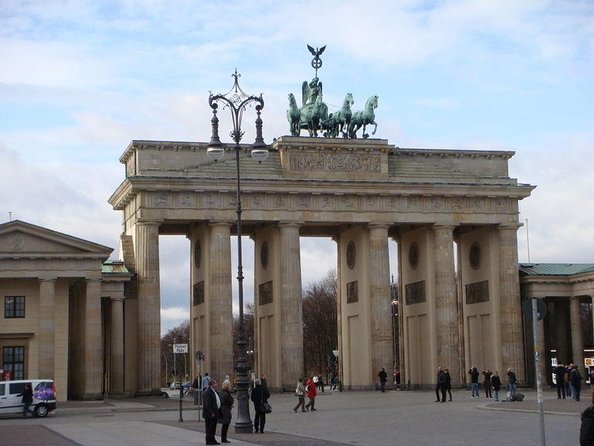
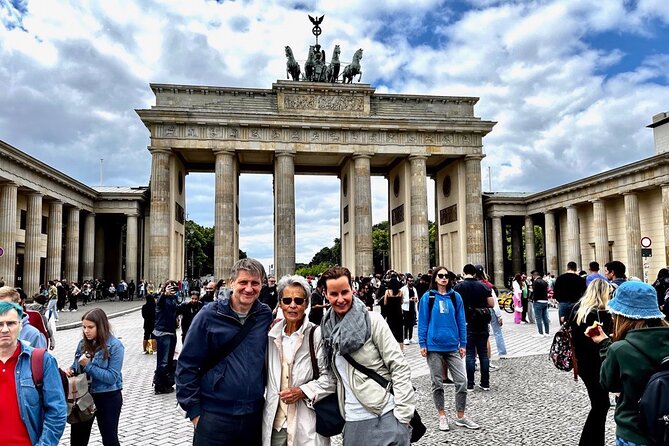
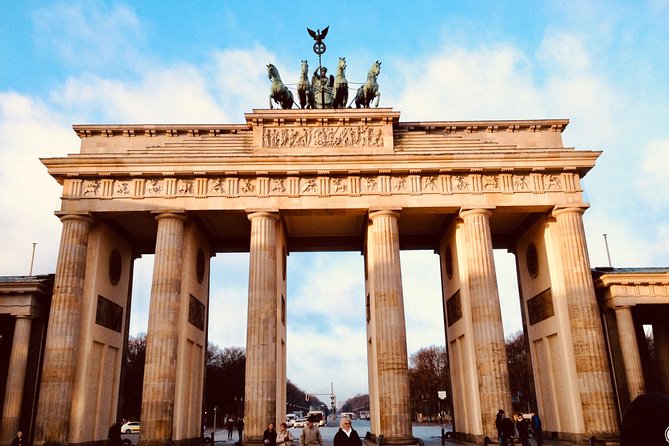
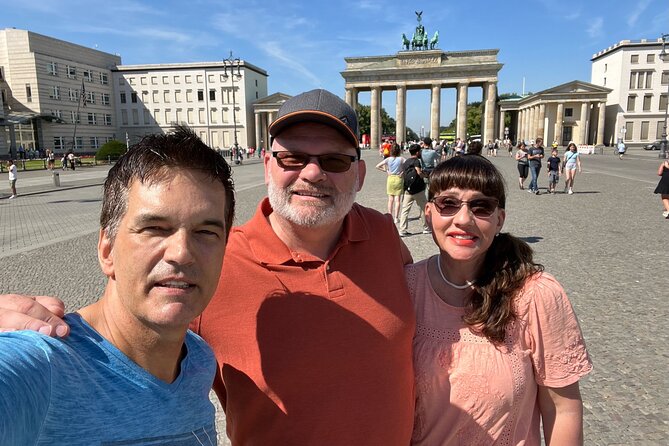
Brandenburg Gate is the natural place to begin. It was once simply a city gate, connecting Berlin with the elector’s hunting grounds in what is now Tiergarten. The Quadriga on top, a four-horse chariot, gained political importance after Napoleon took it to Paris and the Allies brought it back after his defeat.
The gate later became a lonely object during the Cold War. The Berlin Wall blocked access from the west, while fences and barriers cut it off from the east. The surrounding war damage was cleared, and even the remains of the Hotel Adlon disappeared. When the Wall fell, Brandenburg Gate became a symbol of German reunification.
You get about five minutes here as a listed stop, enough for photographs and a short explanation. Do not expect an extended walk around the gate. The value is in seeing the location and understanding why a familiar postcard view carries so much weight.
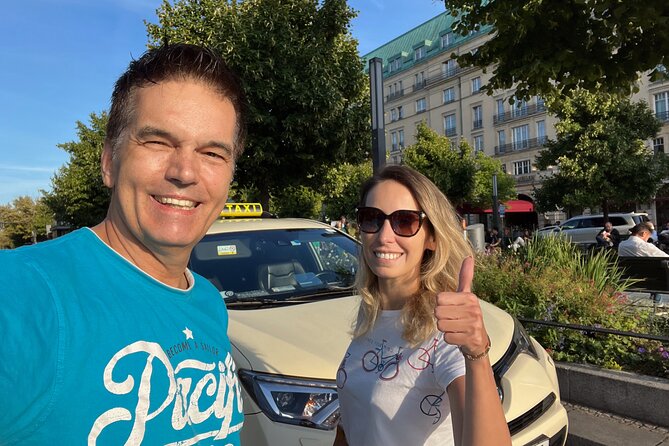
Next comes Pariser Platz, Berlin’s formal front room. The area was rebuilt after reunification with modern interiors but traditional street dimensions. Today it brings together the Brandenburg Gate, the rebuilt Liebermann House, the Academy of Arts, and the French and American embassies.
The square makes a useful comparison with the empty space that once surrounded the gate. Before reunification, it was not a grand public gathering place. It was divided, fenced, and difficult to reach. The rebuilt square now looks polished, but the guide’s explanation helps you see the missing decades behind the architecture.
The Reichstag and the government district
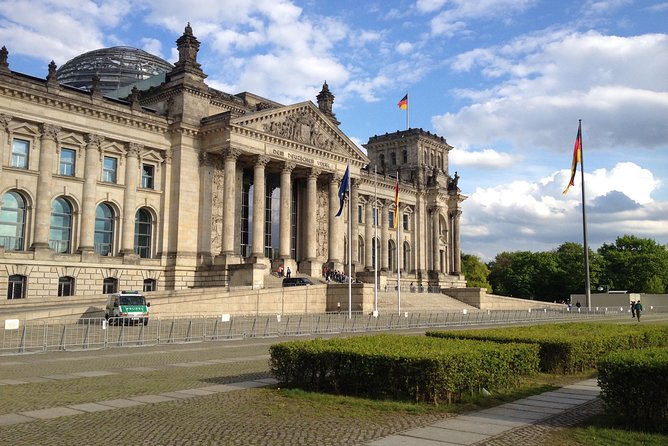
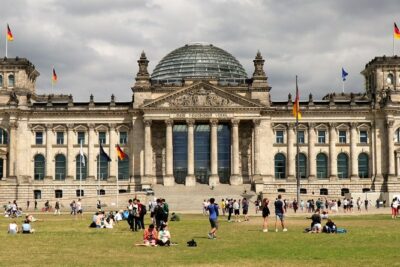
The Reichstag is one of Berlin’s best examples of a building with several lives. It began as a grand parliamentary building, suffered during the Nazi period and the war, and then sat near the Wall in a politically awkward part of West Berlin. It was not used for regular Bundestag meetings during the division of the city.
After reunification, the building was gutted and redesigned for the federal parliament. The glass dome became its most familiar feature, although the original architect had planned a far less memorable roof. Christo’s temporary wrapping of the building also helped make it an international symbol before the modern reconstruction was complete.
The tour also passes the large government buildings that surround it. The Federal Chancellery is deliberately enormous, with ten floors, hundreds of offices, and a large rotunda. The official apartment planned for the chancellor is not used, since its layout is not especially practical.
Across the Spree, the long parliamentary office building is where much of the real work takes place. Speeches and major votes receive attention, but committees handle much of the detailed discussion. Its glass design fits the idea of a parliament that can be seen from outside, although certain secure rooms remain out of view.
These stops are best understood from the vehicle. You see the scale of the government quarter without spending your short tour queuing for entry. If you want to visit the Reichstag dome, you will need separate time and arrangements beyond this taxi experience.
Unter den Linden and the Forum Fridericianum
Unter den Linden began as a riding path from the Berlin Palace toward the elector’s hunting grounds. As Berlin expanded westward, it became a major boulevard lined with linden trees and important public buildings.
The route gives you a quick look at the State Library, Humboldt University, the State Opera, and the historic buildings around the central boulevard. A few cafés remain along the way, offering a more relaxed counterpoint to the official architecture.
Around Bebelplatz, the Forum Fridericianum brings together the former royal library, St. Hedwig’s Cathedral, the State Opera, and Humboldt University. A glass panel in the pavement marks the site of the Nazi book burning on May 10, 1933. Look below and you see an empty underground library, a quiet memorial to the books that were judged unacceptable by the regime.
The square is also a good place to notice how Berlin reused royal buildings. Humboldt University began in a palace built for Friedrich II’s younger brother, Heinrich. What once served the royal family later became a center of education.
The Neue Wache, or New Guardhouse, is another short stop along Unter den Linden. It once housed part of the castle guard and later became a memorial. Inside is Käthe Kollwitz’s enlarged Pietà, showing a mother mourning her dead son. It now serves as a memorial for victims of war and terror.
A different sort of day out in Berlin:
- Berlin: Reichstag, Dome and Government District Guided Tour
★ 4.7 · 18,288 reviews - Berlin: 1-Hour City Tour by Boat with Guaranteed Seating
★ 4.3 · 16,993 reviews - Berlin: Boat Tour Along the River Spree
★ 4.4 · 11,252 reviews - Discover Berlin Half-Day Walking Tour
★ 5.0 · 9,624 reviews
The Berlin Palace and Museum Island
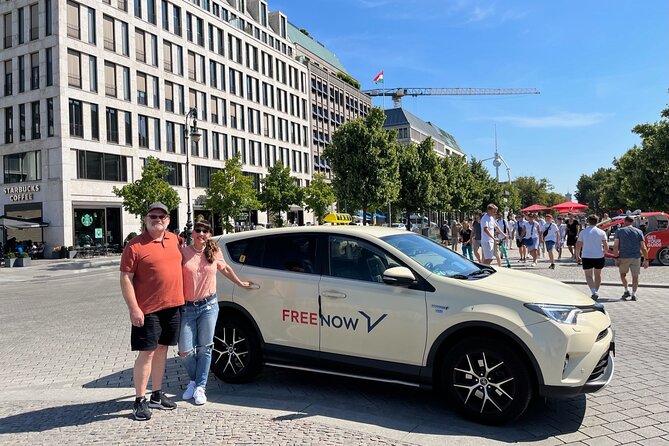
The Berlin Palace once housed the electors, kings, and emperors of Prussia. After wartime damage, East German authorities demolished the remaining structure despite criticism. For decades, the site was an open area used for gatherings and temporary events.
The reconstructed exterior now houses the Humboldt Forum. The project recreates much of the palace’s historic appearance, including the Schlüter courtyard, while using a modern interior. If your route allows, the roof terrace offers one of the better elevated views in central Berlin.
The listed stop is around 25 minutes, although the exact amount of time depends on your chosen route. This is one of the places where you may want to leave the taxi and walk a little. If you only have one to three hours, though, the guide’s explanation and a short look from outside may be the sensible choice.
Berlin Cathedral is nearby. It is not as old as its appearance suggests, dating mainly from the early twentieth century. Its dome, interior decoration, and Hohenzollern burial place make it worth a longer visit if you have time. A dome ascent is possible as part of a separate visit, but it is not presented as a full included activity on this tour.
Museum Island occupies the northern section of an island in the Spree. Five major museums gathered here during the nineteenth and early twentieth centuries, including the Old Museum, the New Museum, the Old National Gallery, the Bode Museum, and the Pergamon Museum.
The taxi can give you the layout and purpose of the island, but museum admission and serious exploration require another visit. I find this overview useful because the buildings are easy to confuse when seen one after another. You leave knowing which museum contains Egyptian collections and Nefertiti, which one focuses on sculpture, and why the island has UNESCO protection.
Hackescher Markt and the smaller-scale city
Hackescher Markt changes the mood. After the royal avenues and government buildings, you reach a more intimate part of central Berlin with courtyards, shops, studios, restaurants, and old residential buildings.
The Hackesche Höfe were restored after reunification after years of poor use during the East German period. Living and working were traditionally mixed in these courtyards, and that pattern still helps explain their layout.
The historic S-Bahn station adds another layer. The area is a good place to stop briefly if you want a sense of everyday central Berlin rather than only its grand monuments. Ten minutes is enough for a look, though a longer walk through the courtyards will give you more than a drive-by view.
The extended route may include the former Spandau suburb around Große Hamburger Straße. Here you can see the Sophienkirche, an old Jewish cemetery, a Catholic hospital, and traces of the area’s mixed religious life. Members of the Mendelssohn family are buried in the cemetery. The old synagogue was planned in the nineteenth century with a Moorish style and golden dome, but its large main hall was destroyed during the war.
This optional section is useful if you want Berlin’s social history rather than another monumental building. Ask Gunter Bauer about it when booking or at the start of the ride, since the duration is limited.
Alexanderplatz, the Red Town Hall, and old Berlin
Alexanderplatz began outside the oldest city walls and was once known as Ochsenplatz. The GDR later redesigned it as a broad socialist square, with plenty of open space and tall modern buildings meant to express a new political order.
The television tower dominates the view. Other landmarks include the World Clock, the House of the Teacher, the House of Electrical Engineering, the House of Statistics, and the House of Tourism. You can stop or simply pass through, depending on what you want from the tour.
The Red Town Hall gets its name from its red brick, not from the political party of the mayor. It served as the seat of East Berlin’s city government during the division of Berlin, while West Berlin’s administration worked from Schöneberg Town Hall.
The Nikolaiviertel offers a constructed version of old Berlin. Most of the original district was destroyed in the war or cleared afterward, and the East German government rebuilt the area in the 1980s with a medieval-looking character. Only a few original structures survived in anything close to their former form.
The Nikolaikirche, Berlin’s oldest church, now belongs to the city museum. The Knoblauch House offers a look at Biedermeier domestic life, and restaurants along the Spree provide a pleasant place to stop for a meal later. Think of this area as a carefully made historical setting rather than an untouched old quarter.
The route can also include the Mühlendamm lock area. Berlin’s earliest river crossing was here, where the settlements on either side of the Spree developed into Berlin and Cölln. Mills once used the river’s water power, and a later lock was replaced by the modern double-chamber structure in the 1930s.
The Wall, the Palace of Tears, and Berlin’s divided past
One of the strongest parts of the tour is its attention to the Cold War. Friedrichstraße station was a key crossing point between East and West Berlin. Trains could pass through, but barriers, customs controls, and Stasi observation areas made the station a tense place.
The Palace of Tears stood beside the station. East Berlin residents said goodbye to family members there, often without knowing when they would meet again. The original building now helps explain the personal cost of a border that otherwise appears on maps as a political line.
The tour also connects the former Jewish tailoring district around Hausvogteiplatz with the rebuilt streets nearby. Jewish tailors helped make the area a center of clothing production, despite earlier restrictions on tailor-made work. Restored row houses and small urban palaces now share space with modern apartments.
At the Memorial to the Murdered Jews of Europe, a walk through the 2,711 concrete stelae is strongly recommended. The uneven ground and changing heights create a sense of uncertainty and confusion. The information center below provides more facts about individual victims and the Nazi murder of Europe’s Jews.
You should not rush through this memorial for a quick photograph. If your schedule allows only a short tour, ask for the car to stop nearby and return later for a proper walk.
Potsdamer Platz and the value of seeing Berlin by car
Potsdamer Platz was once one of Europe’s busiest traffic points. War destroyed most of the surrounding buildings, and the Wall later turned the area into a broad strip of empty ground and concrete barriers.
After reunification, large projects by Sony and Daimler Chrysler created a new business and entertainment district. The area includes the Berlinale Palace, the Film Museum, shops, cafés, bars, offices, and apartments.
Potsdamer Platz is a fitting final stop because it shows modern Berlin’s appetite for rebuilding. Unlike the Palace or Museum Island, much of what you see here is new. That does not make it less useful. It helps you understand how quickly Berlin changed once the Wall no longer controlled the center.
What the $171.52 price includes
At $171.52 per person, the value depends on your group size and how much you value a private airport transfer. You are not paying only for a sightseeing ride. The price includes the airport transfer, the taxi fare, city-tour charges, parking fees, WiFi, and an air-conditioned vehicle.
For one person, the price is a serious expense. For a couple or small group, it can compare more favorably with separate airport transport plus a private guide. Group discounts may also be available, so check the total cost rather than judging the per-person figure alone.
No snacks are included. The tour also does not replace admission to the Reichstag dome, Berlin Cathedral, Museum Island museums, or the underground information center at the Holocaust memorial. Think of it as transport, orientation, and guided context rather than an all-inclusive attraction pass.
Practical details before you book
For an airport pickup, send your flight number and arrival time. After landing, contact Gunter Bauer by SMS or WhatsApp, then send another message when you have your luggage. He waits in the second lane, not in the main taxi queue, and reaches the arrivals hall from his waiting spot in about five minutes.
For a farewell tour, wait inside your hotel or accommodation until Gunter Bauer messages you. Include a working mobile number when you book.
The vehicle is air-conditioned and has WiFi. A Maxi-Cosi baby seat is available on request. A stroller must have a removable cradle and foldable frame, and it will reduce room for suitcases.
Service animals are allowed. Medium-sized dogs can lie on the rear floor, while a large dog may use the back area but then leaves no room for luggage. Other animals must remain in a suitable carrier if placed on a seat.
Free cancellation is available up to 24 hours before the start time. Changes made inside that window are not accepted, so set your plans before the cutoff.
Is this private Berlin taxi tour right for you?
Book it if you want a practical first look at Berlin, need an airport transfer, prefer a private vehicle, or are traveling with luggage, children, or a small group. It is especially useful for fitting major sights into a short arrival or departure day.
Skip it if your main goal is museum time, long memorial visits, or slow neighborhood walks. The route covers a lot, but the one to three hour limit means you will see many places from the car.
For most people, the best use is as a welcome tour. You get your bearings, hear how Berlin’s divided past shaped its present, take photographs at the major landmarks, and then spend the rest of your stay returning to the places that deserve more time.
FAQ
Is the airport transfer included?
Yes. The experience includes pickup from BER Airport for a welcome tour and transport to BER Airport for a farewell tour.
Can I be picked up from my hotel?
Yes. Farewell tours include pickup from your hotel or accommodation. You should wait inside until Gunter Bauer contacts you by SMS or WhatsApp.
How long does the experience last?
The approximate duration is one to three hours.
Is this a private tour?
Yes. Only your group takes part in the activity.
Which language is offered?
The tour is offered in English.
What landmarks are included?
The route can include Brandenburg Gate, Pariser Platz, the Reichstag, Unter den Linden, the Berlin Palace, Berlin Cathedral, Museum Island, Hackescher Markt, Alexanderplatz, the Red Town Hall, Nikolaiviertel, the Holocaust memorial, and Potsdamer Platz.
Can I choose which places to stop at?
Yes. Several places are described as stops or drive-by points depending on your interests. The private format allows you to discuss the route with the guide.
Is the Berlin Cathedral entry included?
The tour description allows for a possible visit to the church, the Hohenzollern burial place, and the dome ascent, but it does not state that admission is included. Confirm details with the provider before booking.
Is food included?
No. Snacks are not included.
Can I cancel for a full refund?
Yes, if you cancel at least 24 hours before the experience start time. Cancellations made less than 24 hours before the start time are not refunded.
Newest Berlin reviews
- Where It All Began: Berlin’s Queer & Trans History Tour★ 4.9 · 6 reviews
- Understanding Kreuzberg: The roots of local (sub)culture★ 4.9 · 11 reviews
- Berlin: guided canoe | kayaktour★ 4.1 · 7 reviews
- Private Potsdam City Tour in an authentic vintage van★ 5.0 · 14 reviews
- Warnemünde Shore Excursion: Private Sachsenhausen and Berlin Tour★ 5.0 · 12 reviews
- Ultimate E-Bike Tour of Berlin with Beer Garden Stop★ 5.0 · 4 reviews
- In the Forbidden City – Potsdam Walking Tour★ 5.0 · 17 reviews
- Private Walking Tour of Potsdam and Sanssouci★ 5.0 · 24 reviews
Private Drivers, compared.
5hours: Guide, Chauffeur & Photographer in Berlin private Tour
Read our review →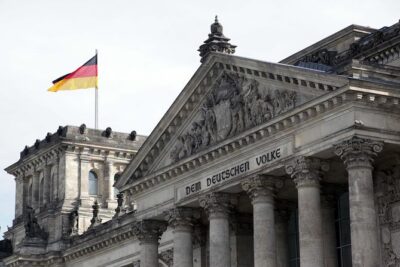
Private Berlin Custom Half-Day Tour with Private Driver and Guide
Read our review →
Berlin Private Transfer to/from Berlin Brandenburg Airport
Read our review →
Private Transfer from Berlin to Prague with 2h of Sightseeing
Read our review →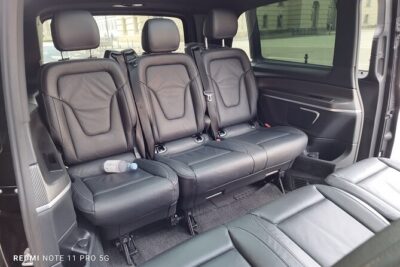
Minivan Driver and Guide (DIN15565) Tailor Made Berlin Highlights
Read our review →
Private One way Airport Transfer Berlin Airport To Berlin
Read our review →
Private Transfer from Berlin to Prague with 4h of Sightseeing
Read our review →
Private Transfer from Berlin to Prague, Hotel-to-hotel, English-speaking driver
Read our review →Browse the lists this tour appears in