
Reviewed · POTSDAM AND SANSSOUCI DAY TRIPS
Private taxi tour to Potsdam and Sanssouci 6-8h
Sanssouci is not just a palace visit. It is a full day of Prussian royal oddities, vineyard terraces, Chinese decoration, Roman ruins, Dutch brick houses, and Cold War history. Guide Gunter Bauer drives you from Berlin and connects the scattered sights with clear stories, rather than leaving you to piece Potsdam together on your own.
I like the private format because you can shape the day around your interests, and I like the hotel pickup because Potsdam’s sights are spread over a large area. Gunter also takes photos for you and can add places such as the Russian colony of Alexandrowka. The main thing to consider is cost: at about $179 per person, this is best value for a small group, not for a solo visitor watching every euro.
Key points to know before booking
- Sanssouci Palace and its vineyard terraces: See Frederick the Great’s intimate Rococo retreat, with the famous fountain and glass-covered vines.
- A private car from Berlin: Hotel or apartment pickup, parking, and the taxi ride are included.
- Gunter Bauer’s storytelling: Expect a strong focus on architecture, royal personalities, wartime damage, reconstruction, and unusual details.
- Potsdam beyond Sanssouci: The route can include the New Palace, Dutch Quarter, Nauen Gate, Cecilienhof, Glienicke Bridge, and other royal sites.
- Admission costs vary: Sanssouci Park is included, but palace interiors are not included unless you book the Sanssouci+ option.
- Plan for walking: Much of the park has unpaved paths, so wear proper walking shoes rather than sandals.
Why this private Potsdam trip works so well
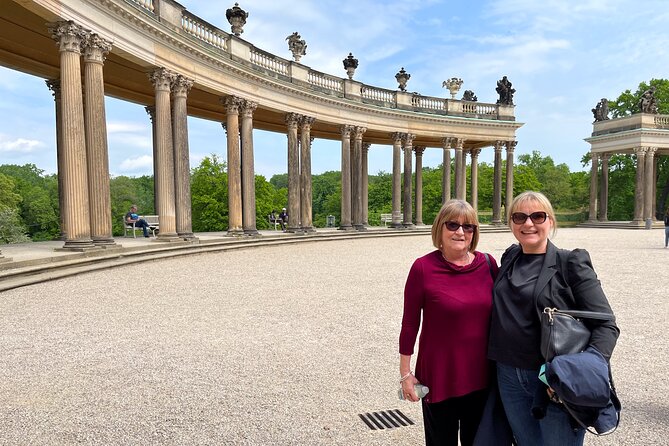
Potsdam is close to Berlin, but it does not feel like a quick side trip. The royal parks and palaces are scattered across a wide area, and the city adds a second layer of history with rebuilt squares, old gates, Dutch houses, and Soviet-era scars.
That is where a private car helps. You are not spending the morning finding the right train, tram, or bus, then walking back to a station after each palace. Gunter picks you up at your accommodation at about 10:30 a.m., drives you into Potsdam, and handles parking along the way.
The vehicle is air-conditioned, and the price includes parking, the taxi ride, and the city guiding service. You get your own group rather than joining a large coach. That makes it easier to ask questions, pause for photos, or adjust the plan.
The day is advertised at six to eight hours, though the exact length depends on your pace and how many interiors you enter. A private outing has room to run longer when there is more to see, but you should not assume every palace interior fits into a short visit.
Gunter’s style is information-heavy and conversational. He talks about architectural styles, Prussian rulers, wartime destruction, rebuilding, and the details you could easily miss from a passing glance. He is also happy to personalize the route. A group interested in Russian history, for example, can request Alexandrowka, the former Russian colony.
More Potsdam and Sanssouci day trips from Berlin:
- Potsdam: City and Castles Tour
★ 4.7 · 3,721 reviews - Potsdam: Palace Tour by Boat
★ 4.5 · 2,369 reviews - Potsdam: Sanssouci Palace and Prussian Palaces Entry Ticket
★ 4.5 · 2,101 reviews
Sanssouci Palace, Frederick’s small retreat
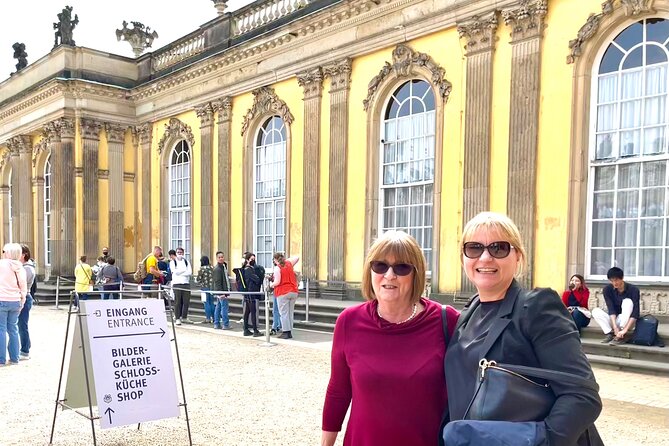
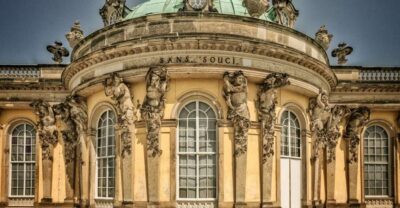
Sanssouci Palace is the emotional center of the visit. Frederick the Great built it as a private retreat on a vineyard, far from the formal pressure of Berlin. The name means without cares, and the small scale tells you a great deal about the king’s idea of comfort.
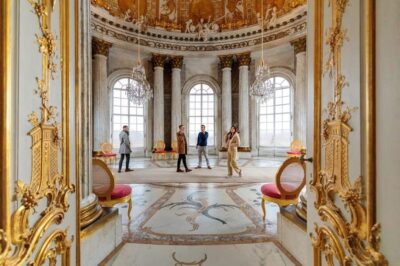
This is not a huge royal residence. The palace has only eight main rooms, and the rooms open toward the garden. Frederick wanted a personal home for himself, his dogs, and selected male visitors. The French philosopher Voltaire was among the famous intellectuals associated with the court.
Frederick spoke French with his visitors, played the flute, composed music, and used Sanssouci as a place to act out his ideal of the cultivated absolute ruler. That mix of private pleasure and royal control gives the palace more personality than a vast ceremonial residence.
The visit to the palace itself is listed at about 30 minutes, and admission is not automatically included. If you want to see the interiors, check the booking option carefully. The Sanssouci+ choice covers the castle visits described by the operator, while the basic arrangement includes the park but not the palace admission.
That distinction matters. You can enjoy the vineyard terraces and outdoor sights without entering every building, but the interior rooms are a major part of the story. If you care about Rococo decoration, Frederick’s private world, or the palace’s art collection, paying for the proper admission option makes sense.
The vineyard terraces and the famous fountain
The vineyard terraces provide the classic view of Sanssouci. Rows of vines climb toward the palace, with a broad fountain below. It is the image most closely associated with the park, and it is worth taking time here rather than treating it as a quick photo stop.
Wine growing was not simple in eighteenth-century Potsdam. The climate was not ideal, so the gardeners protected the vines behind glass. The trick helped shield them from cold weather and allowed the king to produce wine in a place farther north than the major wine regions of Europe.
The fountain below the palace needed a reliable water supply. An upper pond was built to feed it, and the so-called Ruinenberg was created to disguise the technical work. Its romantic ruined structures made the water system look like a deliberate classical feature.
That is typical of Sanssouci. Practical needs were dressed up as poetry. A water reservoir became a ruined mountain, a service building became a decorative palace feature, and an ordinary garden walk turned into a sequence of small surprises.
Windmill, Orangery, and the park’s visual tricks
The Historic Windmill brings a good legal story into the royal setting. Its owner fought the king in court and won at least in the first instance. The mill remained, and grain can still be ground there today.
The stop is short, about ten minutes, but the building has a useful viewpoint over the park. It also reminds you that royal power had limits, at least when challenged through the Prussian legal system.
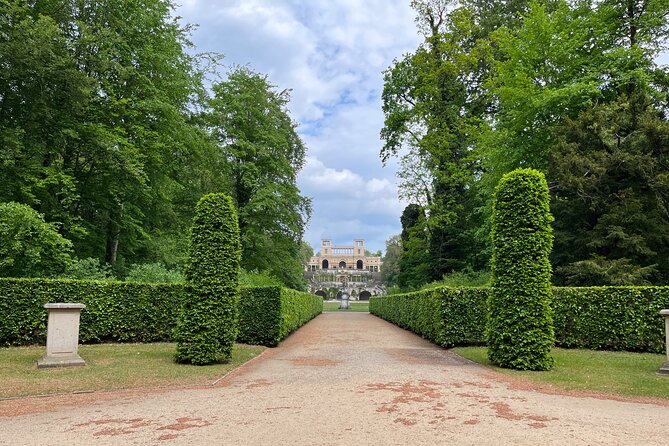
The Orangery Palace sits high enough to offer a fine view across the grounds. Its main practical role was to shelter exotic plants during winter, but it was built as a grand Roman-style feature rather than a plain greenhouse.
Nearby, the Chinese House is far more than a tea pavilion. Its gilded decoration, Chinese porcelain, and figures reflect eighteenth-century European fascination with China. It was made to delight the eye, and it succeeds. The interior visit is a good choice if you enjoy decoration and small-scale buildings more than grand state rooms.
The Roman Baths continue the park’s love of borrowed antiquity. Bathing was not the main point. The building was designed to suggest an idealized ancient world, with water, columns, and carefully arranged views.
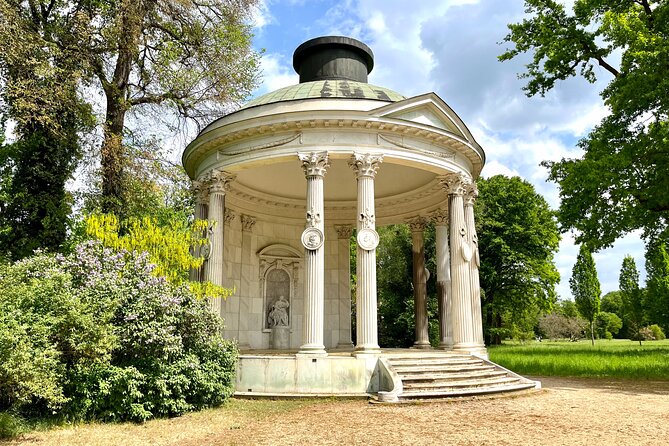
The Friendship Temple offers a smaller and more intimate stop. It was one of the decorative structures meant to provide a destination during a walk, a place for a quiet meeting, or even a picnic nearby.
Other Berlin experiences to weigh up
- Berlin: Private Reichstag and Glass Dome Tour
★ 4.8 · 2,226 reviews - Berlin Private Complete History All Day Walking Tour
★ 5.0 · 474 reviews - Private Walking Tour Berlin Third Reich Hitler and World War II
★ 5.0 · 360 reviews - Private Berlin: Iconic Sights and Hidden Gems Walking Tour
★ 5.0 · 292 reviews
Sanssouci Park is the real half-day experience
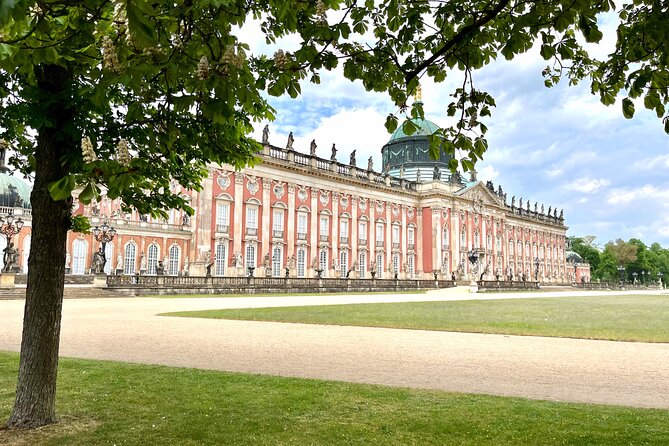
The park links the main palace, the terraces, the fountain, and the New Palace across roughly two kilometers. The route includes planted paths, small buildings, water features, and changing views.
The park admission is included, and about 45 minutes is set aside for it, but that may feel short if you want to wander. The gardens are not a single compact courtyard. You will walk between areas, and some paths are unpaved.
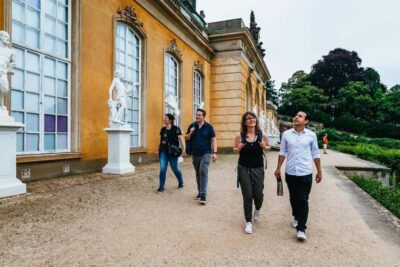
Good shoes matter. The operator specifically advises against sandals, and that is practical advice. You should expect walking around the park and palace grounds, not simply stepping out of a car at each entrance.
The New Palace is the grand counterpoint to Sanssouci. Frederick the Great called it fanfanery, a word suggesting display and show. The building was designed to impress relatives and visiting royalty, with hundreds of rooms arranged as apartments for royal family members.
Its size helps explain Frederick’s choice of Sanssouci. He preferred his small vineyard retreat and kept the grand relatives’ residence at the far end of the park. The long avenue between the two palaces made the separation clear.
The New Palace includes reception rooms, music rooms, bedrooms, writing rooms, and early bathrooms. Kitchens were kept in separate service buildings, known as the Communs, so cooking smells would not reach the royal apartments. Today, those connected buildings also house the University of Potsdam.
The palace interior is listed as an optional paid admission unless you select the Sanssouci+ arrangement. If you want only the outdoor park and main views, you can keep the cost down. If you want to understand the contrast between Frederick’s private taste and royal display, the New Palace is worth adding.
Potsdam’s Italian, Russian, and English touches
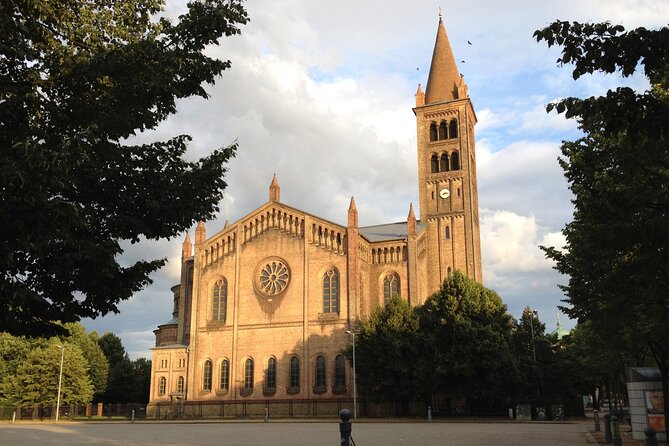
Friedenskirche reflects Frederick William IV’s love of Italy. Its separate bell tower resembles an Italian campanile, and the church sits beside a small artificial pond that mirrors the building.
The king’s burial place is here, away from the Hohenzollern crypt in Berlin Cathedral. That gives the church a quieter role in the royal story, even if the architecture is theatrical.
The park also includes buildings connected with royal children and their spouses. One residence was adapted for a crown prince or princess, with an Oriental-style tent room and a garden shaped for the melancholy Crown Princess Elisabeth of Bavaria.
The Church of Peace, the Roman Baths, the Chinese House, and the royal residences show how freely the Prussian court borrowed from other cultures. This was not a single architectural style. It was a collection of moods, references, and deliberate stage sets.
Alexandrowka adds another layer. Russian immigrants lived in traditional log houses there after a royal exchange brought Russian soldiers and singers to Prussia. The colony remains associated with Russian culture, and you can ask Gunter to include it if that interests you.
The route can also include Babelsberg Palace. Built in an English Gothic style for the future Kaiser Wilhelm I and his wife Augusta, it has battlements, towers, and a medieval appearance. Wilhelm later used a tower study with a broad view over Potsdam.
Cecilienhof and the 1945 Potsdam Conference
Cecilienhof Palace is farther from the main Sanssouci group, so it is easy to miss without a car. It was built for Crown Prince Wilhelm and Crown Princess Cecilie shortly before the First World War.
From the outside, it resembles an English country house rather than a grand Baroque palace. Inside, it offered modern comforts such as central heating and bathrooms. A ship-cabin-style room reflected Cecilie’s interest in sea travel.
The building matters most for its later role. In 1945, Stalin, Truman, and Churchill met here at the Potsdam Conference. The conference room remains arranged to recall that event, and the grounds preserve the setting.
For many people, Cecilienhof is the strongest reason to choose a private vehicle over a narrow Sanssouci-only visit. You can connect Prussian royal history with the political settlement that followed the Second World War in one day.
Potsdam’s gates, Dutch Quarter, and rebuilt center
The city portion of the tour shifts from royal parks to everyday Potsdam. Nauen Gate is the most imposing of the surviving historic gates, with a medieval Romanesque appearance that contrasts with the low buildings around it.
The Dutch Quarter was created for skilled Dutch workers brought to Prussia, including canal builders. Its red brick houses give the area a clear Dutch character, with small shops, cafés, bars, and craft businesses.
You can also pass through or near Potsdam’s other historic gates, including the Brandenburg Gate, Jägertor, and Nauener Tor. The Brandenburg Gate here is smaller than Berlin’s famous gate, but it served a practical route toward Brandenburg.
Potsdam’s main pedestrian streets lead through geometric squares and restored town houses. The small department store with its Art Nouveau glass roof is a worthwhile detail, especially if you like ordinary city buildings as much as palaces.
The City Palace was badly damaged in the war and later demolished during the socialist period. It has since been rebuilt, and the restored exterior and courtyard now house the Brandenburg state parliament. The reconstruction is part of the city’s modern story, not simply a return to an older past.
The Garrison Church is another major rebuilding project. It once dominated the old center, disappeared from the postwar city, and is now being recreated. The Barberini Museum nearby also reflects Potsdam’s renewed cultural life, with its art collection in a rebuilt palace.
Glienicke Bridge and the Cold War edge
Glienicke Bridge adds a sharp change of mood. For decades it marked the border between West Berlin and East Germany. The bridge became famous for secret exchanges of spies and prisoners between the United States and the Soviet Union.
Its story has also drawn filmmakers, so the setting may look familiar from Cold War cinema. Seeing it after the royal palaces makes Potsdam’s timeline unusually clear: Prussian kings, imperial families, twentieth-century war, divided Germany, and modern reconstruction all sit within one extended route.
The nearby Marble Palace and New Garden area can also appear on the drive. On the Berlin side, Glienicke Palace overlooks the water, with Italian-style features and a former casino. These stops are best treated as drive-by context unless your schedule allows more walking.
Price, timing, and what is actually included
The listed price is about $179.01 per person. That is a serious price for a day trip, but the calculation changes if you are traveling with family or friends. You are paying for a private vehicle, pickup, parking, a dedicated guide, and the ability to adjust the route.
For a solo visitor, the price is harder to justify unless convenience and personal attention matter more than saving money. For two or more people, the private format becomes more attractive, especially because public transport does not place every palace and gate directly beside one another.
The base arrangement includes:
- Pickup from your hotel or apartment in Berlin
- An air-conditioned vehicle
- Parking fees
- The taxi ride and city guiding service
- Sanssouci Park admission
Palace interiors are not included unless you select the Sanssouci+ option. Snacks are also not included, so plan a café stop or carry something with you. The route can include cafés in the Dutch Quarter or near the park, but food is not part of the stated package.
Before pickup, wait for Gunter’s SMS or WhatsApp message and then come out to the street. Include a working mobile number when you book. A baby car seat is available on request, and service animals are allowed. A foldable stroller with a removable cradle can be carried, but luggage space becomes tighter.
Free cancellation is available up to 24 hours before the start time. Changes or cancellations inside that window are not accepted for a refund.
Who should book this Potsdam tour?
I would choose this experience if you want to see more than one palace and prefer a guide who explains the connections between buildings. It suits history fans, architecture lovers, families who want door-to-door transport, and solo visitors who value a flexible private day.
It also works well if you want photos. Gunter regularly takes pictures at important sites and sends them afterward, a small service that is particularly useful when you are traveling alone or as a couple.
I would not choose it if you want a quiet, self-guided garden walk with little commentary. Gunter shares a great deal of information, and the day can feel packed. The route also involves walking on rough paths, and palace admissions may add to the advertised price.
Should you book it?
Book this private Potsdam tour if you want a full view of the city, from Frederick the Great’s intimate vineyard retreat to the 1945 conference room at Cecilienhof and the spy exchanges at Glienicke Bridge.
The strongest reasons are the private transport, Gunter Bauer’s engaging historical explanations, and the freedom to add places such as Alexandrowka or the Dutch Quarter. Check the admission option before paying, wear sturdy shoes, and allow enough time for both outdoor walking and palace interiors.
If your main goal is simply to see Sanssouci Palace and the vineyard terraces, a shorter and cheaper visit may suit you better. If you want Potsdam’s many layers in one well-guided day, this is a strong choice.
FAQ
How long does the private Potsdam tour last?
The experience lasts approximately six to eight hours. The exact length can vary depending on walking time, palace visits, and any additional stops added to the route.
What time does pickup begin?
The listed start time is 10:30 a.m. Pickup is from your hotel or accommodation in Berlin.
Where does pickup take place?
Pickup is offered from your chosen hotel, apartment, or other accommodation in the city. You should wait for an SMS or WhatsApp message before coming out onto the street.
Is Sanssouci Palace admission included?
Palace admission is not included in the standard arrangement. The Sanssouci+ option includes admission for the castle tours, so check the selected option when booking.
Is Sanssouci Park admission included?
Yes. Admission to Sanssouci Park is included.
Is transportation included?
Yes. The private taxi ride, an air-conditioned vehicle, parking fees, and the city guiding service are included.
Is the tour private?
Yes. Only your own group participates in the activity.
What should I wear for the tour?
Wear good walking shoes. The park and palace grounds include mostly unpaved paths, so sandals are not recommended.
Newest Berlin reviews
- Where It All Began: Berlin’s Queer & Trans History Tour★ 4.9 · 6 reviews
- Understanding Kreuzberg: The roots of local (sub)culture★ 4.9 · 11 reviews
- Berlin: guided canoe | kayaktour★ 4.1 · 7 reviews
- Private Potsdam City Tour in an authentic vintage van★ 5.0 · 14 reviews
- Warnemünde Shore Excursion: Private Sachsenhausen and Berlin Tour★ 5.0 · 12 reviews
- Ultimate E-Bike Tour of Berlin with Beer Garden Stop★ 5.0 · 4 reviews
- In the Forbidden City – Potsdam Walking Tour★ 5.0 · 17 reviews
- Private Walking Tour of Potsdam and Sanssouci★ 5.0 · 24 reviews
Potsdam and Sanssouci Day Trips, compared.
Sanssouci Palace and Prussian Palaces Entry Ticket
Read our review →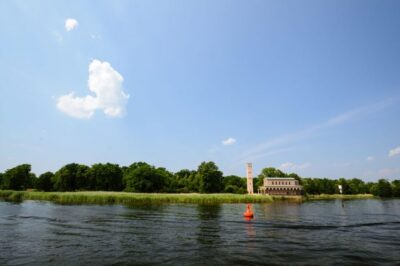
Sachsenhausen Concentration Camp and Potsdam Tour
Read our review →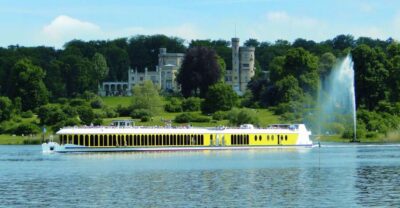
Browse the lists this tour appears in