
Reviewed · BERLIN
Explore Berlin by canoe
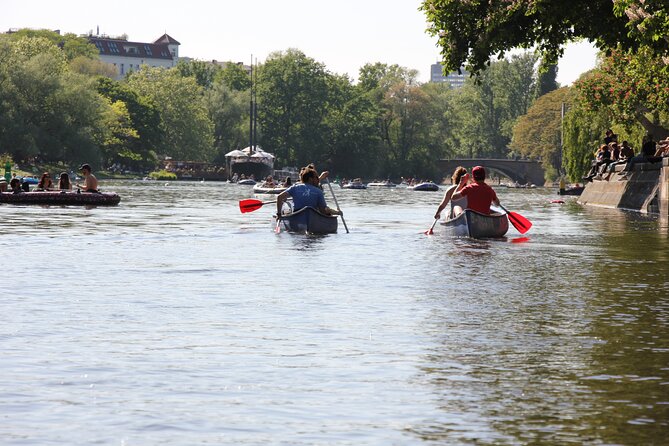
Berlin looks different from a canoe. The city’s brick walls, leafy banks, bridges, houseboats, and old industrial edges unfold at water level, far from the usual museum-and-monument route. This two-hour paddle follows the Landwehrkanal and reaches a scenic stretch of the Spree near Oberbaum Bridge.
I like the gentle current and the relaxed pace. You do real paddling, but the water is calm enough for beginners. I also like the mix of city history and odd little details, from the former border-control remains at Osthafen to the stories told by guides such as Pedro and Florian. The main consideration is that this is a canoe trip first and a full city sightseeing tour second. Much of the route is on the canal, and the guide may not sit in your canoe, so explanations come at selected stops rather than every minute.
Key points to know before you paddle
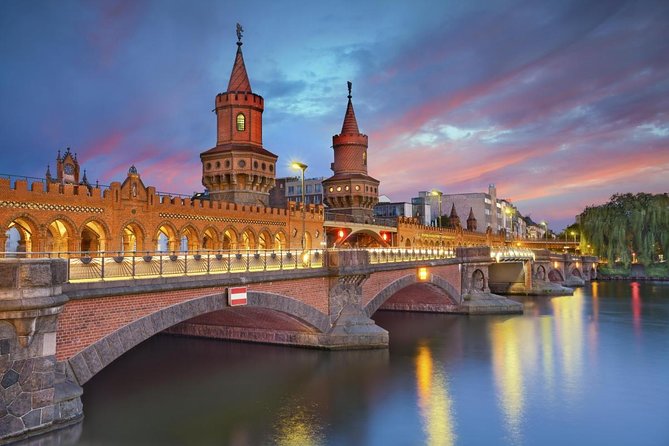
- Oberbaum Bridge from water level: You approach one of Berlin’s best-known bridges from below, with time to appreciate its brick towers and busy history.
- Molecule Man up close: The enormous metal sculpture is one of the tour’s clearest photo moments, especially from the Spree.
- Easy paddling for beginners: Calm water, provided equipment, and patient instruction make this suitable for first-time canoeists.
- A Berlin history lesson with humor: Guides explain the divided city, the neighborhood, and present-day issues without turning the outing into a lecture.
- Mostly canal, with a short Spree section: The route offers a fresh city view, but it does not cover every major Berlin sight from the river.
- Small-group minimum, large stated maximum: At least six people are needed for the trip to operate, while the published maximum is 118.
Berlin begins at Canoa on Ratiborstraße
You meet at Canoa Berlin, Ratiborstraße 14c, in the Kreuzberg area. The activity returns to this same point, so you do not need to plan a separate way back after getting off the water.
Bring comfortable clothing and shoes, a hat or other head covering, sunscreen, and water. The canoe, paddle, life jacket, and a dry box for small belongings are supplied. That dry box matters more than it sounds. You can keep essentials protected without trying to balance a phone or wallet between your knees.
The tour is offered in English. The exact way the guide works with the group can shape your experience. Pedro is praised for helping new canoeists find their rhythm, while Florian is singled out for clear explanations and a good mix of history, stories, and practical help. You may not have one of them on every departure, but the operation is clearly built around friendly, patient instruction.
No prior canoeing skill is required. You will still need to paddle, so this is not a passive boat ride. The effort is generally manageable because the current is slight, and the pace is described as calm rather than strenuous.
More paddling trips around Berlin:
- Berlin: Guided Tour by Canoe
★ 4.7 · 116 reviews - Berlin: guided canoe | kayaktour
★ 4.1 · 7 reviews
The Landwehrkanal gives you a slower Berlin
The opening section follows the Landwehrkanal through a part of Berlin that feels lived-in rather than polished for sightseeing. You pass grassy areas around the Dreiländereck and continue along Görlitzer Ufer, where the city’s open, mixed, and sometimes scruffy character comes through clearly.
This is one of the tour’s strengths. From the water, you see Berlin without the usual traffic, crosswalks, and crowds around major monuments. The banks reveal a less formal city, with greenery, urban edges, and the everyday rhythm of Kreuzberg. The guide adds background on Berlin’s past, along with humorous anecdotes about one of its most colorful districts.
The canal section also explains why expectations matter. If you want a boat route packed with headline sights, you may find this part too quiet. If you want to understand how Berlin feels away from the postcard center, it works well. You are paddling through a neighborhood, not simply being carried past a row of monuments.
The guide may pause at several points to explain the setting, but the guide does not necessarily sit in your canoe. One important detail is that the commentary can feel less continuous than on a walking tour. You may paddle for a stretch and then gather for explanations, so keep your ears open when the group stops.
Approaching the Spree and Oberbaum Bridge
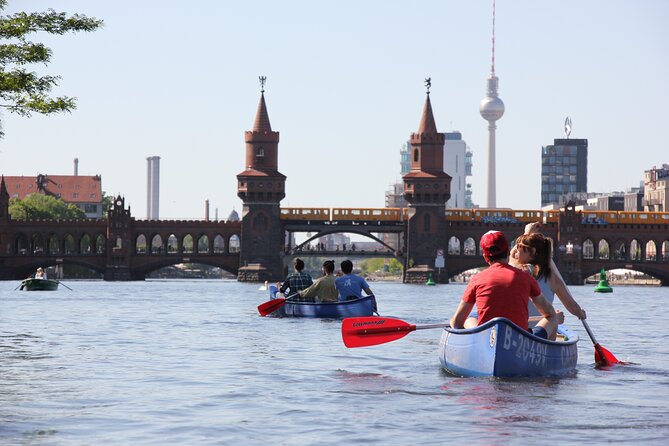
The route turns toward the Spree, where the views become more recognizably Berlin. The change is noticeable: the waterway opens up, and well-known sights begin to appear around you.
Oberbaum Bridge is the major visual prize. Its red brick towers and arches are easy to recognize from land, but seeing it from a canoe gives you a lower, more personal angle. You come close to the bridge, rather than viewing it from a distant riverbank or a crowded footpath. It is a good moment to look up, take photographs, and listen to the guide’s explanation of the area.
The bridge also helps connect the city’s older divisions with its current identity. Berlin’s history is not presented as a tidy sequence of dates. It is tied to the streets, riverbanks, bridges, and neighborhoods around you. That makes the historical talk more useful than a generic lecture delivered indoors.
The Spree section is relatively short compared with the canal route. One Dutch-language account found the experience too focused on the canal and expected more major sights along the Spree. That is a fair warning. The tour includes significant views, but it is not a complete river cruise through central Berlin.
Meeting Molecule Man at water level
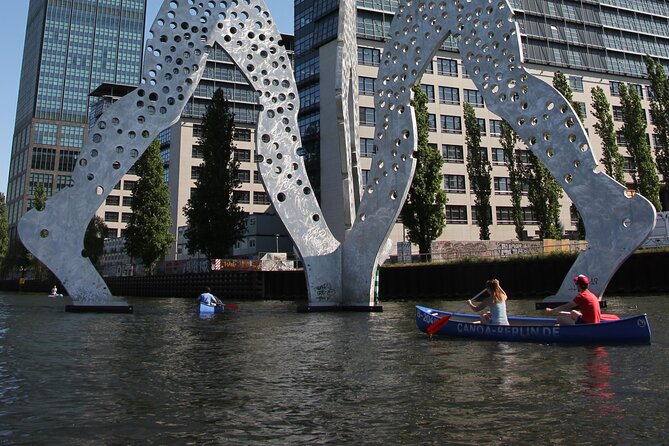
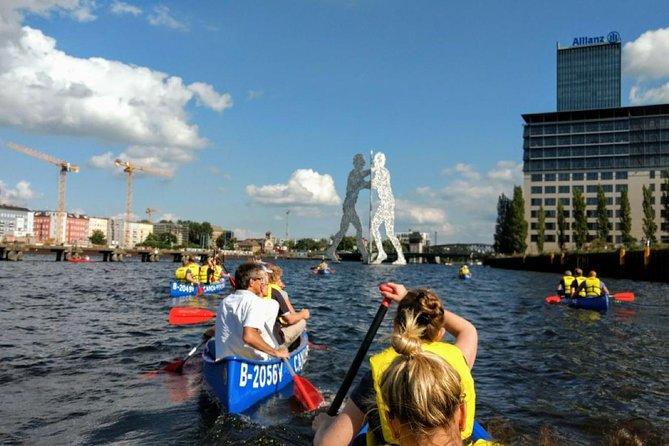
The Molecule Man sculpture is one of the clearest reasons to choose this route. The three towering human figures, made from perforated metal, rise from the Spree near the meeting point of several Berlin districts.
From a canoe, you can approach the sculpture closely and see it from an angle that is hard to get from shore. The scale registers better on the water. It is also a useful example of Berlin’s taste for large public art that is slightly strange, memorable, and tied to the city’s changing identity.
This stop usually provides one of the best chances for photographs, but protect your phone until you are ready to use it. You will be handling a paddle, sitting in a moving canoe, and sharing the water with other boats. The provided dry box gives you a safer place to store it between pictures.
The sculpture is not just a photo stop. The guide connects it with Berlin’s current issues and the way the city has changed. The commentary appears to balance information with humor, which helps keep the history accessible even if you are not usually drawn to formal city tours.
A different sort of day out in Berlin:
- Berlin: Reichstag, Dome and Government District Guided Tour
★ 4.7 · 18,288 reviews - Berlin: 1-Hour City Tour by Boat with Guaranteed Seating
★ 4.3 · 16,993 reviews - Berlin: Boat Tour Along the River Spree
★ 4.4 · 11,252 reviews - Discover Berlin Half-Day Walking Tour
★ 5.0 · 9,624 reviews
Badeschiff, Osthafen, and the traces of division
The route also passes the Badeschiff, the floating swimming pool in the Spree. It is an unmistakably Berlin sight, combining industrial river scenery with the city’s habit of turning unusual spaces into places for leisure.
From the canoe, you get a close view without needing to walk around a busy complex. The stop is brief, but it adds variety after the quieter canal banks and the monumental Molecule Man.
At Osthafen, the tour reaches a more serious piece of Berlin’s past. You can see surviving parts of the former border-control installation from the period when East and West Germany were divided. These remains are easy to miss if you are moving through the city by train or on a standard sightseeing bus.
This is where the water route earns its price. You are not only checking off sights. You are seeing how the river once formed part of a controlled border and how the same waterside spaces now serve recreation, public art, and city life. The guide’s historical context is important here, since the concrete and metal remnants do not explain themselves.
The route brings you very close to Oberbaum Bridge before heading back toward the canal. That final approach is another strong visual moment, though the return also means the tour can feel longer than a simple two-hour loop. One account reported a total duration closer to three hours, so avoid scheduling a tight appointment immediately afterward.
Passing through the lock
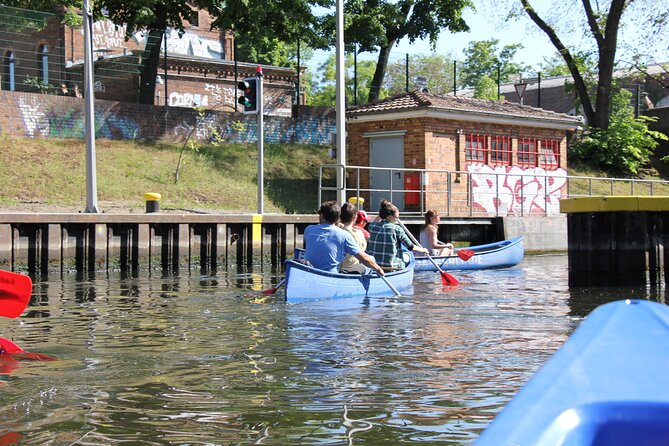
A lock crossing can be a highlight for anyone who has never experienced one from a small boat. The route includes the Oberschleuse near Schlesische Brücke, and passing through it gives the paddle a practical bit of adventure.
You are not simply moving along a straight waterway. The water level changes, the group has to follow instructions, and the setting makes the city’s working infrastructure visible. It is a small experience, but it gives the outing a sense of place that a sightseeing boat often misses.
Listen carefully during this section, especially if you are new to canoeing. The guides are used to helping beginners, but you still need to follow directions and work with your canoe partner. The activity is suitable for first-timers and children according to the supplied information, but an adult should be comfortable with the physical effort and the need to stay attentive on the water.
What the paddling is really like
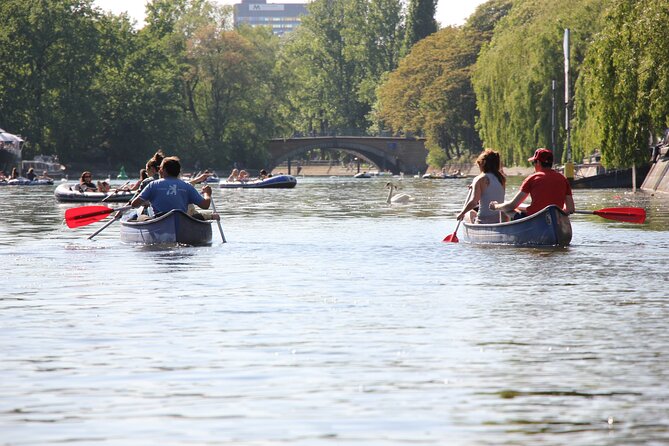
The conditions are described as having very little current. That makes the tour approachable, particularly if you have never handled a canoe before. You will learn through doing, with help from the guide when you need it.
The physical work is part of the appeal. You get a bit of exercise during a trip that might otherwise be filled with meals, museums, and sitting. At the same time, this is not presented as a race or a hard training session. The pace is relaxed, and the mood on the canal and Spree is easygoing.
Canoe partners matter. You share the boat, so a little cooperation helps. If one person paddles much harder than the other, the canoe can turn or move unevenly. New paddlers should not worry too much, though. Pedro is specifically praised for helping beginners, and the equipment and instruction are designed to make the first attempts manageable.
Weather can change the feel of the outing. On a hot day, the open water and gentle movement can be welcome, but you need sunscreen, water, and head protection. Rain does not automatically ruin the experience, as one outing remained enjoyable in wet weather, but the activity requires suitable weather and can be canceled if conditions are poor.
Is $46.73 a fair price?
At $46.73 per person, this costs more than simply renting a canoe for an hour or two. You are paying for the equipment, life jacket, dry box, instruction, guiding, and the added history of the route.
The value is strongest if you want an active city experience with context. You get a different view of Kreuzberg, a look at the Landwehrkanal, a Spree excursion, Oberbaum Bridge, Molecule Man, Badeschiff, Osthafen, and the lock. You also avoid having to arrange the canoe and safety gear yourself.
The value is weaker if your main goal is to see as many central Berlin monuments as possible. The route spends much of its time on the canal, and the Spree portion is limited. A dedicated river cruise may show more of the city from the water, while a walking tour will offer more continuous explanation.
The published rating is 4.6 from 36 reviews, with 92 percent recommending it. The strongest praise goes to the guides, the calm water, the friendly mood, and the unusual perspective. The clearest criticism concerns the balance between paddling and sightseeing. That split gives you a useful way to decide: book it for the experience of canoeing through Berlin, not as a substitute for a full highlights tour.
Who will enjoy this Berlin canoe trip?
I would choose this for first-time canoeists who want some instruction without giving up sightseeing. It also suits couples, families, and friends who enjoy doing something active during a city break.
It is a good fit if you have already seen central Berlin and want a less familiar side of the city. The canal banks, Kreuzberg setting, old border remains, public art, and industrial river edges provide a view that you will not get from the standard route between Museum Island and Brandenburg Gate.
You should think twice if you dislike shared physical activities, want uninterrupted guiding, or expect a long cruise beside Berlin’s most famous buildings. The guide may be a short distance away in another canoe, and commentary comes at selected points. That arrangement works for an informal outing, but it is not the same as having a guide beside you every minute.
The stated maximum is 118 people, though the practical feel will depend on the departure. The tour needs at least six participants to run. If that minimum is not met, you are offered another date or experience, or a full refund.
The practical decision
You can cancel for a full refund up to 24 hours before the start time. Changes or cancellations inside that window are not accepted for a refund. If bad weather stops the tour, you are offered another date or a full refund.
I would book this if you want Berlin with a paddle in your hands, a few strong sights, and a guide who adds stories to the scenery. I would not book it expecting a complete survey of the Spree or a tightly scripted sightseeing cruise.
The best reason to go is the combination of calm water, Oberbaum Bridge, Molecule Man, the lock, and the surviving marks of Berlin’s divided past. Add patient guides such as Pedro or Florian, and the result is an easygoing two-hour outing with enough history to give the views meaning. Just leave room in your schedule, pack for the weather, and remember that the canoeing is not a side detail. It is the point.
FAQ
Where does the canoe tour start and finish?
The tour starts at Canoa Berlin, Ratiborstraße 14c, 10999 Berlin. It ends back at the same meeting point.
How long does the activity last?
The stated duration is approximately two hours. One account reported that the outing lasted closer to three hours, so leave extra time afterward.
Do I need canoeing experience?
No. The tour is designed for beginners as well as experienced paddlers. Canoes, paddles, life jackets, and a dry box are provided.
Which sights does the route pass?
The route includes Oberbaum Bridge, Molecule Man, Görlitzer Park, the Landwehrkanal, Badeschiff, and former border-control remains at Osthafen. It also reaches the Oberschleuse near Schlesische Brücke.
Is the tour offered in English?
Yes. The activity is offered in English.
What happens if the tour is canceled?
If poor weather causes cancellation, you are offered another date or a full refund. If fewer than six people book and the minimum is not met, you are offered an alternative or a full refund.
Newest Berlin reviews
- Where It All Began: Berlin’s Queer & Trans History Tour★ 4.9 · 6 reviews
- Understanding Kreuzberg: The roots of local (sub)culture★ 4.9 · 11 reviews
- Berlin: guided canoe | kayaktour★ 4.1 · 7 reviews
- Private Potsdam City Tour in an authentic vintage van★ 5.0 · 14 reviews
- Warnemünde Shore Excursion: Private Sachsenhausen and Berlin Tour★ 5.0 · 12 reviews
- Ultimate E-Bike Tour of Berlin with Beer Garden Stop★ 5.0 · 4 reviews
- Private Walking Tour of Potsdam and Sanssouci★ 5.0 · 24 reviews
- Potsdam Highlights – Private sightseeing tour by minibus★ 5.0 · 3 reviews