
Reviewed · BERLIN HOP-ON HOP-OFF BUS TOURS
Berlin: Hop-on Hop-off Bus Tour with Live Commentary
Berlin’s past comes into focus from a bus seat on this bilingual city tour, where a local guide connects the Berlin Wall, Nazi-era sites, Prussian monuments, and today’s government quarter. For $22, you can cover a lot of ground in one day without piecing the city together by public transport.
I like the regular buses and the choice of starting at any stop, especially if you are staying near the main station or Zoologischer Garten. I also like the live commentary, with guides such as Otti, Dimitri, Steve, and Thilo adding jokes, personal stories, and useful museum tips. The main drawback is that German and English are mixed on the same bus, so English speakers may miss a few details, and some buses have been reported as old or cold.
Key points to know before boarding
- Live German and English commentary: The guide speaks to the bus rather than relying only on a recording, though the balance between languages can vary.
- A full Berlin overview: The route links Potsdamer Platz, Checkpoint Charlie, Museum Island, Brandenburg Gate, the Reichstag, Tiergarten, and more.
- Frequent service: Buses generally run every 15 to 30 minutes, or every 30 to 45 minutes from November through March.
- Flexible boarding: You can begin at any listed stop, including Galeria on Kurfürstendamm, Alexanderplatz, Hauptbahnhof, or Zoologischer Garten.
- Route changes are possible: Bridge repairs, Christmas markets, and a weak tunnel structure under Unter den Linden can cause detours or temporary stop changes.
- Best value for first-time visitors: It works well if you have one day, limited mobility, or want an overview before choosing which sights deserve more time.
Why the live guide changes the ride
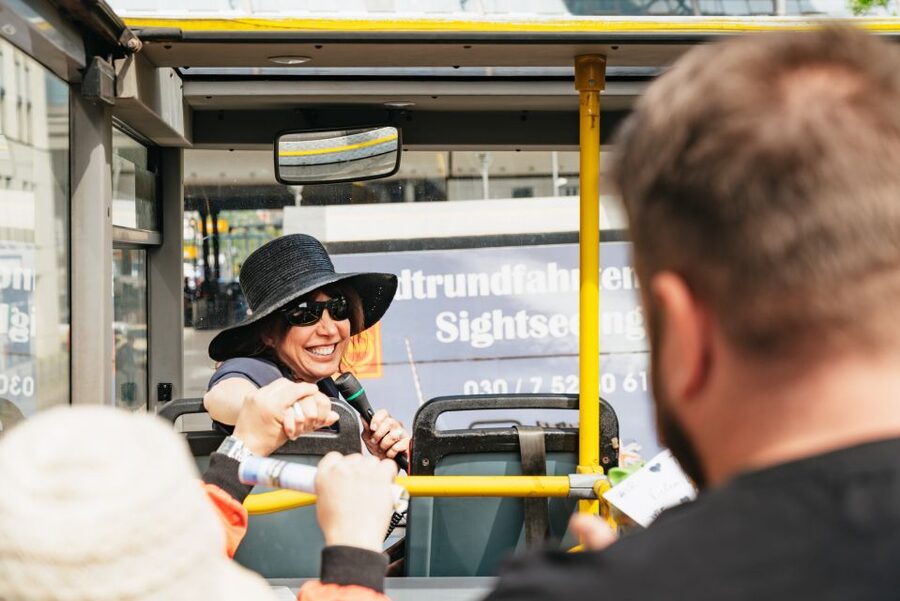
Many city buses give you a recording and a set of headphones. Here, the main attraction is the person at the front. Guides switch between German and English, answer questions, and adjust the pace to what is happening outside the windows.
Otti receives especially warm praise for his humor, clear English, and ability to turn Berlin’s complicated past into a story you can follow. Dimitri is another name to watch for, with a friendly style and useful suggestions for museums. Steve, Thilo, Simon, Kerstin, and Stephanie have also led strong departures.
The quality can vary by guide. One guide may offer lively detail and personal memories, while another may give a shorter commentary. The bilingual format also takes time. If the guide explains each point first in German and then in English, you may pass the next building before the second explanation is finished.
For English speakers, sit where you can hear clearly and keep your eyes outside. If a particular guide is especially good, riding the full loop again can be worthwhile. The complete ride takes about two hours according to the tour information, but hopping off turns it into a full-day outing.
More hop-on hop-off bus tours in Berlin:
- Berlin: City Sightseeing Hop-On Hop-Off Bus Tour
★ 4.1 · 4,233 reviews - Berlin: Hop-On Hop-Off Sightseeing Bus with Boat Options
★ 4.3 · 4,012 reviews - Berlin: East and West Hop-On Hop-Off Bus Tour
★ 4.2 · 2,195 reviews
Starting at Kurfürstendamm and heading east
The main starting point is in front of Galeria at Kurfürstendamm 231, a practical choice if you are staying in western Berlin. You can also board at KaDeWe, Lützowplatz, or the Philharmonic.
The first section passes KaDeWe, Berlin’s famous department store, then moves past Lützowplatz and the Kulturforum. The Kulturforum area includes major cultural institutions, and the Philharmonic stop puts you near one of Berlin’s most distinctive concert halls.
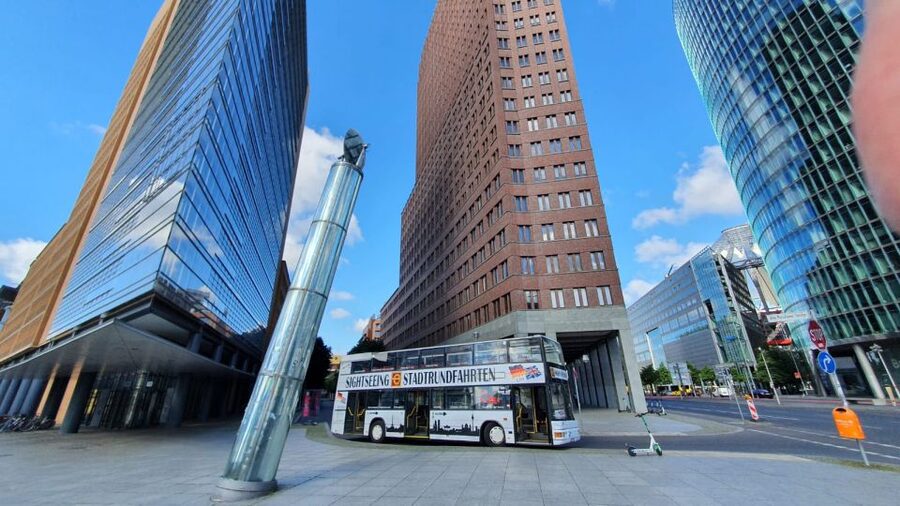
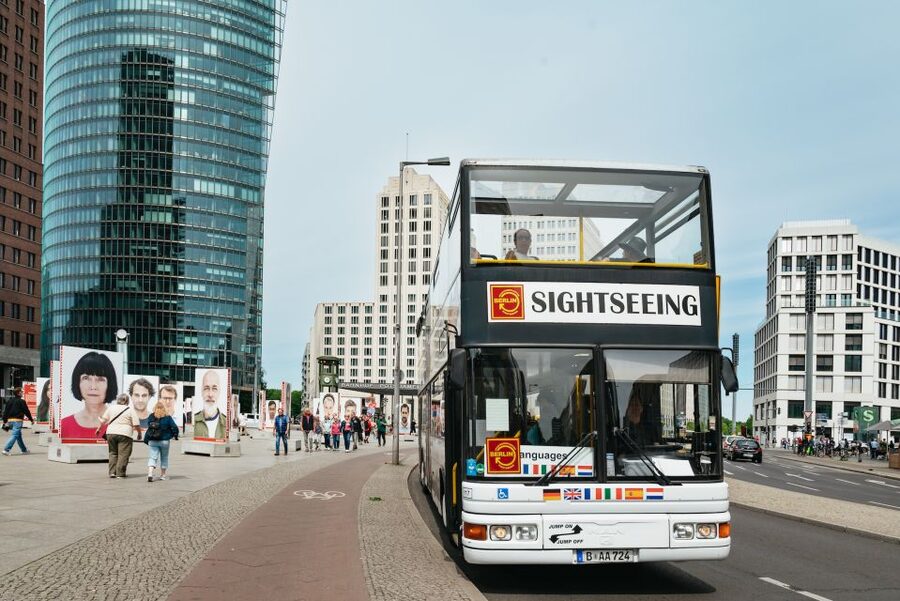
The bus then reaches Potsdamer Platz, one of the most useful stops for understanding how quickly Berlin changed. Before the Second World War, this was a major public square. During the Cold War, it became a barren stretch divided by the Berlin Wall. Now, tall towers and busy streets fill the same space.
That contrast is best understood on foot. Get off near the Kollhoff Tower or Potsdamer Platz and look around before continuing. Legoland Discovery Center is also here, making this stop more useful for families. The area is modern and polished, so it does not feel like old Berlin, but the Wall’s former path and the empty space that once surrounded it give the setting weight.
Nazi history around Niederkirchnerstrasse
The route continues toward Niederkirchnerstrasse and the Topography of Terror. You pass the Berlin state parliament, Martin-Gropius-Bau, and the former Nazi Ministry of Aviation, now used by the Ministry of Finance.
The Topography of Terror documents Nazi persecution and the suffering of Jews and other victims under the regime. This is one of the most important places along the route, but it is not a quick photo stop. If you get off here, allow time to read and reflect rather than trying to squeeze it between two buses.
Checkpoint Charlie follows. The crossing was once a Cold War gateway between East and West Berlin. Today, the setting is crowded with shops and photo opportunities, and some of the theatrical atmosphere can distract from the actual history. The nearby Wall Museum offers more context if you want to move beyond the familiar checkpoint sign.
This part of the route works best as an introduction. The guide can explain how the Nazi government, wartime destruction, division, and reunification shaped the streets you are seeing. You should not expect the bus commentary to replace a museum visit, but it helps you decide where to spend your limited time.
Gendarmenmarkt and Alexanderplatz
Gendarmenmarkt is one of Berlin’s finest architectural squares, framed by the French Cathedral, German Cathedral, and Konzerthaus. The bus stop is normally on Markgrafenstrasse, though the location changes to Französischestrasse and Markgrafenstrasse during the Christmas market for security reasons.
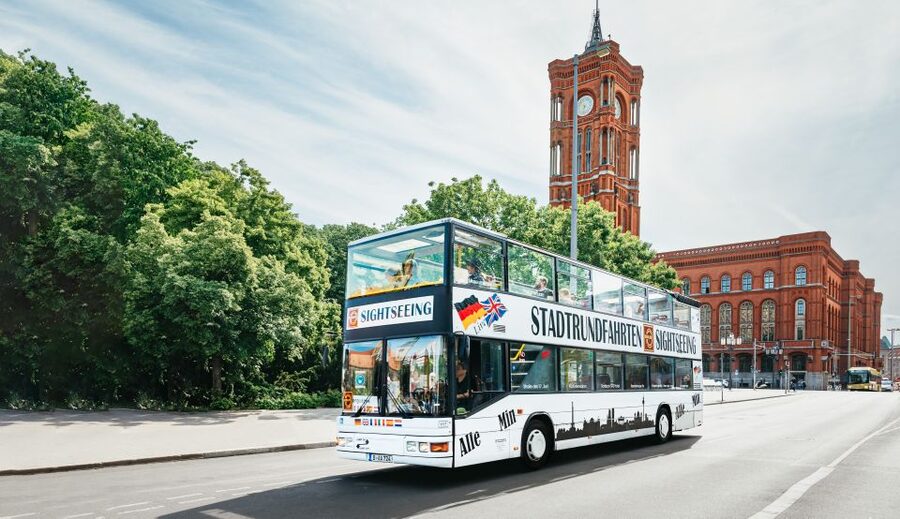
From here, the route moves toward Alexanderplatz and the Fernsehturm, Berlin’s famous television tower. The usual stop is near the Neptune Fountain, between the Red City Hall and the fountain. This stop also puts you near shopping and the broad open spaces of central Berlin.
Alexanderplatz is not a delicate historic square. It is large, functional, and shaped by the former East German city plan. That makes it useful for seeing another side of Berlin, one tied to socialist architecture and postwar rebuilding rather than Prussian grandeur.
The Neptune Fountain stop can close during the Christmas market. In that case, use the Karl-Liebknecht-Strasse 5 stop near the Radisson Hotel. Check the exact stop with the guide before getting off, since a short walk can save a long wait.
A different sort of day out in Berlin:
- Berlin: Reichstag, Dome and Government District Guided Tour
★ 4.7 · 18,288 reviews - Berlin: 1-Hour City Tour by Boat with Guaranteed Seating
★ 4.3 · 16,993 reviews - Berlin: Boat Tour Along the River Spree
★ 4.4 · 11,252 reviews - Discover Berlin Half-Day Walking Tour
★ 5.0 · 9,624 reviews
Museum Island, Humboldt University, and Unter den Linden
The bus next reaches Karl-Liebknecht-Strasse, close to Museum Island and the river. This is also the place where you can transfer to a boat if you want to add a separate view of Berlin from the water. The boat ride is not included in the $22 ticket.
From the bus, you can see the golden dome of the New Synagogue on Oranienburger Strasse. Hackesche Höfe is also only a few minutes away. Its connected courtyards are a good place to stop for a short walk, shops, and cafés, though the atmosphere is more commercial than many first-time visitors expect.
The route then follows Unter den Linden, Berlin’s grand ceremonial avenue. It passes Museum Island, the Humboldt Forum area, Bebelplatz, Humboldt University, and the Bud Spencer Museum at Unter den Linden 10.
Bebelplatz is especially important. It recalls the Nazi book burning of 1933, and the square’s open design makes it easy to miss the memorial if you are simply looking through the bus window. This is a good example of why the tour works best as a survey, not a substitute for walking. Make a note of the places you want to revisit.
The stops at Unter den Linden 36 near Friedrichstrasse and Unter den Linden 74 near Madame Tussauds give you several ways to break the route. Madame Tussauds suits families and visitors wanting a lighter indoor attraction. Museum Island is the stronger choice if you want Berlin’s major art and archaeological collections, but admission to museums is not part of the bus ticket.
There is an important route warning here. A tunnel structure under Unter den Linden cannot safely take some heavy vehicles, so certain buses may bypass stops 11 through 13. The alternate route can pass Hackescher Markt, the New Synagogue, and Friedrichstadt-Palast, but you should not assume every bus will reach each Unter den Linden stop.
Brandenburg Gate, the Holocaust Memorial, and the Reichstag
The route continues past the embassies of the United Kingdom, Russia, France, and the United States before reaching the Brandenburg Gate. The stop is at Platz des 18. März on the western side of the gate.
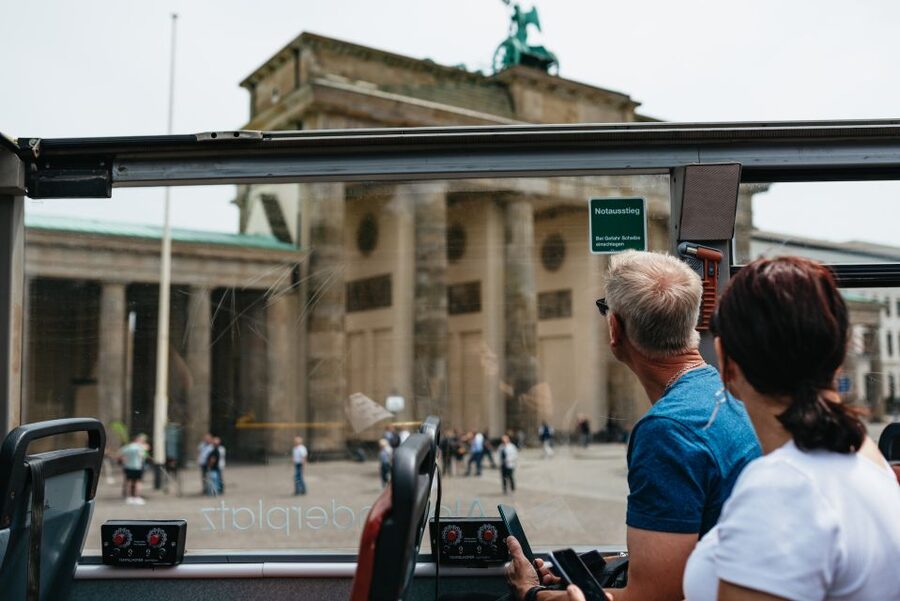
The gate is Berlin’s most recognizable symbol, but its meaning has changed repeatedly. It was part of the old royal city, later stood close to the Wall, and became a powerful image of reunification. Get off here if you want photographs and time to walk through the gate toward Unter den Linden.
Nearby, the Holocaust Memorial is made up of rows of concrete blocks on a broad open site. The memorial is easy to visit from this stop, though its meaning is best approached quietly. The underground information center adds names and personal stories connected to Jewish victims of the Holocaust.
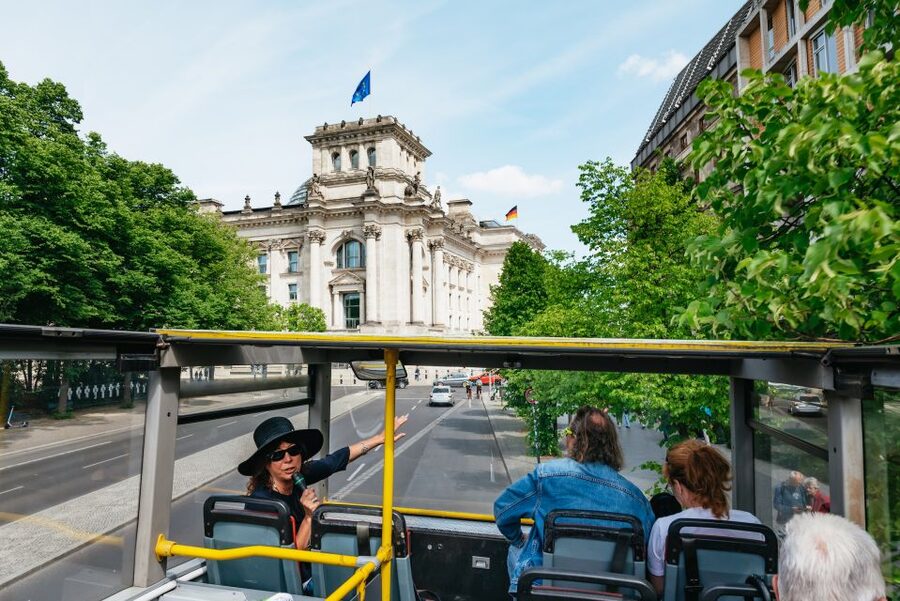
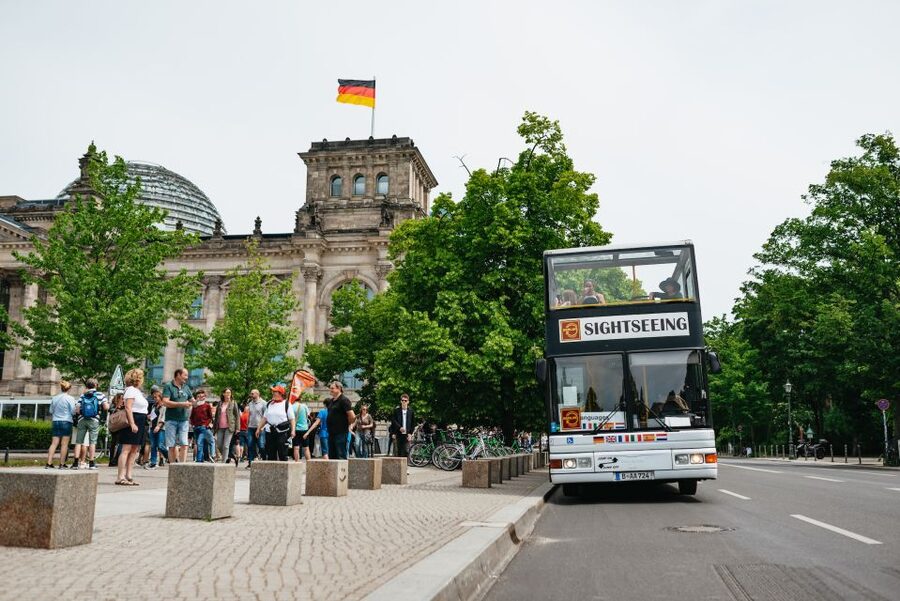
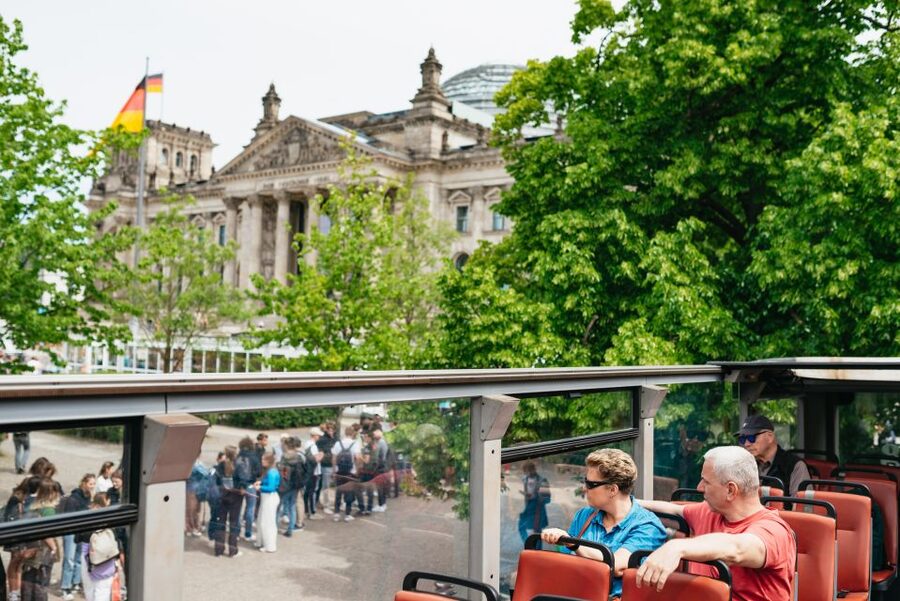
The bus then passes the Reichstag and the government district. The Reichstag is home to the German parliament, while the surrounding area contains modern government buildings beside the Spree. The route gives you a quick look at how reunified Germany placed its political center in a city once split by a fortified border.
Do not assume that seeing the Reichstag from the bus includes entry. The tour only takes you past it. If you want to visit the glass dome, you need to make separate arrangements.
Hauptbahnhof, Tiergarten, and Bellevue Palace
Berlin Hauptbahnhof is one of the most useful stops if you are staying nearby or arriving by train. The stop is at the Washingtonplatz exit. From here, the route offers a broad view of the Chancellery and Reichstag.
There is also a playful local detail here: the guide may point out Berlin’s Fujiyama, a nickname for a distinctive feature visible in the area. It is the kind of small aside that gives the live commentary more personality than a standard recording.
Next comes the Haus der Kulturen der Welt, also called the Congress Hall. The stop is currently listed as out of order, so treat it as a sight passed from the bus rather than a reliable place to board or leave.
The bus crosses the Tiergarten, Berlin’s large central park. It is bigger than New York’s Central Park and serves as the city’s green center. You will not see every corner from the road, but the ride gives you a welcome break from dense streets and monumental buildings.
Bellevue Palace is the official residence of the President of Germany. The stop also offers views toward the Siegessäule, or Victory Column, topped by its golden Victoria statue. These sights are spread out, so staying on the bus is practical if you mainly want an overview. Get off only if you have time for a walk and do not mind waiting for the next bus.
Returning through western Berlin
The final section passes Bikini Berlin and the Zoologischer Garten station before returning to Galeria on Kurfürstendamm. Zoologischer Garten is a good alternative starting point for anyone staying in western Berlin, and it connects with U-Bahn and S-Bahn services.
The route is broad rather than tightly packed. You see major sights across a large city, but you will not stop at every doorway. Berlin’s scale is part of the lesson: Potsdamer Platz, Museum Island, the government quarter, and the Tiergarten are not all clustered together.
Buses are scheduled at least every 15 to 30 minutes between about 9:30 AM and 5 PM. From November through March, the interval can widen to 30 to 45 minutes. That makes a little planning worthwhile, especially in cold weather or when you have a timed museum visit.
Comfort, access, and practical limits
The tour is wheelchair accessible, and you can remain on the bus for the full loop if walking is difficult. That is a real advantage in Berlin, where major sights are spread across several districts.
The buses are not identical. Some are clean and comfortable with options for sun or shade, while an older vehicle may feel cold or dated. One departure was described as having a bad smell and missing upper-level protection, so I would not count on every bus offering the same comfort.
Smoking and large bags are not allowed. Bring a passport or identity card, though a copy is accepted. Food and drinks are not included, so plan a stop near Alexanderplatz, Potsdamer Platz, or Hackesche Höfe if you want a meal.
Illness or heavy demand can also mean a bus uses an audio system instead of a live guide. The next bus should return to live commentary, but you may need to wait. If the human guide is your main reason for booking, ask before boarding.
Is $22 good value for one day in Berlin?
At $22, the ticket is good value if you use it as both transport and orientation. A full loop shows you how the city fits together, and two or three well-chosen stops can save time and help you avoid unnecessary transfers.
The value drops if you only want to visit one or two central attractions. Berlin’s public transport can take you directly to many sights, while the bus follows a longer sightseeing route and can face road delays or detours.
I would start early, ride a full circuit first, then choose two major stops for the rest of the day. Potsdamer Platz, the Topography of Terror, Brandenburg Gate, and Museum Island each deserve more time than a passing view. If you try to visit every stop, you will spend much of the day waiting and boarding.
Who should book this Berlin bus tour?
I recommend it for first-time visitors, short-break visitors, families, and anyone who wants a city overview before choosing museums and memorials. It is also a sensible choice if mobility issues make a long walking day difficult.
You will get the most from it if you enjoy history explained aloud and do not mind sharing time between German and English. If you need every sentence in English, prefer a quiet recorded guide, or want a precise point-to-point service, this may feel less efficient.
The best reason to choose this bus is the local voice. A good guide can connect a Wall memorial, a Nazi building, a royal boulevard, and a modern government office in one clear story. Just allow for traffic, seasonal stop changes, and the possibility of an older vehicle.
FAQ
How long is the Berlin hop-on hop-off ticket valid?
The ticket is valid for one day.
What languages are used during the tour?
Live commentary is provided in German and English. An audio guide in German and English is also included.
How often do the buses run?
Buses generally run every 15 to 30 minutes from about 9:30 AM to 5 PM. From November through March, the interval is usually 30 to 45 minutes.
Where can I start the tour?
You can board at any stop on the route, including Galeria on Kurfürstendamm, KaDeWe, Potsdamer Platz, Alexanderplatz, Hauptbahnhof, Bellevue Palace, Bikini Berlin, or Zoologischer Garten.
Is the tour wheelchair accessible?
Yes, the tour is wheelchair accessible.
Is a boat ride included?
No. You can transfer to a boat near Karl-Liebknecht-Strasse, but the boat experience is not included in the bus ticket.
Is food or drink included?
No. Food and drinks are not included.
Can I bring luggage or a large bag?
No. Luggage and large bags are not allowed on the tour.
What happens if the route changes?
Stops can change because of Christmas markets, bridge restrictions, or the unsafe tunnel structure under Unter den Linden. During some detours, the bus may pass Hackescher Markt, the New Synagogue, and Friedrichstadt-Palast instead.
Newest Berlin reviews
- Where It All Began: Berlin’s Queer & Trans History Tour★ 4.9 · 6 reviews
- Understanding Kreuzberg: The roots of local (sub)culture★ 4.9 · 11 reviews
- Berlin: guided canoe | kayaktour★ 4.1 · 7 reviews
- Private Potsdam City Tour in an authentic vintage van★ 5.0 · 14 reviews
- Warnemünde Shore Excursion: Private Sachsenhausen and Berlin Tour★ 5.0 · 12 reviews
- Ultimate E-Bike Tour of Berlin with Beer Garden Stop★ 5.0 · 4 reviews
- In the Forbidden City – Potsdam Walking Tour★ 5.0 · 17 reviews
- Private Walking Tour of Potsdam and Sanssouci★ 5.0 · 24 reviews
Berlin Hop-On Hop-Off Bus Tours, compared.

Hop-On Hop-Off Sightseeing Bus with Boat Options
Read our review →
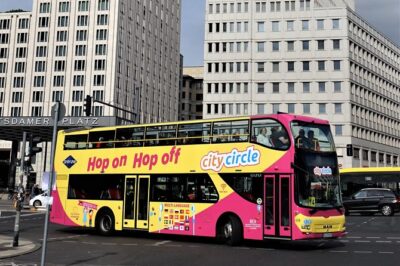
Berlin City Hop-on Hop-off Tour with Optional Cruise
Read our review →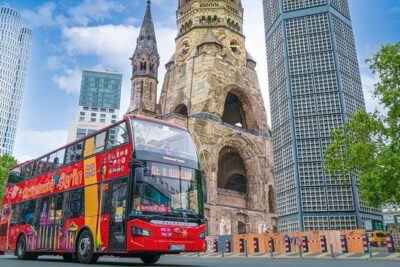

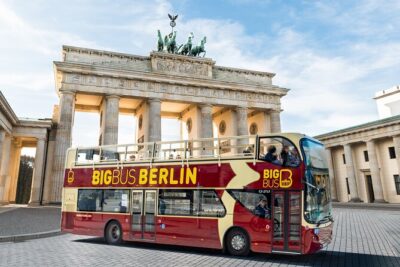
Big Bus Berlin Hop-On Hop-Off Sightseeing Tour & Currywurst
Read our review →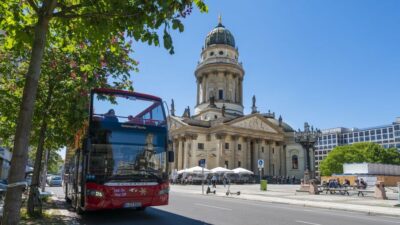
Browse the lists this tour appears in