
Reviewed · BERLIN SIGHTSEEING TOURS
Explore Berlin: See All The Iconic Sights & Some Hidden Gems
Berlin’s past comes at you fast on this three-hour central Berlin walk. You move from the Palace of Tears and Museum Island to Checkpoint Charlie, the Berlin Wall, Hitler’s bunker site, the Holocaust Memorial, and Brandenburg Gate. It is a brisk lesson in how Berlin went from royal capital to Nazi center, divided Cold War city, and reunified German capital.
I like two things here: the route packs in major sights without museum admission fees, and the guides explain how each place fits into the larger story. Guides such as Joseph, Klaus, Hannah, Tina, Jimmy, Paul, and Jef have been praised for clear explanations, humor, and thoughtful answers. The tradeoff is distance and pace. You may walk about three miles, and one person found the guide moved too quickly for photos and became separated from the group.
Key points at a glance
- See Berlin’s big landmarks in one walk: Brandenburg Gate, the Reichstag area, Checkpoint Charlie, Gendarmenmarkt, Museum Island, and the Holocaust Memorial all fit into the route.
- Follow the city’s 20th-century scars: The tour connects the Nazi era, Hitler’s bunker site, the Berlin Wall, and the Cold War checkpoint at Checkpoint Charlie.
- Expect about three miles on foot: Three hours includes frequent short stops, but this is not a slow stroll.
- Learn from a local English-speaking guide: Guides including Joseph, Hannah, Tina, Jimmy, Paul, Rohan, and Jorg have been singled out for strong explanations and an easy manner.
- Admission tickets are not included: You see the outside of major museums and buildings rather than entering their collections.
- Keep the group together: Arrive 15 minutes early, listen for the guide, and stay close when the walk begins.
Why this walk works as a first look at Berlin
Berlin can feel confusing at first. Its sights are spread across a large central area, and a grand square may sit beside a site tied to war, dictatorship, or division. This route helps you connect those pieces instead of seeing them as isolated photo stops.
The tour begins near Friedrichstrasse Station, with the listed meeting address at Reichstagufer 17. Check your booking instructions carefully, since meeting-point clarity was a concern for one person. Arrive 15 minutes early. The activity is offered in English, uses a mobile ticket, and allows a maximum of 25 people.
The price is about $24.07 per person. For three hours with a guide and no separate admission fees, that is good value if you want orientation rather than museum entry. You are paying for the route and the explanation. The guide is the useful part: Berlin’s buildings often reveal little unless someone explains what happened there.
The route has a lot of stops, but most are short. You might hear ten minutes of explanation at an important memorial, then only five minutes at a museum or building before moving on. That format gives you strong coverage, but it does not leave time to study every site.
More alternative tours in Berlin:
- Berlin: Alternative Berlin Walking Tour
★ 4.6 · 1,204 reviews - Berlin: Alternative Bike Tour of Kreuzberg & Friedrichshain
★ 4.7 · 548 reviews - Berlin: Alternative Berlin Bike Tour
★ 4.8 · 359 reviews
From Friedrichstrasse to the Palace of Tears
The walk starts at Berlin Friedrichstrasse Station, a practical central point near the river and several important historic areas. The first stop is the Palace of Tears, or Tränenpalast, a former Cold War crossing point.
Its name comes from the farewells that took place there when people crossed between East and West Berlin. The stop is brief, about five minutes, but it sets the tone. Berlin’s division was not only a line on a map. It affected families, travel, work, and daily life.
This is a good place to listen closely to the guide’s explanation of how ordinary people experienced the border. The walk is strongest when it moves beyond dates and political names and shows how large events changed normal routines.
Memorials, universities, and the older city center
At Neue Wache, you pause at a national memorial connected with war and tyranny. The building gives the tour a quieter moment before the route moves into Berlin’s grand civic and cultural center.
Humboldt University follows. Marx, Engels, and Einstein studied or taught there, and the stop shows that Berlin’s story is not only about dictators and walls. Education, science, music, architecture, and royal power all shaped the city too.
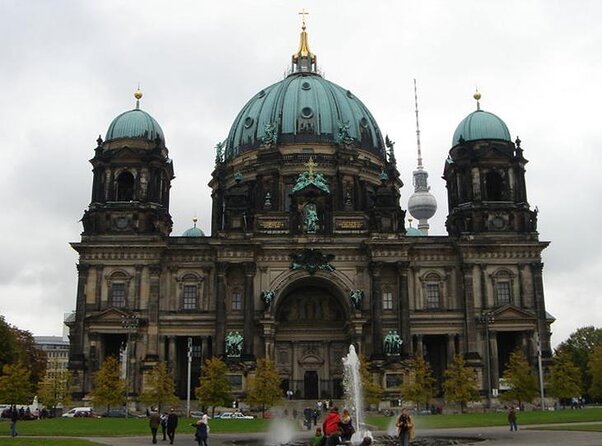
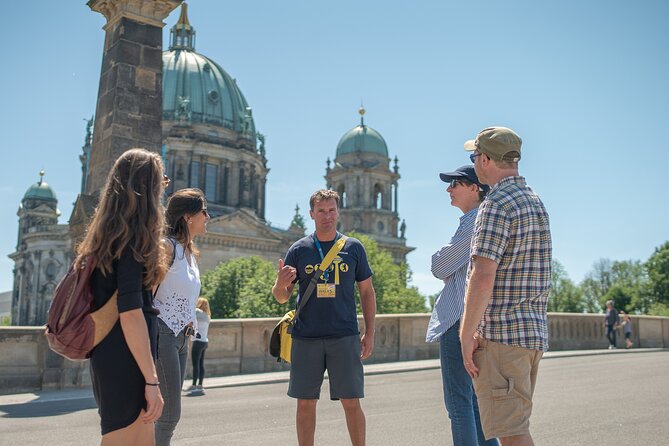
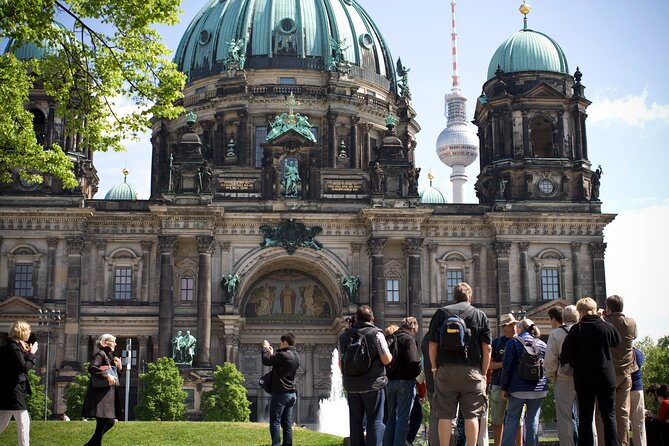
The route then reaches Berlin Cathedral, Lustgarten, the former City Palace, and the Humboldt Forum. You see the largest church in Berlin from the outside, along with the reconstructed palace complex and the modern cultural building that occupies it. The area is visually impressive, but the explanation matters more than the photo. It helps you see how Berlin has repeatedly rebuilt, erased, and reinterpreted its past.
The tour does not include entry to Berlin Cathedral or the museums. Treat these stops as a preview. If one catches your interest, return later with more time.
Museum Island in short, useful glimpses
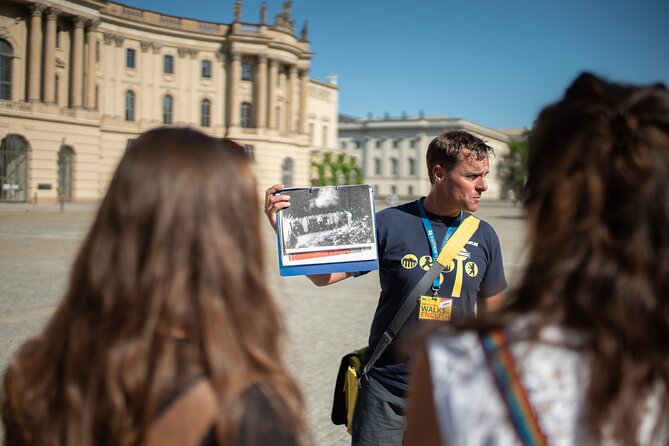
The walk passes the Pergamon Museum, Neues Museum, and Altes Museum. These stops are generally about five minutes each, so you will not tour the galleries.
The Pergamon Museum is associated with major works such as Islamic art, the Ishtar Gate, and the Market Gate of Miletus. The Neues Museum is known for its Ancient Egyptian collection, while the Altes Museum was Berlin’s first museum and was designed by Karl Schinkel.
For a first visit, this quick pass is useful because it gives you a map of Museum Island and a sense of which museums deserve a return visit. The drawback is simple: if you want to see the collections, you need a separate visit and ticket. The tour gives context, not entry.
The route also includes the reconstructed Hohenzollern palace at the Humboldt Forum. Berlin’s central area is full of buildings that look old but have complicated modern stories. A guide can explain those layers more clearly than a quick walk on your own.
More sightseeing tours in Berlin:
- Berlin: 1-Hour City Tour by Boat with Guaranteed Seating
★ 4.3 · 16,993 reviews - Berlin: City Sightseeing Hop-On Hop-Off Bus Tour
★ 4.1 · 4,233 reviews - Berlin: Hop-On Hop-Off Sightseeing Bus with Boat Options
★ 4.3 · 4,012 reviews - Berlin: Sights and Highlights Bike Tour with a Local Guide
★ 4.8 · 2,698 reviews
Bebelplatz and the memory of book burning
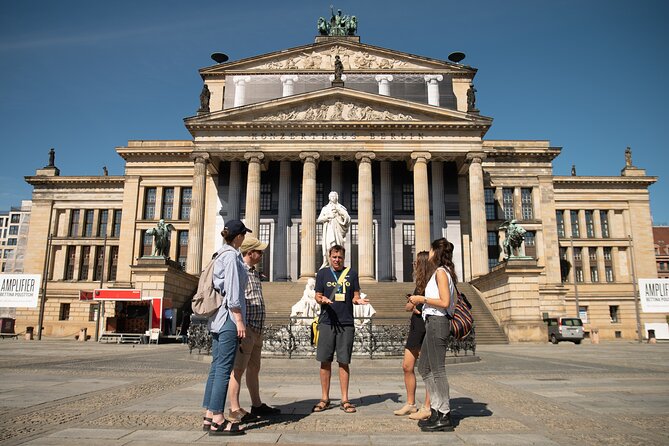
Bebelplatz is one of the prettiest squares on the route, framed by grand 18th-century buildings. It also carries a grim memory. In 1933, the Nazis burned tens of thousands of books here.
The Book Burning Memorial is a reminder that censorship and political violence began before the worst crimes of the Nazi period. The memorial is easy to miss if you do not know where to look, which is one reason a walking guide adds real value.
Nearby, you see the Staatsoper, built under Frederick the Great in 1743, and the Konzerthaus, completed in 1821 and designed in connection with Karl Schinkel. These buildings give you a sharp contrast: elegant architecture beside a site where the Nazi regime attacked free thought.
Gendarmenmarkt and the road to Checkpoint Charlie
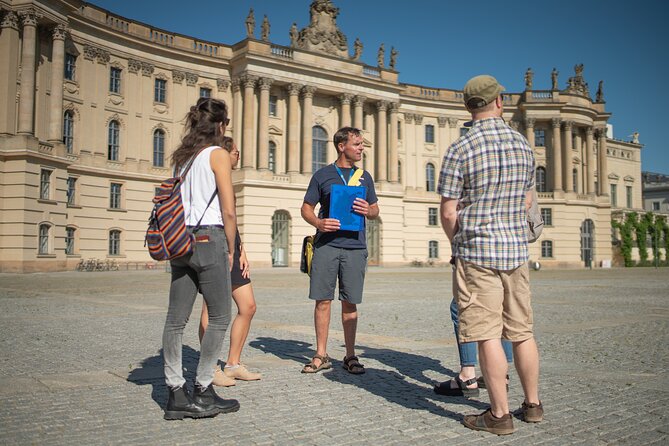
Gendarmenmarkt brings another change in mood. The square is known for the French Cathedral, the German Cathedral, and the concert hall. It reflects a period of religious tolerance and gives you some of the finest urban views on the walk.
The route then reaches Checkpoint Charlie, once the best-known crossing point between East and West Berlin. In 1961, Soviet and American tanks faced each other here during a tense confrontation.
Today, Checkpoint Charlie can feel more like a busy tourist stop than a preserved border crossing. That is precisely why the guide’s explanation helps. You learn what the checkpoint meant for civilians, soldiers, and a city split by ideology. Do not expect a large surviving border complex. The significance is historical, and the current setting is much more commercial.
The Berlin Wall and the Nazi government district
At the Topography of Terror, you see a roughly 200-meter section of the Berlin Wall. The site also deals with the Nazi institutions that planned and carried out repression. The stop is short, but it connects the physical wall with the machinery of dictatorship that came before it.
You also pass the former Aviation Ministry of Berlin. The building was associated with Hermann Göring’s air force ministry, later served as the East German house of ministers, and now houses Germany’s Finance Ministry. This is classic Berlin: one building, several political lives.
The tour does not include entry to the Topography of Terror or the ministry. If you want more detail on the Nazi period, the Topography of Terror is a logical place to revisit after the walk.
Hitler’s bunker site and the Holocaust Memorial
The stop at the Führerbunker is handled from above ground. You stand near the location where Hitler spent his final days in World War II. There is no grand preserved bunker attraction here, and the site is intentionally plain.
That plainness is useful. It prevents the place from becoming a shrine and keeps attention on the historical facts. A strong guide can explain what happened without turning the site into spectacle.
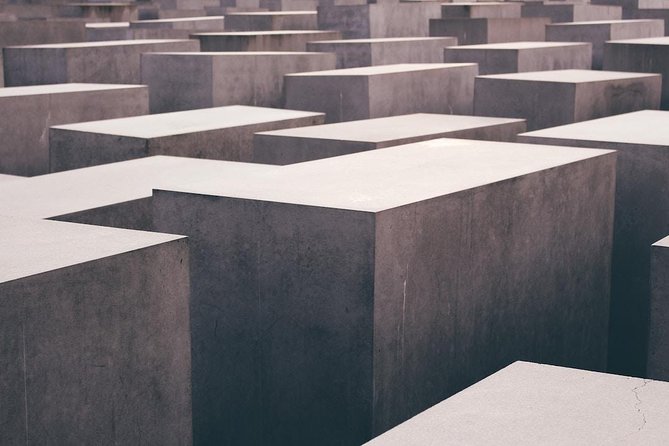
The Holocaust Memorial follows, officially the Memorial to the Murdered Jews of Europe. You walk among its concrete blocks, with the ground changing as you move through the field. The design can feel unsettling and difficult to read at first, which is part of its effect.
Give this stop your attention. Guides such as Grayson and others have been praised for handling the Holocaust with care and seriousness. This is not just another photo stop. It is one of the places where the tour asks you to slow down mentally, even if the group must keep moving physically.
Brandenburg Gate, Pariser Platz, and the government quarter
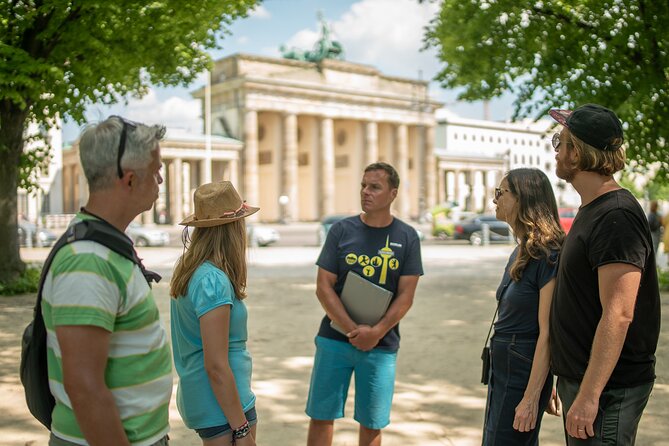
The walk finishes around the Reichstag and government quarter, then continues to Brandenburg Gate and Pariser Platz. The precise final point is listed as Brandenburg Gate, Pariser Platz.
Brandenburg Gate once symbolized Prussian power, then became a symbol of division when the Berlin Wall cut through the city. Today it represents German unity and peace. The guide also points out the American Embassy, French Embassy, Hotel Adlon, and Academy of Fine Arts around Pariser Platz.
The Reichstag is the meeting place of the German Parliament. You see the building from outside on this walk, rather than taking a guided interior visit. That makes the finish easy to extend: after the tour, you can decide which nearby building or memorial deserves more time.
This final stretch is also good for photos, but do not wait until the last minute if you want many pictures. The group has a schedule, and one person had trouble keeping up after the guide moved on. Ask the guide when the group is stopping, and stay within sight.
What the guide can add
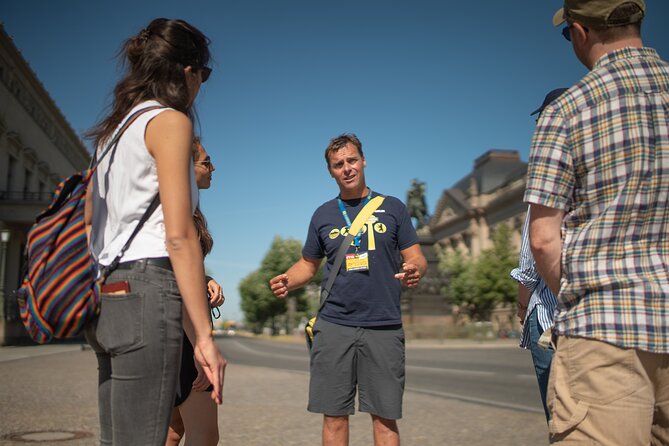
The best part of this experience depends on the person leading it. The strongest feedback centers on clear storytelling, answers to questions, and the ability to make difficult history understandable.
Joseph was praised for making Berlin’s history informative and entertaining while welcoming questions. Klaus explained life before and after the Wall. Hannah kept a steady pace with short stops, which mattered in cold weather. Tina was noted for explaining centuries of history in plain terms while keeping the group on time.
Jimmy was described as friendly, fun, and well informed. Paul helped explain the main sights and answered questions. Rohan’s engaging explanations left someone wishing the walk had lasted longer. Jorg used personal anecdotes to make the past feel more relatable, while Brian provided a useful overview at the beginning of a Berlin visit.
There is no guarantee that you will have one particular guide, but the range of names gives you a sense of the style to expect: history-led, conversational, and focused on major locations. The guide may also offer recommendations for what to see next.
Pace, weather, and practical comfort
Plan on a steady walk of roughly three miles. You will stop often, but the route is not designed for sitting or lingering. Comfortable shoes are more important than stylish ones.
Cold weather can make the pace feel better because you keep moving, but you should still dress warmly. Hannah’s short warm-up stops were appreciated on a cold day. In warmer weather, carry water, since the tour lasts three hours.
Most people can take part, and service animals are allowed. The tour runs near public transportation, but no transport is included. The route itself is on foot.
The group can include up to 25 people. That is manageable, though a larger group makes it harder to hear a soft-spoken guide or take a front position. If you have trouble hearing, move closer before the explanation begins. If you stop for a photo, tell someone in the group or guide so you do not lose the route.
Who should book this Berlin walk?
I would choose this tour for a first or second day in Berlin, especially if you want the city’s major sights placed in a historical order. It is also useful if you have only a short stay and want to identify where to return later.
History-minded visitors will get the most from it. The route covers the Nazi period, the Holocaust, the Cold War, the Berlin Wall, Prussian buildings, museums, music, and modern government. Families and older participants should consider the distance and pace before booking.
I would not choose it as your only Berlin activity if you want museum interiors, long photography stops, or a slow architectural walk. You will see many places, but usually from the outside and for only a few minutes.
Free cancellation is available up to 24 hours before the start time. After that point, the amount paid is not refunded, and late changes are not accepted.
Should you book it?
Book this walk if you want a low-cost, high-coverage introduction to Berlin’s central sights and difficult history. At $24.07, the value is strong because the route covers so much ground and uses a local English-speaking guide rather than leaving you to decode the city alone.
Skip it if three miles sounds tiring, if you need lots of time for photos, or if you mainly want to enter museums. For most first-time visitors who can keep a brisk pace, this is a smart way to get your bearings and choose what deserves a closer look later.
FAQ
How long is the Berlin walking tour?
The tour lasts approximately three hours.
What language is the tour offered in?
The tour is offered in English with a local English-speaking guide.
Where does the tour start?
The listed meeting address is Reichstagufer 17 in central Berlin, near Friedrichstrasse Station. You should check your booking instructions and arrive 15 minutes early.
Where does the tour finish?
The tour finishes around Brandenburg Gate and Pariser Platz. The route also covers the Reichstag and government quarter.
Are museum admission tickets included?
No. The walking tour does not include admission to Berlin Cathedral, the Pergamon Museum, the Neues Museum, the Altes Museum, or other paid attractions along the route.
Does the tour visit Hitler’s bunker?
The tour takes you to the location above Hitler’s former bunker. The stop is outdoors and does not involve entering a preserved bunker.
How large can the group be?
The tour has a maximum of 25 travelers.
Can I cancel for a full refund?
Yes. You can cancel up to 24 hours before the experience start time for a full refund. Cancellations or changes made less than 24 hours before the start are not refunded.
Newest Berlin reviews
- Where It All Began: Berlin’s Queer & Trans History Tour★ 4.9 · 6 reviews
- Berlin: guided canoe | kayaktour★ 4.1 · 7 reviews
- Understanding Kreuzberg: The roots of local (sub)culture★ 4.9 · 11 reviews
- Private Potsdam City Tour in an authentic vintage van★ 5.0 · 14 reviews
- Warnemünde Shore Excursion: Private Sachsenhausen and Berlin Tour★ 5.0 · 12 reviews
- Ultimate E-Bike Tour of Berlin with Beer Garden Stop★ 5.0 · 4 reviews
- In the Forbidden City – Potsdam Walking Tour★ 5.0 · 17 reviews
- Private Walking Tour of Potsdam and Sanssouci★ 5.0 · 24 reviews
Berlin Sightseeing Tours, compared.
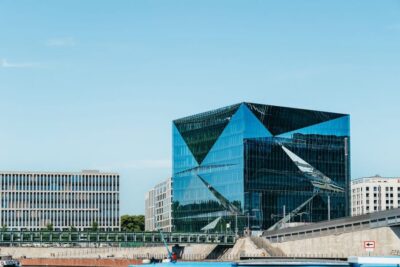
1-Hour City Tour by Boat with Guaranteed Seating
Read our review →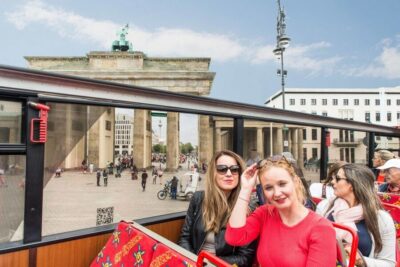
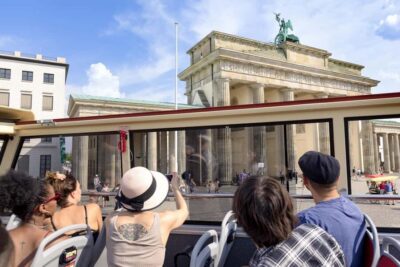
Hop-On Hop-Off Sightseeing Bus with Boat Options
Read our review →
Sights and Highlights Bike Tour with a Local Guide
Read our review →

Sightseeing Tour in Classic Volkswagen T1 Samba Bus
Read our review →
Browse the lists this tour appears in