
Reviewed · BERLIN BIKE TOURS
Best of Berlin E-Bike Tour
Berlin is spread out, and this three-hour e-bike tour gives you a smart way to connect its major sights. Starting at Alexanderplatz, you ride to the Reichstag, Brandenburg Gate, Bebelplatz, the Holocaust Memorial, and Checkpoint Charlie, with the motor taking the strain when you need it.
I like the small group of no more than 15 people, which makes it easier to hear the guide and stay together in city traffic. I also like the strong historical focus, especially on Berlin’s Nazi past and Cold War division. The main drawback is that three hours allows only short stops, so you will see many places but enter none of them.
Key points to know
- Ride from Alexanderplatz to Checkpoint Charlie: The route links central Berlin’s major sights without asking you to make sense of the city’s wide distances on foot.
- Expect a history-led outing: Guides such as Sam, Thor, Michelle, Neil, and Binti are praised for clear explanations, humor, and useful local context.
- The e-bike does most of the hard work: You still pedal, but the motor helps on longer stretches and makes the flat city easy to cover.
- Stops are brief but well chosen: Most last five to ten minutes, enough for orientation, photos, and a short talk rather than a full visit.
- You must ride independently: There are no child seats or tag-alongs, and every participant needs to control a bike alone.
- Plan for Berlin weather: Bring water and suitable clothing. The tour requires good weather and may be moved or canceled if conditions are poor.
Why an e-bike makes sense in Berlin
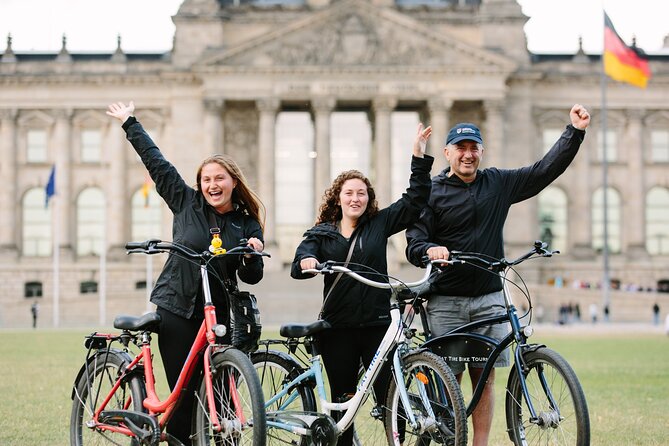
Berlin is not difficult to walk in, but its main sights are scattered across a large area. Alexanderplatz, the Brandenburg Gate, Checkpoint Charlie, and the Reichstag are all central, yet walking between them takes time and energy. An e-bike lets you see the connections between these places instead of treating each sight as a separate stop.
You still pedal, so this is not a motorized sightseeing ride. The electric assist simply takes the sting out of the distance. That matters on a busy sightseeing day, especially if you want to keep your energy for museums and evening plans.
The city’s mostly flat terrain also helps. One rider who had never used an e-bike before found it easy to manage, while another noted that even the regular bikes in the group were comfortable on the route. You should still be comfortable steering, braking, and riding in a group.
The route uses streets, bike paths, and quieter areas where possible. A guide leads the way through Berlin traffic, and comments from the tours point to guides taking care to keep the group together. Still, you are riding in a capital city, not on a closed trail. Pay attention, keep a safe distance, and follow the guide’s signals.
More bike tours in Berlin:
- Berlin: Sights and Highlights Bike Tour with a Local Guide
★ 4.8 · 2,698 reviews - Berlin Highlights 3-Hour Bike Tour
★ 5.0 · 948 reviews - Berlin City Bike Tour with Beer Garden Stop
★ 5.0 · 917 reviews
Alexanderplatz gives you a useful starting point
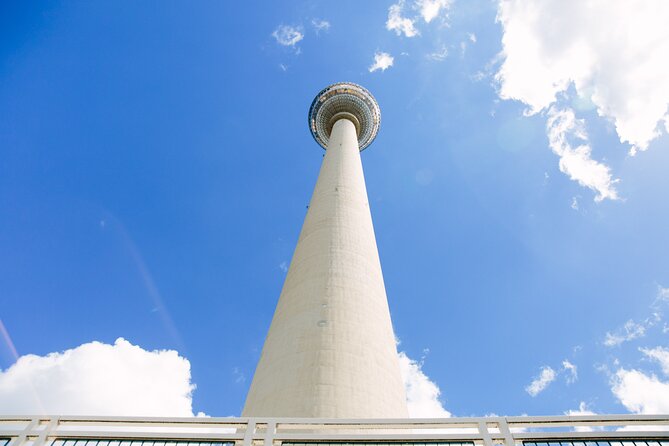
The meeting point is the Unlimited Biking shop at Panoramastraße 1A, beside the Berlin TV Tower. The same location is used at the end, so you do not need to arrange a one-way trip across the city after the ride.
Alexanderplatz is more than a convenient transport hub. It is one of the best places to begin thinking about Berlin’s layers. The square reflects different periods of the city, from royal and industrial growth to the planned scale of East Berlin. The TV Tower, built during the German Democratic Republic era, gives the area its unmistakable profile.
Your guide provides the bikes and helmets, then explains the basics before departure. If you have never used an e-bike, allow yourself a few minutes to get comfortable with the assistance. The motor helps, but you remain in control of speed and braking.
The route finishes where it begins. That makes the tour easy to pair with a meal, a museum visit, or further sightseeing in Mitte.
Reichstag and Brandenburg Gate: power, symbols, and memory
The Reichstag is one of Berlin’s most important political buildings. At this stop, the guide connects the building with Hitler’s rise to power and explains how modern Berlin handles the memory of the Nazi period.
The stop is scheduled for about five minutes, so think of it as a sharp introduction rather than a visit inside the building. You will not have time to tour the dome or explore the parliamentary complex. The value comes from the setting and the explanation, which helps you read the building as part of Germany’s political story.
From there, you reach the Brandenburg Gate. Its classical design and the figure of Victoria on top make it one of Berlin’s most recognizable monuments. It has served as a royal entrance, a symbol used by competing political systems, and a powerful image of German reunification.
Again, the planned stop is short. The guide gives you the meaning of the gate and time to look around, but you should not expect a long photo session without the group waiting. The quick format works well early in a trip because it gives you the background needed to return later on your own.
Bebelplatz shows Berlin’s darker royal past
Bebelplatz is an elegant square created under Frederick the Great, but its appearance can hide the painful event associated with it. The area includes Humboldt University and one of Berlin’s opera houses. It also carries a stark reminder of the Nazi book burning campaign.
The stop lasts about ten minutes, giving the guide a little more time to explain the square’s changing role. This is one of the better examples of how the tour links architecture with political history. You see a refined royal setting, then learn how propaganda and repression changed its meaning.
That layered approach is useful in Berlin. A grand building is rarely just a grand building here. The guide helps you notice who built it, how it was used, and what later events took place around it.
A different sort of day out in Berlin:
- Berlin: Reichstag, Dome and Government District Guided Tour
★ 4.7 · 18,288 reviews - Berlin: 1-Hour City Tour by Boat with Guaranteed Seating
★ 4.3 · 16,993 reviews - Berlin: Boat Tour Along the River Spree
★ 4.4 · 11,252 reviews - Discover Berlin Half-Day Walking Tour
★ 5.0 · 9,624 reviews
Gendarmenmarkt adds a broader European view
Gendarmenmarkt brings a different tone to the route. Its story reaches back to the aftermath of the Thirty Years’ War, when Berlin had lost much of its population. Protestant Huguenot refugees from France were invited to settle here, helping rebuild the city.
The stop is only about five minutes, but it widens the tour beyond the twentieth century. Berlin was not created by one ruler or one political period. Migration, religion, war, royal planning, dictatorship, division, and reunification all shaped the city.
This is also a good place to appreciate Berlin’s architecture without rushing straight into its modern political story. You get a brief look, a concise explanation, and then return to the bike before the route moves on.
The Holocaust Memorial requires quiet attention
The Memorial to the Murdered Jews of Europe is one of the most serious stops. Rows of concrete slabs form an open field that changes as you walk between them. The site is close to major sightseeing routes, yet the design asks you to slow down and consider what it represents.
The guide discusses the Holocaust and the ways Berlin and Germany remember the crime in the present day. That focus matters. The memorial is not treated as a quick photo stop or a decorative monument. You receive context about memory, responsibility, and the place of commemoration in modern Berlin.
The schedule allows about ten minutes. That gives you time to look through part of the memorial, but it is not enough for a long visit or the underground information center. If this is a subject you want to study in depth, return later with more time.
Some people may find the transition from cycling and conversation to this memorial abrupt. That is not a flaw in the site, but it is worth knowing that the tour covers difficult history at a brisk pace. Listen carefully, be respectful, and avoid treating the space as an ordinary sightseeing backdrop.
Checkpoint Charlie explains the divided city
Checkpoint Charlie is the tour’s clearest Cold War stop. This former crossing between the American and Soviet sectors became a symbol of Berlin’s division, and the guide explains how the city was split between East and West.
The physical checkpoint itself is modest, and the surrounding area has changed greatly. That is exactly why the explanation matters. Without context, you might see a guardhouse and a famous sign and miss the larger story of restricted movement, rival political systems, and the risk attached to crossing the city.
The stop lasts about ten minutes. You get an orientation to the former border and the Cold War story, but not a full museum visit. If Checkpoint Charlie is a major interest, you may want to return independently to spend more time with the nearby exhibits.
The ride between these sights is part of the lesson. You are not simply jumping from monument to monument. You can see how the former East and West areas fit together, and how Berlin’s present-day streets cross old political boundaries.
What the guides add to the ride
The guide can make or break a history tour, and this experience puts much of its value in that person’s delivery. Sam is described as calm, patient, and able to answer questions in cold, wet weather. Thor is praised for energy, humor, and confident handling of city traffic. Michelle is noted for setting a comfortable pace for beginners and mixing history with fun facts.
Other named guides include Marco, Carlo, Binti, Alex, Allister, Tom, Craig, and Neil. Neil in particular is described as personable, clear, and impartial, with suggestions that helped shape later sightseeing. Binti is praised for making the three hours pass quickly, while Craig’s longer e-bike route included Tempelhof Airport.
Guide assignments can change, so you should not book on the assumption that one particular person will lead your departure. The useful point is that the tour depends on live explanation rather than an audio recording. You can ask questions, request clarification, and hear stories adjusted to the group.
The English-language format is important. You need to understand spoken English to get the full benefit from the commentary and safety instructions. The activity is offered in English only.
Three hours gives you a strong city introduction
The official duration is about three hours. That is enough to cover a striking number of major locations, but it is not enough to explore the interiors of those places.
I would treat this as a first-day orientation. You get the city’s basic structure, its key political stories, and a list of places worth revisiting. Afterward, you can return to the Reichstag area, the Holocaust Memorial, or Checkpoint Charlie with a better sense of what you are seeing.
The pace is relaxed rather than athletic. You stop often, and the e-bike reduces the effort between stops. Several riders found the route easy, including people with little or no previous e-bike experience. One important distinction: a separate longer route may reach Tempelhof Airport, but that is not part of the stated three-hour itinerary. Do not assume this shorter tour includes it.
Because stops are brief, photography and listening compete for your attention. I suggest putting the camera away during the guide’s main explanation, then taking pictures once the talk ends. You will get more from the tour that way.
Price, group size, and practical value
At $65.90 per person, the tour is not the cheapest way to see Berlin’s center. You could walk between some of these sights for free, and public transport costs less. The price includes the e-bike, helmet, and professional guide, which changes the comparison.
I think the value is strongest if you have limited time or want a clear introduction before exploring alone. You cover more ground than on foot, avoid the effort of a full-day bike rental, and receive historical context at each stop. The small maximum group of 15 also makes it more personal than a large coach outing.
The value is weaker if you want long visits at individual monuments, museum admission, or a serious cycling workout. Food and drinks are not included, and there is no hotel pickup or drop-off. Bring your own water, since the tour specifically advises it.
The experience is booked, on average, about 28 days ahead. That does not guarantee every date sells out, but it is a useful sign to plan early during busy periods.
Who should book this Berlin e-bike tour
I would recommend it to first-time visitors who want to understand Berlin’s major sights quickly. It also suits people who find a long walking tour tiring but still want to move through the city at street level.
It is a good fit for families with older children who can ride independently, couples, solo visitors, and anyone interested in the Nazi and Cold War periods. The route is also practical for people who want to learn where things are before planning the rest of their stay.
I would be cautious if you are not comfortable riding alone, dislike city traffic, or need frequent long breaks. There are no child seats or tag-alongs, and every participant must be able to ride a bike without assistance.
Weather matters. The tour requires good conditions, and poor weather can lead to a new date or a full refund. You can cancel for a full refund up to 24 hours before the start time, but changes or cancellations inside that window are not accepted.
Should you book it?
Book this tour if you want broad coverage, clear history, and an easy ride rather than deep visits inside monuments. The route puts Berlin’s most important twentieth-century stories into a single morning and gives you a useful map of the city.
Skip it if you mainly want museums, lengthy time at each stop, or a quiet ride away from traffic. For most first visits, though, the combination of a flat route, electric assistance, and guides such as Sam, Thor, Michelle, or Neil makes this a practical way to get your bearings fast.
FAQ
How long is the Best of Berlin E-Bike Tour?
The tour lasts about three hours.
Where does the tour start?
It starts at Unlimited Biking, formerly Fat Tire Tours, at Panoramastraße 1A, 10178 Berlin, beside the TV Tower at Alexanderplatz.
Where does the tour end?
The activity ends back at the Alexanderplatz meeting point.
Which sights are included?
The route includes the Reichstag Building, Brandenburg Gate, Gendarmenmarkt, Alexanderplatz, Bebelplatz, the Holocaust Memorial, and Checkpoint Charlie.
Is the electric bike included?
Yes. The price includes use of an electric bike and helmet, along with a professional guide.
Is the tour offered in English?
Yes. The tour is offered in English.
Can children use a child seat or tag-along?
No. Child seats and tag-alongs are not available. Every participant must be able to ride a bike independently.
What happens if the weather is poor?
The activity requires good weather. If it is canceled because of poor conditions, you will be offered another date or a full refund. You can also cancel at least 24 hours before the start time for a full refund.
Newest Berlin reviews
- Where It All Began: Berlin’s Queer & Trans History Tour★ 4.9 · 6 reviews
- Understanding Kreuzberg: The roots of local (sub)culture★ 4.9 · 11 reviews
- Berlin: guided canoe | kayaktour★ 4.1 · 7 reviews
- Private Potsdam City Tour in an authentic vintage van★ 5.0 · 14 reviews
- Warnemünde Shore Excursion: Private Sachsenhausen and Berlin Tour★ 5.0 · 12 reviews
- Ultimate E-Bike Tour of Berlin with Beer Garden Stop★ 5.0 · 4 reviews
- In the Forbidden City – Potsdam Walking Tour★ 5.0 · 17 reviews
- Private Walking Tour of Potsdam and Sanssouci★ 5.0 · 24 reviews
Berlin Bike Tours, compared.
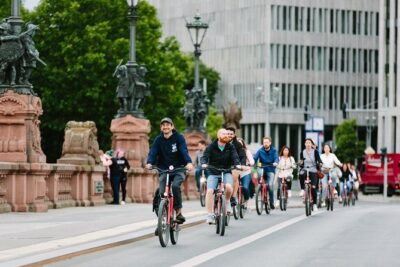
Sights and Highlights Bike Tour with a Local Guide
Read our review →
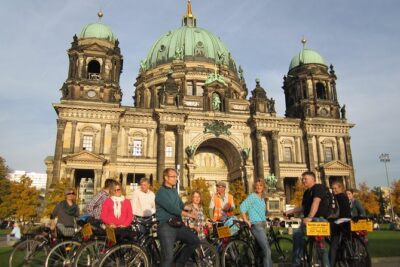
Berlin Highlights Sightseeing Bike Tour in Small Groups
Read our review →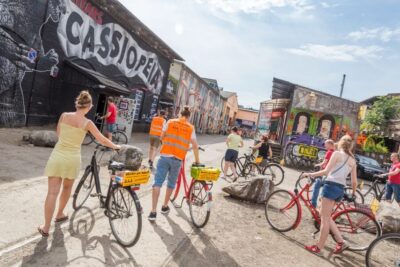
Alternative Bike Tour of Kreuzberg & Friedrichshain
Read our review →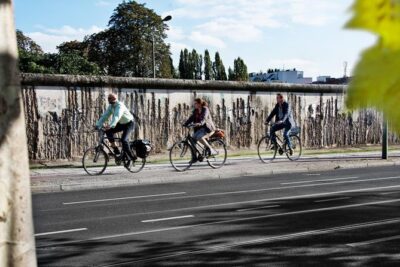
Guided Bike Tour of the Berlin Wall and Third Reich
Read our review →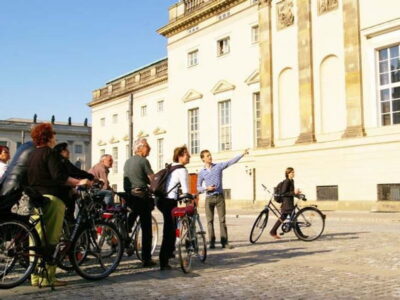
Browse the lists this tour appears in