
Reviewed · BERLIN COMEDY AND VARIETY SHOWS
The porcupine anniversary program: I still have a Tesla in Berlin
The most interesting thing about this show is its wildly skewed vision of Germany in 2028. A cheese roll costs 14 euros, half of all taxes go toward interest, and Berlin is offered up as the country’s silverware. I like the way current politics become farce, and I like the intimate setting inside the Europacenter, where the jokes land close and fast.
The main drawback is clear: the performance is entirely in German. You need strong German to follow the political wordplay, rapid dialogue, and satire. If you are comfortable with the language, this is a lively way to spend two hours. If not, the music and acting may not be enough to carry the evening.
Key points at a glance
- A 2028 political fantasy: Chancellor Wagenknecht and Vice Chancellor Pistorius face a national debt crisis, collapsing industries, and impossible election promises.
- Berlin’s first cabaret theater: Die Stachelschweine performs in the basement of the Europacenter, putting you right in the middle of a long-running Berlin cabaret tradition.
- Three named performers: Santina Maria Schrader, Mirja Henking, and Sebastian Stert lead the anniversary production.
- Music with sharp humor: The show mixes political jokes, black comedy, and live stage music rather than relying on spoken sketches alone.
- A two-hour evening for $45: The price is reasonable if you understand German and want a complete theater outing in central Berlin.
- Simple logistics: Choose a seating category, exchange your voucher at the box office, and return to the same theater entrance when the performance ends.
A future Berlin where everything is for sale
The anniversary program, Ich hab’ noch einen Tesla in Berlin, imagines a Germany that has pushed its finances and political promises past the breaking point. The setup is intentionally absurd, but it starts with familiar pressures: public debt, rising prices, industrial decline, housing costs, and grand election pledges.
By 2028, Chancellor Wagenknecht and Vice Chancellor Pistorius are under pressure as the national debt keeps growing. A cheese roll costs 14 euros. BASF and Bayer have moved to Asia. Volkswagen and BMW belong to Tesla. Germany’s credit rating has fallen to BB, and half of the tax revenue goes toward interest payments.
That list gives the performers plenty to work with. The jokes do not depend on one isolated political scandal. They build from the collision between promises and arithmetic. The more generous the promises become, the less possible they seem.
Pistorius finds what appears to be an answer. He calculates that the government could finance retirement at 55, free public transport, and a rent cap at 1989 levels through one major measure: selling Berlin. The capital becomes Germany’s reserve fund, an object to be divided and marketed.
An electric-car developer and owner of a microblogging service moves in quickly. The plan appears foolproof. Then, as the title promises, everything goes wrong.
You do not need to treat the plot as a realistic prediction. Its value is in the comic pressure it places on real arguments. How much can a government promise? What happens when a city becomes a product? Who gets to decide what Berlin is worth? The show uses exaggerated answers to ask familiar questions.
More comedy and variety shows in Berlin:
- Berlin: FALLING | IN LOVE Grand Show Friedrichstadt-Palast
★ 4.7 · 1,268 reviews - Berlin: 1.5-Hour Comedy Bus Tour in German
★ 4.5 · 1,165 reviews - Berlin: Laughing Spree Comedy Show on a Boat
★ 4.9 · 670 reviews
Inside Die Stachelschweine at the Europacenter
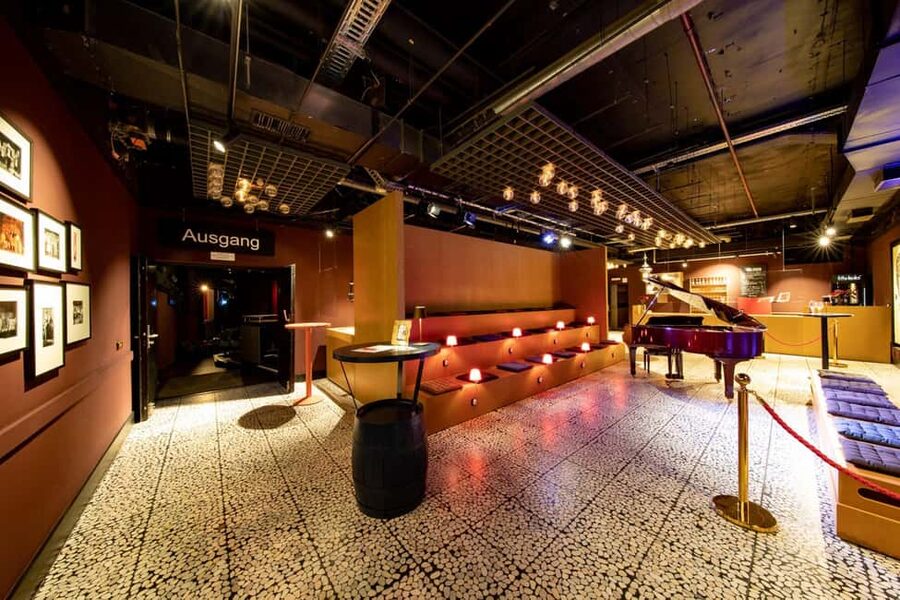
The theater entrance is in the basement of the Europacenter. That location matters. You are not heading out to a distant concert hall or a large suburban venue. The performance takes place in a central Berlin setting, with the cabaret tucked into one of the city’s best-known commercial landmarks.
Die Stachelschweine is Berlin’s first cabaret theater, and the anniversary production marks 75 years of the company. That long run gives the evening some useful context. Political cabaret is not an imported format here. It is part of Berlin’s stage culture, where public figures, government decisions, and social habits can become material for pointed jokes.
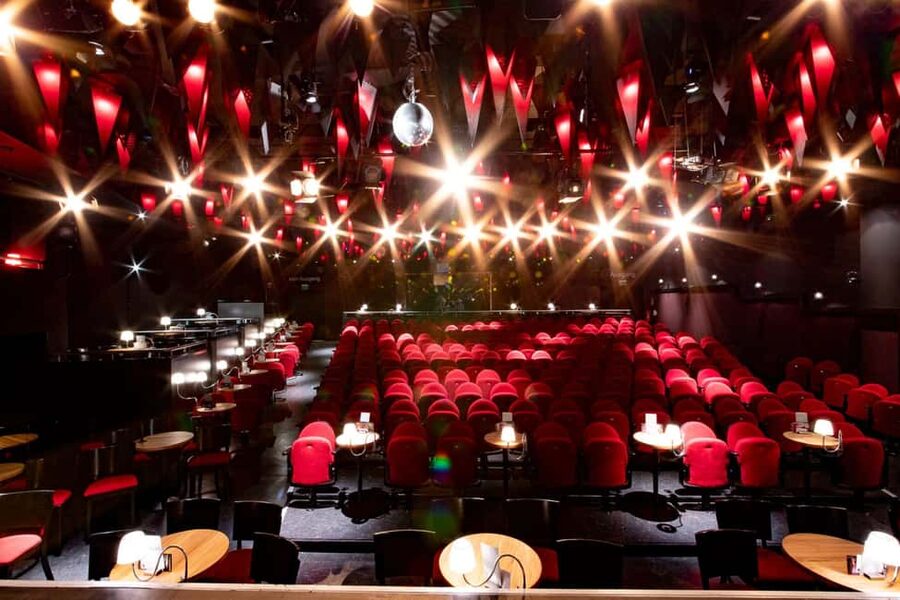
The basement setting should appeal to you if you prefer a close theater room to a grand auditorium. The supplied information identifies the booking as a small group experience, limited to six participants. That limit applies to the booking arrangement, not necessarily to the full theater audience, but it does suggest a more personal way to arrange the evening.
You choose a seating category rather than a specific seat. The box office assigns the exact place, so you should not book this expecting to select a particular row or position. That is a minor loss of control, but it keeps the booking simple.
The actors and the style of the show
Santina Maria Schrader, Mirja Henking, and Sebastian Stert perform the anniversary program. Their job is not only to deliver political lines. They must move quickly between character work, comic timing, music, and the changing levels of the story.
The production is written by Frank Lüdecke and Sören Sieg, with Lüdecke also directing. Luca Fazioli provides the music, and Martin Rosengarten handles the arrangements. Those credits matter because the evening is described as musical cabaret, not a straight political lecture with a few jokes added.
You can expect a fast pace. The show combines short comic turns with the larger story about Germany’s finances and Berlin’s sale. Black humor gives the material an edge, while what the theater calls Berlin serenity keeps the tone from becoming pure panic.
That balance is one of the production’s strongest ideas. The country is supposedly in financial ruin, the political leadership is under pressure, and Berlin may be sold off. Yet the comic mood remains cool and dry. The contrast creates the evening’s particular flavor: serious problems delivered with a shrug, a song, and another bad proposal.
The humor is also topical. The names in the story connect the imagined future to recognizable German politics and business. That gives the show immediacy, but it also means some jokes may date quickly. Political cabaret rewards you most when you know the figures and debates being mocked.
How the two-hour evening unfolds
Your visit begins at the theater entrance in the basement of the Europacenter. Before the performance, exchange your voucher at the box office. This step is important, since the voucher itself is not the final theater ticket.
Once seated, the show introduces its 2028 premise and the crisis facing the government. The opening sections establish the economic absurdities: food prices, weakened companies, the credit downgrade, and the huge tax burden created by interest payments.
The central proposal then comes into focus. Pistorius believes the government can finance its election promises by selling Berlin. The idea works as both plot engine and political joke. The capital is treated like an object on a balance sheet, with developers and corporate power ready to claim it.
As the plan develops, the show can move from policy satire to personal and social comedy. The announcement that nobody intends to sell Berlin becomes especially funny because the entire story has already suggested the opposite. The production plays with the gap between official reassurance and what is plainly happening in front of you.
Music helps separate the scenes and keeps the pace moving. You should not expect a quiet evening of long speeches. The appeal is the quick change between jokes, characters, songs, and political targets.
The activity ends back at the theater. Since the stated duration is two hours, it fits neatly into an evening plan without taking over an entire day. You can treat it as a self-contained cultural outing in central Berlin.
A different sort of day out in Berlin:
- Berlin: Reichstag, Dome and Government District Guided Tour
★ 4.7 · 18,288 reviews - Berlin: 1-Hour City Tour by Boat with Guaranteed Seating
★ 4.3 · 16,993 reviews - Berlin: Boat Tour Along the River Spree
★ 4.4 · 11,252 reviews - Discover Berlin Half-Day Walking Tour
★ 5.0 · 9,624 reviews
Why the political satire works best in German
German is not a minor detail here. It is a requirement. The performers work with political references, wordplay, timing, and subtle shifts in tone. Translation in your head will make the jokes arrive late, and a few seconds can matter in a fast cabaret sketch.
You will get the most from this show if you can follow spoken German comfortably and recognize some of the country’s political vocabulary. You do not need to be an expert in every party or policy, but basic familiarity with German public life will help you catch the targets.
The written premise gives you a useful map before you arrive. You already know about Wagenknecht, Pistorius, the sale of Berlin, Tesla, the rent cap, free transport, and retirement at 55. That preparation can help you follow the turns even when the dialogue speeds up.
If your German is limited, this is a risky choice at $45. You may still appreciate the performers’ energy and the music, but the main product is verbal satire. For fluent German speakers, the same price buys a full theatrical performance with a clear story and several comic layers.
What $45 means in practical terms
At $45 per person, the ticket is not a bargain basement activity, but it is fair for a two-hour professional theater performance in central Berlin. The price includes the ticket for Ich hab’ noch einen Tesla in Berlin and nothing beyond the performance itself.
You are paying for the production, the actors, the writing, the music, and the setting. There is no tour transport, meal, or extended introduction. That makes the value easy to judge: book it for the cabaret, not for a package of extras.
I would call it good value for someone who already wants an evening of German theater. The anniversary program offers a more specific experience than a general sightseeing show. Its value rises if you enjoy political humor and want to see a Berlin institution working with present-day themes.
The value drops if you are choosing it only because it is centrally located. The Europacenter makes access convenient, but the location does not compensate for missing the language. You should decide based on your German and your interest in satire first.
Free cancellation up to 24 hours before the start gives you some protection if your Berlin plans change. You can also reserve now and pay later, which helps if you are arranging several activities and want to keep your schedule flexible.
Who should book this cabaret
I would recommend the show to you if you fit several of these descriptions:
- You understand German well enough to follow rapid stage dialogue.
- You enjoy political comedy more than conventional sightseeing.
- You want a central Berlin evening activity that lasts about two hours.
- You are curious about German public life and contemporary political references.
- You prefer a small cabaret theater to a large commercial production.
- You like humor that combines music, social criticism, and black comedy.
It is also a good choice for repeat visitors who have already seen Berlin’s major sights. The program focuses on the city as a political symbol and a possible commodity, not just as a collection of monuments.
I would be more cautious if you need English subtitles, an English-language performance, or a plot that works without cultural context. None of those features is listed. The show is performed in German, and the comedy depends heavily on language.
The wheelchair-accessible venue is useful to know when planning. You should still make sure your chosen seating category suits your needs during booking, since exact seats are not selected in advance.
Small details that make the booking easier
Allow enough time to find the basement entrance of the Europacenter. The theater is not described as a street-level venue, so looking for a large theater facade may send you in the wrong direction.
Exchange your voucher at the box office before the performance begins. Do not leave this until the last moment, especially if you are unfamiliar with the shopping center.
You can choose a seating category, but not a precise seat. If sitting in a particular place matters to you, this arrangement may feel limiting. If you mainly want to attend the performance, it keeps the process straightforward.
The booking is limited to six participants, making it suitable for a small party. The theater itself may hold more people, so do not read that limit as a promise of a six-person performance.
The final call
Book Ich hab’ noch einen Tesla in Berlin if you want German-language political cabaret with a timely story, three named performers, music, and a strong Berlin setting. The anniversary angle adds a sense of occasion, while the 2028 plot gives the actors room to mock debt, housing, industry, technology, and political promises.
Skip it if you cannot follow German quickly. This is not a visual theater piece where you can understand most of the action from scenery and gestures. The jokes and social criticism do the main work.
For the right audience, $45 is a sensible price for two hours at one of Berlin’s long-running cabaret theaters. Go expecting sharp jokes, frantic political logic, music, and a city that may be for sale by the end of the evening.
FAQ
Where does the performance take place?
The performance takes place at Die Stachelschweine, with the entrance in the basement of the Europacenter in Berlin.
How long does the activity last?
The performance lasts two hours. Starting times depend on availability.
Is the show performed in English?
No. The play is performed in German, and knowledge of German is required.
Who performs in the anniversary program?
Santina Maria Schrader, Mirja Henking, and Sebastian Stert perform the show.
Can I choose my exact seat?
You can choose a seating category, but you cannot select an exact seat.
Is the venue wheelchair accessible?
Yes, the activity is listed as wheelchair accessible.
Newest Berlin reviews
- Where It All Began: Berlin’s Queer & Trans History Tour★ 4.9 · 6 reviews
- Understanding Kreuzberg: The roots of local (sub)culture★ 4.9 · 11 reviews
- Berlin: guided canoe | kayaktour★ 4.1 · 7 reviews
- Private Potsdam City Tour in an authentic vintage van★ 5.0 · 14 reviews
- Warnemünde Shore Excursion: Private Sachsenhausen and Berlin Tour★ 5.0 · 12 reviews
- Ultimate E-Bike Tour of Berlin with Beer Garden Stop★ 5.0 · 4 reviews
- Private Walking Tour of Potsdam and Sanssouci★ 5.0 · 24 reviews
- Potsdam Highlights – Private sightseeing tour by minibus★ 5.0 · 3 reviews
Berlin Comedy and Variety Shows, compared.

Quatsch Comedy Club Berlin: Die Live Show Entry Ticket
Read our review →
FALLING | IN LOVE Grand Show at Friedrichstadt-Palast Berlin
Read our review →
Cabaret – The Berlin Musical at Tipi am Kanzleramt
Read our review →
The Dark Humor Comedy Show in English Entry Ticket
Read our review →
Ticket for Bar Jeder Vernunft – Theater & Restaurant
Read our review →Browse the lists this tour appears in