
Reviewed · BERLIN BIKE TOURS
Berlin: Guided Private Bike Tour to Explore the Highlights
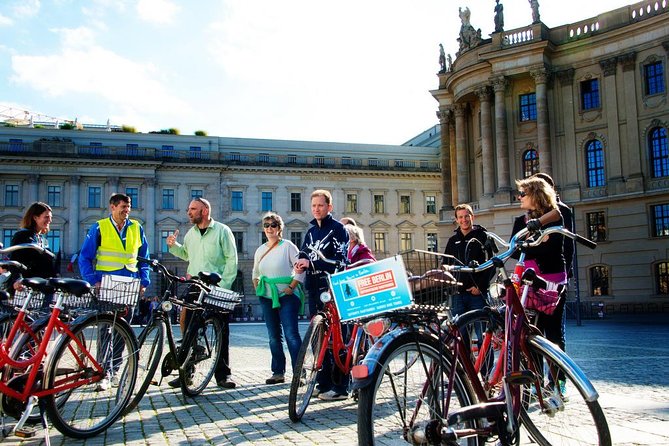
Berlin’s story makes more sense when you move through it by bike. In three hours, this private tour links the old city, Nazi-era sites, Cold War landmarks, grand avenues, and the modern government quarter, with a local guide explaining how each piece fits together. Brandenburg Gate and the Holocaust Memorial are major stops, but the route also reaches quieter corners and side streets.
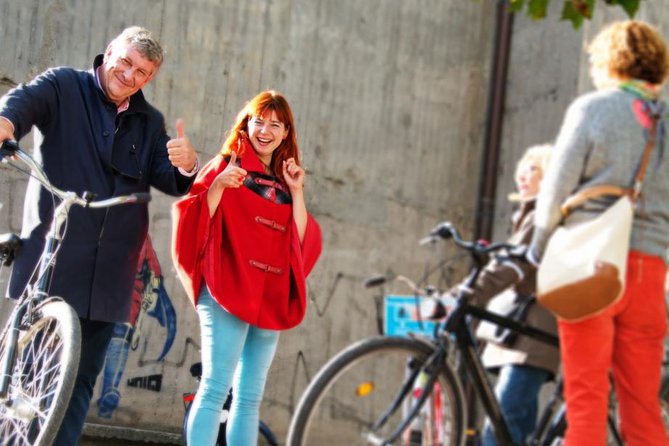
I like the small-group flexibility and the fact that every guide designs a slightly different route. I also like the practical setup: a bicycle and helmet are included, and guides such as Jake, Julia, Fabian, and Rico have been praised for humor, safe riding, useful stories, and adapting the ride to the group. The main consideration is pace. You cover a lot in three hours, and some stops last only about ten minutes.
Key points to know
- Fourteen kilometers can feel easy on a bike: One reported route covered roughly 14 km at a comfortable pace.
- The route connects several eras of Berlin: You move from medieval Nikolaiviertel to Nazi history, the divided city, and reunified Berlin.
- Every guide shapes the ride: Free Berlin’s concept lets guides choose their own route and respond to your interests.
- English tours include Checkpoint Charlie: Prenzlauer Berg is listed only for the German version.
- Bikes, helmets, and private touring are included: Children can join with an adult, and infant seats are available on request.
- Book early in your stay: The ride can help you get oriented and provide ideas for later sightseeing.
Why a bike is a smart way to see central Berlin
Berlin is spread out. Its major sights do not sit in one compact old center, and walking between them can use up much of your day. A bicycle lets you cover the broad avenues and open spaces quickly while still stopping often enough to hear the story behind them.
This is not a race. The published stops generally allow about ten minutes each, with a longer half-hour period in Prenzlauer Berg on the German route. That means you should expect a guided overview rather than long visits inside museums or buildings. The value comes from seeing how the city’s districts connect.
The tour is private, so only your group participates. That matters if you are traveling with friends or family and want to ask questions without holding up strangers. It also gives the guide room to respond to your interests. Fabian, for example, adjusted a route to suit his group, adding discussion of Berlin’s history, culture, and police.
The company supplies the bicycle and helmet. You can also use your own bike, as one outing did, but the included equipment makes planning easier. Children must be accompanied by an adult, and infant seats can be provided if requested.
More bike tours in Berlin:
- Berlin: Sights and Highlights Bike Tour with a Local Guide
★ 4.8 · 2,698 reviews - Berlin Highlights 3-Hour Bike Tour
★ 5.0 · 948 reviews - Berlin City Bike Tour with Beer Garden Stop
★ 5.0 · 917 reviews
Starting in Nikolaiviertel, Berlin’s oldest core
The meeting point is Free Berlin Bike Tours & Rental on Poststraße 11, close to public transportation in central Berlin. From there, the ride begins around Nikolaiviertel, the area associated with Berlin’s earliest beginnings.
Today’s quarter has an old-town feel, though much of its present appearance was created during rebuilding in the late 1980s. That detail makes it a useful first lesson in Berlin: even places that look old may reflect deliberate reconstruction rather than an untouched medieval past.
The stop is brief, about ten minutes, so use it to get your bearings and ask how Berlin’s historic center changed over time. The nearby TV Tower may also enter the opening part of the route. When it opened in 1969, it was the second-tallest building in the world, and its huge presence remains one of the clearest signs of the former East Berlin.
Bebelplatz and the warning beneath the square
At Bebelplatz, the tour shifts from grand architecture to one of Berlin’s most sobering memorials. The square holds the Book Burning Memorial, marking the Nazi book burning of 1933. A window in the pavement reveals empty shelves below, a stark image of what happens when a government tries to control thought by destroying books.
Bebelplatz also brings several impressive buildings into one view: Berlin’s oldest university, the former opera house, St. Hedwig’s Cathedral, a former bank building now used as a hotel, and a guardhouse with temple-like columns. Your guide can explain why this square matters as both an architectural set piece and a place of public persecution.
The stop is listed at about ten minutes. That is enough to see the memorial and orient yourself, but not enough for a long, quiet visit if the guide is also explaining the surrounding buildings. If this subject matters deeply to you, note the location and return later on foot.
The nearby university connects the square with major figures such as Albert Einstein and Karl Marx. Some guides have studied or still study there, which can give the explanation a personal local angle without turning the stop into a lecture.
Checkpoint Charlie and the divided city
Checkpoint Charlie is included in the English version of the tour and is one of the clearest symbols of Cold War Berlin. The former border station once marked the crossing between the American and Soviet sectors. Today, the area is busy and commercial, and the original checkpoint structure is represented by a reconstruction, so expectations matter.
The useful part of seeing it by bike is the context. Instead of treating Checkpoint Charlie as an isolated photo stop, your guide can connect it to the wider division of Berlin and the routes people used to cross, escape, or move between sectors. The ten-minute stop is short, but the location works well as one chapter in a larger story.
This is also a good place to ask questions. Berlin’s Cold War geography can be hard to grasp from a map alone. Moving between Checkpoint Charlie, Unter den Linden, Potsdamer Platz, and the government quarter helps you see how the former border cut through ordinary city life.
More sightseeing tours in Berlin:
- Berlin: 1-Hour City Tour by Boat with Guaranteed Seating
★ 4.3 · 16,993 reviews - Explore Berlin: See All The Iconic Sights & Some Hidden Gems
★ 5.0 · 4,429 reviews - Berlin: City Sightseeing Hop-On Hop-Off Bus Tour
★ 4.1 · 4,233 reviews - Berlin: Hop-On Hop-Off Sightseeing Bus with Boat Options
★ 4.3 · 4,012 reviews
Unter den Linden and the grand center
Unter den Linden is Berlin’s ceremonial boulevard, often compared with the Champs-Élysées. It runs through the historic center, linking Museum Island and the Brandenburg Gate. The avenue has gained a subway line, but a bicycle gives you a closer view of the buildings and lets the guide steer onto less direct streets when useful.
The tour does not treat the boulevard only as a grand parade route. Its buildings reflect royal Berlin, the old university district, wartime destruction, East German rebuilding, and the city’s present-day public life. A guide may use the avenue to explain how Berlin repeatedly changed its identity without erasing every layer beneath it.
A ten-minute stop is enough for an overview. You should not expect a detailed tour of every building along the avenue, and there is no admission to an indoor attraction included.
Potsdamer Platz, from nightlife to no man’s land
Potsdamer Platz is one of the best places to understand Berlin’s sharp changes in fortune. In the 1920s, it was a major traffic hub and a popular nightlife district. During the city’s division, the same area became part of the no man’s land around the Wall.
After reunification, Potsdamer Platz turned into one of Europe’s largest construction zones. The modern towers and broad public spaces now show how Berlin tried to reconnect parts of the city that had been separated for decades.
I find this stop especially useful for visitors who assume Berlin’s modern architecture is simply new development. Here, construction carries political meaning. The ten-minute visit will not explain every building, but it gives you the key timeline and a good reason to look beyond the polished surfaces.
The Holocaust Memorial and Brandenburg Gate
The Memorial to the Murdered Jews of Europe is made up of thousands of concrete blocks arranged across an open field. As you walk or cycle around its edge, the changing heights and uneven ground create a disorienting effect. The memorial does not offer a simple historical display, and the tour guide’s role is to provide context while allowing you to think for yourself.
The stop is listed at about ten minutes. That is enough to introduce the site, but you may want to return later without a schedule. The nearby underground information center is not listed as part of the tour, so do not assume an indoor museum visit is included.
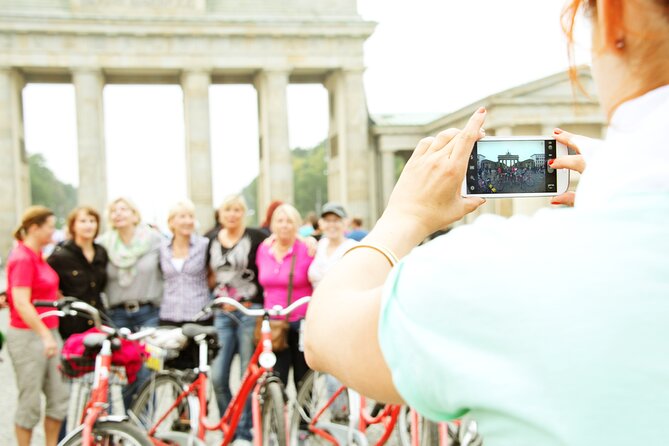
A short ride brings you to Brandenburg Gate, Berlin’s defining landmark. It has served as a royal entrance, a Nazi symbol, a backdrop during the Cold War, and a celebration site after reunification. Its meaning changed as the city around it changed.
Seeing the gate by bike lets you approach it as part of the former border zone rather than as a stand-alone monument. The guide can connect it with the Wall, the nearby memorial, and the modern government district. This is one of the tour’s strongest combinations of place and story.
Tiergarten and the Reichstag
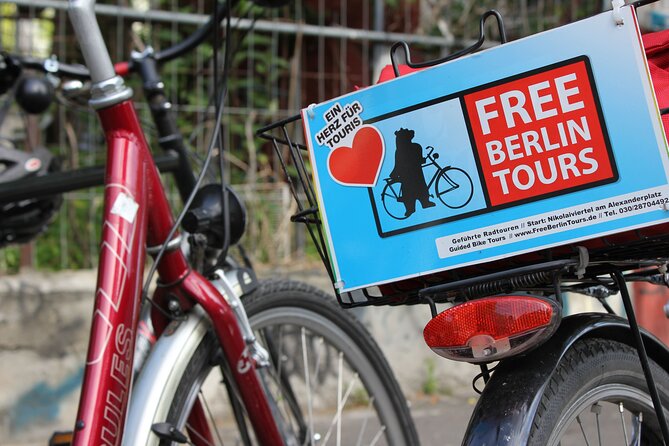
From Brandenburg Gate, the route can lead through the Tiergarten, one of central Berlin’s largest parks. Its name means Garden of the Animals, a reminder that German place names do not always describe a site’s original use. The park offers a welcome change from stone streets and wide government avenues.
You are not given a long park visit, but cycling through it breaks up the historical stops. It also makes the three-hour route feel less like a string of monuments. You keep moving while the guide explains how central Berlin fits together.
The Reichstag is Germany’s parliament, surrounded by the modern government quarter. Its glass dome is designed to suggest openness and public oversight, and it has become one of the most recognizable sights in the reunited city.
The tour views the building from outside. Admission to the Reichstag or its dome is not included, so arrange that separately if you want to go inside. The guide may also share the sort of stories that circulate about Germany’s political buildings, while sorting fact from local humor.
Museum Island and the final return
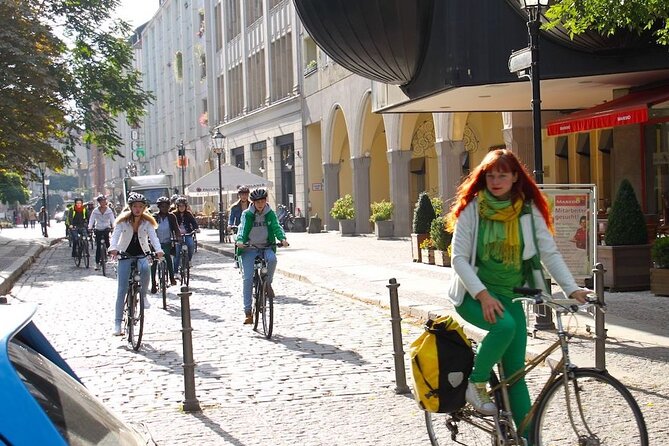
Museum Island brings the ride back toward Berlin’s historic center. Its monumental buildings line the Spree and reflect the city’s ambition to create an Athens on the river. The architecture is the main focus here, not an indoor museum visit.
Since the tour ends back at the Poststraße meeting point, Museum Island is a practical final chapter. You can continue on foot to a museum, return to your hotel, or use the central location to plan the rest of your day. Food and drinks are not included, so this is a good point to arrange your own break after the ride.
The German version also includes about thirty minutes in Prenzlauer Berg. This district shows another side of post-reunification Berlin, with a bohemian and residential character rather than the monumental center. The supplied route information lists Prenzlauer Berg only for the German tour, so English-speaking visitors should not book expecting that stop.
What the guides add to the ride
The strongest part of this experience is the guide-led storytelling. Jake is described as funny and deeply interested in history, with a route that covered the key places while remaining safe and easy over roughly 14 km. Julia is noted for clear historical explanation, including Berlin’s rebuilding after World War II and the choices behind it.
Rico is associated with practical care as well as storytelling. When a small bicycle problem arose, he repaired it confidently, which is exactly the sort of detail that matters on a cycling tour. Daan, David, Simon, Fabian, and other guides bring their own styles, and the company’s route policy means you are not receiving one fixed script every time.
That variety is a benefit and a small uncertainty. One guide may focus more on architecture, another on political history, and another on local anecdotes. Tell the guide at the start what interests you most. The private format gives you a reasonable chance of shaping the discussion.
Price, pace, and practical value
At $107.77 per person, this is not the cheapest way to see Berlin’s center. The price includes a professional guide, bicycle, helmet, and a private tour. For a couple or small group, the cost can make sense because you are paying for personal attention and equipment, not just transport between landmarks.
Group discounts are available, which may improve the value for families or friends traveling together. A larger private group can also make the per-person cost more attractive, though the ride still needs to stay manageable on city streets.
The tour lasts about three hours and operates in all weather. Dress for the forecast, and remember that rain or cold can change the feel of a bicycle ride quickly. The route is family-friendly, but children need an adult with them, and infant seats require a request.
The company allows free cancellation up to 24 hours before the start time. Cancellations or changes made inside that window are not refunded or accepted. The tour ends where it begins, and hotel pickup is not included.
Who should book this Berlin bike tour?
I would choose this ride early in a Berlin stay if you want a clear first look at the city. The route covers enough ground to show you where the major districts sit, and local tips can help you decide which places deserve a longer return visit.
It suits active visitors who prefer moving between sights rather than spending a full morning inside one museum. It also works well for families, couples, and private groups that want to ask questions at their own pace.
I would be more cautious if you want long visits at each memorial or building. Ten-minute stops are useful introductions, not full explorations. You should also confirm which route applies to your language, since Prenzlauer Berg is listed only for the German version and Checkpoint Charlie is specifically included in the English version.
Should you book it?
Book this tour if you want Berlin’s major landmarks tied together by one local voice, with a bike, helmet, and private format included. The best reasons are the safe, easy pace, the chance to cover about 14 km without exhausting yourself, and the guides’ mix of history, humor, and personal route choices.
Skip it if you dislike cycling in a city, need long uninterrupted time at memorials, or want indoor admissions included. For most active visitors, especially those new to Berlin, it offers a useful three-hour framework and leaves you with plenty of places to explore on your own.
FAQ
How long does the Berlin private bike tour last?
The tour lasts approximately three hours.
Where does the tour start and end?
It starts at Free Berlin Bike Tours & Rental, Poststraße 11, 10178 Berlin, Germany, and ends back at the same meeting point.
Are the bicycle and helmet included?
Yes. The tour includes use of a bicycle and a helmet.
Is the tour private?
Yes. Only your group participates in the activity.
Is Checkpoint Charlie included in the English tour?
Yes. Checkpoint Charlie is listed as included in the English version of the tour.
Can children join the bike tour?
Yes. Children are welcome, but they must be accompanied by an adult. Infant seats can be provided on request.
Newest Berlin reviews
- Where It All Began: Berlin’s Queer & Trans History Tour★ 4.9 · 6 reviews
- Understanding Kreuzberg: The roots of local (sub)culture★ 4.9 · 11 reviews
- Berlin: guided canoe | kayaktour★ 4.1 · 7 reviews
- Ultimate E-Bike Tour of Berlin with Beer Garden Stop★ 5.0 · 4 reviews
- Private Potsdam City Tour in an authentic vintage van★ 5.0 · 14 reviews
- Warnemünde Shore Excursion: Private Sachsenhausen and Berlin Tour★ 5.0 · 12 reviews
- In the Forbidden City – Potsdam Walking Tour★ 5.0 · 17 reviews
- Private Walking Tour of Potsdam and Sanssouci★ 5.0 · 24 reviews
Berlin Bike Tours, compared.
Sights and Highlights Bike Tour with a Local Guide
Read our review →
Berlin Highlights Sightseeing Bike Tour in Small Groups
Read our review →
Alternative Bike Tour of Kreuzberg & Friedrichshain
Read our review →
Guided Bike Tour of the Berlin Wall and Third Reich
Read our review →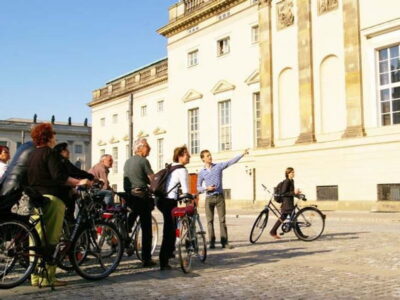
Browse the lists this tour appears in